
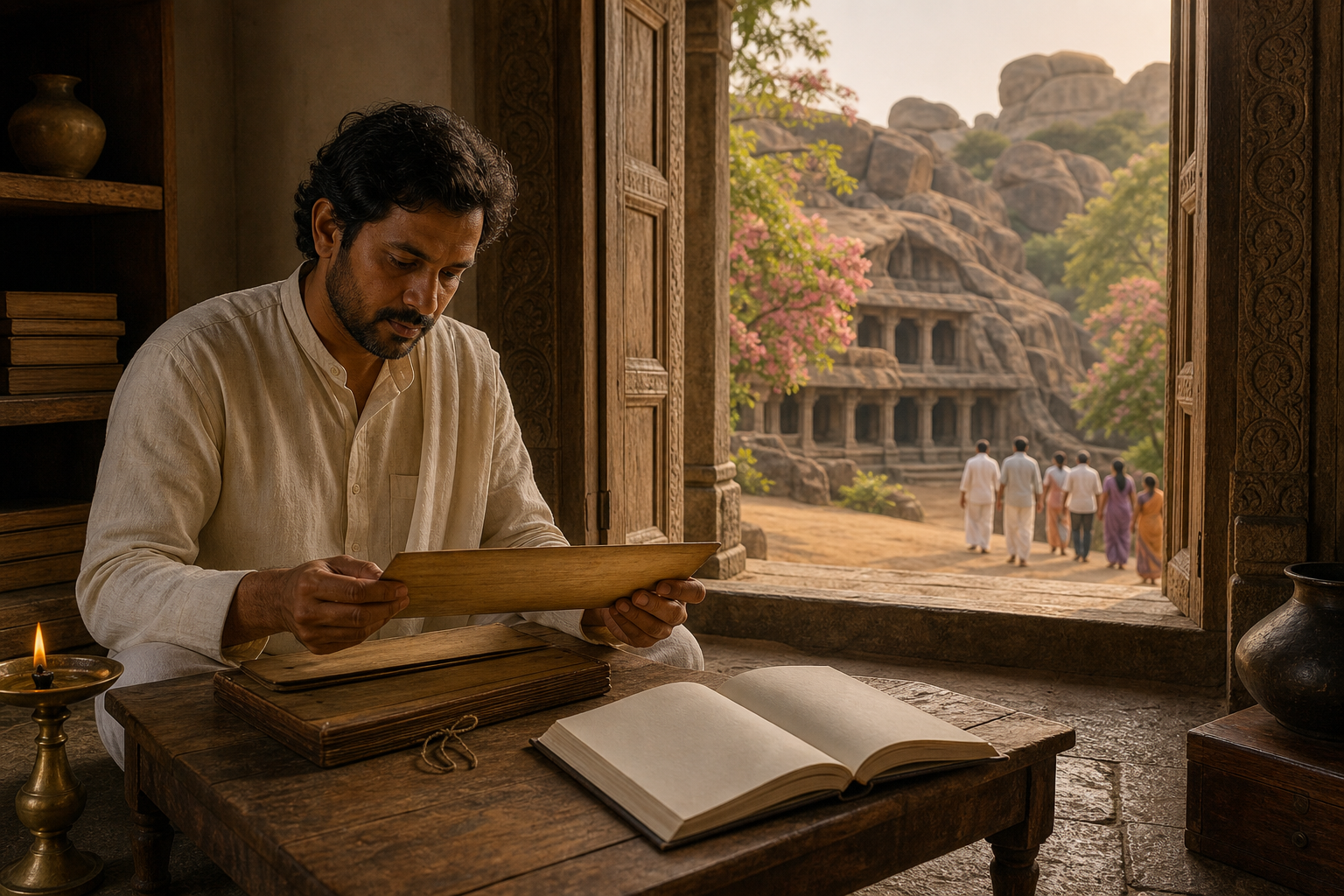
You may recognize the great names – the Ramayana, Mahabharata, Puranas, Vedanta, regional novels, Pallava temples – and still feel unsure where serious study should begin. A catalogue gives you information, but it doesn’t show you how a story, image, inscription or sacred place carries memory into the present.
Begin with a more useful question: what does this inheritance make a person or community notice, judge, remember and do? That question lets you read a modern novel and a rock-cut temple within one civilizational field without confusing literature with scripture, art with doctrine or shared dharmic values with identical beliefs.
Key takeaways
- Read classical references for the work they perform. Ask whether an epic memory changes a decision, enlarges an emotion or exposes a moral failure.
- Treat a temple’s core, mandapas, gateway, inscriptions and neighbouring shrines as layers of evidence, not as interchangeable decoration.
- Use Dharma, Tapas, Rasa, compassion, Ahimsa and disciplined practice as comparative questions. Do not assume that Hindu, Buddhist, Jain and Sikh traditions define or apply them identically.
- Separate what you can observe from what you infer. A nearby Jain and Shaiva presence establishes a shared landscape; it does not, by itself, establish doctrinal sameness.
- End study with an act of transmission or care: preserve a text, document a permitted detail, support a library, revisit a translation or bring another reader into the inquiry.
Read modern literature for the work inherited memory performs
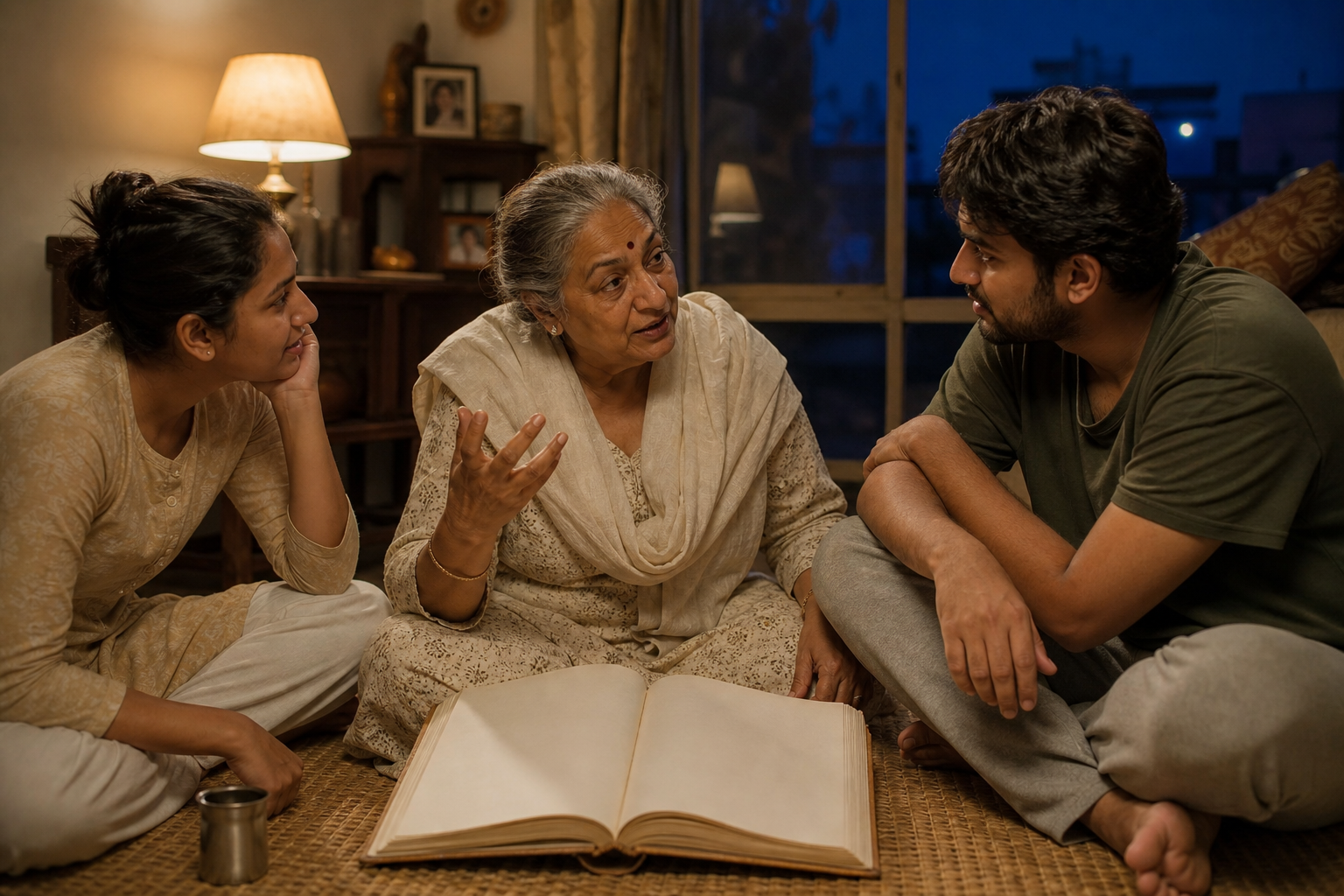
Start with a scene in which inherited memory changes conduct. This keeps you from reducing literary heritage to a hunt for familiar names. An allusion matters because of what happens through it, not merely because you can identify it.
In S.L. Bhyrappa’s Tantu, Hemant Honnatti sits on the steps of Harishchandra Ghat in Kashi, watching funeral pyres while confronting his affair with a friend’s wife. The remembered ordeal of Satya Harishchandra enters the scene: Chandramati arrives with her son’s body, and recognition occurs through the Mangalasutra that only her husband can see. That inherited story doesn’t remain in the background. It exerts enough moral pressure for Hemant to end the affair.
Annotate that movement as three linked transitions: place to memory, memory to self-recognition, and self-recognition to decision. If you record only that Harishchandra is mentioned, you have catalogued the reference but missed the literary mechanism. If you extract only a rule against adultery, you have missed how setting, grief, recognition and epic memory combine to make the rule inwardly compelling.
A different mechanism operates in Mandra’s rendering of Hindustani music. An accomplished singer appears to surrender his individual agency to the Raag, becoming a Rishi of Swara. The musician’s movement through the octaves evokes Matsya, the cosmic fish passing effortlessly from oceanic depths to the surface and beyond. The Puranic image translates musical command into a vision of disciplined surrender. It doesn’t merely decorate a technical description.
Here your annotation should separate three things: the observable art, the inherited image and the aesthetic claim. The observable art is the singer’s control across registers. The inherited image is Matsya. The aesthetic claim is that mastery can become so complete that the performer seems to disappear into what is being revealed. This is where Rasa gives a reader more than a message: form, emotion and cultural memory become one experience.
Use the following questions whenever an epic, Puranic or philosophical image enters a modern work:
- What immediate human problem is the character facing? State it without philosophical vocabulary first.
- Which inherited story, symbol, sacred place or artistic discipline enters the scene?
- What changes after it enters: perception, emotion, conduct, judgement or nothing at all?
- Does the older form resolve the conflict, or does it make the conflict more difficult and truthful?
- What remains unsettled when the scene or novel ends?
The final question matters because Bhyrappa’s epic mode often resists tidy closure. Life continues beyond a topical controversy, and a character cannot always be reduced to the position an ideology wants that character to represent. Read the unresolved remainder as evidence. It may reveal a collision among duty, desire, family, memory and self-deception that no slogan can settle.
Keep important Sanskrit and regional terms beside any English gloss. Dharma is not exhausted by duty, Rasa by emotion or Tapas by austerity. A provisional gloss helps you enter a passage, but it should not replace the term whose range the work is testing. This small habit protects you from building a large interpretation on a thin translation.
Read a sacred site from its visible entrance back to its earliest core
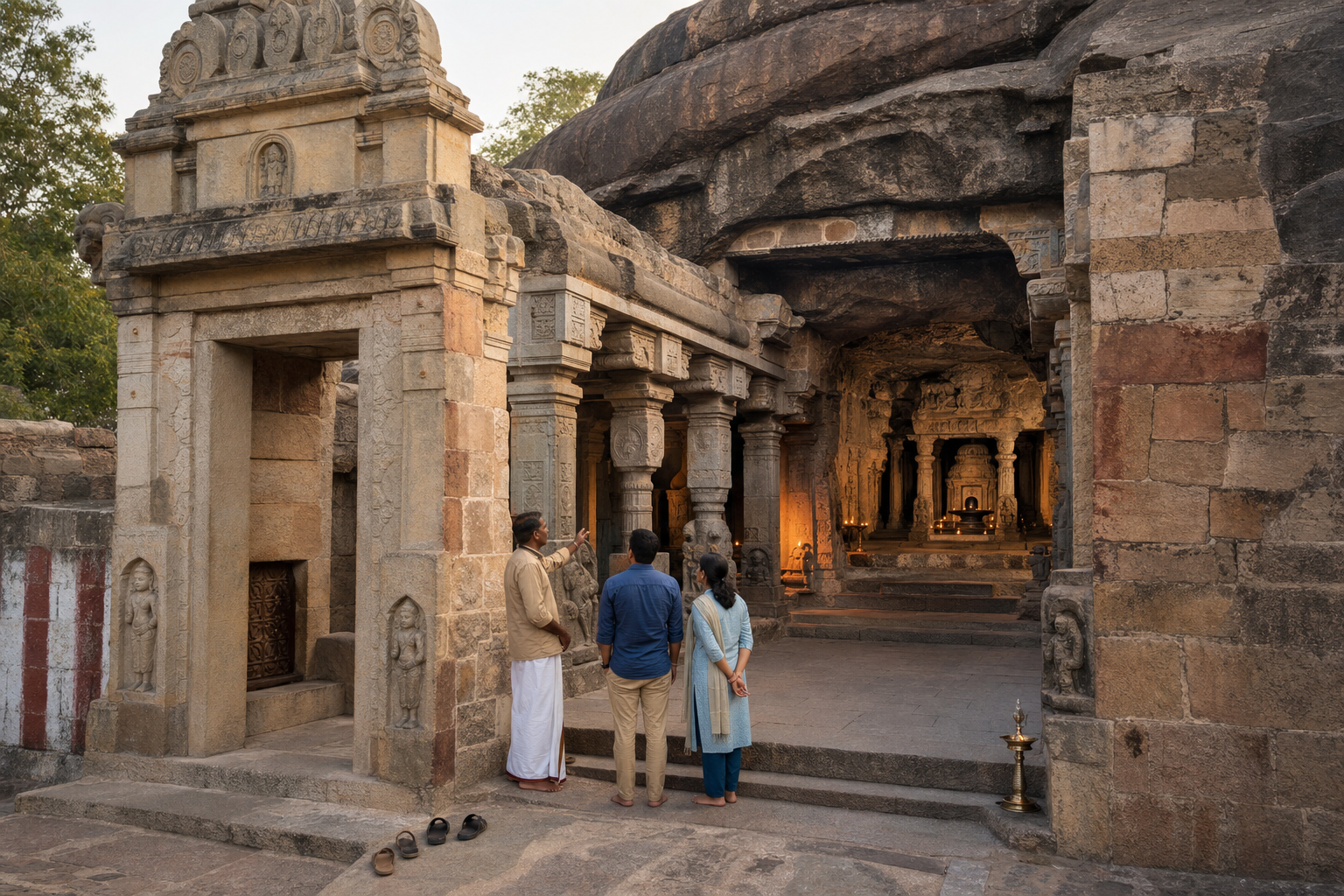
A sacred monument rarely belongs to a single moment. Its oldest part may be the least conspicuous, while the gateway that first commands your attention may belong to a later phase. Read the building as accumulated time.
The Stambheshwara complex at Seeyamangalam, about twenty-five kilometres southwest of Vandavasi, makes this method concrete. The three-tiered Rajagopuram, pillared spaces, enclosure and shrines present one sacred complex, but they do not all represent one construction event. Behind two mandapas stands the early Shaiva rock-cut shrine associated with Pallava king Mahendravarman I. Chola and Vijayanagara patronage subsequently enlarged the temple’s architectural life.
Follow this sequence when you visit a historic temple or study it through a photographic record:
- Record every attested name. Seeyamangalam is also connected with Simhamangalam and Simhavishnu Chathurvedhi Mangalam. A historical name can preserve royal memory, religious endowment and the changing identity of a settlement.
- Locate the earliest surviving core. At Stambheshwara, the rock-cut sanctuary is the chronological anchor. Its relationship to the mandapas and gateway helps you see expansion rather than one frozen design.
- Separate construction phases before interpreting the whole. Mark Pallava, Chola and Vijayanagara elements where the available evidence supports those labels. Mark uncertain features as uncertain instead of assigning them to a dynasty by visual intuition alone.
- Read inscriptions for patron, purpose and obligation. Ask who commissioned the work, under whose authority, for whose merit and who was expected to protect it.
- Look beyond the enclosure. Nearby shrines, caves, water bodies, roads and settlements may reveal the wider sacred ecology in which the monument functioned.
The entrance pillars at Seeyamangalam show why epigraphy changes the reading of architecture. A Sanskrit record on the right identifies the temple as Avanibhajana-Pallaveshwara and attributes its creation to King Lalitankura, an epithet associated with Mahendravarman I. Its royal language also uses poetic wordplay: Lalitankura evokes a tender sprout, while Pallava can carry a related sense. The inscription therefore preserves devotion, kingship and literary craft in the same physical place.
The record on the left pillar widens the circle of responsibility. Written in archaic Tamil with Grantha phrases, it commemorates a mandapa made by the local headman Adavi after he obtained permission from the Ganga-Pallava ruler Nergutti. The gift was made for the spiritual merit of Adavi’s mother, Nangani Nangai. Its appeal to future protectors turns stone into a relationship among royal authority, local office, filial devotion and generations not yet born.
This corrects a common misreading of Indian temple heritage. A monument is not simply the product of a famous dynasty. The dynasty may establish the core, but local patrons, craftspeople, devotees and later rulers keep adding to its life. Even after Pallava political power had largely waned by the late ninth century, the sanctity of Stambheshwara continued through such stewardship.
If you cannot visit, sketch the complex from the available sequence of views and inscriptional details. Label the visible entrance, mandapas, rock-cut core, pillars and nearby Mahavira cave. Use one notation for documented facts and another for your inferences. You will notice more from this simple plan than from saving dozens of unlabelled photographs.
Hold dharmic kinship and doctrinal difference at the same time
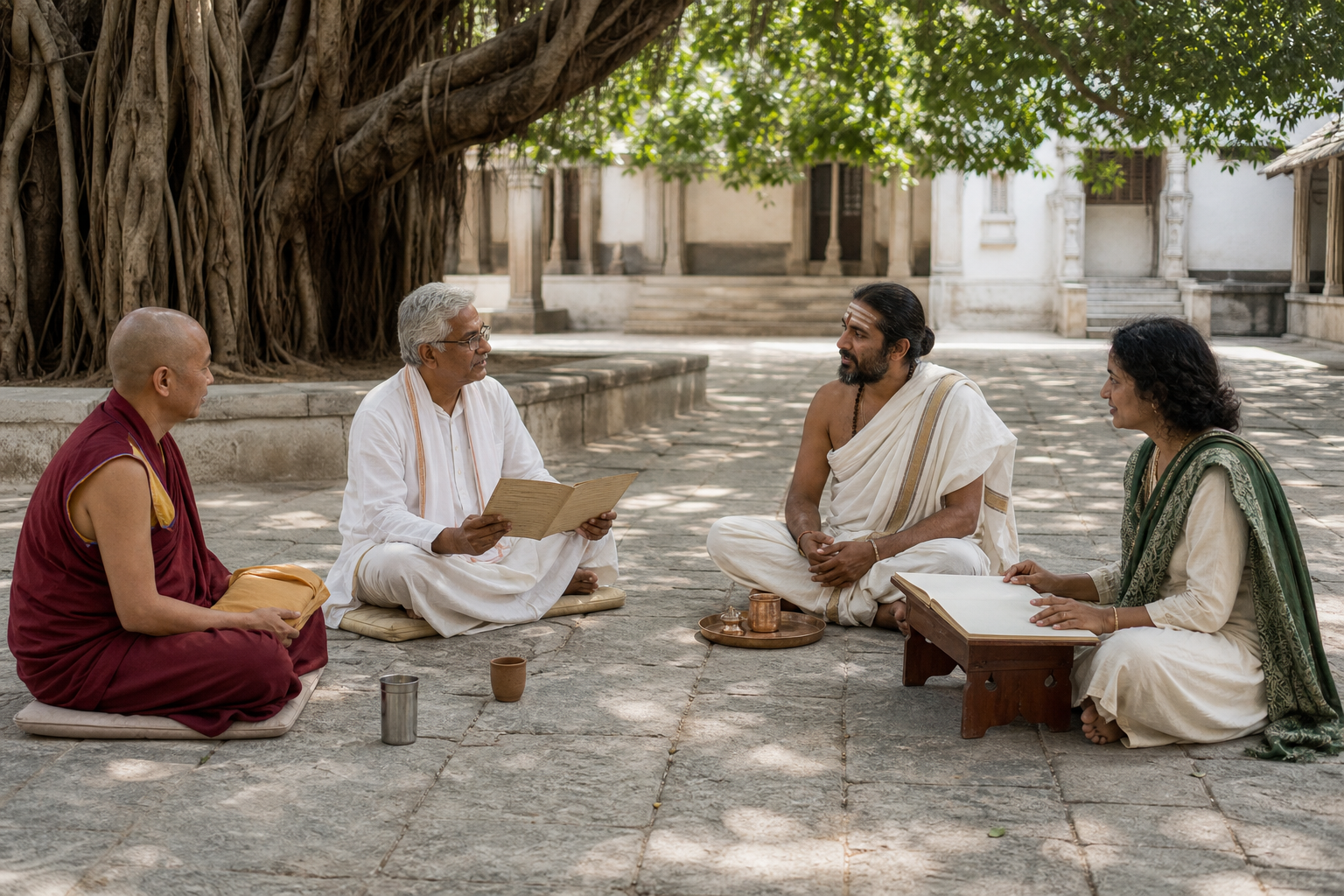
Shared civilizational space is neither a claim that every dharmic tradition is identical nor a demand that you study each in isolation. The sounder approach is to compare recurring ethical and contemplative questions while preserving the particular authority, practice and goal that each tradition gives them.
Dharma, Tapas, Rasa, compassion, Ahimsa and disciplined practice can open conversations among Hindu, Buddhist, Jain and Sikh inheritances. They cannot close those conversations. The same term may carry different weight across communities, and a shared value may be grounded in different scriptures, lineages, institutions or accounts of liberation.
- Ask what disciplined practice does in the specific tradition or work before calling all discipline Tapas.
- Ask how compassion and non-violence shape conduct, including where duties or interpretations create tension.
- Ask whether art is being used to instruct, to transform perception, to support devotion or to disclose an experience that prose cannot capture.
- Ask who carries memory: an epic, scripture, teacher, monastic lineage, family, musician, inscription, congregation or sacred site.
- Ask what kind of person the practice is meant to form, then identify the evidence for your answer.
Seeyamangalam offers a useful boundary test. Its Shaiva temple and nearby Mahavira rock-cut cave support a claim of Jain and Hindu presence within a shared South Indian landscape. Their proximity does not prove that Jain and Shaiva doctrines were interchangeable. State the material fact first, then make only the inference it can bear.
The same discipline applies to literature. Bhyrappa’s epic imagination draws specifically on the Ramayana, Mahabharata, Puranas, Vedanta and the sadhana of Hindustani music. Readers from several dharmic traditions can still deliberate through his portrayals of truth, duty, self-mastery and moral failure. Participation in that deliberation does not require pretending that every image originated equally in every canon.
When you write a comparison, give it two halves. First name the genuinely shared question. Then name the distinct answer, authority or practice found in each case. For example, several dharmic traditions can be asked how disciplined practice changes ethical life; your next sentence must specify which practice, toward what end and on what textual or lived evidence. This form produces kinship without vagueness and difference without hostility.
Turn reading and seeing into a repeatable heritage practice
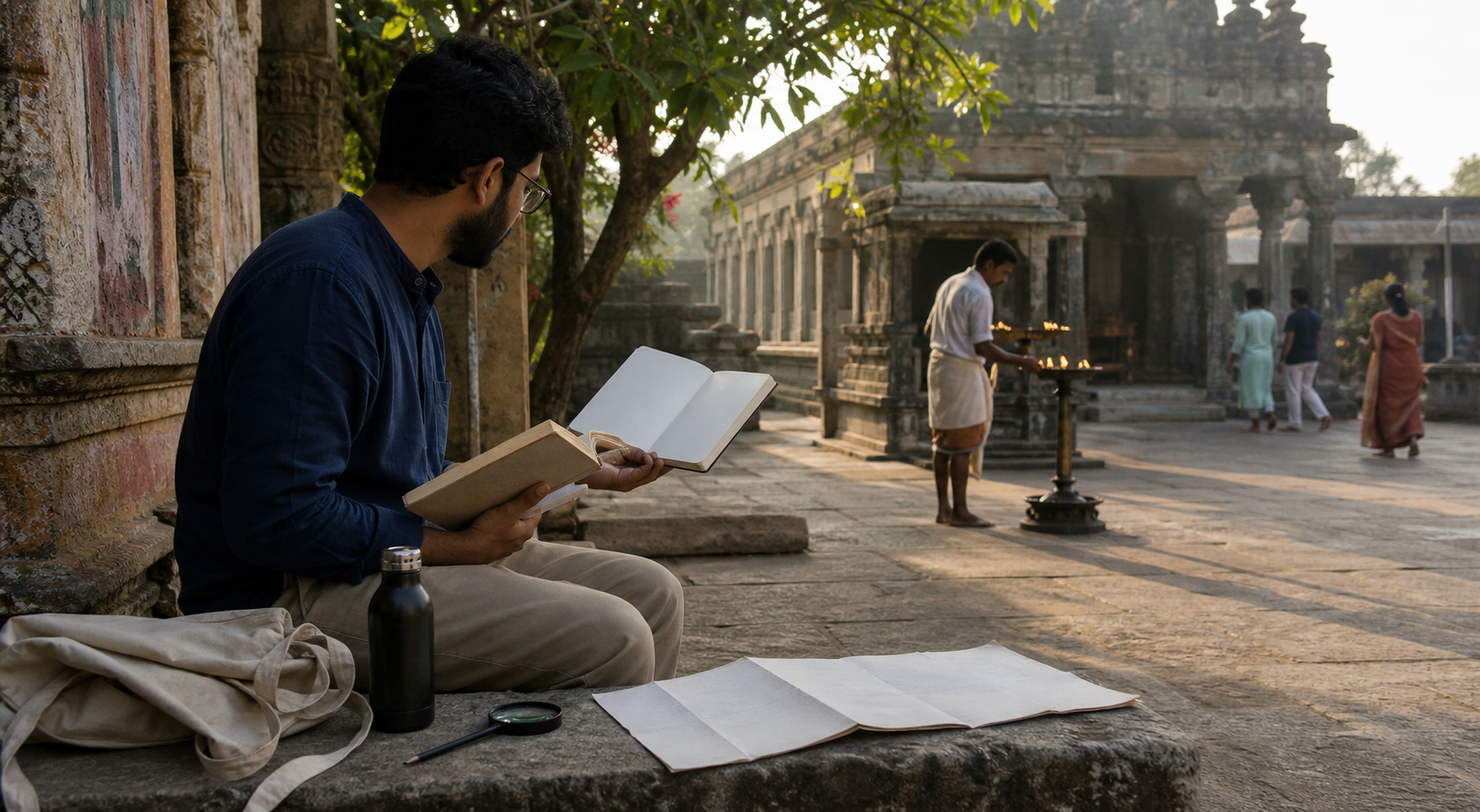
You do not need to master an entire canon before forming a serious relationship with it. Work through one bounded encounter, preserve the evidence and widen the circle only after you can explain what the first object actually did.
- Choose one scene or feature. Use Hemant at Harishchandra Ghat, the Matsya comparison in Mandra, the Stambheshwara rock-cut sanctuary or Adavi’s mandapa inscription. Do not begin with a claim about all Indian civilization.
- Create an evidence note with five fields: the object observed, the inherited form it invokes, the present human pressure, the action or perception it produces and what remains uncertain.
- Trace one line of continuity. In Tantu, follow Harishchandra from epic memory into a modern moral decision. At Seeyamangalam, follow a Pallava rock-cut core into later mandapas, a gopuram and continuing local custody.
- Name one difference that continuity does not erase. A novel is not an epic, an inscription is not a scripture, later architectural patronage is not the original Pallava commission, and coexistence is not doctrinal identity.
- Choose one act of care. Catalogue an inherited edition, compare a key term across translations, learn the correct names of a site’s layers, support a public library, document permitted details responsibly or share the inquiry with a younger reader.
Care is part of interpretation because heritage survives through choices. Adavi’s mandapa converted filial piety into a public sacred gift. In Santeshivara, Bhyrappa established a public library and helped rejuvenate the village lake. One act added to a temple; the other strengthened the civic ground from which future culture can grow. Neither treated inheritance as passive admiration.
Begin with one page, not a civilizational verdict. Place the Harishchandra Ghat scene beside Seeyamangalam’s entrance records and answer three questions: who carries memory, what conduct does that memory produce, and who is asked to protect what has been received? Once you can answer with evidence, choose the next pairing. That is how a large heritage becomes a disciplined, living practice rather than an impressive list of names.
References
- DharmaRenaissance Blog – S.L. Bhyrappa’s Epic Genius: The Complete, Proven Legacy That Transformed Indian Literature
- DharmaRenaissance Blog – The Complete Guide to Stambheshwara’s Divine Legacy: Discover Seeyamangalam’s Rock-Cut Masterpiece
