
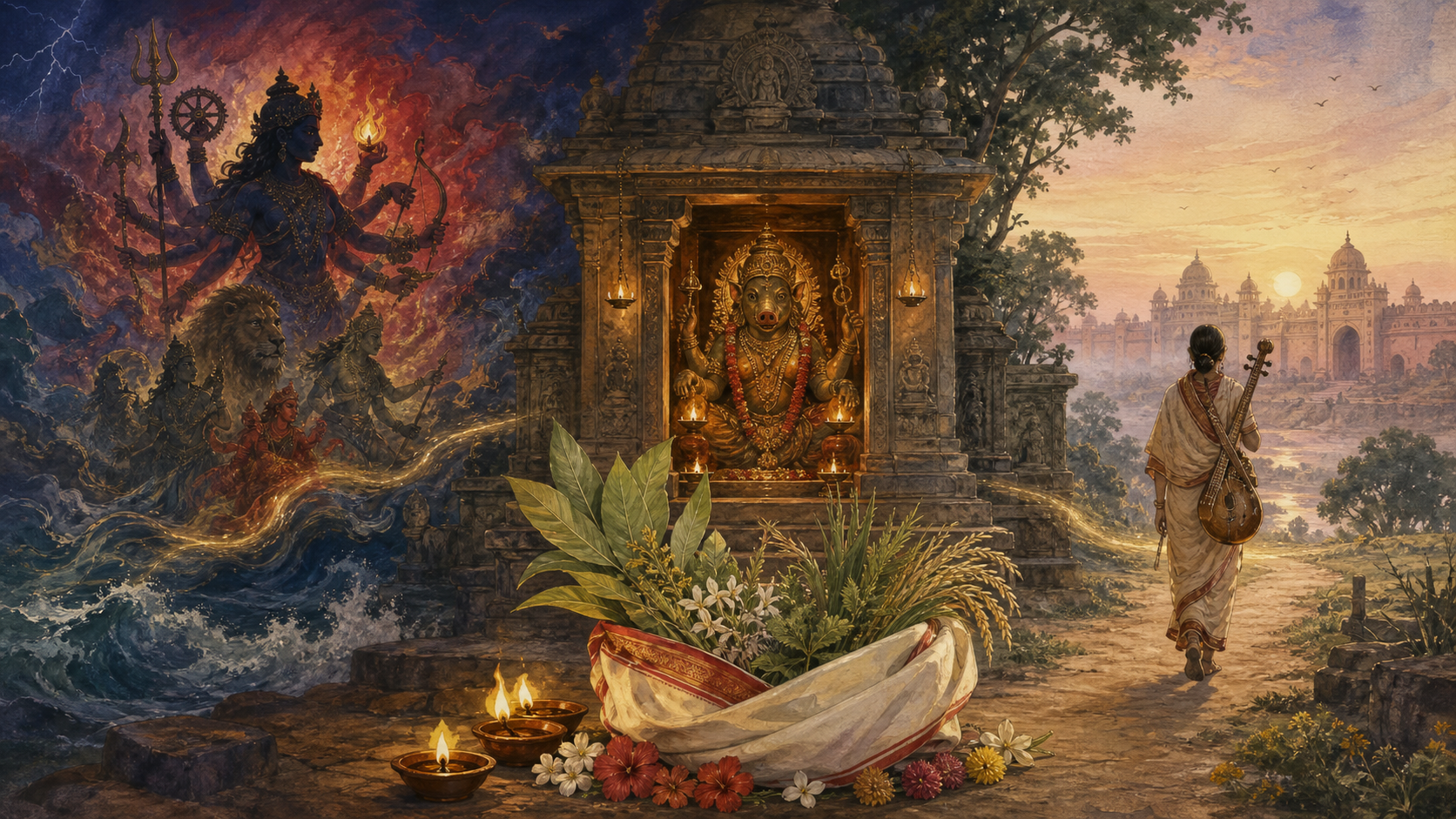
A severed head worshipped as a compassionate mother, a boar-faced guardian in a quiet sanctum, nine plants dressed as a bride, and a woman saint who walks away from royal privilege can look like unrelated fragments. If you approach each one with the same definition of Shakti, the tradition becomes either confusing or suspiciously tidy.
You need a better question than “What does Shakti symbolize?” Ask what Shakti is doing in each setting. Myth discloses transformation. A temple establishes presence. Ritual turns meaning into coordinated action. A saint shows what spiritual power can look like in a human life. Once you keep those registers distinct, their relationship becomes much easier to see.
Recognize Shakti by her work, not by one fixed image
Shakti is often translated as power or energy, but those English words are too thin on their own. In lived Hindu traditions, Shakti is the capacity through which protection, discernment, nourishment, creation, restraint, devotion, and transformation become effective. She may be addressed as a personal Goddess, encountered in a murti, invoked through natural substances, or recognized in disciplined human agency.
This does not make every expression interchangeable. Renuka’s head, Varahi’s shrine, the Navapatrika, and Akka Mahadevi’s renunciation do not “mean the same thing.” They belong to different devotional worlds and perform different religious work. Their unity lies in a shared grammar of effective sacred power, not in a single image that erases regional and theological distinctions.
- In myth, ask what crisis reveals a power that ordinary life had concealed.
- In a temple, ask how a community recognizes, houses, approaches, and serves divine presence.
- In ritual, follow the sequence: what is gathered, purified, clothed, offered, transferred, or returned?
- In a saint’s life, ask which discipline converts inward realization into freedom, courage, teaching, or service.
One distinction matters especially when discussing women saints. A woman does not become an incarnation of the Goddess merely because she is spiritually accomplished, and a saint’s authority should not be reduced to an abstract “feminine quality.” Unless a tradition explicitly makes a divine identification, it is more accurate to speak of her as manifesting spiritual capacity through knowledge, bhakti, renunciation, compassion, or leadership. That preserves both the transcendence of Devi and the individuality of the woman.
Myth and temple make sacred power present in different ways
Read Renuka’s severed head without evading the difficult story
In widely circulated Purāṇic and regional tellings, Renuka’s momentary inward wavering leads the sage Jamadagni to command a severe test of obedience. Parashurama severs his mother’s head, and subsequent boons restore her to life. Regional Yellamma and Renuka traditions then give unusual prominence to the head itself, sometimes through a face-centred murti, a mukha, or a kalasha that represents the head. These practices extend across parts of Karnataka, Maharashtra, Telangana, and Andhra Pradesh.
This is a difficult myth. Respectful interpretation does not require pretending otherwise. Nor should its religious meaning be exhausted by judging the plot as if it were an instruction for ordinary family conduct. A sound reading keeps three levels in view: the narrated event, the symbol produced by it, and the devotional reception that develops around that symbol.
The head becomes a concentrated seat of buddhi, manas, and viveka: intelligence, mind, and discernment. Severance can therefore be contemplated as an inward cutting away of pride, delusion, and compulsive identity. Restoration prevents severance from becoming the final word. What returns is life transformed, while the independently worshipped head becomes the ever-watchful presence of the Mother. Her gaze is understood as protective, particularly for people living with vulnerability or social precarity.
Do not use the symbolic interpretation to erase the story’s violence, and do not use the violence to make the symbolism unintelligible. Instead, work through four questions in order:
- What order is broken in the narrative?
- What must be surrendered or severed before that order can change?
- What is restored, and what remains permanently marked by the crisis?
- How does the resulting form guide devotees toward discernment, protection, or compassion?
This method lets you take the myth seriously without turning every action in it into a moral command. Its practical demand is directed inward: examine the ego that wants to rule the mind, then ask whether greater clarity is making you more protective of others or merely more certain of yourself.
At Varahi’s shrine, distinguish sacred continuity from a dated claim
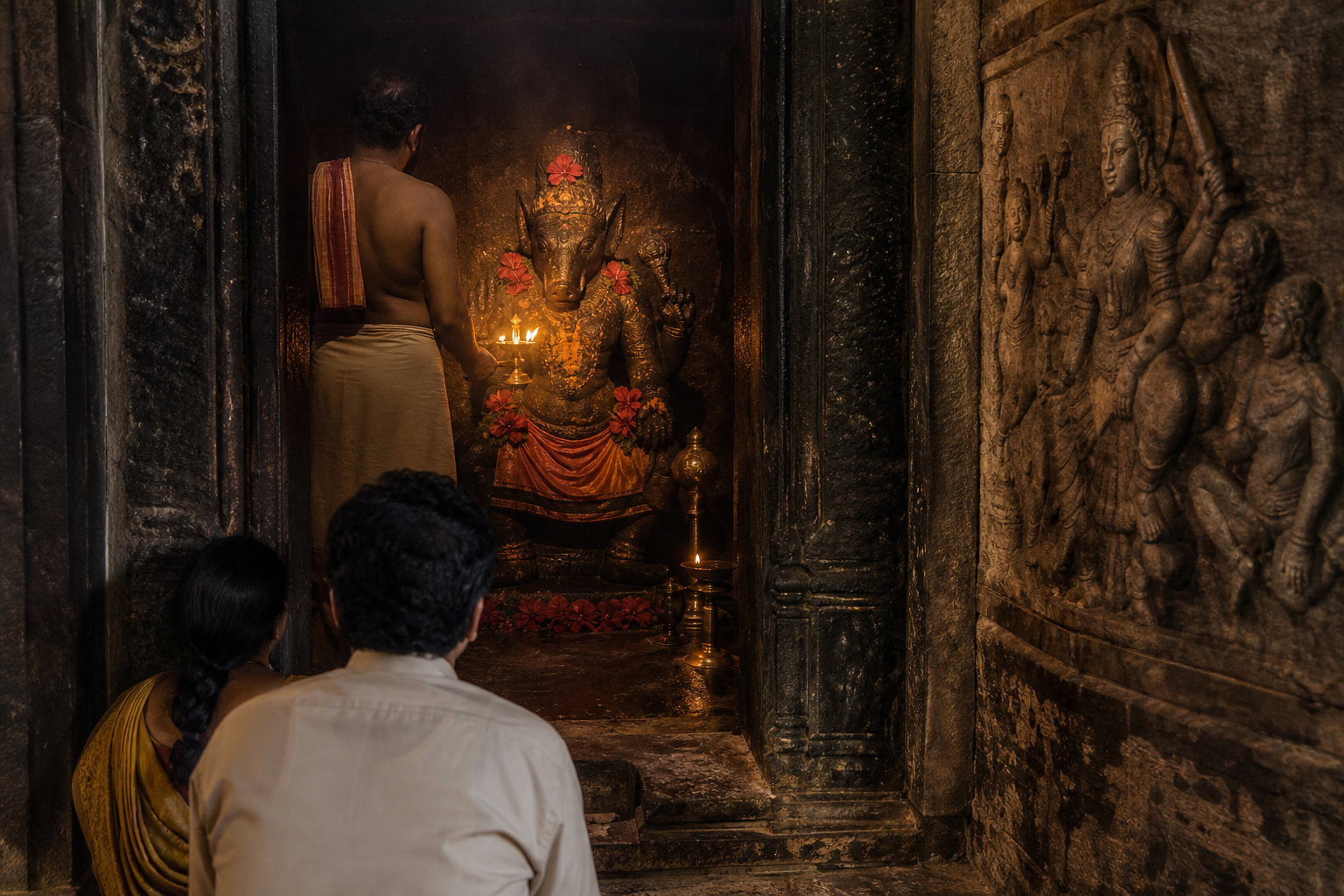
A temple does something a narrative alone cannot. It gives divine presence an address, a rhythm, custodians, and a community of return. At the Suyambu Varahi Amman Temple in Uthirakosamangai, Varahi is approached as a self-manifested guardian associated with courage, protection, and ethical discernment. Local tradition places the shrine’s legacy at roughly 3,200 years, while the scarcity of early inscriptions leaves the precise historical chronology less secure than the continuity claimed in community memory.
That distinction is not an attack on the temple. It is the correct way to honour two kinds of truth without confusing them. An archaeological date asks when surviving material was made. A living sacred history asks how a community remembers the presence, protection, and worship of its deity. Renovation can alter masonry while ritual continuity survives; conversely, an ancient structure can remain after active worship has disappeared.
If you visit such a shrine, do not treat the sanctum as an exhibit from which you must extract a photograph. Watch how the temple teaches through arrangement and timing. The modest sanctum directs attention inward. Oil lamps, conch, incense, and recurring worship organize the senses around the deity. Navaratri observances and selected Ashtami nights intensify that devotional rhythm. Mornings and late evenings are commonly suited to quieter darshan, while respectful clothing, restrained photography, and attention to local instructions protect the space shared with other devotees.
A useful temple visit can be simple. Enter without rushing. Observe one complete sequence of worship rather than collecting disconnected visual details. Notice which substances are offered and which attributes of the deity are invoked. If you ask about the shrine’s age or legend, distinguish the temple’s own sacred account from an inscriptional claim instead of forcing one to cancel the other. You will leave with a clearer understanding of how Shakti is encountered there, not merely with a list of objects you saw.
Ritual shows Shakti moving through matter and community
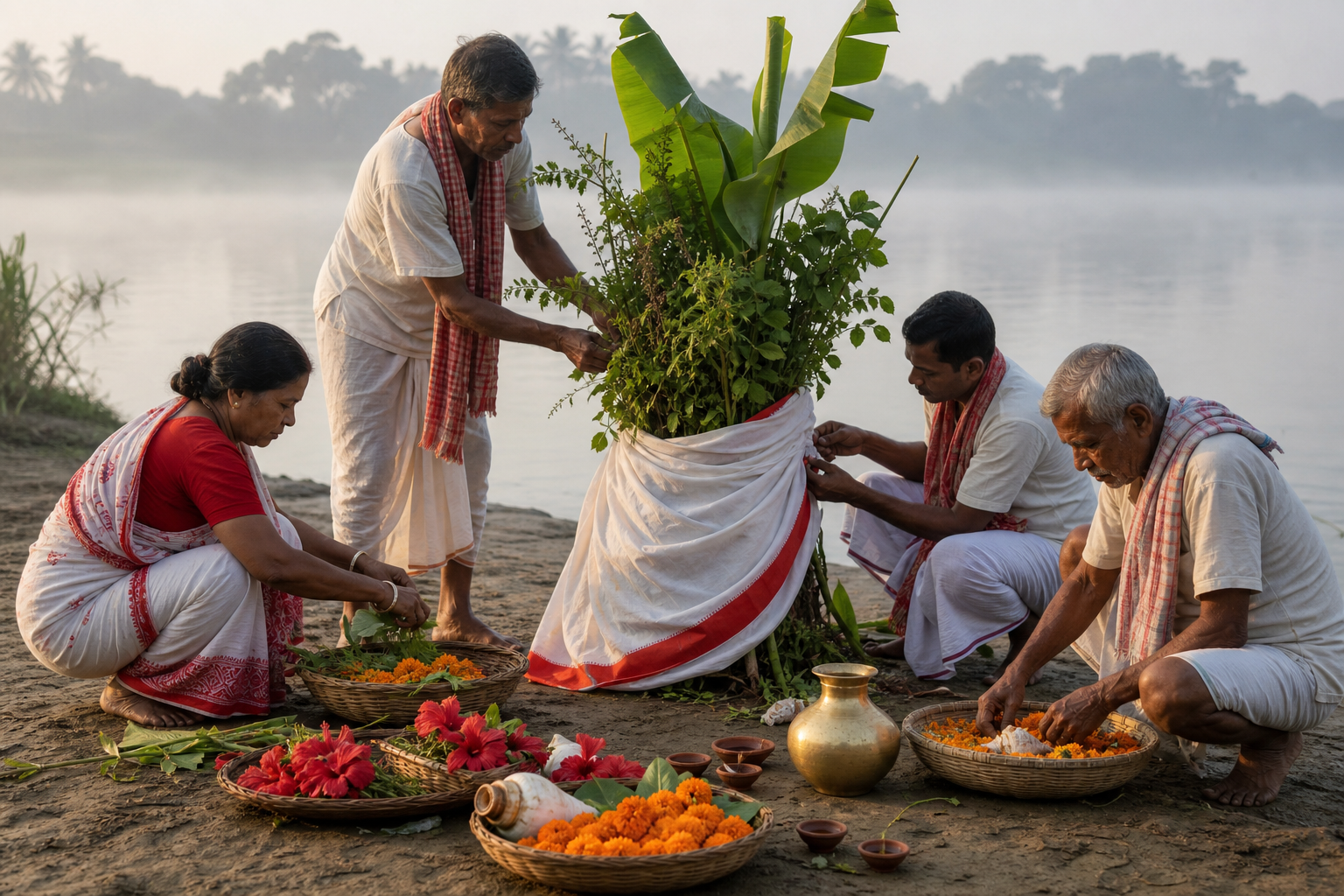
During Bengali Durga Puja, the sari-draped banana plant popularly called Kola Bou is sometimes explained as Ganesha’s wife. That affectionate folk account is easy to remember because the figure stands near Ganesha and looks like a bride. Its ritual identity, however, is larger: Kola Bou is the visible centre of the Navapatrika, an assemblage of nine plants through which forms of divine and life-sustaining power are invoked.
The group brings together banana, turmeric, arum, pomegranate, ashoka, wood apple, rice, jayanti, and kanchu or kachi. The plants are associated respectively with Brahmani, Durga, Chamunda, Raktadantika, Shokarahita, Shiva, Lakshmi, Kartiki, and the Vedas or the nourishment of life within the ritual explanation preserved around the practice. They are tied to the banana plant, bathed, clothed in a sari, and ceremonially received.
The sequence matters more than the spectacle. Plants that ordinarily feed, heal, shelter, or support life are gathered into one ritual body. Bathing marks transition. Clothing makes that body socially recognizable. Worship acknowledges sacred presence before attention settles fully on Durga and her divine household. Nature is not used as scenery around the Goddess; nature becomes an active bearer of Shakti.
When you encounter an unfamiliar ritual, follow its verbs before debating its labels:
- Gathering reveals which parts of the local world a community considers mutually dependent.
- Binding creates one sacred body without pretending that its members are identical.
- Bathing and clothing move the ensemble from ordinary use into ritual relationship.
- Placement beside the divine household shows how nature, nourishment, protection, and community belong within one sacred order.
- Repeated annual performance carries the teaching into cultural memory even when participants explain individual details differently.
This approach also lets you correct a misconception without humiliating the person who inherited it. “Ganesha’s wife” belongs to the ritual’s folk reception; Navapatrika names its fuller liturgical structure. One explanation need not be mocked for the other to be taught accurately.
The ecological implication should remain concrete. Rice, turmeric, fruit, and leaves are not generic tokens of a vague green spirituality. They are particular sources of sustenance and healing drawn into worship. If a Durga Puja committee uses the ritual to speak about sacred nature, the practice should shape its treatment of materials, food, and ritual remains. Learn the locally appropriate handling from those responsible for the puja rather than imposing an improvised disposal method after the ceremony.
There is also a wider Dharmic resonance, but it should not be overstated. Hindu reverence for Shakti in living nature can enter meaningful conversation with Buddhist compassion, Jain ahimsa, and Sikh seva and stewardship. These are resonances in ethical attention, not evidence that all four traditions perform the same ritual or hold an identical theology. Shared civilizational values become more credible when differences are preserved.
Women saints reveal three disciplines of spiritual power
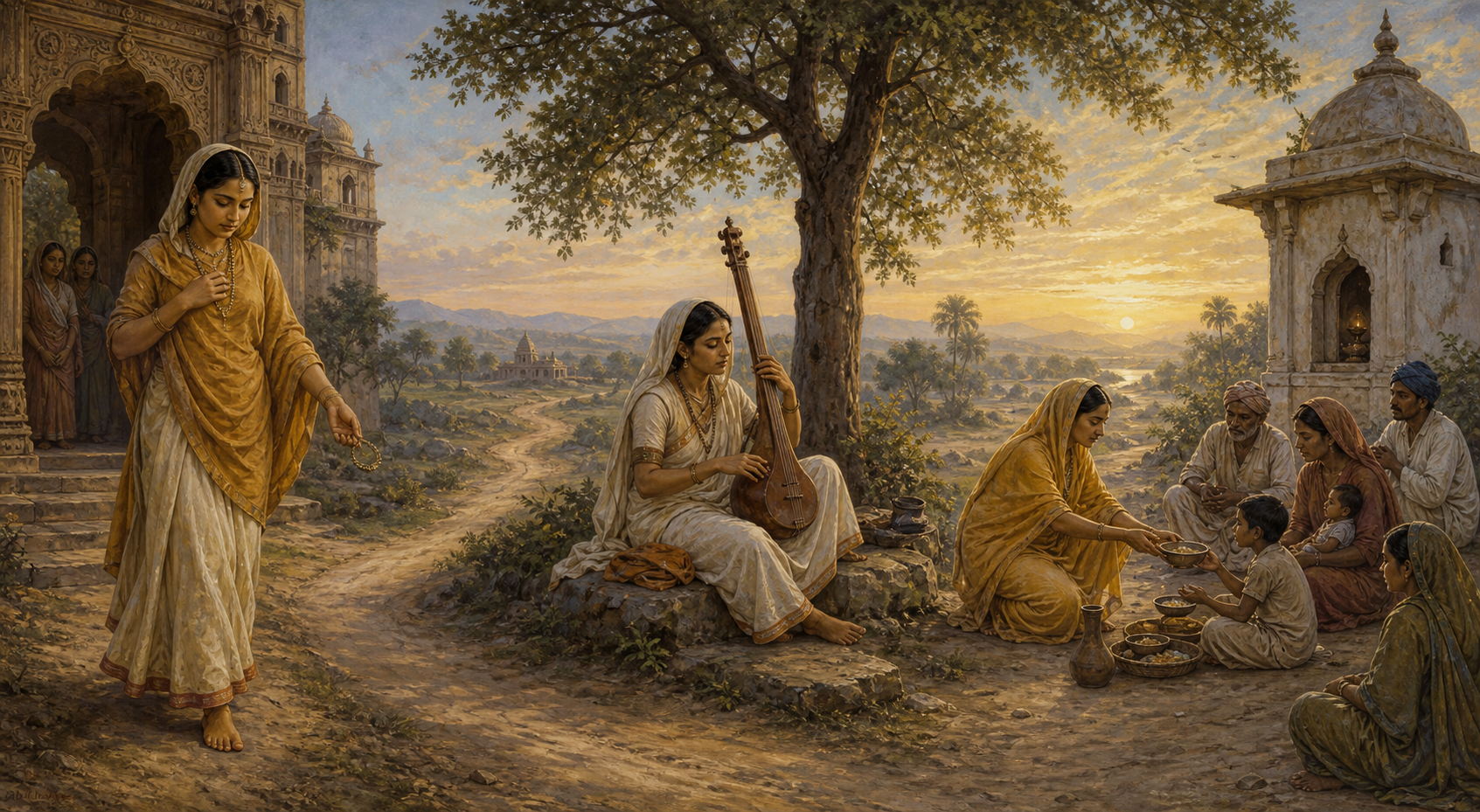
Women saints are sometimes recruited as proof for claims so broad that their actual teachings disappear. A more useful approach is to ask how each woman exercises freedom. Hemalekha teaches discernment. Akka Mahadevi makes devotion stronger than social possession. Anandamayi Ma turns inward absorption into an inclusive field of guidance. They should not be flattened into one model of ideal womanhood.
Hemalekha: power as discriminating knowledge
Hemalekha is a teaching figure within a sacred narrative rather than a historically situated saint in the same sense as Akka Mahadevi or Anandamayi Ma. That difference matters. Her story is structured to guide inquiry: Prince Hemachuda encounters her at the ashram of her foster-father, Sage Vyaghrapada; they marry; and her growing detachment unsettles him. She then redirects his search for happiness away from pleasures that rise and fall with the senses.
Her method is exacting rather than vague. Examine wealth, status, body, emotion, and thought. Notice that each changes. Then investigate the awareness by which change is known. In the narrative, Hemachuda’s recognition of steady consciousness softens his ego and informs his later rule, while Hemalekha helps communicate the insight to the people of Dasarna.
You can test the first step without pretending to have reached the conclusion. Choose one identity you defend strongly: profession, family role, reputation, possession, or opinion. Write down what about it has changed during your life. Then notice the difference between the changing description and the awareness noticing that change. The practical measure is not whether you can repeat a doctrine of the Self. It is whether the inquiry reduces defensiveness and enlarges your responsibility toward others.
Akka Mahadevi: power as uncompromising bhakti
Akka Mahadevi, born around 1130 in Karnataka’s Shimoga region, addressed Shiva as Chenna Mallikarjuna, the beautiful Lord white as jasmine. When marriage to the regional ruler Kaushika was proposed, she required freedom for uninterrupted devotion and association with saints and scholars regardless of gender. Courtly demands eventually proved incompatible with those conditions. She renounced privilege and clothing, later joining the spiritual community at Kalyana associated with Basavanna and Allama Prabhu. Her path continued toward Srisailam and the forest of Kadali, where her vachanas gave poetic form to longing and union.
The sensational reading stops at her unclothed body. The spiritual reading notices her refusal to let court, marriage, possession, or public judgment claim ownership of her devotion. Her external act was radical and belongs to her vocation; it is not a costume for admirers to imitate. The question it directs toward you is smaller and harder: which comfort or social reward are you allowing to overrule a commitment you call sacred?
Choose one boundary that protects your actual practice. It might be a fixed period for prayer, freedom to seek satsang, or refusal to participate in conduct you consider adharmic. State the boundary without drama, then accept the ordinary cost of keeping it. Bhakti becomes Shakti when devotion can organize a life, not merely intensify an emotion.
Anandamayi Ma: power as steady and inclusive presence
Anandamayi Ma was born Nirmala in Kheora in 1896. She married at 13, joined her husband at 18, and lived celibately with his understanding while giving herself to spiritual practice. States of deep absorption became especially visible during kirtan. Over time she travelled widely, established ashrams and shrines, and welcomed seekers across social and religious boundaries. By her passing in 1982, her authority had come to rest not on formal scholarship but on lived realization, self-discipline, and an unusual capacity to meet householders, renunciants, scholars, and people without formal education where they stood.
Her life corrects the idea that spiritual power must always appear as confrontation. Presence can be active without being aggressive. Inclusivity need not mean doctrinal vagueness; it can mean offering appropriate guidance without making status or literacy a condition of dignity.
The practice here is consistency. Select one accessible form of abhyasa, such as japa, silent sitting, or devotional singing, and give it a stable place in your day. Then watch its social fruit. If practice makes you contemptuous of people with less learning or different circumstances, intensity has outrun compassion. The steadiness associated with Anandamayi Ma points in the opposite direction: deeper inwardness should increase your capacity to receive another person without surrendering discernment.
Key takeaways for reading Shakti responsibly
- Do not force myth, temple, ritual, and saintly biography into one kind of evidence. Each reveals Shakti through a different religious form.
- Keep a difficult myth’s narrative, symbolism, and devotional reception distinct. Interpretation can disclose transformation without turning every narrated act into an instruction.
- At a temple, separate community sacred history from externally verifiable chronology while taking both seriously on their own terms.
- In ritual, follow the sequence of actions. What is gathered, purified, clothed, placed, and offered usually explains more than the most popular nickname.
- Do not call every woman saint a form of Devi. Identify the particular discipline through which she exercises knowledge, devotion, renunciation, compassion, or leadership.
- Treat similarities across Dharmic traditions as ethical resonances, not permission to erase differences in theology and practice.
The next time you meet a Shakta image or story, make a four-line field note: the crisis in the myth, the presence established by the sacred place, the transformation enacted by the ritual, and the discipline embodied by the devotee. Then choose one demand it makes on your conduct. Shakti becomes intelligible when sacred power moves from something you admire to something that clarifies how you live.
References
- DharmaRenaissance Blog — The Ultimate Symbolism Behind Yellamma’s Head Worship: Discover a Transformative Devi Myth
- DharmaRenaissance Blog — Discover Suyambu Varahi Amman Temple: Complete Guide to Uthirakosamangai’s 3200-Year Legacy
- DharmaRenaissance Blog — Essential Female Hindu Saints: Discover Hemalekha, Akka Mahadevi, and Anandamayi Ma
- DharmaRenaissance Blog — Discover Kola Bou’s Secret: The Complete Guide to Navapatrika and Shakti’s Transformative Power
