
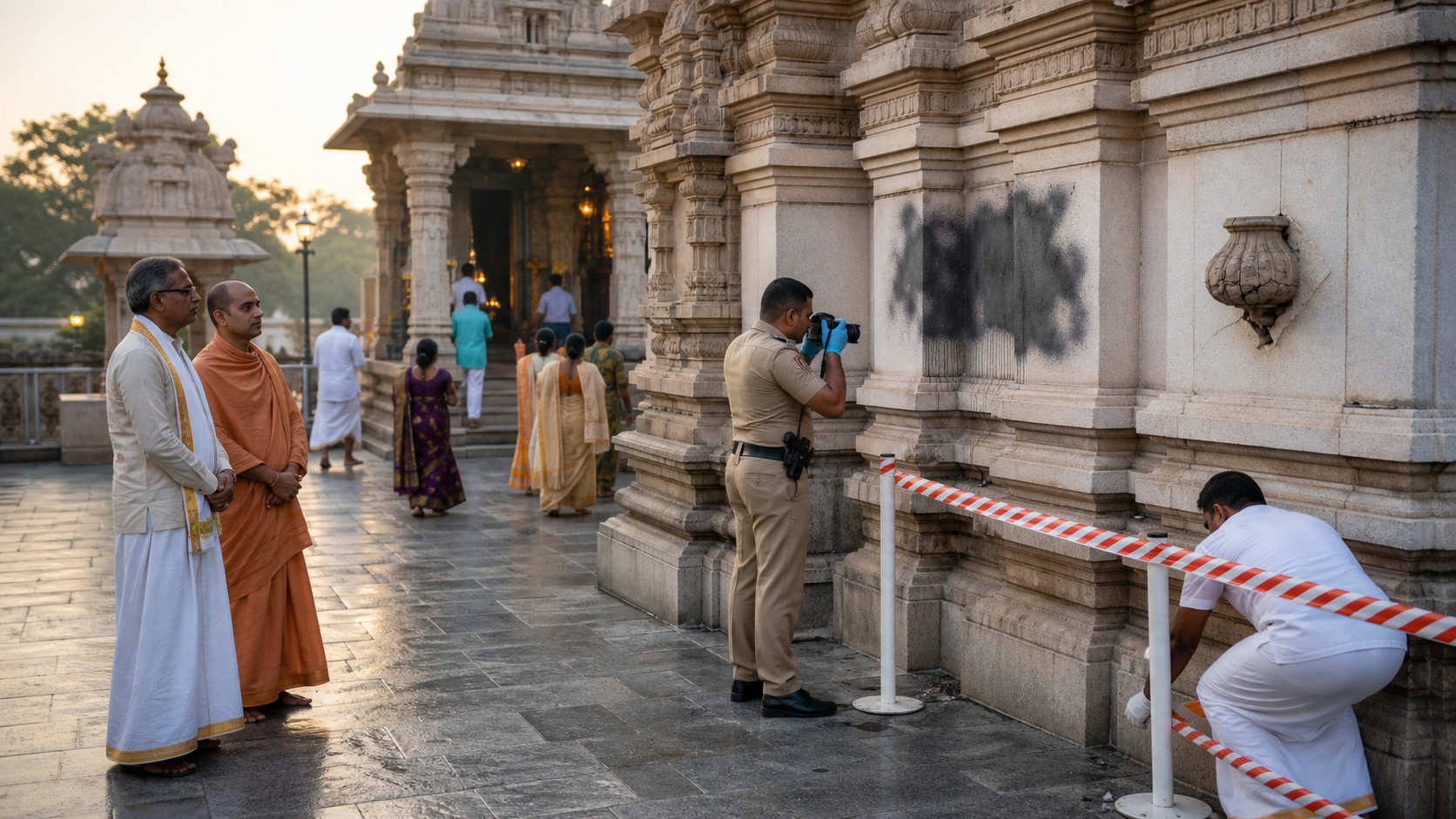
You unlock the mandir and find graffiti on an exterior wall, a damaged murti, threatening words at the entrance, or an object placed deliberately to desecrate a sacred space. Your first impulse may be to remove the insult immediately. Someone else may want to publish every camera image and name a suspected group. Both reactions can make a difficult situation worse.
The useful response lies between silence and retaliation. Protect people, preserve evidence, report the suspected bias accurately, communicate without communal blame, and keep worship and seva functioning as safely as possible. That is how a temple turns justified hurt into lawful, disciplined action.
Key takeaways for temple leaders
- If danger may still be present, keep people away, call emergency services, and do not confront or pursue anyone.
- Before cleaning, repainting, covering, or moving anything, photograph the scene and ask police what must remain undisturbed.
- Report observable facts and specific signs of possible anti-Hindu bias. Let investigators and prosecutors determine the legal classification.
- Tell the public what is confirmed, what remains unknown, and what the mandir is doing next. Do not publish identities or theories based only on a clip or slogan.
- Treat lighting, cameras, access control, volunteer procedures, police liaison, and interfaith relationships as one protection system rather than unrelated precautions.
What to do when vandalism is discovered
First determine whether you are dealing with an active safety threat or damage discovered after the perpetrator has left. A person nearby, a fire, a forced door, an unknown substance, a suspicious object, or a direct threat requires an emergency response. Keep devotees and volunteers at a safe distance. Do not enter merely to inspect the damage, and do not ask a volunteer to follow a fleeing suspect.
If there is no immediate danger, use the following sequence:
- Restrict access to the affected area. Use a barrier, close an internal door, or station a volunteer at a safe distance. Keep a simple record of anyone who enters after discovery.
- Call the appropriate police number. State that the location is a place of worship, describe the damage or threat without interpretation, and disclose any immediate concern for children, elders, staff, or an approaching service. Obtain an incident or case number.
- Record when the damage was discovered, who found it, and when the area was last known to be intact. Ask witnesses to write their own accounts before discussing details as a group.
- Take wide photographs showing the location, medium views showing each affected surface, and close views of words, symbols, damaged objects, entry marks, footprints, or discarded items. Keep the original files.
- Export relevant CCTV footage before the system overwrites it. Include the period before discovery and the activity afterward, not only the most dramatic moment. Preserve an untouched copy and note who exported it.
- Pause cleanup until police explain what they need and the temple has checked any insurer requirements. If a priest believes a sacred object must urgently be covered or moved, explain the religious concern to police, photograph the item first when safe, and record exactly who moved it and what changed.
- Notify a small response team: the designated temple officer, religious leadership, security lead, legal adviser where available, insurer where relevant, and one spokesperson. Avoid forwarding unverified images and accusations through volunteer groups.
Preserving evidence does not mean devotees must be exposed indefinitely to hateful imagery. Once authorities release the scene, screen the damage from public view where practical, arrange cleaning or repair, and follow the temple’s sampradaya and priestly guidance for purification or restoration. Criminal procedure, surveillance, privacy, and insurance rules differ by jurisdiction, so local police instructions and jurisdiction-specific legal advice should govern contested decisions.
Build an evidence packet without declaring anyone guilty
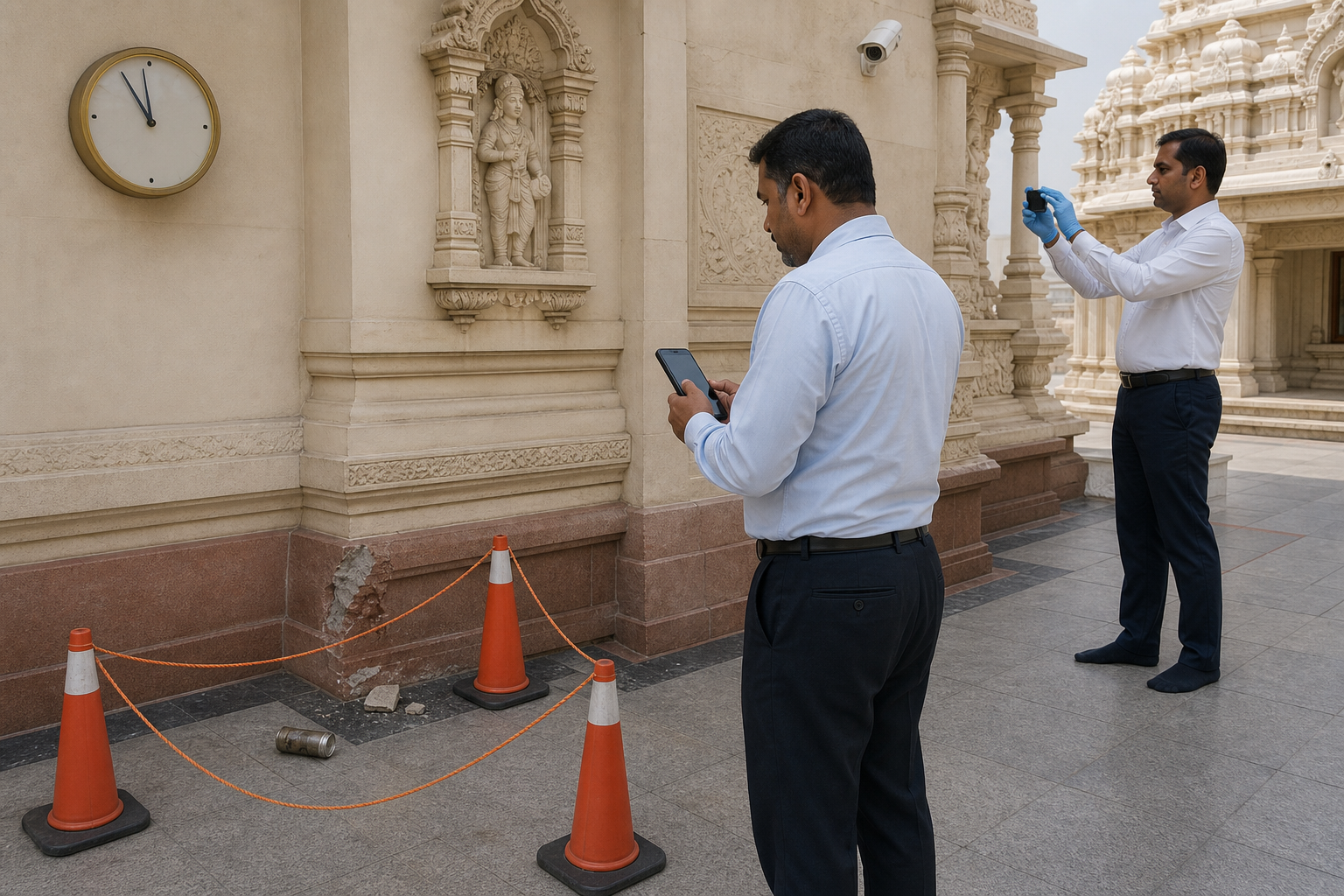
Quietly erasing vandalism may restore the wall, but it can also erase the record. Repeated attacks are easier for police, civil-rights bodies, elected officials, and journalists to recognize when temples provide consistent timelines, original imagery, and prior case numbers. Communities confronting repeated anti-Hindu graffiti have therefore emphasized documentation, reporting, pattern analysis, and civil-rights channels rather than treating each incident as an isolated maintenance problem.
A useful incident packet should contain:
- The police incident number, investigating agency, assigned contact, and the temple’s designated liaison.
- A chronology separating confirmed events from estimates and unknowns.
- Original photographs and video, plus a short index explaining when and where each file was captured.
- An exact transcription of graffiti or threats. Preserve spelling, language, punctuation, symbols, and placement rather than paraphrasing them.
- Separate witness accounts with names and contact information. Do not coach witnesses toward a common version.
- A map or simple description of camera locations, entrances, damaged areas, and possible routes through the property.
- Known prior incidents, including dates and case numbers, without assuming that the same person committed them.
- Repair estimates, invoices, canceled activities, additional security costs, and other documented effects on temple operations.
Words such as vandalism, trespass, criminal threat, hate crime, and bias-motivated offense have different legal requirements in different places. A temple committee can identify possible bias indicators, but it should not announce a legal verdict. Graffiti naming Hindus, attacking a deity, telling Hindus to leave, or combining anti-Hindu and anti-India messages may be relevant evidence. So may deliberate damage to a murti or repetition of distinctive language at other mandirs. None of those details, by itself, proves who acted or whether several incidents share an organizer.
That distinction matters because an image can provide an investigative lead without proving guilt. In the reported Belur desecration, slippers were found on Lord Ganesha’s murti, CCTV imagery placed a woman under investigation, and police urged the public not to speculate while the inquiry continued. A circulating clip should therefore be preserved and given to investigators, not converted into a public conviction.
Pattern evidence still deserves attention. At least 20 incidents since 2022 were counted across the United States, Canada, and Australia, involving mandirs and, in some cases, statues of Mahatma Gandhi outside temple grounds. That scale is a reason to compare language, timing, methods, and locations. It is not a license to claim that every damaged temple belongs to one campaign before investigators establish the connection.
Communicate firmly without feeding rumour or communal blame
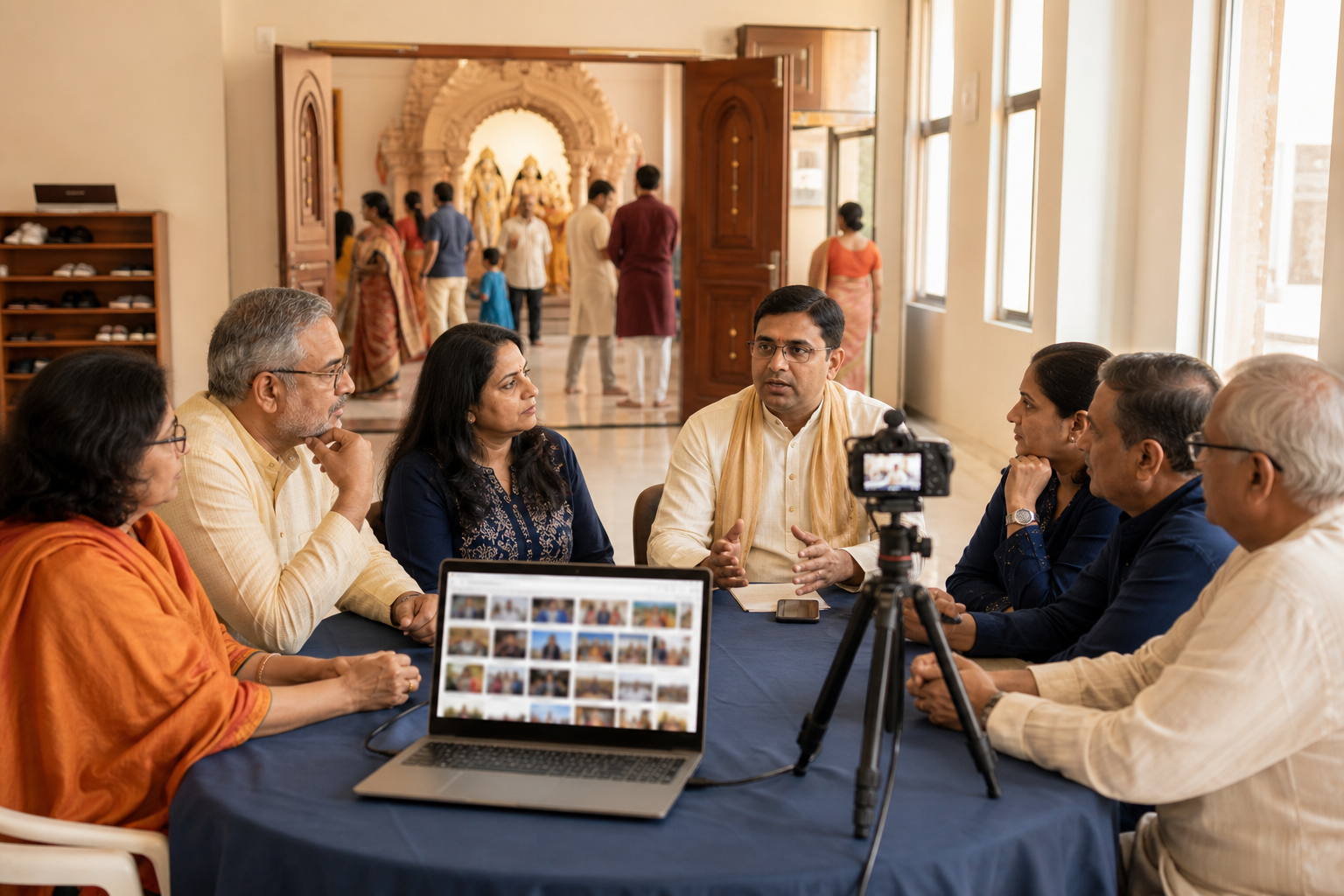
A temple statement has two immediate jobs. It must ensure the incident is not minimized, and it must prevent uncertainty from hardening into accusation. The safest structure is simple: confirmed facts, possible bias indicators, actions already taken, what remains unknown, and when another update will be issued.
A practical first statement can follow this form: "We discovered vandalism at [mandir] on [date and time] and immediately contacted [police agency]. The incident number is [number]. The observed damage included [specific facts]. Because [exact words, symbols, or targeted sacred object] may indicate hostility toward Hindus or the mandir, we asked authorities to assess possible bias motivation. We do not yet know who is responsible and will not speculate. [Services or activities] will [continue or change]. Evidence should be sent to [official contact], not posted publicly."
Do not say that nobody was harmed unless that has been verified. Do not call an act a hate crime merely because the phrase is rhetorically powerful. Do not publish a face, name, vehicle plate, or edited CCTV clip unless investigators request public assistance or legal advice supports release. Premature publication can misidentify an innocent person, expose witnesses, trigger online harassment, compromise privacy, or alert a suspect to evidence the police possess.
Precision is equally important when a political message appears beside religious abuse. A fringe Khalistan-linked extremist element has been discussed in connection with several diaspora attacks, but an allegation about fringe actors must never become collective blame against Sikhs. Hindu and Sikh families share deep social ties, and efforts to turn temple vandalism into Hindu-Sikh hostility should be resisted directly. The same principle applies to every faith and ethnic community: describe the conduct, evidence, and suspected ideology without treating an entire population as the accused.
Invite local Sikh, Jain, Buddhist, and other faith leaders to condemn the act with the mandir when they are willing. A joint statement should defend the safety of the targeted Hindu community plainly; it should not dilute the nature of the attack into generic language. Solidarity works when allies name the harmed community and the shared civic principle at stake.
Create layered security that supports worship and seva

A camera above the entrance is not a complete security plan. Temple protection works in layers: deter intrusion, detect unusual activity, delay unauthorized access, summon help, preserve evidence, and reopen safely. The objective is a confident, welcoming mandir, not a building so fortified that devotees feel they are entering a checkpoint.
- Improve visibility. Walk the property after dark and identify unlit walls, hidden approaches, overgrown landscaping, isolated footwear areas, and places where a person could remain unseen. Repair failed lights promptly.
- Design camera coverage around likely routes. Cover entrances, exterior walls, parking approaches, service doors, donation areas, and access points to sacred spaces. Confirm that faces and actions are usable in the actual lighting conditions, not merely visible on a small monitor.
- Test the recording system, not just the live view. Verify the date and time, retention setting, export process, administrator access, and recovery after a power or network interruption. Assign responsibility for recurring checks and document when they occur.
- Control keys, codes, and after-hours access. Maintain a current list of authorized holders, remove access when roles change, and record contractors or unfamiliar visitors entering non-public areas. Emergency exits must continue to comply with local safety requirements.
- Define the volunteer role narrowly. Volunteers can greet, observe, guide people away from a restricted area, record relevant details, and call police. An informal watch group should not chase, search, threaten, interrogate, or detain people.
- Use an opening and closing procedure. The assigned people should check doors, exterior walls, vulnerable objects, camera status, and unusual items before admitting a crowd or leaving the site unattended.
- Plan for continuity. Decide in advance who may move a service, redirect families to another entrance, contact parents, postpone a class, or close the site. Keep the decision chain short enough to function under pressure.
Lighting, CCTV coverage, police-guided volunteer vigilance, documentation, and cultural awareness are most effective when treated as a coordinated routine. Surveillance and audio-recording rules vary, however. Obtain jurisdiction-specific advice before enabling audio, using advanced identification tools, or placing cameras where devotees may reasonably expect privacy.
Ask local police to walk the site with temple representatives and identify practical vulnerabilities. Give officers an accurate site contact, service schedule, gate procedure, and explanation of sacred areas they should not enter casually. The purpose is not preferential treatment. It is to reduce confusion when minutes matter and make ordinary public-safety services usable in the mandir’s particular setting.
Make lawful protection part of dharmic civic duty
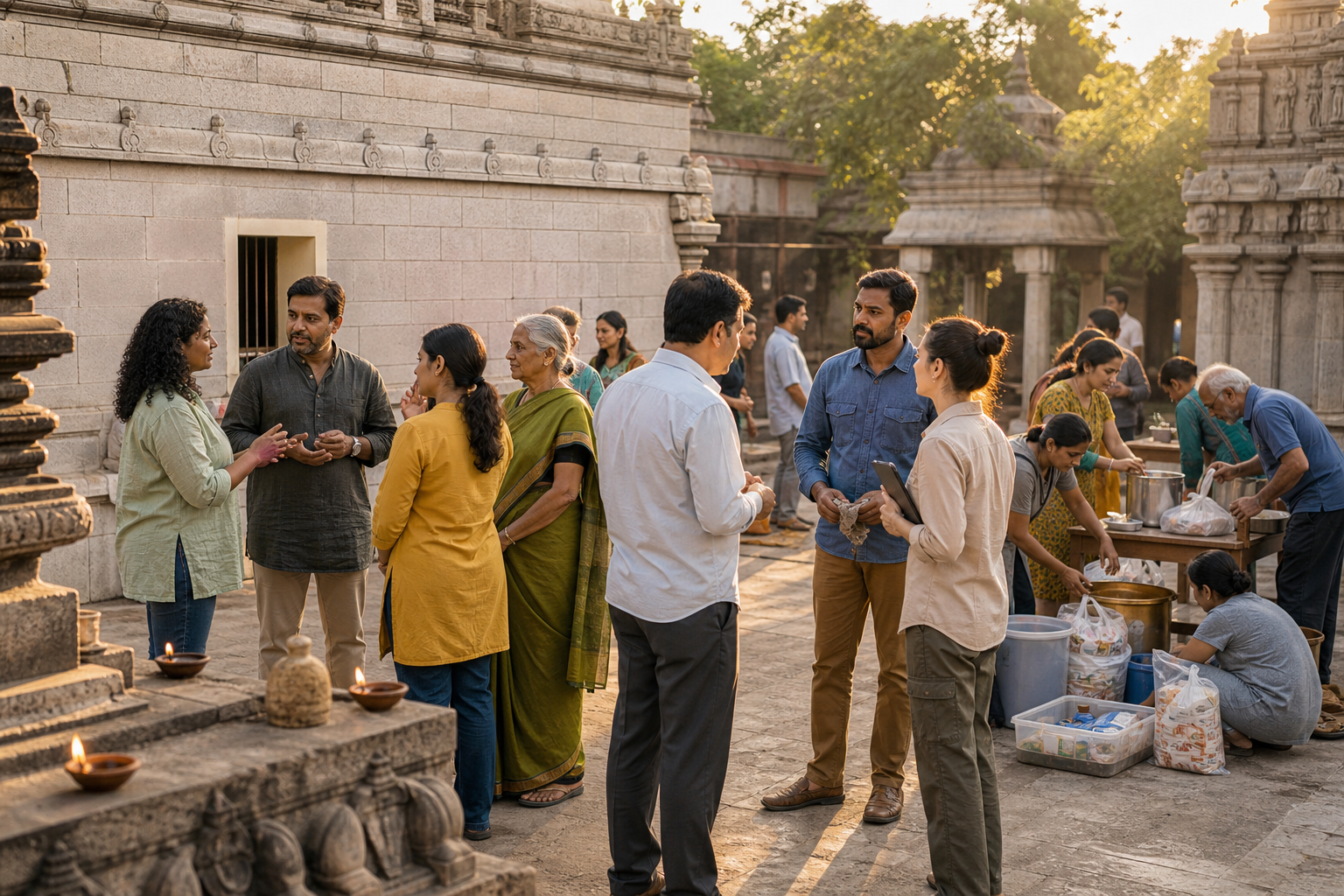
When briefing officials, explain what the mandir actually does and how the incident affected it. Mandirs are not merely buildings containing religious objects. They sustain worship, youth education, food service, cultural learning, charitable activity, and interfaith relationships. Attacks can make elders avoid evening aarti, burden volunteers with unfamiliar security work, frighten children, and disrupt community programs. Protecting a mandir therefore protects both religious freedom and the civic life built around it.
Give elected representatives a concise incident packet rather than a stream of forwarded messages. Ask for specific actions: confirmation that police leadership knows about the case, an assessment of possible bias indicators, information about the correct civil-rights reporting route, equitable public condemnation, and attention to any documented regional pattern. Record each request and response so responsibility does not disappear after the news cycle moves on.
Ahimsa does not require passivity. In this setting, it means preventing further harm, controlling angry speech, refusing collective punishment, and pursuing accountability through evidence and lawful institutions. The Bhagavad Gita’s ethic of purposeful action without dependence on a desired result offers a useful discipline: do the necessary work carefully even when an arrest, prosecution, or public response is not guaranteed.
At the temple committee’s next meeting, leave with six concrete items: a named incident lead and backup, an updated emergency contact sheet, a verified method for exporting camera footage, a written list of physical fixes from a site walk, a pre-approved holding-statement template, and two designated people to maintain police and interfaith relationships. Then talk through a fictional discovery from the first phone call to the reopening of the mandir. Any step nobody owns is the next weakness to fix.
A vandal should not be allowed to dictate either silence or disorder. When your mandir responds with safety, evidence, disciplined speech, lawful persistence, and dharmic solidarity, it protects the sacred space while denying divisive actors the escalation they seek.
References
- DharmaRenaissance Blog – Essential Briefing: Belur Ganesha Idol Desecration
- DharmaRenaissance Blog – Proven Strategy to Stop Temple Vandalism
- DharmaRenaissance Blog – An Essential Call to Safeguard Mandirs
