
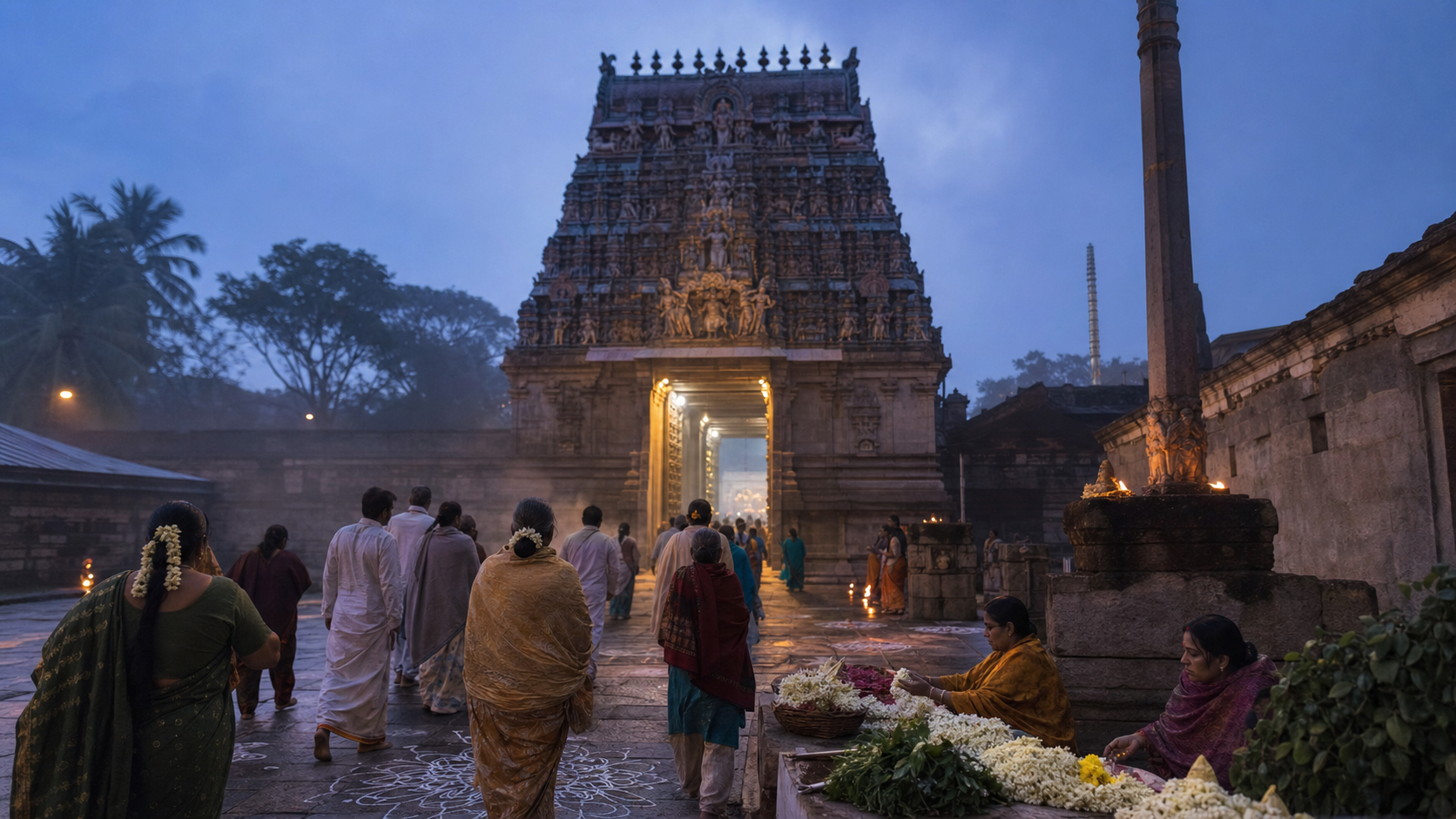
If you are deciding which Chennai temple to visit during Margazhi, the hard part is not finding a famous shrine. It is deciding what you want to be present for. A Vaikunta Ekadasi congregation, an Arudra Darshan abhishekam, a daily hymn recitation, and a temple kacheri are all meaningful experiences, but they ask different things of you.
You will receive more from one well-chosen dawn than from racing through a list of temples. Choose the observance first, build a realistic route around it, and leave enough time to listen. That simple order turns a temple tour into Margazhi sadhana.
Choose the observance before you choose the temple
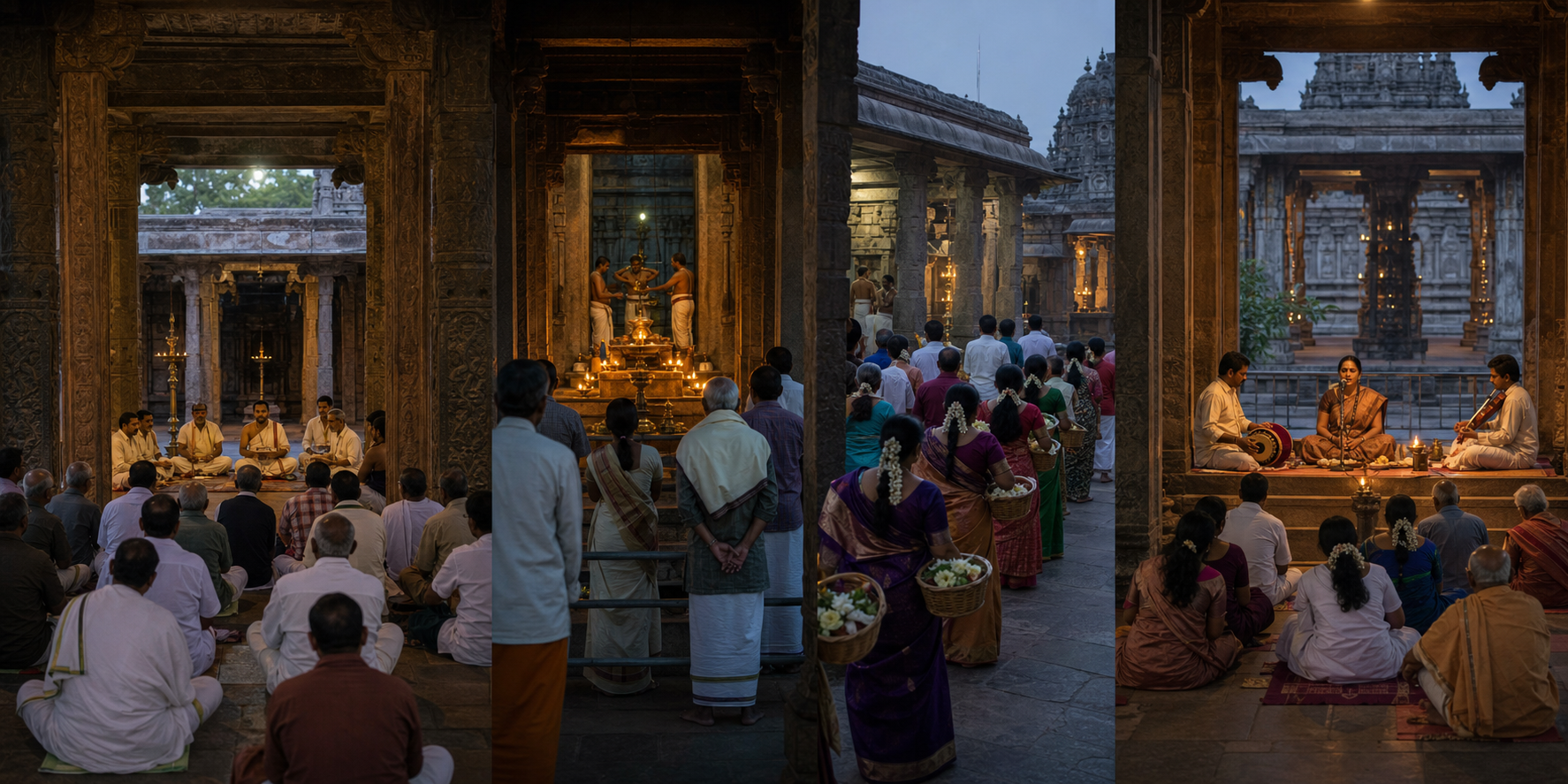
Margazhi, also observed as Dhanurmasam, gives the early morning a distinct devotional rhythm. Temple streets acquire fresh kolams, while recitations of Thiruppavai and Thiruvempavai bring worshippers together before the usual pace of the city takes over. Chennai’s temples also schedule special pujas, discourses, festivals, and selected music or dance programs during the month. The important word is selected: the observance and programme vary from shrine to shrine.
Begin with one question: what do you want to understand or practise that morning? Your answer should determine the temple, the arrival plan, and what you do once you enter.
| Your devotional focus | Temples to consider | What to attend for | How to plan |
|---|---|---|---|
| Vaishnava Margazhi | Sri Parthasarathy Temple in Triplicane, Sri Adi Kesava Perumal Temple in Mylapore, or Ashtalakshmi Temple in Besant Nagar | Thiruppavai, Divya Prabandham parayanam, and the Vaikunta Ekadasi observance, including Sorga Vaasal when announced | Choose one shrine as your anchor. Expect Vaikunta Ekadasi to attract a substantial congregation, and do not combine it with an ambitious cross-city schedule. |
| Shaiva Margazhi | Kapaleeswarar Temple in Mylapore, Marundeeswarar Temple in Thiruvanmiyur, or the historic shrine at Tiruvottiyur | Thiruvempavai, Arudra Darshan or Thiruvathirai worship, early abhishekam, and special alankaram | Confirm which part of the observance you want to witness. The abhishekam, alankaram, recitation, and final darshan are connected but are not interchangeable experiences. |
| Murugan or Amman worship | Vadapalani Andavar Temple or Thiruverkadu Karumariamman Temple | Themed alankaram, bhajans, or an organised community seva | Do not assume that every activity occurs daily. Follow the programme issued for that temple and date. |
| Bhakti through sacred art | A temple that has announced a courtyard kacheri, devotional singing, or classical dance | The relationship between worship, music, movement, and sacred space | Treat the performance as part of the devotional setting. Attend the worship as well as the art, and observe the temple’s rules throughout. |
Vaikunta Ekadasi and Arudra Darshan are festival observances, not labels for every day of Margazhi. If your visit falls on an ordinary day of the month, the morning recitation may be the most coherent focus. If it falls on a major festival day, the congregation and ritual sequence should govern your plan.
Check the current temple notice before leaving home. A general understanding of Margazhi cannot tell you the day’s opening arrangements, procession sequence, entry controls, or performance schedule. When information is uncertain, preserve the morning for a single temple rather than building a plan that depends on an unconfirmed event.
Build a route that protects the dawn experience
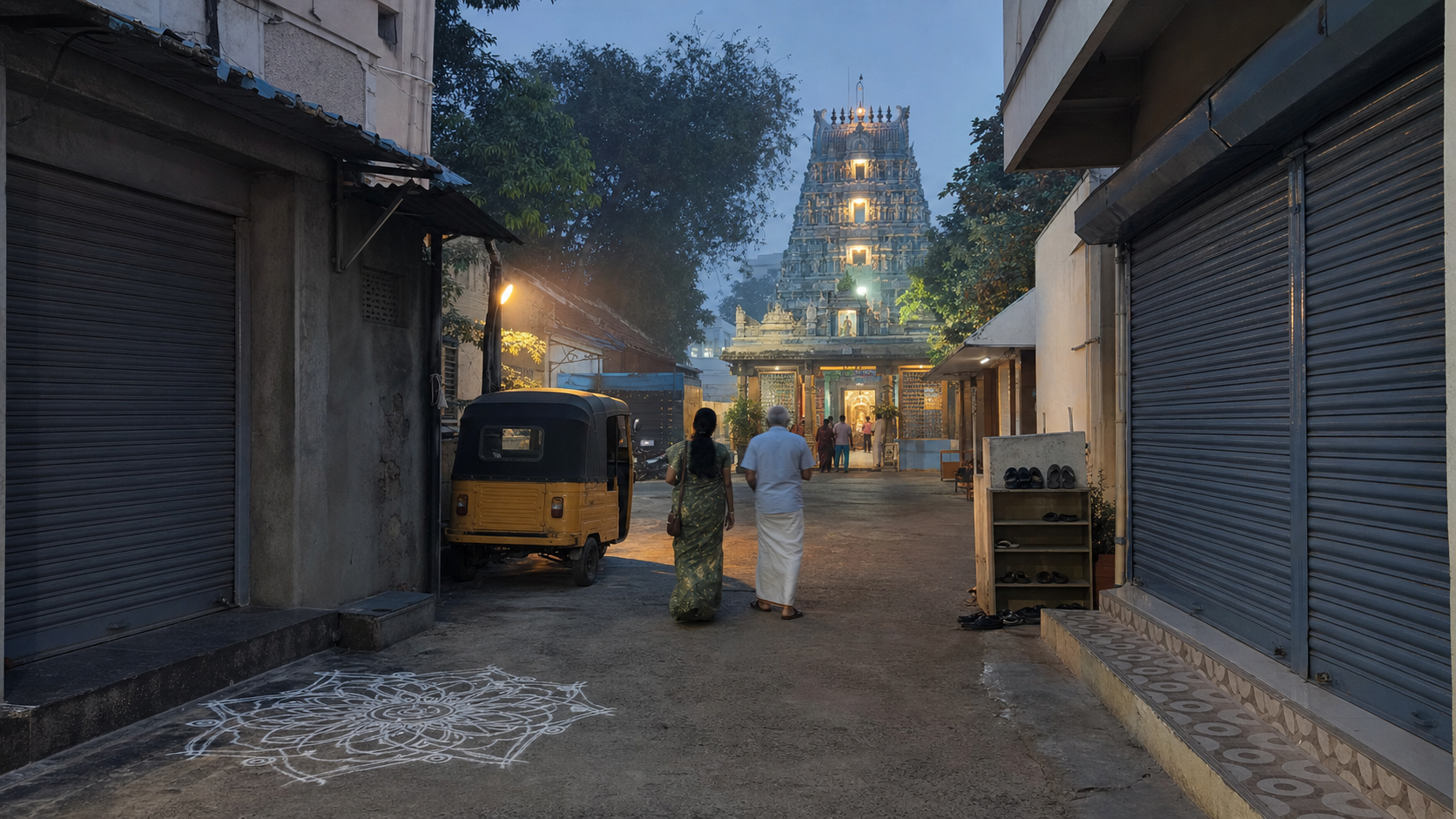
Chennai offers enough important temples to tempt you into treating Margazhi as a checklist. Resist that impulse. The first recitation, the main worship, the queue, and the unhurried movement through the prakaras all need time. A route is useful only if it protects those things.
- Use Mylapore for a concentrated introduction. Kapaleeswarar and Sri Adi Kesava Perumal place Shaiva and Vaishnava Margazhi traditions in the same part of the city. Make one the primary observance and the other a quieter complementary visit. Do not rush out of the first shrine merely to say that you reached both.
- Use the southern coastal arc for two distinct traditions. Ashtalakshmi Temple in Besant Nagar and Marundeeswarar Temple in Thiruvanmiyur allow you to pair Vaishnava and Shaiva worship. Again, choose which one receives your dawn attention; visit the second only after completing the first experience properly.
- Let Triplicane stand on its own on a major day. Sri Parthasarathy Temple is a natural Vaishnava anchor, especially when Vaikunta Ekadasi observances are central to your visit. Sorga Vaasal, Divya Prabandham, and Andal-centred Thiruppavai recitation can draw large congregations, so another distant temple should not be the condition for calling the day successful.
- Give the older city and northern belt their own outing. Kalikambal Temple in George Town and Tiruvottiyur offer a different encounter with Chennai’s urban and temple history. This is the better choice when you want to compare sacred architecture and neighbourhood histories, not when you are already trying to cover the southern coastal temples.
- Choose Vadapalani or Thiruverkadu for a specific commitment. A Murugan or Amman visit works best when you are going for that deity, an announced alankaram, bhajan, or seva. It should not be treated as an extra stop squeezed into a crowded festival itinerary.
A workable order for one temple morning
- Confirm the day’s observance and any entry instructions before travelling.
- Arrive early enough to settle before the recitation or principal ritual begins. Pre-dawn matters because sacred sound is part of the Margazhi experience, not merely an accompaniment to darshan.
- Stay through one complete sequence that the temple permits you to witness. Avoid leaving midway solely to reach a second shrine.
- After worship, move through the prakaras and mandapas without obstructing devotees. This is the right point to study the architecture more closely.
- Add a second temple only if it does not force you to hurry, skip food or rest that you need, or abandon the discipline with which you began.
- Attend a temple music or dance programme later only when it has been announced. Chennai’s wider music season is not proof that every temple courtyard has an event that day.
If you have only one morning, Mylapore is the most flexible introduction because it offers both a major Shaiva shrine and a Vaishnava shrine in one locality. If your purpose is Vaikunta Ekadasi, however, begin with the selected Vaishnava temple rather than choosing a neighbourhood for convenience. If Arudra Darshan is your purpose, let the Nataraja-centred observance determine the day. Ritual priority should defeat itinerary neatness.
Know what you are hearing, seeing, and waiting for
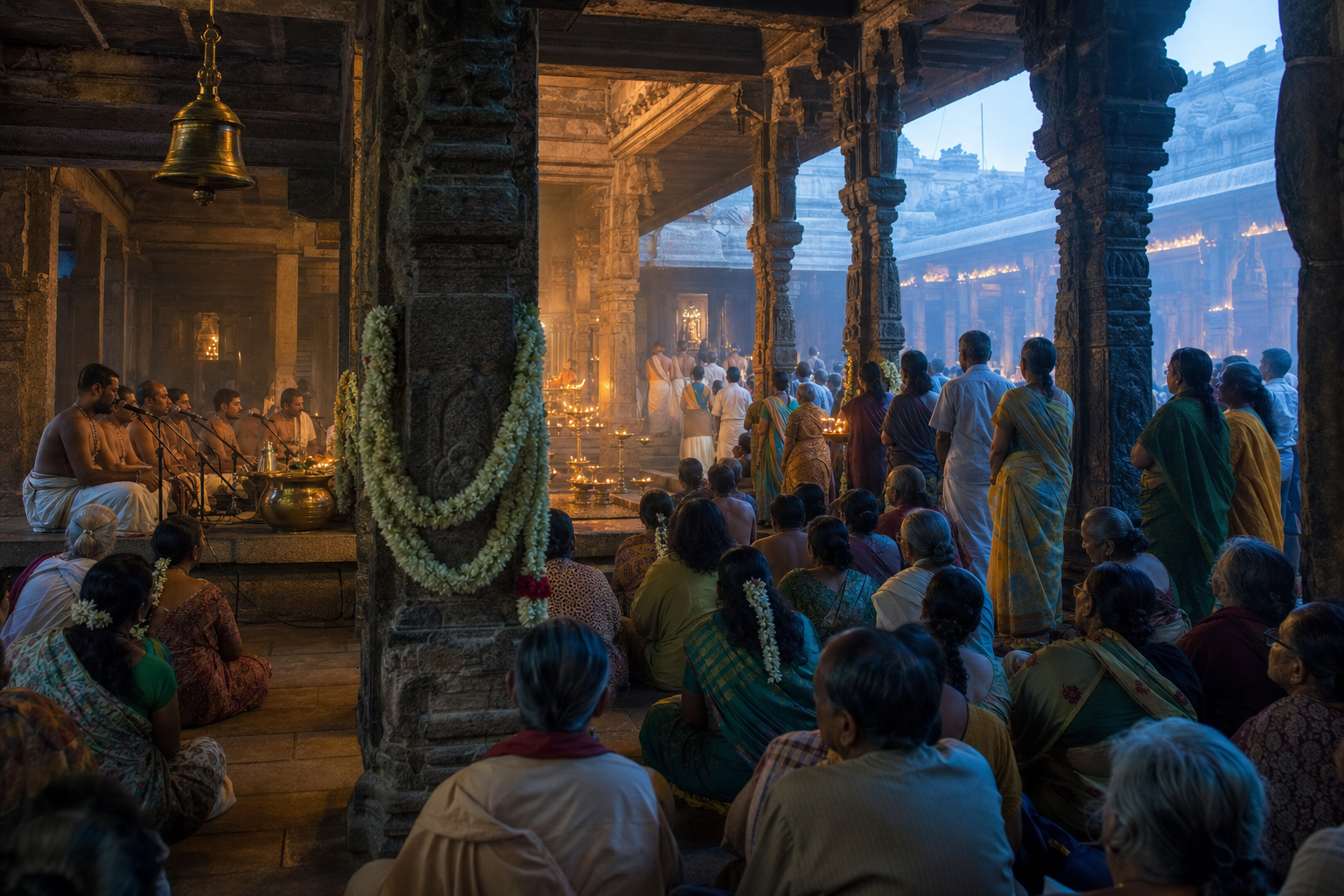
A Margazhi temple visit can become visually busy: lamps, kolams, flowers, alankaram, gopurams, queues, and festival movement compete for attention. The easiest way to stay oriented is to identify the liturgical thread before you enter.
Listen before you begin sightseeing
At a Vaishnava shrine, listen for Thiruppavai and, where scheduled, Divya Prabandham parayanam. Thiruppavai brings Andal’s voice to the centre of Margazhi devotion. Parayanam is not ambient sound placed behind a visual spectacle; it is recitation offered and received as worship. Stand or sit where directed, keep conversation for later, and let a complete portion of the recitation reach you.
At a Shaiva shrine, Thiruvempavai gives the month its corresponding devotional cadence. Around Arudra Darshan, attention turns to Nataraja, with early-morning abhishekam, special alankaram, and Thiruvempavai recitation forming distinct parts of the observance. If you arrive only for the decorated form, you may receive darshan but miss the preceding ritual movement. Decide in advance whether your priority is the abhishekam, the recitation, the completed alankaram, or the whole sequence available to devotees.
On Vaikunta Ekadasi, Sorga Vaasal is a specific ceremonial focus. It should not be reduced to getting through a doorway as quickly as possible. The waiting, the hymnody, the ordered movement of the congregation, and the discipline required in a crowd are also part of how you inhabit the observance. Humility is not separate from the ritual simply because the queue is long.
Read the temple after you have attended to the deity
Once the principal worship is complete, give the building your unhurried attention. Look up at the gopuram and distinguish its architectural mass from the stucco figures that narrate a sacred world. Notice how inscriptions belong to the temple’s accumulated memory rather than functioning as decoration. Observe how a mandapa receives gatherings and ritual movement, how successive prakaras regulate approach, and how the temple tank relates the sacred complex to its neighbourhood.
This order matters. If you begin photographing details while recitation is underway, architecture becomes a distraction from the living tradition that gives it purpose. If you worship first and study the space afterward, gopurams, iconography, inscriptions, sanctum layouts, mandapas, prakaras, and tanks reveal how design supports devotional attention and community life.
The same discipline applies to a temple kacheri or dance presentation. Sacred art in a courtyard is not simply a smaller version of a sabha performance. The deity, liturgical calendar, architecture, and assembled devotees remain part of its context. Listen for how bhakti shapes the repertoire and mood. Do not talk through the performance, block ritual movement, or treat worshippers as scenery.
Follow etiquette that keeps devotion larger than the crowd
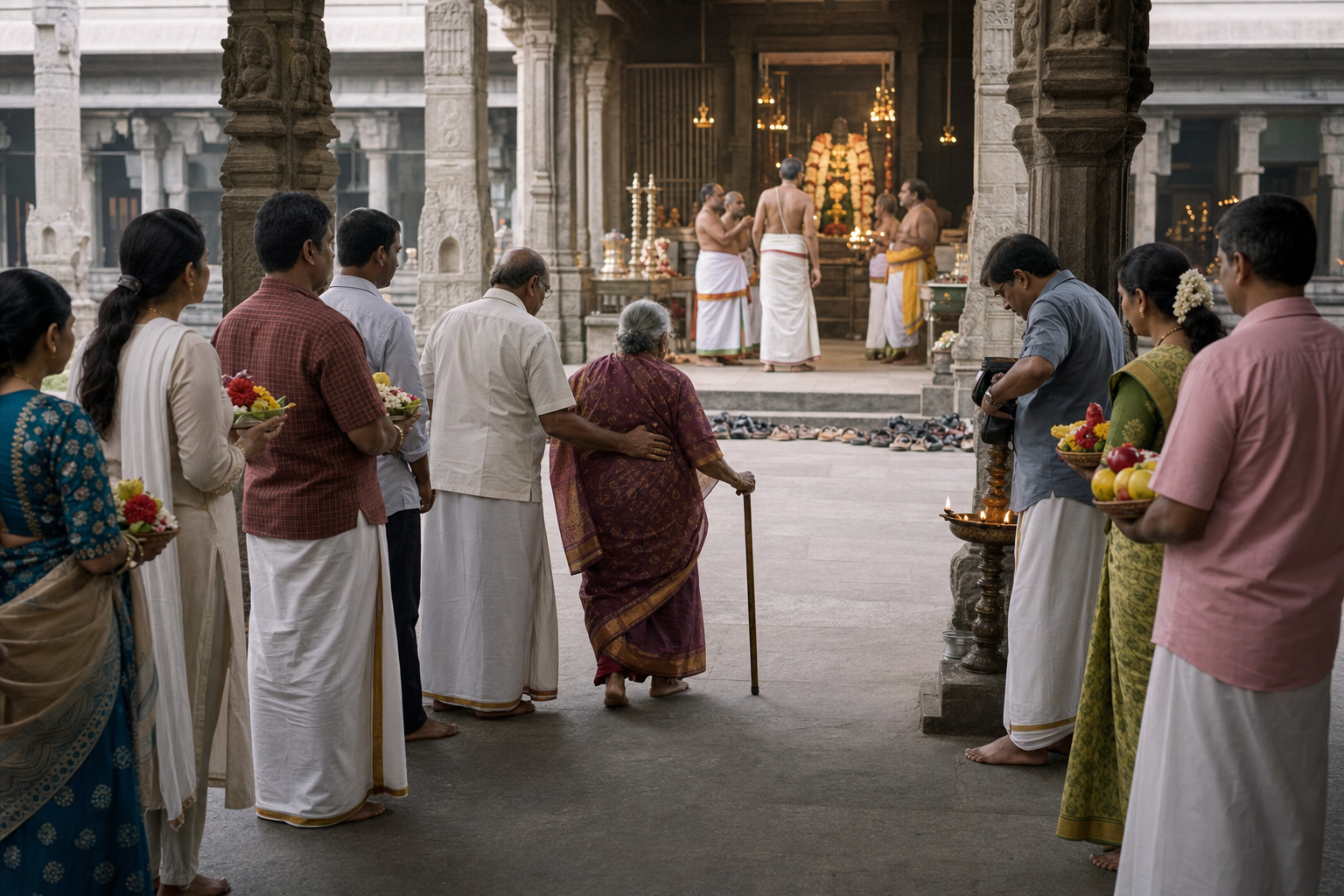
Margazhi hospitality does not remove the need for discipline. The most respectful visitor is not necessarily the person who knows every custom. It is the person who watches, listens, and follows the temple’s actual instructions without making others carry the cost of their uncertainty.
- Wear modest, practical clothing. Choose attire suitable for worship and for sitting, standing, and moving through queues. Bring only what you can manage without occupying other people’s space.
- Keep your phone silent. Do not assume that photography or recording is permitted during recitation, abhishekam, alankaram, darshan, or a performance. When the rule is unclear, put the device away.
- Follow the queue and the volunteers. Festival congestion is not a reason to create a private shortcut. Allow elderly devotees, families, and those with limited mobility the space that the setting requires.
- Do not stop the line after darshan. Receive the moment fully, then move when directed so that the devotee behind you can do the same.
- Use offerings accepted by that temple. Eco-conscious offerings are better than elaborate materials that become waste. If you do not know what is appropriate, ask or make a simple inward offering rather than improvising.
- Join seva through an organised channel. Community service is part of Margazhi’s ethical arc, but spontaneous distribution or activity can obstruct temple operations. Participate in what the shrine or its community has arranged.
- Listen during parayanam. Conversation can wait until you are outside the recitation area. Even if you do not understand every verse, attentive presence is more fitting than treating the chant as background sound.
- Move through the prakaras mindfully. Follow the temple’s customary flow and any restrictions around particular spaces. Curiosity does not override a sacred boundary.
If a major festival crowd would be difficult for a child, an elderly family member, or anyone who cannot wait comfortably, choose a quieter Margazhi morning rather than making Vaikunta Ekadasi or Arudra Darshan the only valid experience. Daily recitation, ordinary darshan, and an unhurried circuit of the temple can preserve the substance of the month without the strain of its largest congregations.
Visitors from Buddhist, Jain, Sikh, and other dharmic backgrounds may recognise the month’s emphasis on self-discipline, non-violence, compassion, service, and community harmony. That kinship is an entry point, not a reason to flatten the traditions into one another. Enter a Hindu temple on its own terms, attend to its deity and liturgy, and allow respect to precede comparison.
Key takeaways for your Margazhi visit
- Choose your ritual focus first: Vaishnava recitation and Vaikunta Ekadasi, Shaiva recitation and Arudra Darshan, Murugan or Amman worship, or a specifically announced sacred-art programme.
- Give one temple the dawn. A second shrine should deepen the day, not force you to abandon the first observance early.
- Use Mylapore for a compact Shaiva-Vaishnava introduction, the Besant Nagar-Thiruvanmiyur arc for a southern route, Triplicane for a strong Vaishnava anchor, and George Town or Tiruvottiyur for a separate heritage-focused outing.
- Distinguish recitation, abhishekam, alankaram, Sorga Vaasal, and final darshan. Arriving for one does not mean that you have attended the others.
- Listen before studying the architecture. Examine gopurams, inscriptions, mandapas, prakaras, and the temple tank after the principal worship.
- Confirm the current temple programme. Margazhi creates a shared devotional season, but it does not produce an identical daily schedule at every shrine.
- Keep attire, offerings, photography, queue conduct, and seva subordinate to the temple’s rules and the comfort of fellow devotees.
Before you leave home, complete one sentence: “I am going to this temple for this observance.” If you cannot fill in both parts clearly, your itinerary is still too broad. Choose one dawn, one liturgical thread, and one act of restraint or service to carry beyond the temple. That is enough to begin Margazhi well.
References
