
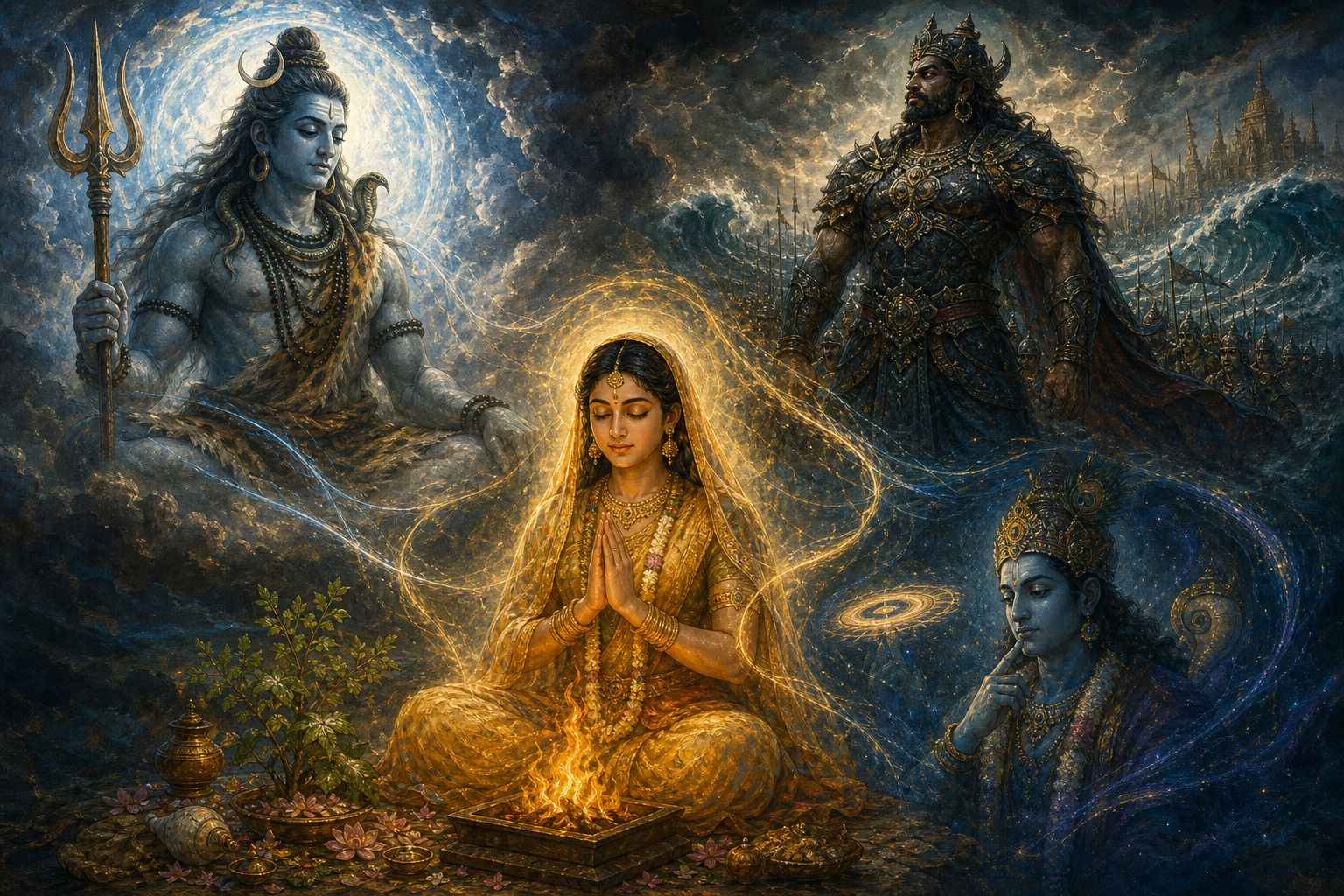
If you came to the Jalandhara Katha with one uneasy question – how can a story about restoring dharma turn on the breaking of Vrinda’s sacred fidelity? – you have reached its real point of tension. Knowing that Shiva defeats Jalandhara is not enough. You need to see what made the asura powerful, why direct force failed, and why his defeat still carried a moral cost.
The central movement of the katha connects four forms of power: Shiva’s tejas, Jalandhara’s martial strength, Vrinda’s tapas, and Vishnu’s strategic intelligence. Read them separately and the episode can look like a simple battle. Read their relationship carefully and it becomes a demanding lesson in how dharma responds when righteous qualities are protecting an unrighteous course.
Follow the chain of power before judging the ending
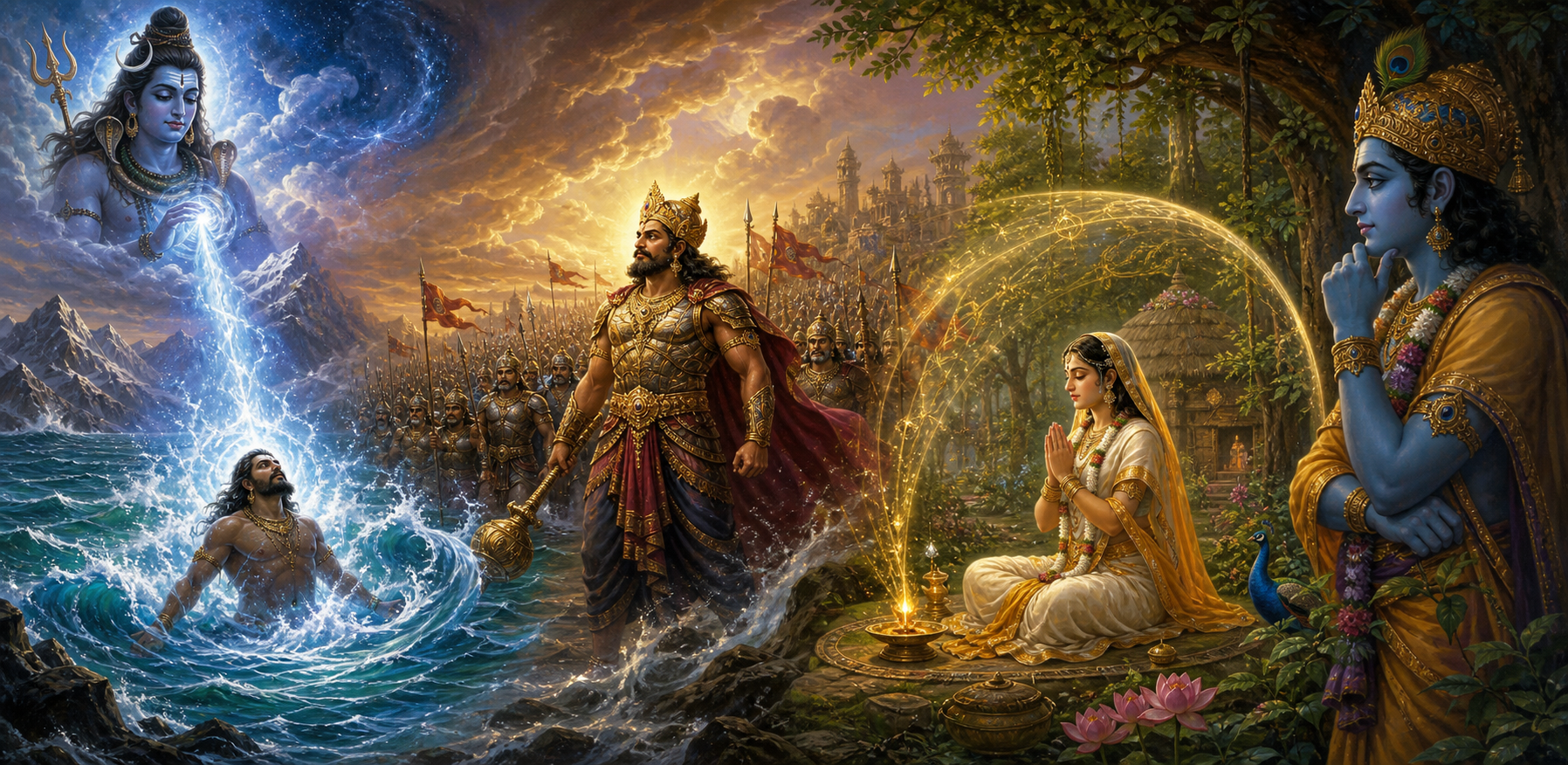
In the Padma Purana and allied traditions, Jalandhara does not begin as an ordinary enemy who happens to become strong. His origin lies in Shiva’s brilliant tejas, which enters the ocean and is nurtured by Varuna. His name itself evokes the waters, and he rises as a mighty king among the asuras from that maritime setting.
That origin matters because the katha does not divide existence into two sealed containers, one containing divine power and the other containing demonic power. Jalandhara possesses energy of an extraordinary source. His failure lies in what he makes that energy serve. Sacred provenance is not the same thing as righteous conduct.
- Power is generated: Shiva’s tejas enters the ocean, where Jalandhara emerges and is nurtured.
- Power becomes political: Jalandhara rises among the asuras, expands his dominion, and pushes the devas from their stations.
- Power receives spiritual protection: the fidelity and tapas of his wife Vrinda create the merit that shields him.
- Force reaches a limit: even the cosmic battle with Shiva cannot be settled while that protection remains intact.
- Strategy changes the condition: Vishnu intervenes at the level of the vow that sustains Jalandhara’s invulnerability.
- Shiva ends the conflict: once the protection is gone, Shiva strikes Jalandhara down with the trishula and restores order.
Keep that sequence in view. If you skip Vrinda’s role, the battle becomes a contest over who is stronger. If you skip the deception associated with Vishnu’s intervention, the moral difficulty disappears. If you skip Jalandhara’s choices, his divine origin can be mistaken for moral legitimacy.
A useful way to read the episode is to track three things on every turn: who possesses force, who generates merit, and who chooses the purpose for which power is used. Those three answers are not always the same person. That distinction is the foundation of the katha.
Vrinda is the moral centre, not a device in the battle

Jalandhara’s armies explain his reach, but they do not explain his invincibility. His protection rests on Vrinda’s unwavering fidelity and tapas. In many retellings, Vishnu’s grace or boon is intertwined with the merit of her vow, making Jalandhara effectively unconquerable while that vow remains whole.
This creates the katha’s sharpest distinction: a virtue can be genuine even when someone else benefits from it unjustly. Vrinda’s discipline does not become false because Jalandhara grows arrogant. Nor does her fidelity automatically make his conquests righteous. Her tapas is hers; the use Jalandhara makes of the protection remains his responsibility.
That distinction prevents a common and harmful misreading. Vrinda should not be treated as proof that marital loyalty requires approval of every action performed by a spouse. The narrative shows the potency of her vow, but it also shows the terrible imbalance created when that potency shields expanding ambition. Fidelity and moral endorsement are not identical.
When you hear or retell this katha, do not let Vrinda enter only when Vishnu needs to defeat Jalandhara. Name her contribution as soon as his invulnerability becomes relevant. Ask whose discipline is actually sustaining the apparent strength on the battlefield. That question turns her from a plot mechanism into an agent whose spiritual stature governs the course of the conflict.
It also exposes a pattern worth noticing beyond the story: visible authority is often upheld by invisible restraint, loyalty, or sacrifice. The person occupying the throne may not be the person generating the moral capital that keeps it standing. Dharma requires us to recognise the difference.
Vishnu’s stratagem is the ethical knot of the katha
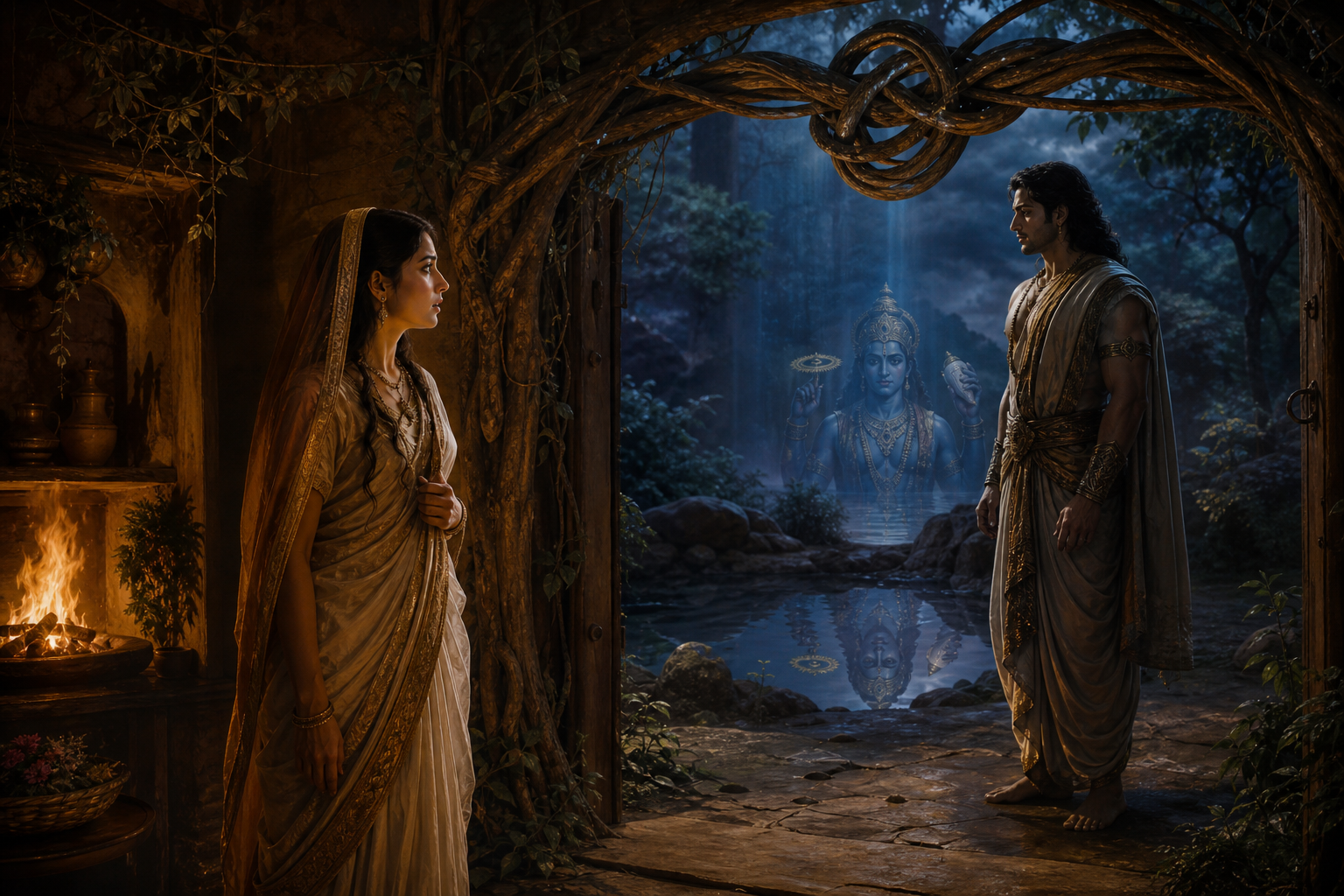
The battle reaches an impasse because Jalandhara’s protection is not merely physical. More weapons cannot solve a condition produced by tapas. Vishnu therefore acts where the protection originates. In certain versions, he assumes a deceptive semblance associated with Jalandhara, and Vrinda’s vow is broken without her knowingly intending to abandon it.
You do not have to make this episode morally painless in order to remain faithful to the katha. The cosmic danger is real: Jalandhara’s campaign has displaced the devas and disturbed the balance of the worlds. The limit of brute force is also real. Yet the cost of the solution falls on Vrinda, whose virtue created the protection but whose consent did not create the deception.
Vrinda’s curse matters precisely because her injury is not erased after the desired outcome is achieved. Tradition connects its aftermath with the sanctity of Tulsi and with Shaligram. The woman affected by the divine strategy does not simply vanish once the battlefield has been cleared. Her tapas, grief, and response become part of sacred memory.
To weigh the episode carefully, hold three judgements together. First, Jalandhara’s destructive ambition had to be stopped. Second, direct combat could not stop him while Vrinda’s merit protected him. Third, the means used to remove that protection produced a moral remainder expressed through Vrinda’s curse. Dropping any one of these judgements makes the story easier, but also poorer.
This is also where you must distinguish interpretation from imitation. A divine stratagem within a Puranic crisis is not a general licence for human beings to deceive whenever they believe their goal is worthy. At the human level, we rarely possess complete knowledge of consequences, and we remain answerable for the people made to bear the cost of our plans. The practical lesson is not that good ends automatically purify difficult means. It is that dharmic judgement must examine the threat, the available means, the distribution of harm, and the voices that remain after victory.
Shiva’s victory restores order rather than proving raw superiority
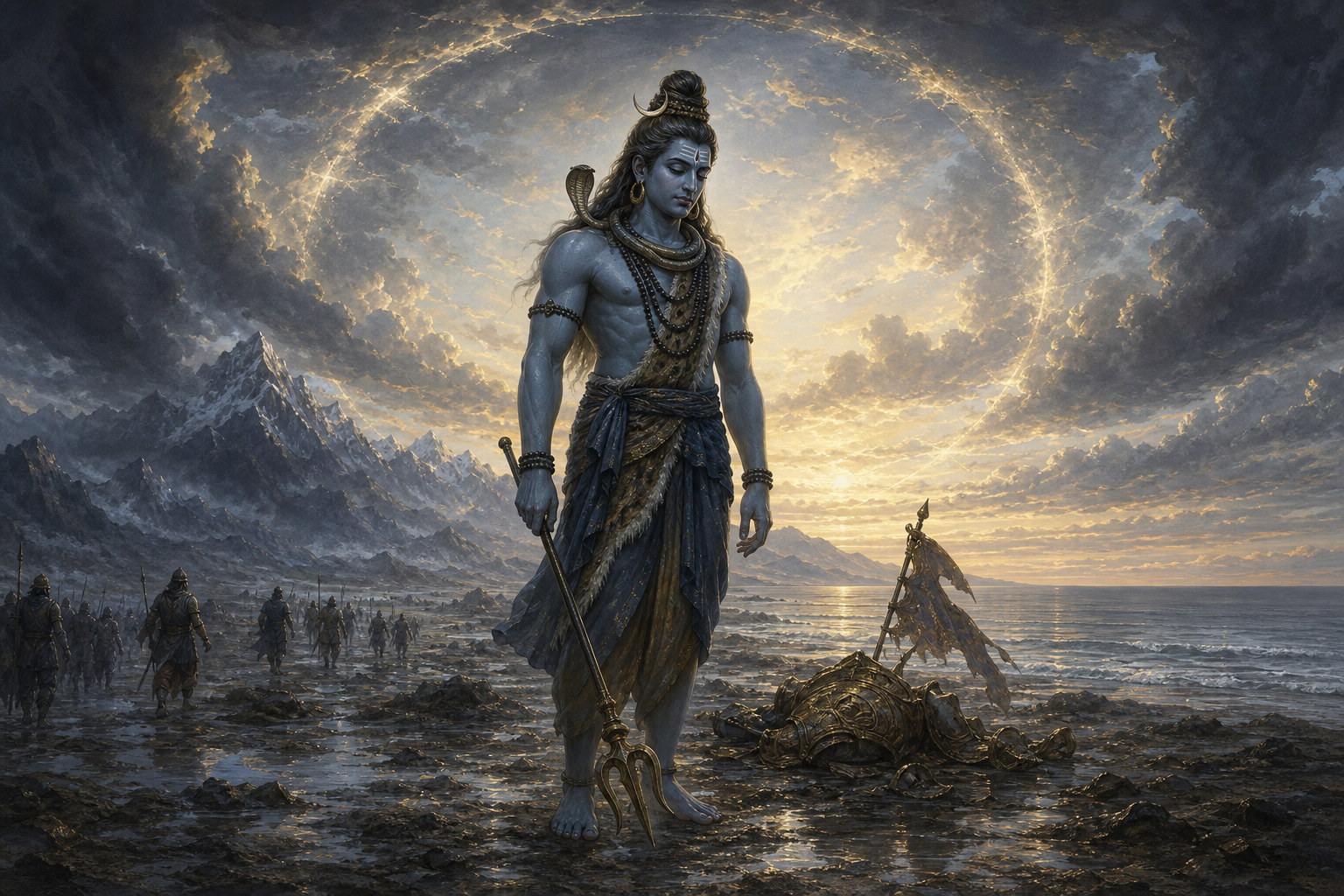
Once Vrinda’s protective merit no longer shields Jalandhara, Shiva brings the war to its decisive close with the trishula. The seas calm, the devas regain their stations, and the tejas from which Jalandhara arose returns to equilibrium. The ending answers the cosmic emergency, but its meaning depends on everything that came before it.
Shiva is not merely defeating an unrelated force from outside his domain. Jalandhara arose from Shiva’s own radiance. The confrontation therefore carries the shape of power being recalled from a distorted purpose. What came from a divine source cannot claim permanent immunity after becoming an instrument of ego and domination.
The victory also depends on more than Shiva’s weapon. Vrinda’s tapas established the condition of invulnerability. Vishnu’s intervention removed that condition. Shiva’s force then ended the embodied threat. The katha gives strategy, devotion, and righteous strength different functions; none can be substituted casually for another.
This gives you a precise test for power: do not ask only where it came from or how impressive it is. Ask what restrains it, whom it serves, and whether it remains answerable to dharma. Jalandhara fails that test because extraordinary origin and extraordinary protection feed expanding entitlement rather than humility.
The episode is distinctly Hindu and Puranic, and it should not be flattened into a generic moral fable. Yet its ethical vocabulary can still speak across the wider Dharmic family. Self-restraint, truthfulness, courage, responsibility, and conquest of ego carry resonance in Hindu, Buddhist, Jain, and Sikh reflection, even though each tradition develops those values through its own teachings and forms.
How to carry the katha into devotional practice
The Jalandhara Katha often returns to devotional memory during Kartika observances and reflections connected with Tulsi. That setting can make the telling familiar, but familiarity sometimes causes the difficult moments to pass too quickly. Slow the recitation at the points where the ownership of power changes.
- At Jalandhara’s birth, separate the source of his energy from the purpose he later gives it.
- At the account of his victories, notice when strength becomes entitlement and conquest begins disturbing the wider order.
- At Vrinda’s vow, identify the person generating the merit rather than crediting only the warrior protected by it.
- At Vishnu’s intervention, resist both reflexive condemnation and automatic sanitisation. Name the necessity claimed by the situation and the cost borne by Vrinda.
- At Vrinda’s curse, notice that protest remains spiritually consequential even after cosmic order is restored.
- At Shiva’s final act, read the victory as the restoration of measure, not as a celebration of violence for its own sake.
Key takeaways
- Jalandhara’s divine origin gives him power, not moral permission.
- Vrinda’s tapas is the hidden force behind his invulnerability, but her virtue does not justify his ambition.
- Vishnu’s stratagem resolves a cosmic deadlock while leaving a real ethical cost that the tradition does not simply erase.
- Vrinda’s curse and her association with Tulsi keep her agency within sacred memory.
- Shiva’s trishula ends the war only after the spiritual condition protecting Jalandhara has been removed.
- The katha asks you to judge power by its restraint and purpose, not merely by its source or scale.
Before your next recitation or Tulsi reflection, write down three questions: What protected Jalandhara? What corrupted his power? What did the restoration of order cost? If an interpretation cannot answer all three without silencing Vrinda, it has not yet reached the full moral depth of the katha.
References
