
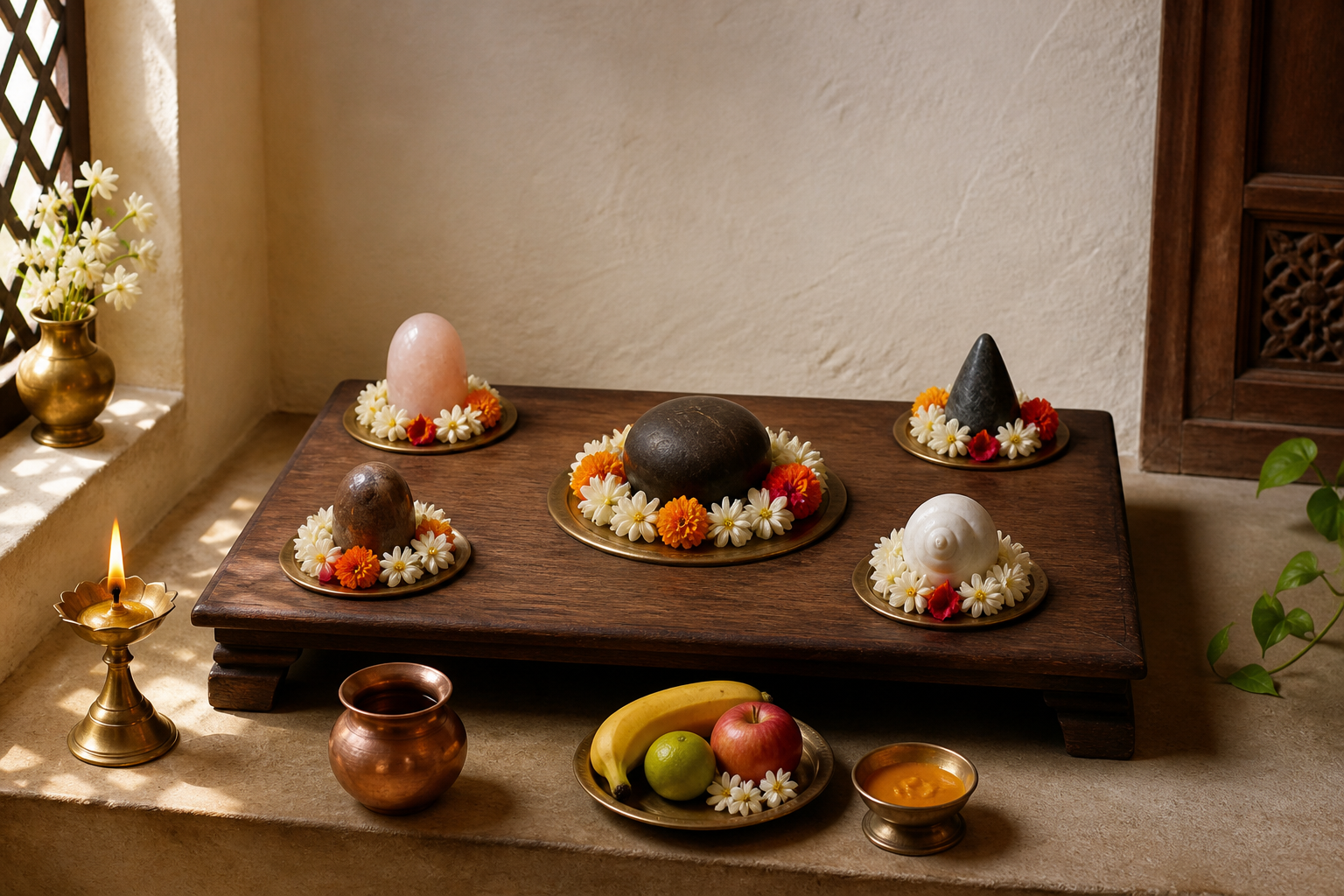
You want to establish Panchayatana Puja at home, but one question may be holding you back: if one deity is your Ishta-devata, does worshipping four others weaken that relationship? It does not. The arrangement gives your chosen form a visible center while making reverence for other divine forms part of the same discipline.
You do not need to feel identical devotion toward all five deities, invent a complicated ceremony, or discard the customs your family already follows. You need a clear center, respectful acknowledgement of all five, and a form of worship you can sustain without pretending that a general outline is a lineage-specific ritual manual.
Choose the center without turning devotion into a ranking
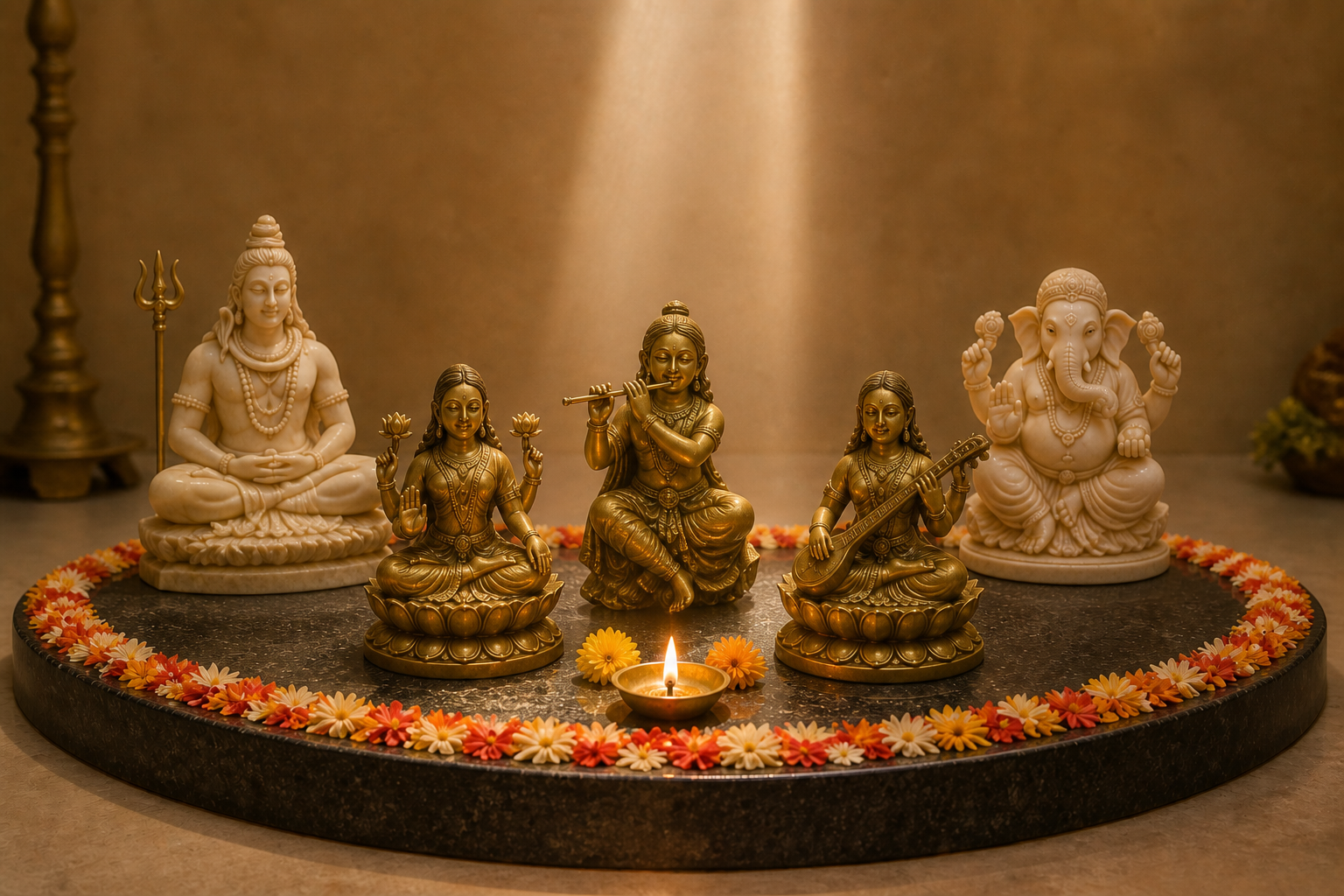
In its classical form, Panchayatana Puja brings Shiva, Vishnu, Devi, Surya, and Ganesha into one sacred arrangement. One occupies the center, and the other four surround that central form.
The central position belongs to the devotee’s Ishta-devata: the form of the Divine toward which personal devotion is principally directed. If Shiva is your Ishta, Shiva may occupy the center. The same principle applies when your primary devotion is to Vishnu, Devi, Surya, or Ganesha. The center identifies your devotional point of concentration; it does not declare that the surrounding deities are unreal, profane, or unworthy of worship.
This distinction solves a common misunderstanding. Panchayatana does not require equal emotional attachment to five forms. It asks for depth without exclusion. Your relationship with the Ishta can remain intimate and one-pointed while your shrine visibly acknowledges that the sacred is not exhausted by the form closest to you.
If you are unsure which deity should be central, use the following order of discernment:
- Look first at the established practice of your household. An inherited center may express a family tradition larger than one person’s current preference.
- Notice which form already anchors your regular prayer, remembrance, or contemplation. An Ishta is not a decorative favorite chosen merely to complete the layout.
- If personal inclination and family practice differ, do not hastily dismantle the household arrangement. Ask a knowledgeable elder or teacher how personal devotion can be honored within the inherited form.
- Once you have chosen a center for regular worship, let it remain stable long enough to support concentration. Constant rearrangement can turn a spiritual decision into a matter of mood.
The aim is neither sectarian rivalry nor devotional indecision. It is a disciplined relationship between commitment and reverence: one form receives your concentrated attention, and the other four remain consciously within your field of worship.
Arrange the five forms as a coherent shrine
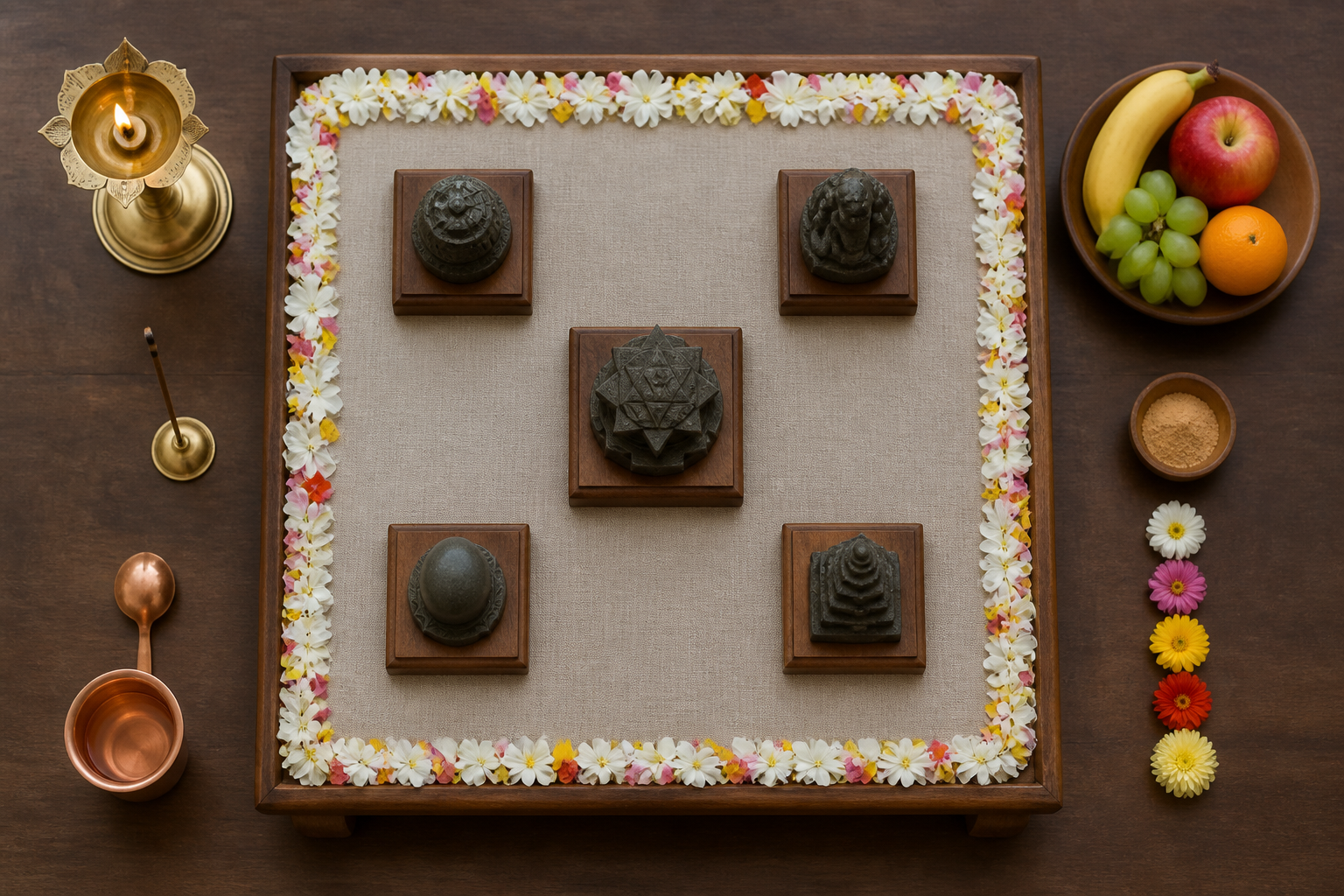
The basic spatial pattern is a quincunx: one representation at the center and four placed around it. Think of the pattern made by the five marks on a die. It is the relationship between center and surroundings, rather than a row of unrelated images, that makes the arrangement immediately legible.
| Surrounding deity | ||
| Surrounding deity | Ishta-devata at the center | Surrounding deity |
| Surrounding deity |
The surrounding labels are deliberately neutral. The quincunx establishes the central relationship, but it should not be used to manufacture a universal directional rule where a family, region, or sampradaya may have its own order. If you have received a specific arrangement, retain it. Do not overturn an inherited shrine merely because an unaffiliated diagram places the four surrounding deities differently.
Use this setup checklist:
- Confirm that the classical five are all represented: Shiva, Vishnu, Devi, Surya, and Ganesha.
- Place the representation of your Ishta-devata at the center.
- Place the remaining four around the center so that each is distinct and can be acknowledged intentionally.
- Keep the arrangement stable, orderly, and suitable for regular worship rather than treating it as a temporary display.
- Check any inherited instructions before assigning the surrounding positions or changing an existing order.
A household does not necessarily need five large murtis. Panchayatana shrines may use murtis, yantras, or aniconic sacred symbols, with materials and visual forms shaped by regional and family practice. This flexibility is especially useful when space is limited. A compact shrine can still communicate the complete pattern if the five representations are clear and respectfully placed.
Do not mistake visual uniformity for ritual correctness. Five objects do not have to be identical in size, material, or artistic style merely to look like a purchased set. Continuity with an established tradition matters more than showroom symmetry. At the same time, avoid collecting unidentified objects simply to fill the required positions. You should know which deity each representation signifies and why it belongs where it has been placed.
Begin with a daily form you can perform honestly
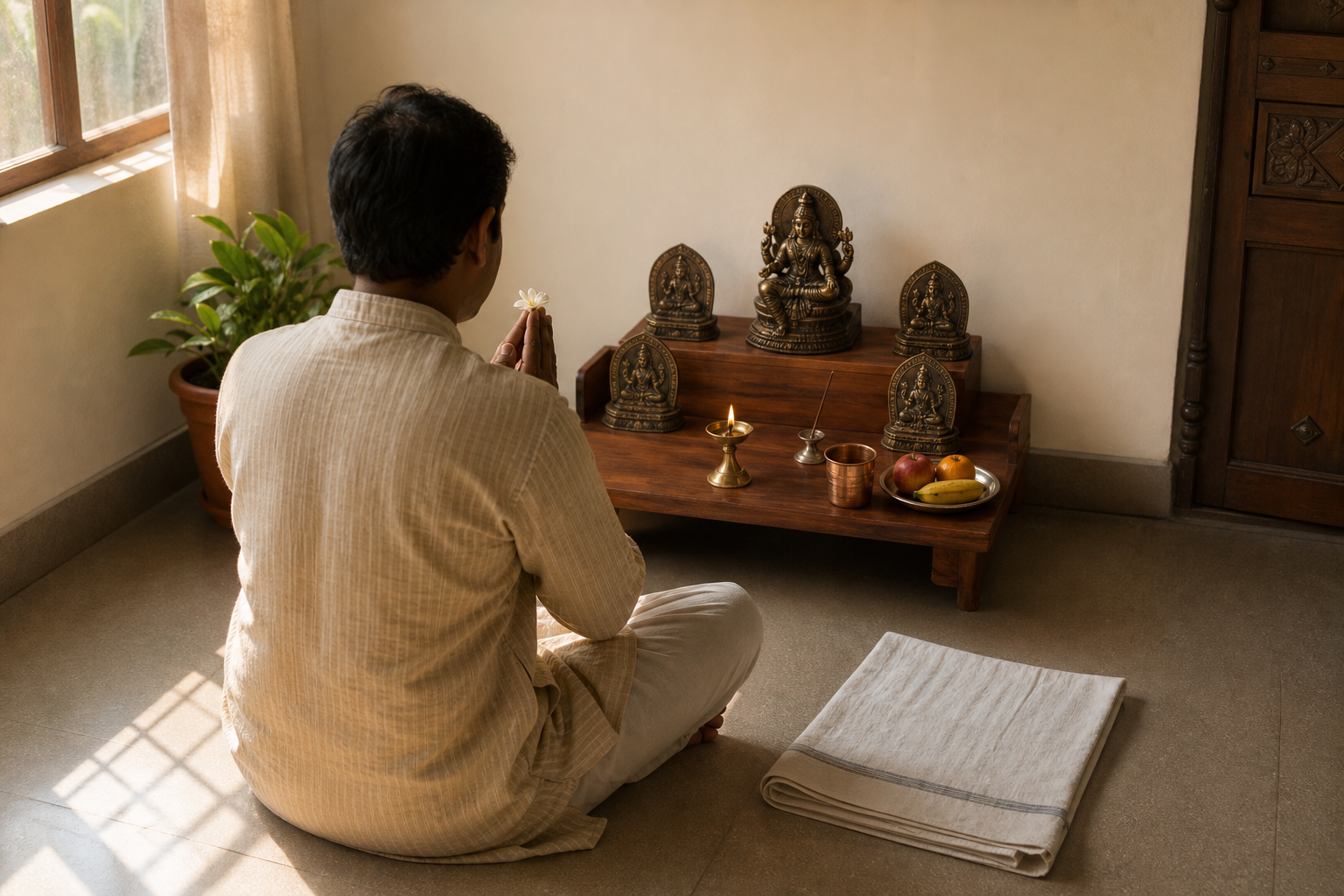
The shrine arrangement and an elaborate ritual procedure are not the same thing. Panchayatana supplies the fivefold devotional structure, but it does not erase differences among household customs, local traditions, or formal ritual systems. A brief daily observance can therefore be sincere without being presented as a complete traditional paddhati.
If you have not received a detailed procedure, this conservative sequence gives you a workable beginning:
- Set aside an uncluttered interval and make the shrine ready for attentive worship.
- Light a lamp if that belongs to your household practice and can be done safely. Keep an open flame on a stable surface and never leave it unattended.
- Offer your principal salutation to the Ishta-devata at the center.
- Acknowledge each of the four surrounding deities separately rather than treating them as background decoration.
- Use names, prayers, or mantras that you have actually learned. A simple, respectful namaskara is more honest than improvised Sanskrit or a ritual formula whose meaning and use you do not understand.
- Make the offering customary in your household or tradition. The offering should support attention and reverence, not become a display of expense.
- Allow a brief period for contemplation, gratitude, or an ethical resolve before closing in the manner familiar to your family.
The lamp, mantra, and offering are not unrelated tasks to complete as quickly as possible. They give the mind a rhythm: turn toward the sacred, attend to each form, offer something without grasping, and become quiet enough to notice the quality of your own attention.
Keep the central emphasis visible throughout. You may direct the fuller portion of your worship toward the Ishta while offering concise salutations to the other four. Panchayatana does not require five elaborate pujas every day. If excessive complexity makes the observance impossible to maintain, simplify the general framework and seek guidance before adding specialized rites.
There is also an important boundary: do not label a self-composed sequence as an ancient or universally binding procedure. If you want a full ceremonial form, learn it from a qualified person within the tradition you intend to follow. That is where questions about exact mantras, order, offerings, and inherited ritual obligations should be settled.
Let lineage govern details that the general pattern leaves open
Panchayatana Puja is historically associated with the Smarta tradition and is often linked with Adi Sankara. That connection should be stated carefully. An association is not permission to claim that every present arrangement was invented at one identifiable moment or that every Hindu lineage understands the practice in exactly the same way.
For practical decisions, use a clear hierarchy of authority:
- Inherited household practice: preserve the arrangement, prayers, and forms transmitted within the family unless there is a sound reason to change them.
- Your teacher, local temple, or knowledgeable community: use living guidance when the household practice is incomplete, disputed, or no longer remembered.
- General explanations: use them to understand the fivefold structure and ask better questions, not to overrule a specific lineage from a distance.
This hierarchy matters because regional custom, family lineage, and community guidance all shape the practice. Flexibility keeps Panchayatana accessible, but flexibility is not arbitrariness. The five-deity structure provides a boundary; received custom supplies many of the details inside it.
Watch for these common mistakes:
- Omitting an unfamiliar deity: the classical form is specifically the worship of Shiva, Vishnu, Devi, Surya, and Ganesha. Removing one changes the fivefold structure.
- Treating the central deity as the only sacred presence: this turns the other four into ornaments and defeats the integrative purpose of the arrangement.
- Assuming respect requires identical devotion: the Ishta principle exists precisely so that focused personal devotion and reverence for other forms can coexist.
- Copying a directional layout without context: an image detached from its lineage cannot by itself establish a universal rule.
- Increasing complexity faster than understanding: adding unfamiliar formulas and offerings may create anxiety without deepening attention.
- Correcting relatives from a generic template: first determine whether the apparent difference reflects a legitimate family or regional convention.
If members of one household have different Ishtas, the shared shrine need not become a contest. The inherited household center can remain in place while individuals direct personal prayer toward the form closest to them. A proposed change to a collective shrine should be discussed with the people who worship there and, when necessary, with someone competent in the family’s tradition.
Let the arrangement reshape how you regard other paths
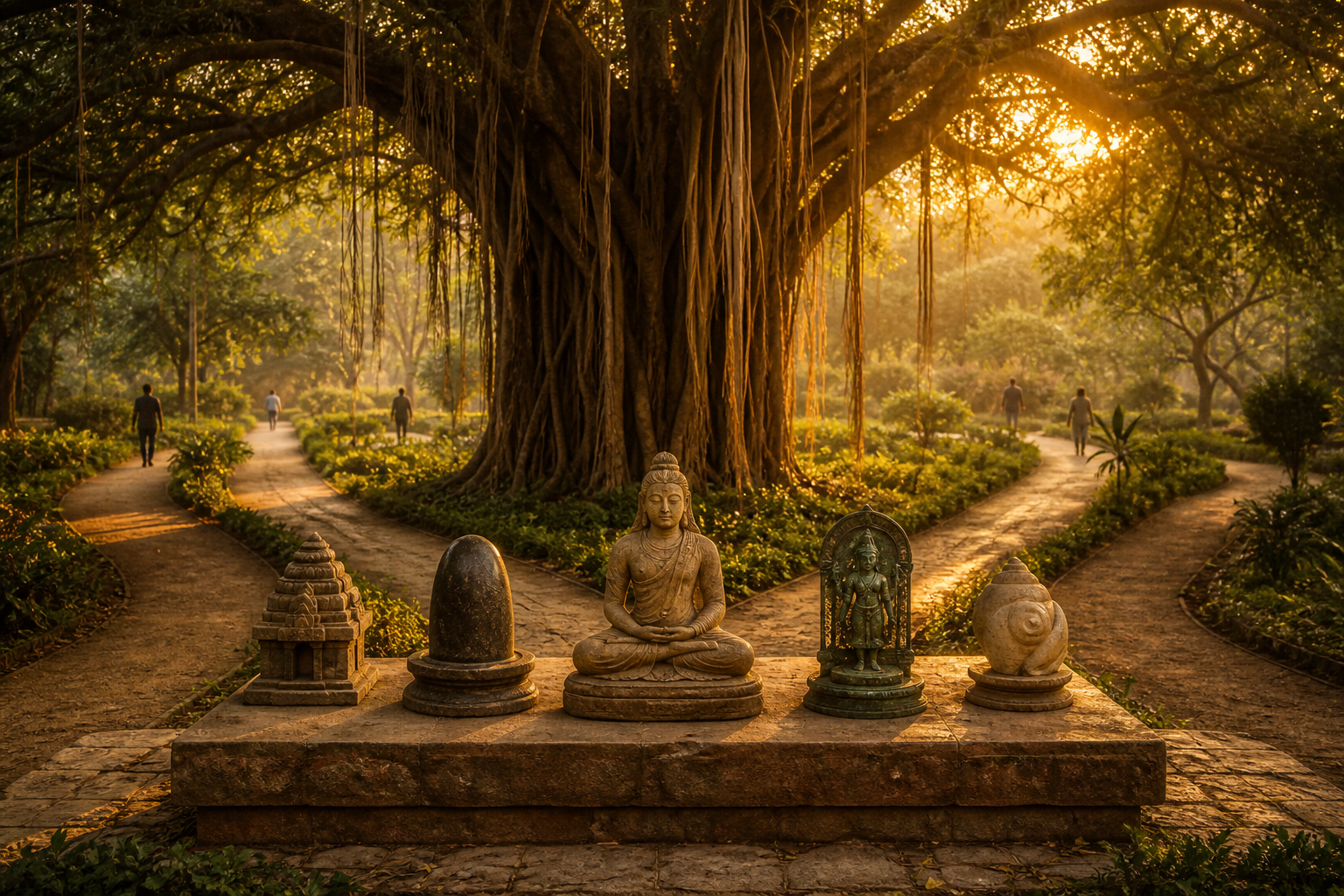
The Smarta and Advaita Vedanta setting gives Panchayatana its best-known philosophical interpretation: distinct divine forms can serve as approaches to the same Brahman. The shrine makes this claim spatially. The Ishta stands at the center of lived devotion, but the center exists in relationship with four other sacred forms rather than by negating them.
This does not require you to say that every deity, doctrine, or sampradaya is interchangeable. Unity becomes shallow when it is achieved by pretending differences do not matter. Panchayatana offers a more demanding discipline: remain rooted enough to worship with conviction and expansive enough to honor forms that are not your own primary doorway.
That discipline also explains why the practice has wider Dharmic resonance. Jain Anekantavada values attention to more than one perspective; Buddhist traditions accommodate diverse contemplative methods; Sikh tradition affirms divine oneness. These are not identical doctrines, and Panchayatana should not be recast as a combined interfaith ritual. The resonance lies in a shared refusal to assume that difference must produce contempt, coercion, or hostility.
You can test whether the shrine is doing more than decorating a room. After worship, ask whether devotion to your Ishta has made you steadier or merely more concerned with ranking traditions. Ask whether you can acknowledge the other four forms without defensiveness. Then ask whether reverence is becoming visible in patience, compassion, restraint, and non-harm. If conduct remains untouched, the arrangement’s deepest teaching has not yet entered daily life.
Key takeaways
- Classical Panchayatana Puja honors Shiva, Vishnu, Devi, Surya, and Ganesha together.
- Your Ishta-devata occupies the center; the remaining four are placed around it in a quincunx.
- The center expresses concentrated devotion, not a universal ranking of divine forms.
- Murtis, yantras, and aniconic symbols may be used according to family, regional, and community practice.
- A modest daily observance can include a lamp, salutations, mantra or prayer already learned, an offering, and quiet contemplation.
- Inherited guidance should decide lineage-specific positions and procedures that the general fivefold pattern does not settle.
- The practice succeeds when devotion becomes deeper without turning difference into disrespect.
Begin with the shrine you can maintain: five clearly understood representations, one stable devotional center, and a sincere acknowledgement of every form present. Before adding complexity, confirm the details with your family tradition or a competent teacher. The first task is not to acquire more ritual objects. It is to decide what belongs at the center and what honoring the four around it should require from you.
References
