
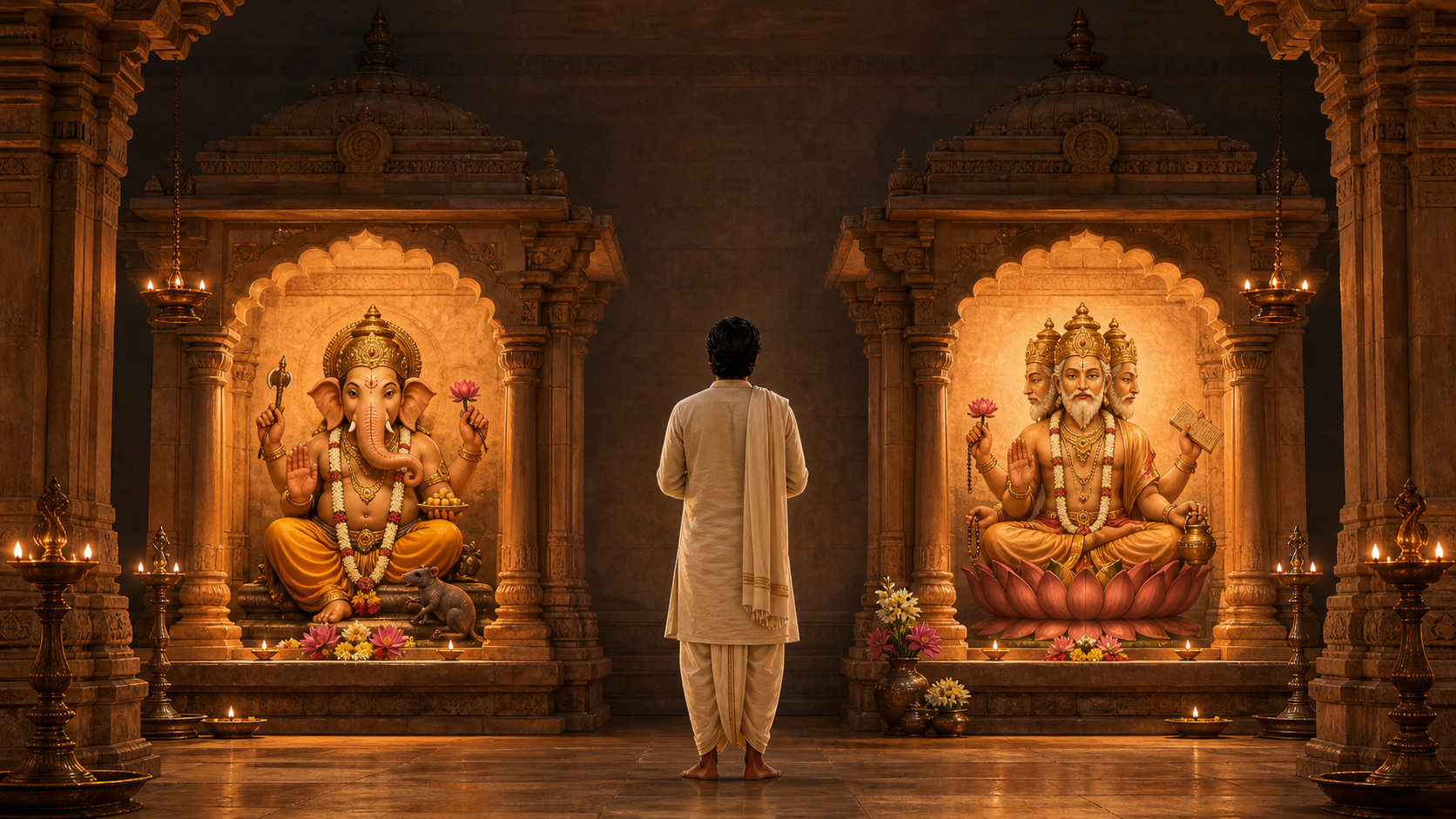
You may be standing before a four-faced Brahma or an unfamiliar form of Ganesha and wondering what the image expects you to understand. Are the extra faces literal anatomy, symbolic additions, separate personalities, or evidence of many different gods? The number alone cannot answer that question.
A better approach is to treat the image as a compact theological map. Divine multiplicity can express several capacities, perspectives, relationships, or modes of presence at once. Once you learn to ask what has been multiplied and why, an apparently strange image becomes much easier to read without reducing it to either fantasy or decoration.
Multiplicity is a visual grammar, not divine arithmetic
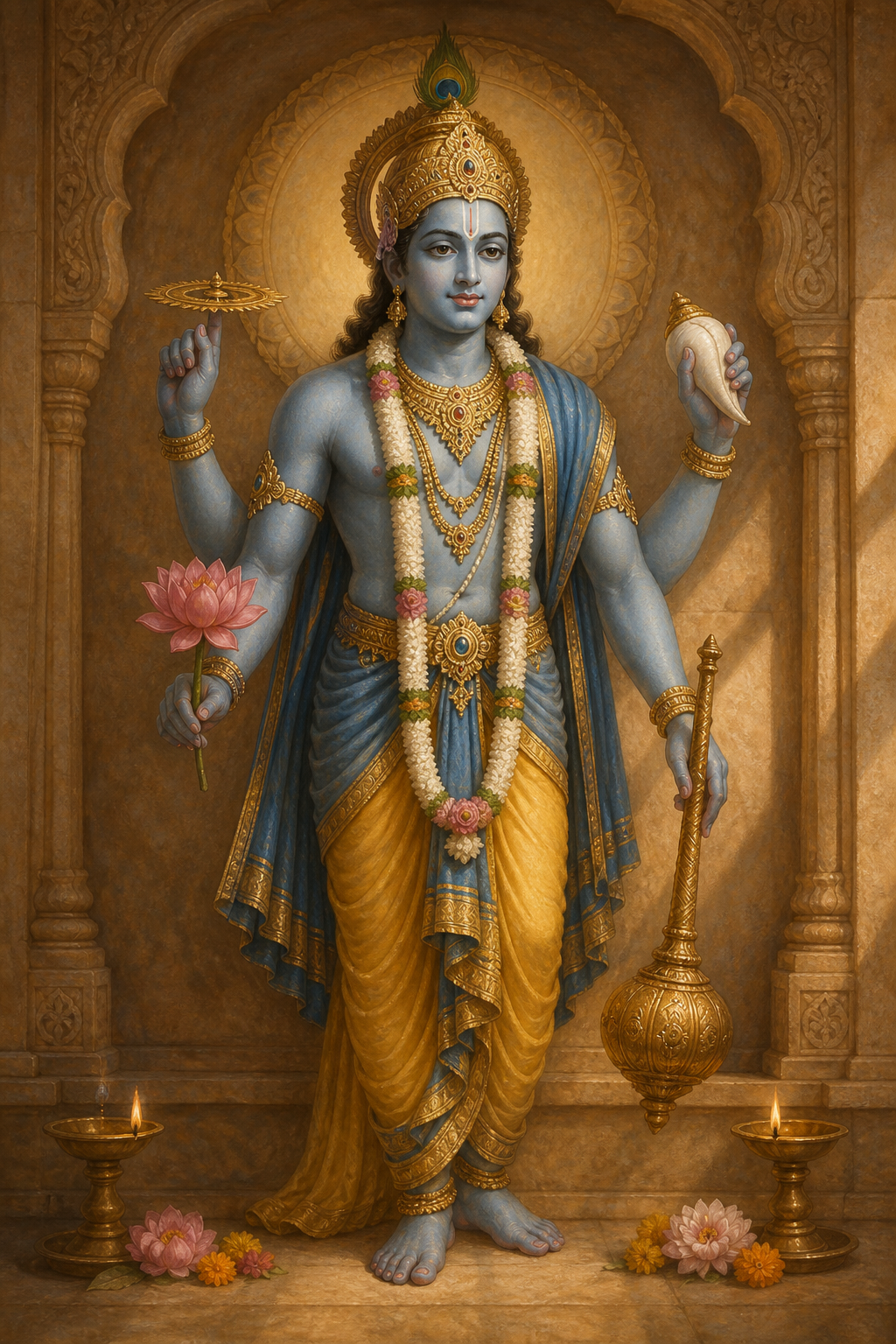
A Hindu sacred image is not merely a portrait of what a deity would look like in an ordinary human room. Its form communicates identity and activity. A face establishes a way of seeing. A gesture establishes a relationship. An attribute identifies a capacity or association. A posture reveals a state. When one body is insufficient to show all that must be shown, iconography can multiply the relevant feature.
This is why counting parts is only the beginning. Four faces do not automatically mean four separate beings. Several arms need not represent a biological claim. Many forms bearing one divine name need not be interchangeable copies. Multiplication tells you that the image is making something simultaneous, comprehensive, or differentiated. Your task is to discover what that something is.
At the same time, calling every feature “just a symbol” creates another distortion. In many Hindu traditions, a murti is approached through darshana, worship, offering, and relationship. Its visual language carries meaning, but the sacred presence is not exhausted by an art-historical explanation. You do not have to choose between a form that is spiritually real and a form that communicates through symbols.
Begin with three questions. What has been multiplied: the deity’s forms, faces, arms, attributes, or relationships? What limitation of ordinary vision does that multiplication overcome? Which tradition, temple, text, or ritual setting gives the image its particular meaning? These questions are more reliable than starting with a theory about how many gods Hinduism permits.
Ganesha’s thirty-two forms show how one deity can be encountered differently
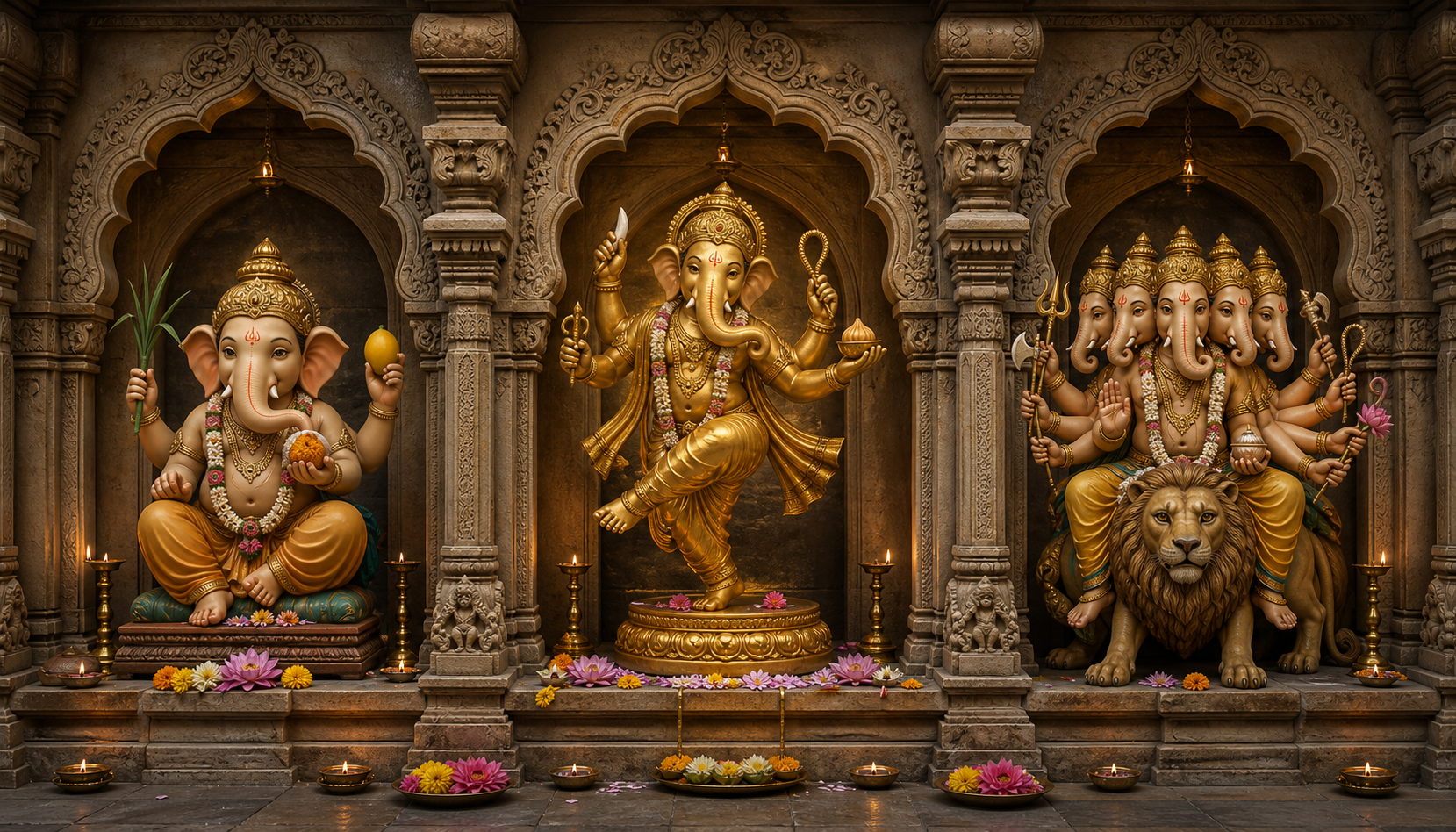
The Ganesha Purana describes thirty-two forms of Ganapati. These forms are also identified in Agamic traditions, and some Tantric practitioners worship such manifestations. This is multiplicity at the level of rupa: a stable divine identity appears through distinguishable forms.
The first named form, Bala Ganapati, presents Ganesha in a childlike mode. The point is not that the familiar Ganesha has been replaced by another deity. The form directs attention toward a particular way of encountering him. Divine identity remains recognizable while the mode of manifestation changes.
That distinction matters whenever you encounter an unfamiliar Ganesha. Asking only, “Is this Ganesha?” ends the inquiry too early. Ask instead, “Which form of Ganesha is this, and what relationship does this form invite?” The local name, posture, gestures, attributes, and ritual setting may distinguish a particular manifestation from a generic representation.
Do not assume that all thirty-two forms are decorative variations, but do not invent a meaning from appearance alone either. First record what you can actually see. Then look for the form’s proper name in the temple, community, or tradition presenting it. A recognized name can lead you to a specific interpretive framework; an imaginative guess cannot.
This also gives you a useful response to the common claim that many forms must mean many unrelated gods. Iconographic plurality can operate within a continuous devotional identity. One name may contain a range of manifestations without making those manifestations meaningless, and without requiring every Hindu school to explain their unity in exactly the same metaphysical terms.
Brahma’s four heads make comprehensive awareness visible
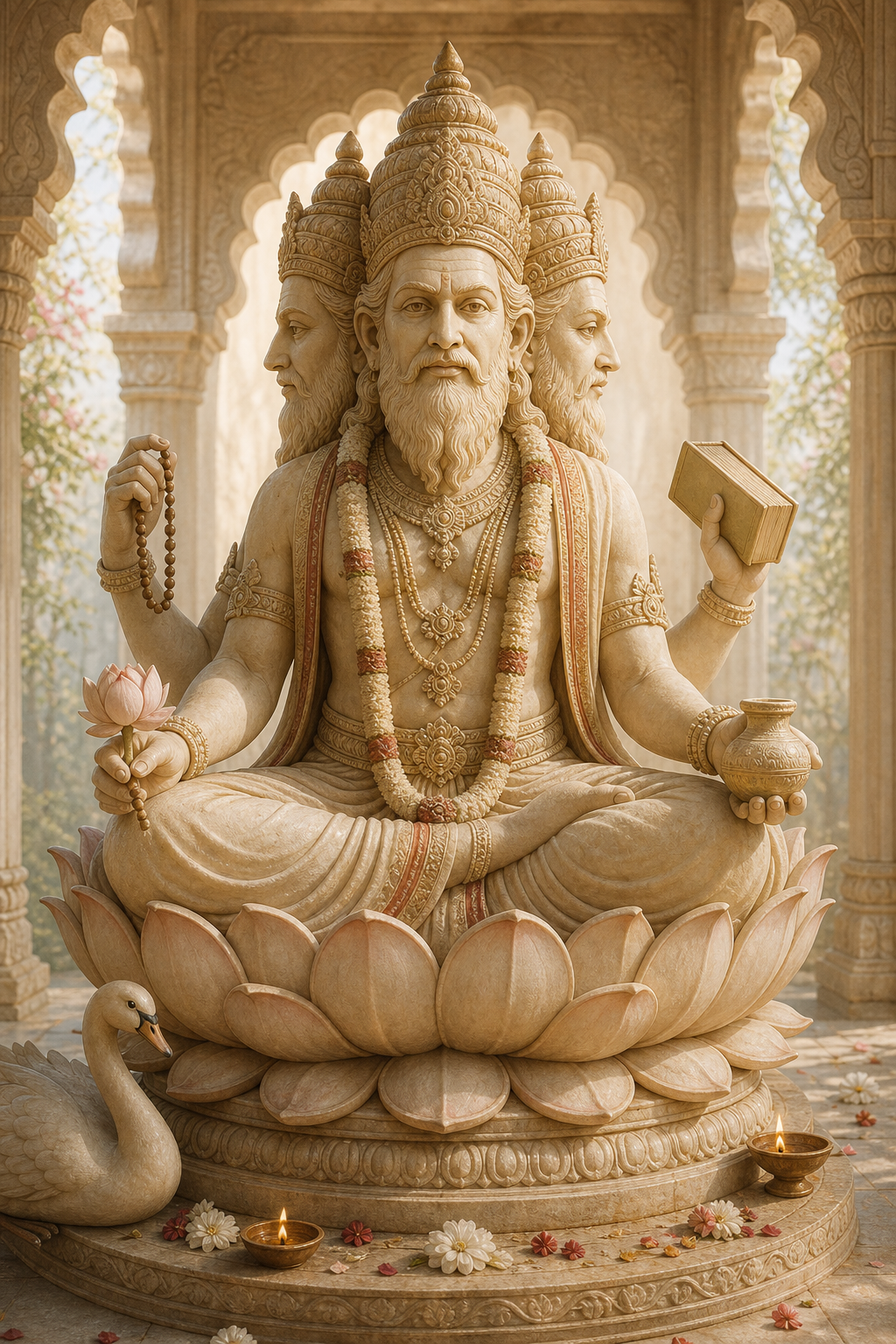
Brahma is presented as Prajapati, the progenitor and creator who brings forth a universe marked by diversity and complexity. In a familiar account of divine functions, Vishnu sustains while Shiva dissolves. Brahma’s creative role provides the necessary context for reading his four-headed form.
A single human face looks in one direction at a time. Four faces break that limitation. They make an expanded field of awareness visible and invite you to associate creation with a vision capable of holding more than one direction or perspective. The image does not merely add an unusual number to Brahma’s body; it gives visual form to the scope demanded by his cosmic function.
Read the heads together rather than treating each one as an isolated character. Their force lies in simultaneity. The image asks you to contemplate awareness that is not trapped within a single angle of vision. That is a more useful interpretive starting point than searching for four competing personalities.
You can also use the image as a disciplined reflection without pretending that your reflection is the only canonical interpretation. When a problem looks complete from your current position, ask what remains invisible from another direction. What consequence, person, duty, or assumption lies outside your present field of attention? Brahma’s form can train you to notice the limits of one-sided seeing.
Keep that application modest. A sacred image is not a blank surface onto which any modern lesson may be projected. The contemplation should arise from the visible feature and the deity’s established role: multiple faces, comprehensive awareness, and creation in its diversity. If an interpretation ignores that structure, it is probably using the image rather than reading it.
Read an unfamiliar murti in five deliberate passes
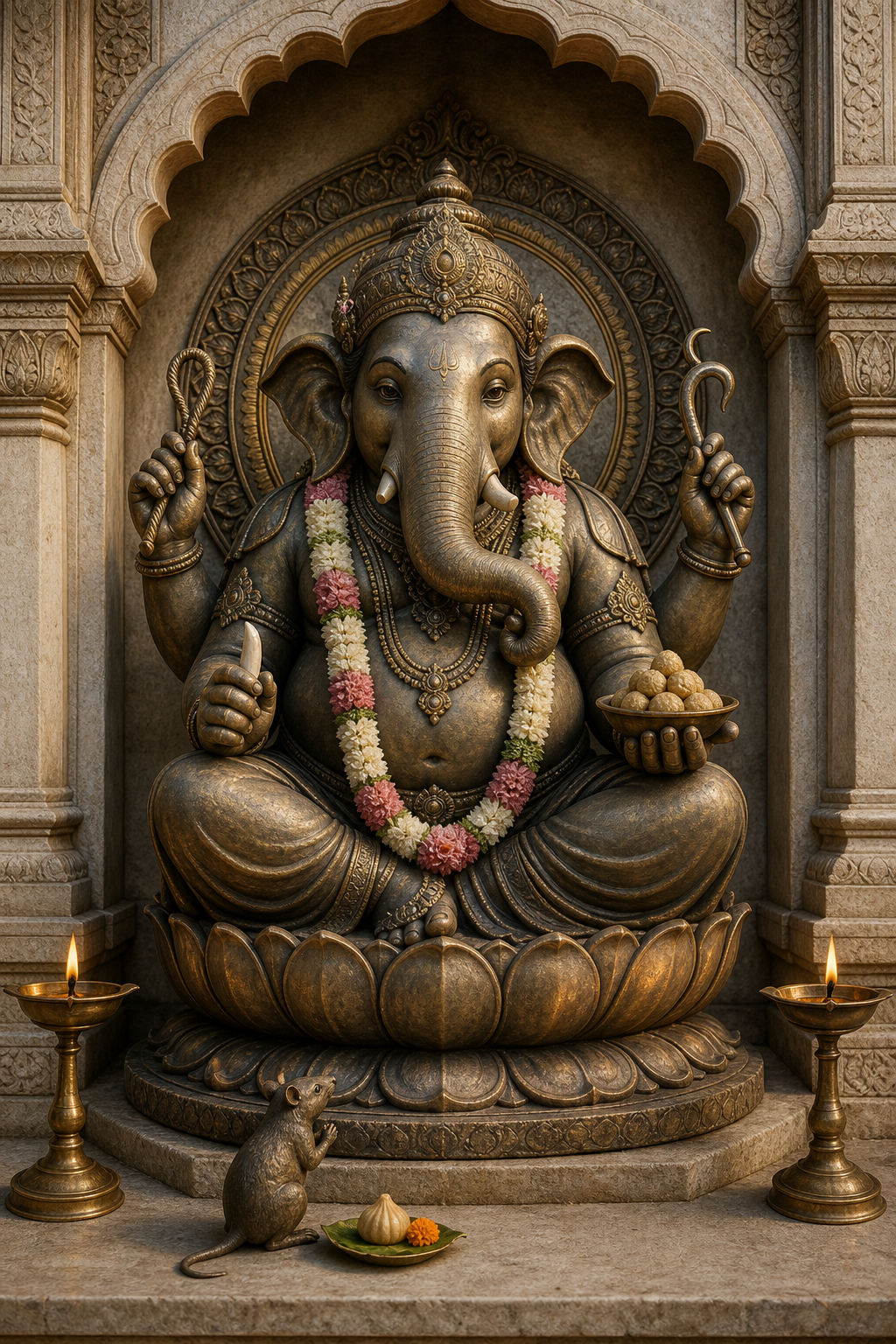
You do not need to recognize every icon immediately. In fact, premature recognition is a common cause of error. Use the following sequence when a form is unfamiliar.
- Establish the context. Notice whether the image belongs to a temple, home shrine, festival, manuscript, teaching diagram, or museum display. A living ritual context may preserve a name and function that an isolated photograph does not.
- Separate identity from variation. Ask which features establish the deity’s identity and which features distinguish this particular rupa. Do not treat every difference as a different deity, and do not erase meaningful differences by applying only the broadest name.
- Inventory before interpreting. Count visible faces and arms. Note posture, gestures, held objects, companions, orientation, and repeated features. At this stage, describe what is present without assigning meanings you cannot yet support.
- Ask what the multiplication accomplishes. Multiple forms can differentiate modes of encounter. Multiple faces can enlarge perspective or awareness. Multiple arms can display coordinated capacities that an ordinary two-armed figure could show only one after another. Treat these as questions to test in context, not as a universal decoding chart.
- Verify the local reading. Look for the form’s proper name, the temple’s identification, or an explanation grounded in its Agamic, sectarian, or devotional tradition. If no reliable key is available, leave the interpretation partly unresolved. Honest uncertainty preserves more meaning than a confident invention.
The order matters. Observation comes before interpretation, and interpretation comes before philosophical generalization. If you begin by deciding that every image must prove monism, polytheism, psychology, or mythology, you will force the icon into a conclusion chosen in advance.
Also distinguish three different levels of multiplicity. A deity may have several recognized forms. A single form may have several faces or arms. Several deities may appear together in one composition. These are not the same visual statement. Confusing them produces questions that the image was never designed to answer.
Four common mistakes flatten the meaning of sacred images
The first mistake is turning iconography into a census. Numbers of heads, arms, or forms describe the image’s structure; they do not by themselves settle how divine unity and plurality are understood. Hindu schools differ in how they explain the relation between a chosen deity, other deities, the cosmos, and ultimate reality.
The second is treating every unusual feature as a detachable code. Iconographic meaning is relational. Brahma’s four heads become intelligible in connection with his creative scope. Ganesha’s thirty-two forms become intelligible as manifestations associated with one recognizable divine identity. Removing a feature from its deity and context weakens the interpretation.
The third is choosing between crude literalism and crude symbolism. A devotee may receive a murti as sacred presence while also attending to its theological visual language. “Real” and “meaningful” are not opposites here. The image can be worshipped and interpreted without one activity cancelling the other.
The fourth is imposing one master key on every tradition. A general principle can help you ask better questions, but it cannot replace a form’s proper name, textual setting, or living sampradaya. Use broad iconographic patterns to orient yourself; use the particular tradition to decide what the particular image means.
Key takeaways
- Divine multiplicity is usually a meaningful visual structure, not a headcount of unrelated gods.
- Ganesha’s thirty-two forms show how one divine identity can be approached through distinct manifestations.
- Brahma’s four heads are best read in relation to his creative role and the need to visualize comprehensive awareness.
- Observe the image first, interpret its multiplication second, and verify the local or traditional identification third.
- No single visual feature can settle the whole metaphysics of Hindu plurality.
The next time you meet an unfamiliar murti, spend the first minute naming only what you can see. Then ask what has been multiplied, what limitation that multiplication overcomes, and what the form is called where it is worshipped. That small discipline turns visual confusion into attentive engagement and gives the tradition room to speak in its own grammar.
References
- Hindu Pad – 32 Forms of Ganesha | Ganapati’s 32 Manifestations
- Hindu Blog – Brahma’s Four Heads: The Hindu Vision of Total Awareness and Inner Peace
