

If you are trying to decide whether Meghalaya’s tensions are fundamentally about indigenous survival, ethnic exclusion or religious power, do not accept the forced choice. All three questions can matter, but they require different evidence and different remedies.
The useful approach is to separate protection from impunity, identity from guilt, and institutional influence from religious affiliation. That lets you defend Meghalaya’s indigenous communities without excusing attacks on Assamese, Bengalis, Hindus or anyone marked as an outsider.
Begin with what happened, not the largest interpretation
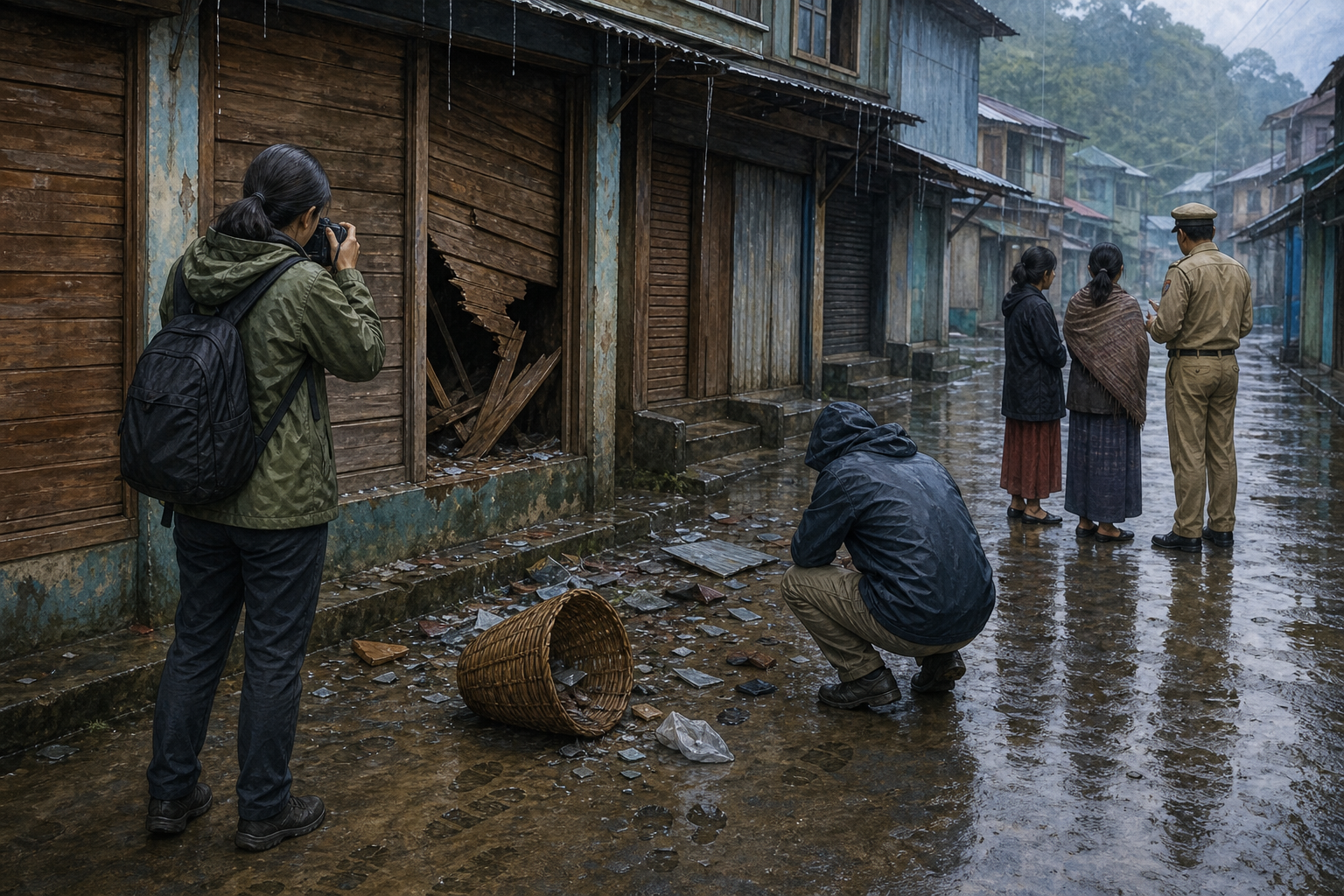
On 19 August 2026, violence reportedly followed a rally organised by the Khasi Students’ Union in Shillong. At least 31 vehicles, described as predominantly driven by people from Assam, were vandalised. Assamese and Bengali residents were reportedly assaulted and subjected to stone-pelting.
The targets were not limited to people and vehicles. Memorial sculptures and idols associated with Netaji Subhas Chandra Bose and Swami Vivekananda were also reportedly vandalised. Vehicles bearing Assam registration numbers were said to have faced further attacks on 20 and 21 August.
Those details establish a serious reported pattern that warrants investigation and protection for those at risk. They do not, by themselves, prove who directed every assault, whether all the attackers shared one motive, or whether a religious institution caused the violence. A rally preceding an attack is relevant evidence of sequence; it is not automatically evidence of command responsibility.
Keep three separate ledgers whenever you assess an episode like this:
- Events: what happened, where it happened, who was harmed and what property was damaged.
- Responsibility: which individuals committed, organised, encouraged or knowingly enabled particular acts.
- Structure: which political incentives, administrative failures or institutional relationships allowed the danger to grow.
Collapsing those ledgers produces two opposite errors. One side may deny obvious ethnic targeting because organisational responsibility remains disputed. Another may assign guilt to an entire union, tribe or faith before individual and institutional responsibility has been demonstrated.
Police subsequently arrested KSU president Raymond Kharjana, general secretary Reuben Najiar and vice-president Pynkmenlang Sanmiet, while also acting against the union’s Shillong office. Some local residents considered those measures excessive, and the reported violence did not immediately end. Neither fact settles the case. An office-bearer’s title is not proof of personal guilt, while the continuation of attacks is not proof that police action was unnecessary.
Ask instead for the grounds attached to each arrest, the acts attributed to each accused person, available recordings or witness accounts, and the status of the cases. That is how you distinguish lawful accountability from a symbolic roundup.
Indigenous protection and equal citizenship are two duties

An indigenous community can have legitimate concerns about land, language, political voice, inherited institutions and demographic vulnerability. Recognising those concerns is not an endorsement of ethnic supremacy. It is an acknowledgement that a community can lose control of its collective inheritance even when its individual members possess formal citizenship.
But vulnerability is relational. A community may be culturally vulnerable at the national or regional level while members of a smaller non-tribal population are physically vulnerable within a particular town. One condition does not cancel the other. A state must be able to preserve indigenous life and protect a Bengali shopkeeper, an Assamese driver or a Hindu family at the same time.
Reservation and indigenous safeguards operate through public rules. Street punishment does not. If a crowd selects a person because of language, surname, appearance or vehicle registration, it is not enforcing a reservation policy. It is substituting collective suspicion for lawful process.
Use four questions to judge any protective arrangement:
- What is being protected? The answer should identify a real collective interest such as land, political representation, language or customary life.
- How is it enforced? Eligibility rules and public procedures are categorically different from intimidation, unofficial checks or mob action.
- Who carries the burden? A safeguard should not turn an unrelated resident or worker into a convenient substitute for a political or administrative problem.
- What corrects abuse? People affected by arbitrary treatment need an accessible authority that can record complaints, provide protection and review decisions.
This test avoids a common trap. You do not have to choose between abolishing every indigenous protection and accepting every demand made in its name. You can defend a carefully defined safeguard while opposing its conversion into an unlimited social veto over people classified as outsiders.
Bengali Hindu residents of Shillong’s RR Colony have accused political leaders of seeking their votes during elections but failing to provide security and dignity when they are targeted. That allegation points to a concrete democratic test: evaluate leaders by what they do between elections. Ask whether complaints are recorded, vulnerable neighbourhoods receive protection, damaged livelihoods are addressed and prosecutions progress regardless of the victim’s electoral weight.
Identity politics becomes dangerous when labels replace evidence

An Assam registration plate does not establish the driver’s ethnicity, religion, political views or conduct. It is an administrative marker. When it becomes a proxy for guilt, the practical result is indiscriminate punishment. The same is true of labels such as Bengali, Khasi, tribal, non-tribal, Hindu or Christian. They can describe part of a person’s identity; they cannot prove responsibility for an act.
Watch for three warning signs in public discussion. The first is an elastic collective noun: an entire population is made responsible for something done by unnamed individuals. The second is passive language: people are said to have been caught in tensions when they were actually selected as targets. The third is asymmetric proof: detailed evidence is demanded for harm to one community, while rumours are accepted when they incriminate another.
The damage to symbols associated with Bose and Vivekananda deserves particular care. It is evidence that nationally and civilisationally significant objects were reportedly selected. It can reasonably raise concern about anti-national or anti-Hindu hostility. The precise motive, however, still has to be established through the attackers’ words, conduct, targeting pattern or other evidence. Concern is justified; certainty cannot be manufactured.
The same discipline applies to the KSU. Its rally provides context, and the arrests of its leaders make scrutiny necessary. Yet organisational guilt requires evidence linking office-bearers or institutional channels to incitement, planning, assistance or concealment. Conversely, the absence of an established central order would not make individual assaults harmless or erase the need to protect the people targeted.
Continued attacks after arrests can have several explanations: a wider network, unaffiliated imitators, inadequate policing, mistaken arrests or more than one of these at once. Do not select the explanation that best fits your politics. Ask which explanation is supported by incident locations, timing, communications, witness evidence and identified perpetrators.
Claims of Church influence need an institutional chain

Church influence is a legitimate subject of inquiry wherever religious institutions exercise political power. It becomes communal prejudice when Christian identity itself is presented as proof of coordination. A politician’s faith, a region’s religious demography or the presence of churches does not establish that a particular church directed a policy, campaign or act of violence.
A defensible claim should identify four things: the actor, the channel, the decision and the evidence. Which denomination, diocese, congregation, council, school network, clergy member or affiliated organisation acted? Was the alleged channel a public directive, funding, organised mobilisation, private coordination or privileged access? Which appointment, policy, electoral choice or administrative response was affected? What record connects the actor to that outcome?
Useful evidence can include formal statements, documented organisational instructions, financial records, corroborated communications or a consistent and attributable intervention in public decisions. Mere correlation is not enough. If a Christian office-holder supports a tribal policy, that does not by itself show church control; the policy may arise from ethnicity, party strategy, constituency pressure, personal belief or several forces together.
The expression “the Church” is usually too imprecise to carry a serious accusation. It can blur distinctions among denominations, local congregations, individual clergy, educational bodies and ordinary believers. Name the institution whose conduct is at issue. If no institution can be named and no channel can be shown, influence remains a hypothesis rather than an established explanation.
In the Shillong episode described above, the reported facts establish ethnic targeting, damage to public symbols and a disputed police response. They do not establish church direction of the attacks. A broader concern about missionary or ecclesiastical power cannot be used to fill that evidentiary gap.
A Dharmic standard should be both firm and symmetrical. We should oppose coercive conversion, sectarian discrimination and unaccountable religious power wherever they are documented. We should apply the same demand for evidence to a church body, temple organisation, gurudwara committee, monastery, political union or secular non-governmental organisation. That consistency protects the credibility of a pro-Dharma case.
It also protects freedom of conscience. Indigenous practitioners, Hindus, Christians, converts and people of other beliefs remain individuals with moral agency. Criticising an institution’s political conduct must not become permission to treat every believer as its operative.
Key takeaways for reading Meghalaya responsibly
- Defend both duties: indigenous continuity deserves protection, and every resident deserves security against ethnic or religious targeting.
- Keep sequence separate from responsibility: violence after a rally warrants investigation, but timing alone does not prove that organisers directed the violence.
- Reject identity as evidence: a registration plate, language, surname, tribe or religion cannot establish individual guilt.
- Demand case-level accountability: ask what each arrested person is alleged to have done and what evidence supports that allegation.
- Test Church-influence claims institutionally: name the actor, channel, affected decision and supporting record instead of treating Christian affiliation as proof.
- Judge politicians between elections: track complaint registration, protection for vulnerable localities, investigation of attacks and the progress of prosecutions.
Before you forward the next claim about Meghalaya, reduce it to four sentences: what is known, what is alleged, what evidence is missing and what remedy is justified now. That small discipline makes room for indigenous self-preservation without normalising exclusion, and for a clear defence of Hindus without assigning inherited guilt to another community.
References
