
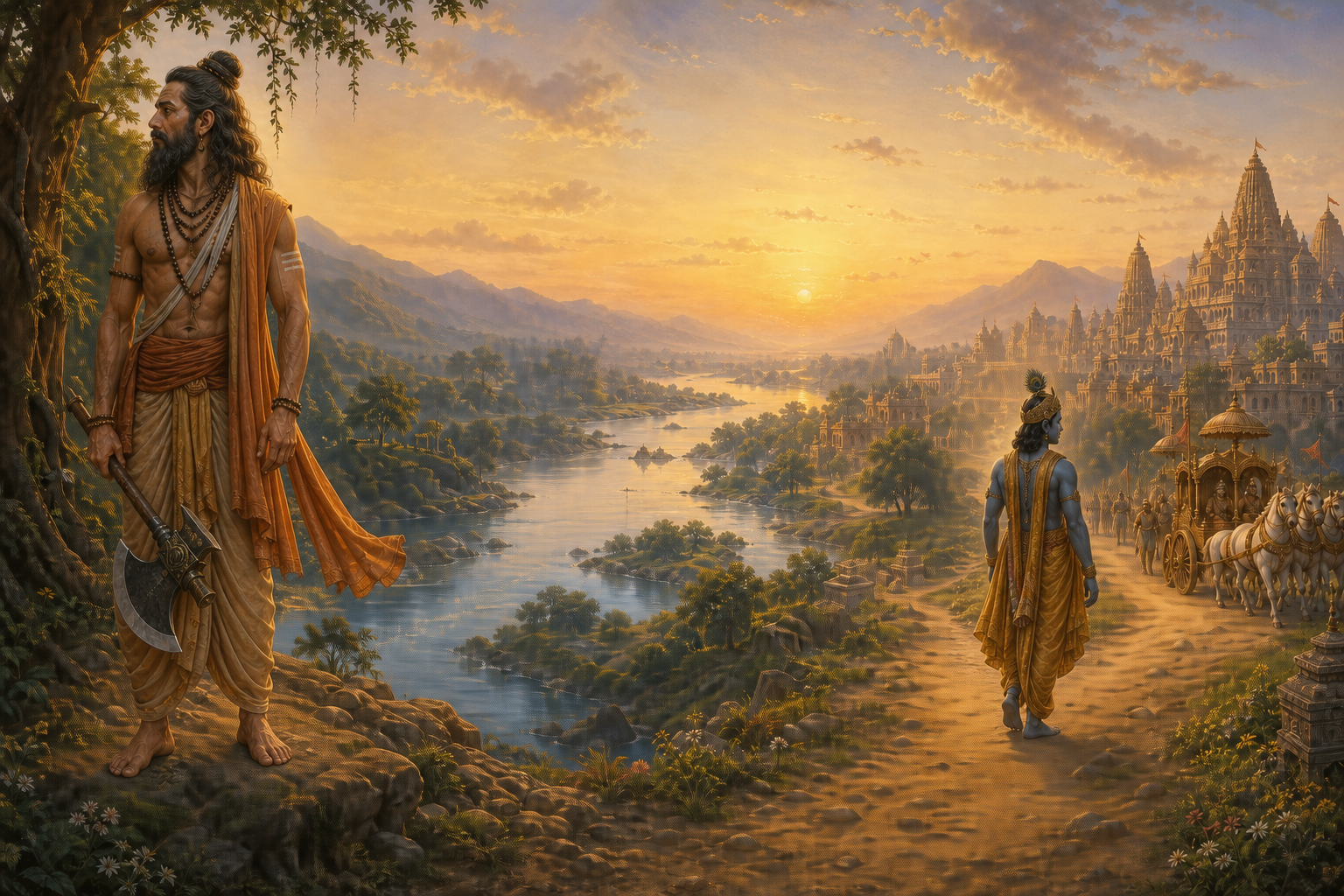
You may have heard two confident answers to this question. One says Parashurama and Krishna must have met because both lived within the Mahabharata’s sacred chronology. The other says they could not have met because one avatar had to disappear before the next arrived. Neither argument is sufficient.
The careful answer is narrower. Parashurama and Krishna can coexist without any theological contradiction, but coexistence does not prove a face-to-face encounter. If someone attributes such a meeting to Hindu scripture, you need the name of the text and the actual scene before repeating the claim.
Begin with three separate questions
The question “Did they meet?” usually combines three different questions: Were they present within the same sacred chronology? Does the Mahabharata explicitly place them in a shared scene? Can Hindu theology allow two avatars of Vishnu to be present at the same time?
The answer to the first is yes in the broad narrative sense. Parashurama’s life does not end when the principal work associated with his avatara is completed. He remains part of the world inherited by the Mahabharata’s warriors. Krishna then acts within that world as counsellor, diplomat, kinsman, strategist and teacher.
The answer to the second requires restraint. The Mahabharata does not present a direct exchange between Parashurama and Krishna as a clear, consequential episode in its central narrative. It gives both figures important places, but it does not make their meeting a landmark comparable to Krishna’s counsel to Arjuna or Parashurama’s encounters with the warriors connected to his own story.
The answer to the third is also yes. The familiar Dashavatara sequence is an ordering of divine manifestations, not a rule requiring one avatar’s bodily absence before another can appear. Treating the list as a relay race imports a restriction that the sacred narratives themselves do not require.
The Mahabharata connects them without staging a famous meeting
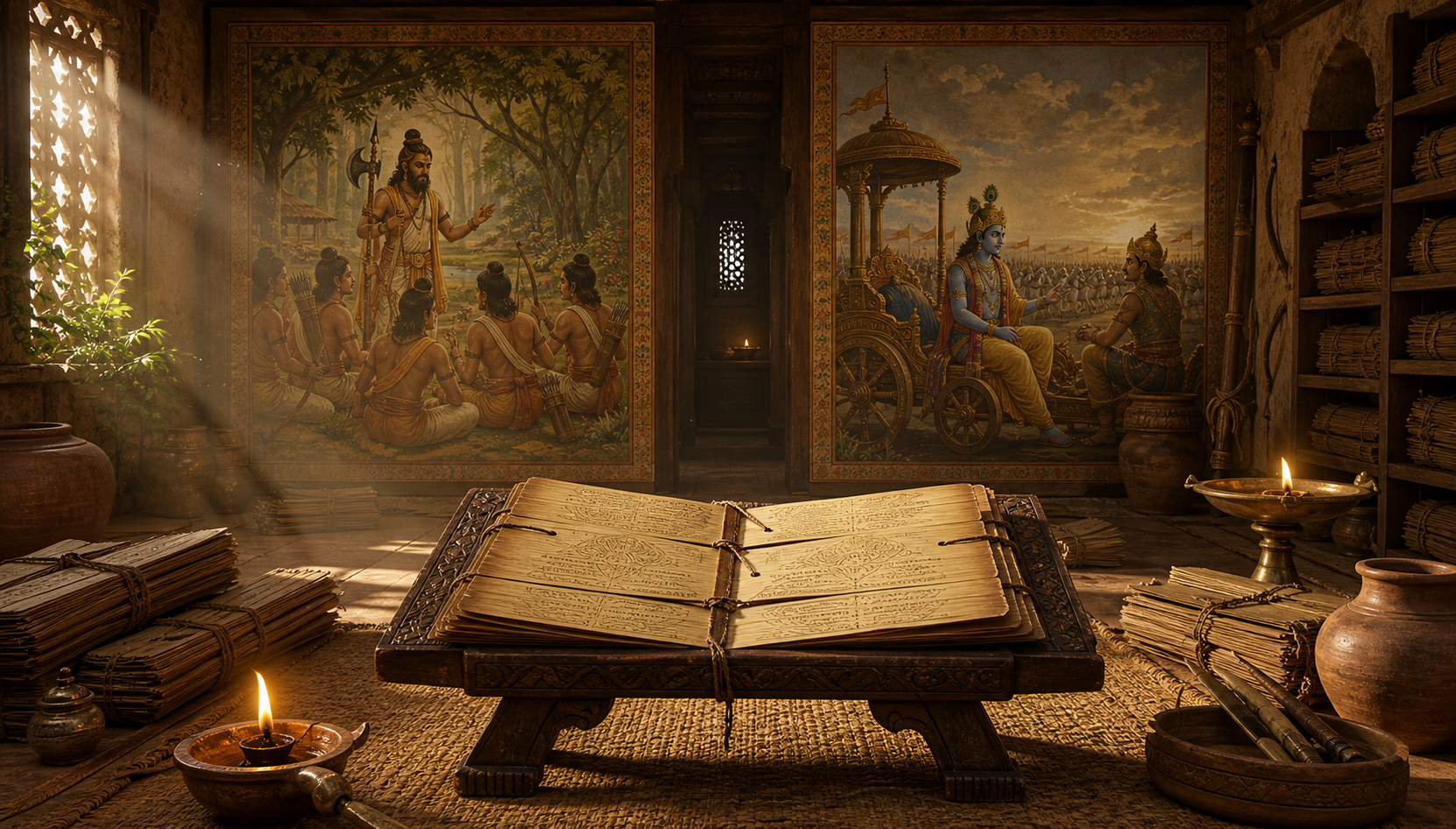
Parashurama’s influence reaches the Mahabharata through the formation of its warrior world. He is associated with the discipline, weapons and moral testing of major martial figures. Bhishma’s history includes both instruction under Parashurama and conflict with him. Karna receives instruction from Parashurama after concealing his identity, and that concealment carries consequences. These relationships place Parashurama behind some of the abilities and unresolved obligations that later shape the great war.
Krishna’s role is different. He operates inside the political and ethical crisis itself. He attempts diplomacy, advises the Pandavas, guides Arjuna and explains the demands of action in the Bhagavad Gita. Krishna therefore confronts a martial order that Parashurama had already helped form, discipline and judge.
This is a real literary connection, but it is indirect. Two people can affect the same chain of events without sharing a conversation. Parashurama shapes teachers, warriors and inherited ideas of martial authority; Krishna guides participants when that inheritance culminates in the Kurukshetra crisis. Calling this a “meeting” would erase the distinction between influence and encounter.
Watch the names before accepting a claimed passage
Epic names are a common source of false certainty. Parashurama may be identified as Bhargava Rama, Rama Jamadagnya or by another epithet connecting him to Bhrigu or Jamadagni. The unqualified name Rama can also indicate Dasharathi Rama or Balarama, depending on the passage.
Krishna presents a similar problem. Vasudeva Krishna appears under epithets such as Madhava and Keshava, while Krishna Dvaipayana is Vyasa and Krishnaa can identify Draupadi. A search result containing “Rama” and “Krishna” is therefore not proof that Parashurama and Vasudeva Krishna occupy the same scene.
When you encounter a confident citation, check who is speaking, the patronymic or epithet attached to each name, and several paragraphs on either side. Then ask whether both figures act or speak in the passage. A narrator mentioning one while addressing the other still does not establish a meeting.
Why overlapping avatars create no contradiction
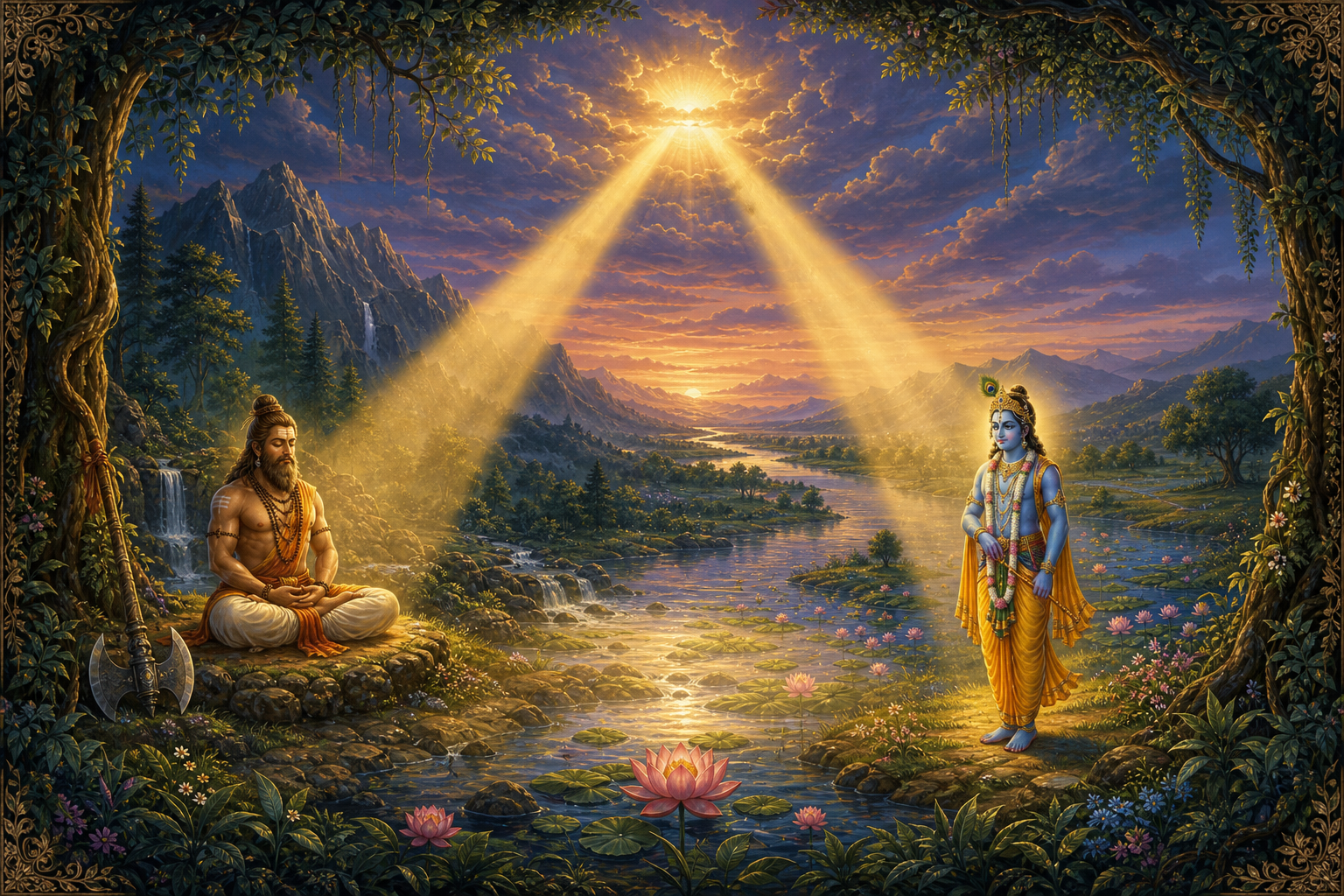
Parashurama is traditionally counted among the chiranjivis. The word conveys extraordinary longevity and continuing presence, although English discussions often compress it into “immortal.” His continuing existence is therefore not an accidental loophole devised to make two stories fit. It is part of how tradition understands his place in sacred time.
An avatara is a divine descent undertaken for a purpose. It is not merely the next mortal body occupied after a previous body dies. Vishnu is not a finite substance that must be removed from one manifestation before becoming present in another. That is why the appearance of Krishna does not require Parashurama to cease existing.
Vaishnava schools do not all describe divine manifestation with identical metaphysical terms. They may distinguish forms, portions, plenary manifestations and divine descents in different ways. You do not need to settle those doctrinal differences to answer the practical question. None makes a simple chronological numbering system sufficient evidence against overlap.
If you are explaining this to someone new to Hindu thought, use one precise sentence: the avatar numbers identify places in a traditional sequence of divine descents; they do not impose exclusive time slots. That resolves the apparent contradiction without pretending that chronology proves an encounter.
The deeper comparison: one dharma, different modes of action
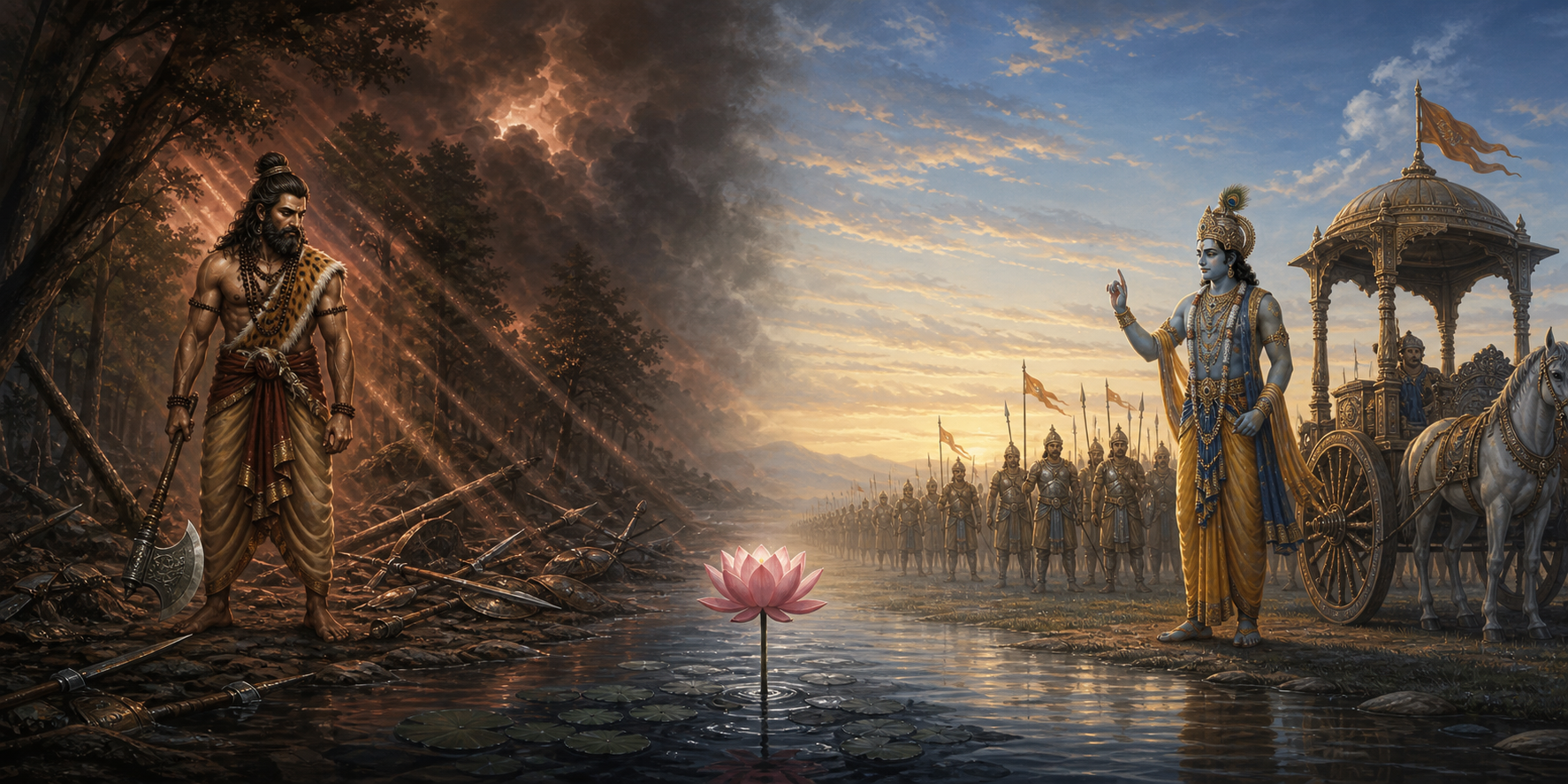
The more fruitful question is not whether the two avatars exchanged words, but why sacred literature gives them such different forms of action. Parashurama stands at the difficult junction of brahminical austerity and martial force. His stories address the corruption of power through direct correction, severe vows, discipline and the transmission of weapons knowledge.
Krishna works through a wider range of relationships. He teaches, negotiates, forms alliances, reveals the limits of superficial neutrality and guides action within an already entangled political order. His presence does not eliminate force; the Mahabharata still culminates in war. What changes is the mode of guidance required when every available choice carries consequences.
It is tempting to reduce the contrast to “Parashurama used violence, while Krishna used wisdom.” That reading fails both figures. Parashurama is also an ascetic and teacher, while Krishna’s counsel prepares Arjuna to fight. Their difference is not force versus peace. It is the form that dharmic intervention takes under different duties and conditions.
Use that distinction when reading an episode ethically. First identify the disorder being confronted. Then identify the actor’s role and obligations. Finally, notice the consequences attached to the chosen action. Dharma cannot be extracted from the weapon, tactic or emotion alone. The same outward act can carry a different moral character when its purpose, authority and circumstances change.
This also explains why a physical meeting is not needed to establish theological unity. The tradition can present Parashurama and Krishna as manifestations of Vishnu while allowing each to perform distinct work. Unity of divine source does not require uniformity of temperament, method or narrative role.
Key takeaways
- Parashurama and Krishna belong to an overlapping sacred chronology, but contemporaneity is not proof of a meeting.
- The Mahabharata does not make a direct conversation between them a clear episode in its central narrative.
- Parashurama’s continuing presence as a chiranjivi makes overlap with Krishna consistent within the tradition.
- The Dashavatara order does not mean that each manifestation must end before the next can appear.
- A claimed meeting should be checked against a named text, section, speaker and context; “scripture says” is not a usable citation.
- Later, regional or oral retellings may carry devotional value, but a scene from one tradition should not be silently attributed to every Hindu text.
The next time you see the claim, ask for the grantha and passage before arguing over it. Check the epithets, confirm that both figures actually participate, and keep possibility separate from narration. Until a precise passage is supplied, the most responsible answer is simple: their coexistence is theologically coherent, their influence belongs to the same epic world, and the Mahabharata does not give us a famous, unambiguous meeting scene.
References
