

You may be looking at a Bhadrapada calendar and wondering whether Thadiya Gauri, Rishi Panchami, and Aparajita Saptami are different names for the same observance. They are not. They occur close together, but they differ in devata, traditional participants, regional expression, and even the length of the commitment.
You do not need to collect every vrata listed on the calendar. You need to identify the observance that belongs to your family, sampradaya, region, or chosen devotional path, and then make a sankalpa you can honor properly.
Read the three names as three different commitments

A vrata is more than a festival date or a period without food. It is a defined discipline undertaken with intention. Depending on the tradition, that discipline may include puja, dietary restraint, recitation, charity, service, or continued worship. The important questions are simple: What are you observing, toward whom, according to which tradition, and for how long?
- Thadiya Gauri Vratham is a Gauri-centered Bhadrapada observance known through related names such as Shodasha Gauri Puja, 16 Kudumula Thadde, and Haritalika or Hartalika Teej. Its regional identity is part of the practice, not a decorative detail.
- Rishi Panchami is observed on Shukla Paksha Panchami, immediately after Ganesh Chaturthi. It is described as a women’s vrata, with snan and Saptarshi pujan among its named components.
- Aparajita Saptami is dedicated to Surya Bhagavan on Shukla Paksha Saptami. Its observance is described as continuing for one year, so it should not be treated as merely a single morning’s puja.
None is an upgraded or inferior version of another. A nearby tithi does not make two vratas interchangeable. If your household has a living practice, begin there. If you are adopting a vrata for the first time, choose the one for which you have a genuine devotional connection and reliable guidance.
The three Bhadrapada observances in the 2026 calendar

| Observance | 2026 civil date and lunar place | Traditional center | What you must confirm locally |
|---|---|---|---|
| Thadiya Gauri Vratham, Shodasha Gauri Puja, or 16 Kudumula Thadde | 14 September 2026, during Bhadrapada | Gauri worship; associated with Andhra Pradesh and Telangana and related to the northern observance of Hartalika Teej | The name used by your family, the regional procedure, required offerings, food discipline, and conclusion |
| Rishi Panchami | 15 September 2026, Shukla Paksha Panchami | A women’s vrata involving snan and Saptarshi pujan; it follows Ganesh Chaturthi | The local Panchami boundary, snan and puja window, household method, and rules for completing the vrata |
| Aparajita Saptami | 18 September 2026, Shukla Paksha Saptami | Surya Bhagavan; worship undertaken for one year | What the year-long discipline requires, how often it is performed, and how it is formally completed |
These civil dates help you see the sequence, but they do not replace a local panchang. A tithi is a lunar division, not a midnight-to-midnight civil day. Its boundaries and an appropriate puja window must be applied to your location. This is especially important if you live outside Bharat or if your family’s calendar convention differs from the calendar you found online.
Use this order of priority when two calendars, relatives, or community announcements appear to disagree:
- Identify the calendar and practice consistently followed by your family or temple.
- Check the tithi for your actual town or time zone rather than copying an Indian civil date automatically.
- Ask which moment governs the observance: the relevant tithi at sunrise, a specified puja period, or another rule preserved by the tradition.
- Confirm the method with the same priest, elder, or teacher whose calendar rule you are following. Mixing one authority’s date with another authority’s ritual timing can create avoidable confusion.
Preserve the regional form instead of flattening the names
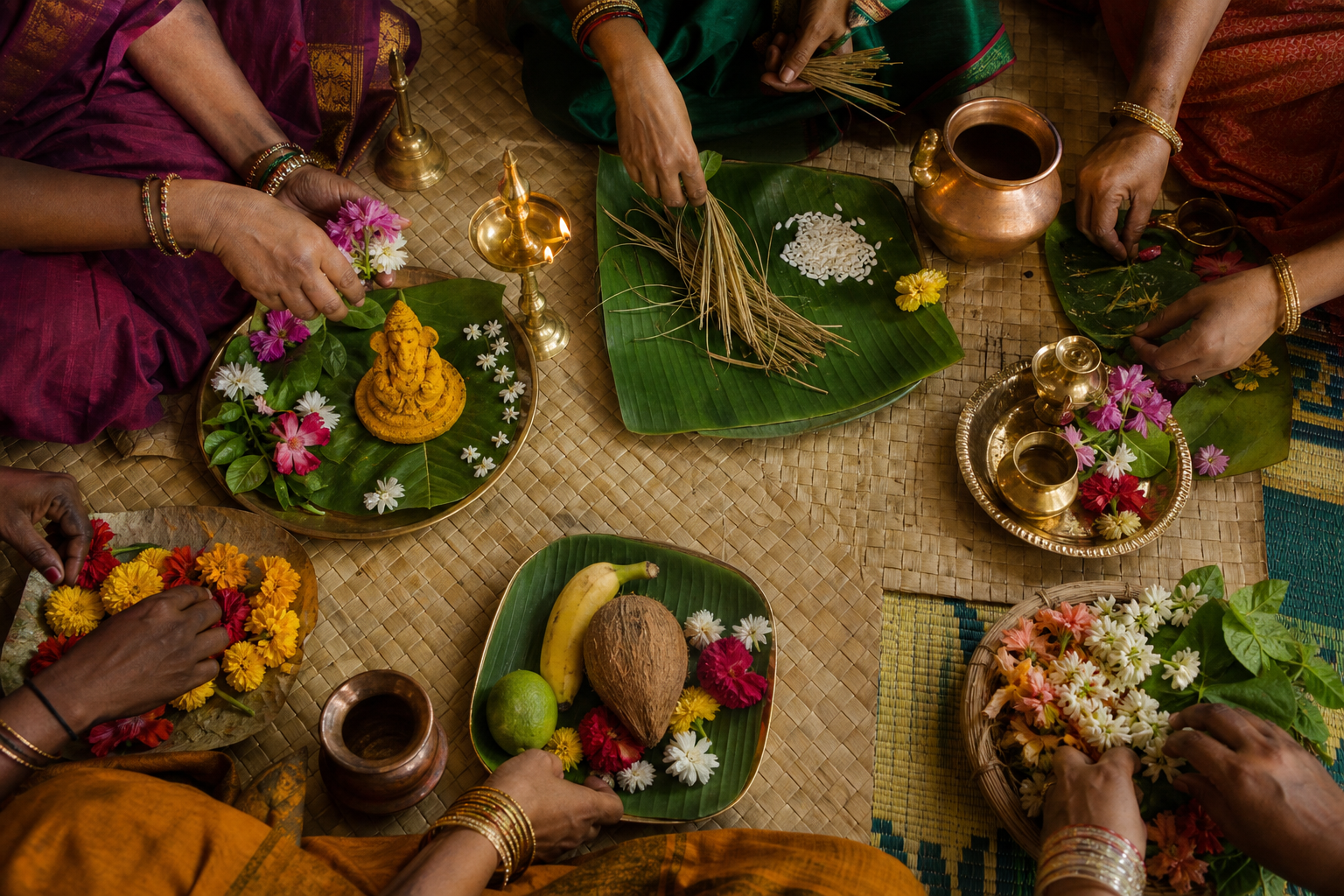
Thadiya Gauri Vratham shows why names must be handled carefully. In Andhra Pradesh and Telangana, the observance is associated with names including Shodasha Gauri Puja and 16 Kudumula Thadde, while northern communities commonly know the related Bhadrapada vrata as Hartalika Teej Vrat. A shared devotional center does not guarantee that every region uses the same offerings, sequence, fasting rule, or concluding act.
When you ask for instructions, do not ask only, “How is Hartalika done?” Give the information that identifies your form: the name your family uses, your language and region, whether the practice is inherited or newly adopted, and the temple or sampradaya you follow. This prevents a search result from quietly replacing a living family tradition with a procedure assembled elsewhere.
Rishi Panchami needs a similar discipline of scope. Its stable identifying features here are Shukla Panchami, its place after Ganesh Chaturthi, its traditional observance by women, and the named acts of snan and Saptarshi pujan. Those points do not supply every mantra, material, dietary rule, or local muhurta. Obtain those details from the tradition you are actually following rather than improvising a universal ritual.
Aparajita Saptami demands even more restraint. Detailed information about this vrata is limited in some primary texts. That uncertainty should remain visible. Do not fill the gap by combining attractive elements from unrelated Surya vratas and presenting the result as an established Aparajita procedure. If you have no inherited method, seek a competent teacher and distinguish clearly between a traditional prescription and a simple devotional practice offered to Surya.
Before accepting any detailed checklist, ask five questions:
- Which regional or sampradaya form does this procedure represent?
- Which parts are indispensable, and which are household customs?
- Who traditionally undertakes this vrata?
- Does the vow conclude that day, or does it create a continuing discipline?
- How and when is the sankalpa formally completed?
Build a sankalpa you can carry without confusion

The most common planning mistake is to begin with shopping. Begin with scope. You should be able to write the essential commitment in one sentence before acquiring puja materials: the vrata’s exact name, its devata or sacred focus, the date or tithi, the tradition you will follow, and its duration.
- Choose one primary vrata. Do not undertake all three merely because their dates appear together. A carefully kept observance is better than three hurried commitments with borrowed procedures.
- Verify the local calendar. For 2026, begin with 14 September for Thadiya Gauri, 15 September for Rishi Panchami, and 18 September for Aparajita Saptami. Then confirm the relevant tithi and puja window for your location.
- Find a complete method from one living tradition. Ask which acts make the vrata complete, what preparation belongs before the puja, what food discipline is expected, and how the observance is concluded. Keep optional decorations and online additions separate from the essentials.
- Settle fasting questions before the day. Food restraint is one possible limb of a vrata; it is not a contest in physical severity. Never skip necessary medicine or ignore a health condition to imitate someone else’s fast. If restriction could conflict with medical needs, obtain clinical advice and ask your religious guide for an appropriate adapted form.
- Plan for the actual duration. This is crucial for Aparajita Saptami because the commitment is described as Surya worship for one year. Before making that sankalpa, establish what your tradition requires throughout the year, how you will track it, and what constitutes completion.
- Record what you followed. Keep the calendar authority, regional name, essential procedure, and guidance you received on one page. That record will be more valuable next Bhadrapada than a folder of conflicting screenshots.
This approach also leaves room for honest limits. If you cannot verify a specialized vrata’s full procedure, you can still offer ordinary devotion to Gauri, the Saptarshis, or Surya without claiming that you have completed a formally prescribed vrata. In dharmic practice, precision about what you did is a form of respect.
Key takeaways
- Thadiya Gauri, Rishi Panchami, and Aparajita Saptami are distinct Bhadrapada commitments, not interchangeable labels.
- The listed 2026 dates are 14 September, 15 September, and 18 September respectively, but your local panchang must determine the applicable tithi and puja window.
- Thadiya Gauri has regional identities, including Shodasha Gauri Puja, 16 Kudumula Thadde, and Hartalika Teej; use the name and method preserved by your community.
- Rishi Panchami is a women’s vrata on Shukla Panchami, following Ganesh Chaturthi, with snan and Saptarshi pujan among its central named acts.
- Aparajita Saptami centers on Surya Bhagavan and is described as a one-year observance. Do not make that sankalpa until its continuing requirements are clear.
- A vrata should be sustainable and truthful. Adapt food restrictions when health requires it, but do so with appropriate medical and religious guidance.
Before buying anything, write the exact local name of your vrata at the top of a page, identify the elder, priest, or teacher whose procedure you will follow, and verify the tithi in a panchang for your location. Once those three points are fixed, the calendar stops being a source of anxiety and becomes what it should be: the doorway to a clear promise carried with attention.
References
- Hindu Pad – Aparajita Saptami 2026
- Hindu Pad – Thadiya Gauri Vratham, Shodasha Gauri Puja | 14 September 2026 (16 Kudumula Thadde)
- Hindu Pad – Rishi Panchami Puja Muhurat 2026 | Timings for Rishi Panchami Snan, Saptarshi Pujan
