

If you are choosing a nath for a wedding, festival, piercing, or inherited ornament, the hardest question is not which design looks most elaborate. It is whether the form belongs to your family or region, what it will signify on that occasion, and whether the wearer has freely chosen it.
A sound decision begins by separating religious obligation from living tradition. The nath is not a scriptural requirement, but it can still carry deep Hindu meaning through Shakti, vivaha, family memory, regional identity, and auspicious observance. That distinction lets you honor the tradition without turning it into a test of someone else’s dharma.
Begin with the meaning your family actually carries
The word nath may sound as though it names one ornament with one fixed meaning. In practice, nose ornaments form a regional family that also includes names such as mukkuthi and bulak. Their shape, placement, occasion, and inherited associations can differ. You therefore learn more by asking a grandmother, parent, artisan, or community elder about a particular ornament than by asking for a universal definition.
Within Hindu life, the nath commonly gathers several meanings at once. It can mark auspiciousness, dignity, continuity, marital commitment, or a relationship with the sacred feminine. Wearing it as a gentle invocation of Shakti does not require turning the ornament into a theological declaration. The symbolism may instead appear through the conduct associated with it: grace, self-command, responsibility, and care for family and community.
This layered meaning matters when you are interpreting an old photograph or deciding what to wear. A bridal nath may participate in the symbolism of marriage. The same or a related form worn at a festival may primarily express regional identity, celebration, or devotion. An heirloom can hold all those meanings while also preserving the memory of the person who wore it before you.
Do not begin with the question, What must every Hindu woman wear? Begin with three narrower questions: Who wore this form in our family? On which occasions? What did the family call it? Those answers protect the tradition from being flattened into either a fashion accessory or a rigid religious rule.
Region, placement, and occasion form a visual language
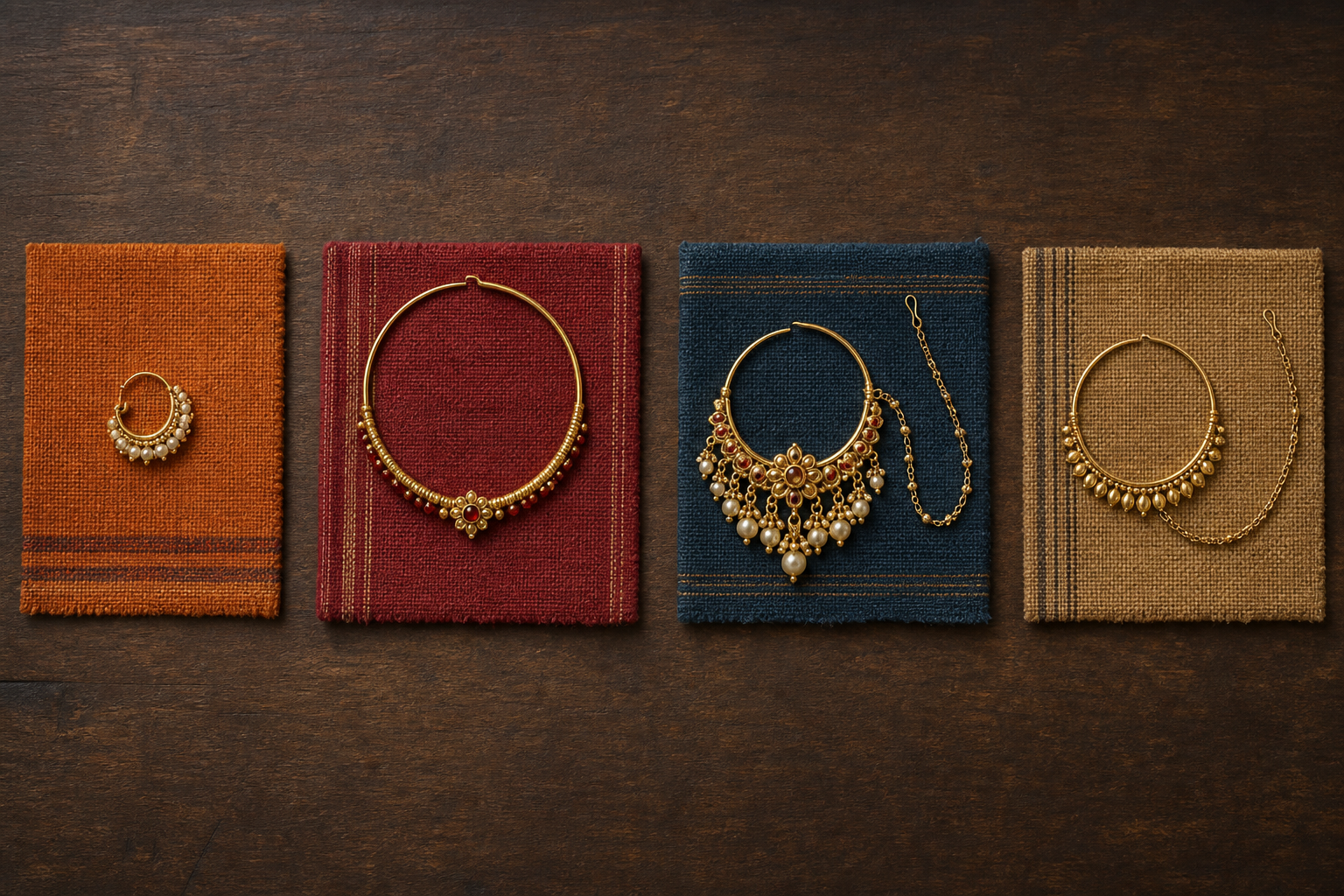
There is no single pan-Indian nath design. Maharashtrian, Punjabi, Rajasthani, and South Indian traditions demonstrate why the region must be identified before the symbolism is interpreted. Even the side of the nose is not governed by one rule: the left or right nostril may be used according to community custom, while particular communities also use septum ornaments.
| Regional context | Form to recognize | What you should verify |
|---|---|---|
| Maharashtra | Distinctive Maharashtrian nath traditions | Ask which family or community form is appropriate for the occasion rather than choosing solely by a generic product label. |
| Punjab and Rajasthan | Regional nostril ornaments and, in particular communities, septum ornaments | Confirm whether the placement belongs to the wearer’s community; do not assume that every regional form carries the same message. |
| South India | The stud commonly called a mukkuthi | Check the family’s preferred form and side, especially when preparing for a wedding or life-cycle ceremony. |
Occasion changes the reading as much as geography does. Nose ornaments appear at weddings, festivals, vrata observances, and other life-cycle events. That means you should not infer a woman’s marital status from a nose ornament alone. First identify the setting and the local convention. An ornament worn as bridal suhaag and one worn as ordinary regional adornment may look related without functioning identically.
If you inherit a nath, preserve its context along with the jewellery. Record the previous wearer’s name, the family’s region or community, the occasions on which it appeared, the customary placement, and any blessing or presentation ceremony remembered by relatives. A labelled photograph or short written note can keep the next generation from having to reconstruct the story from appearance alone.
Its wedding meaning is important, but not compulsory
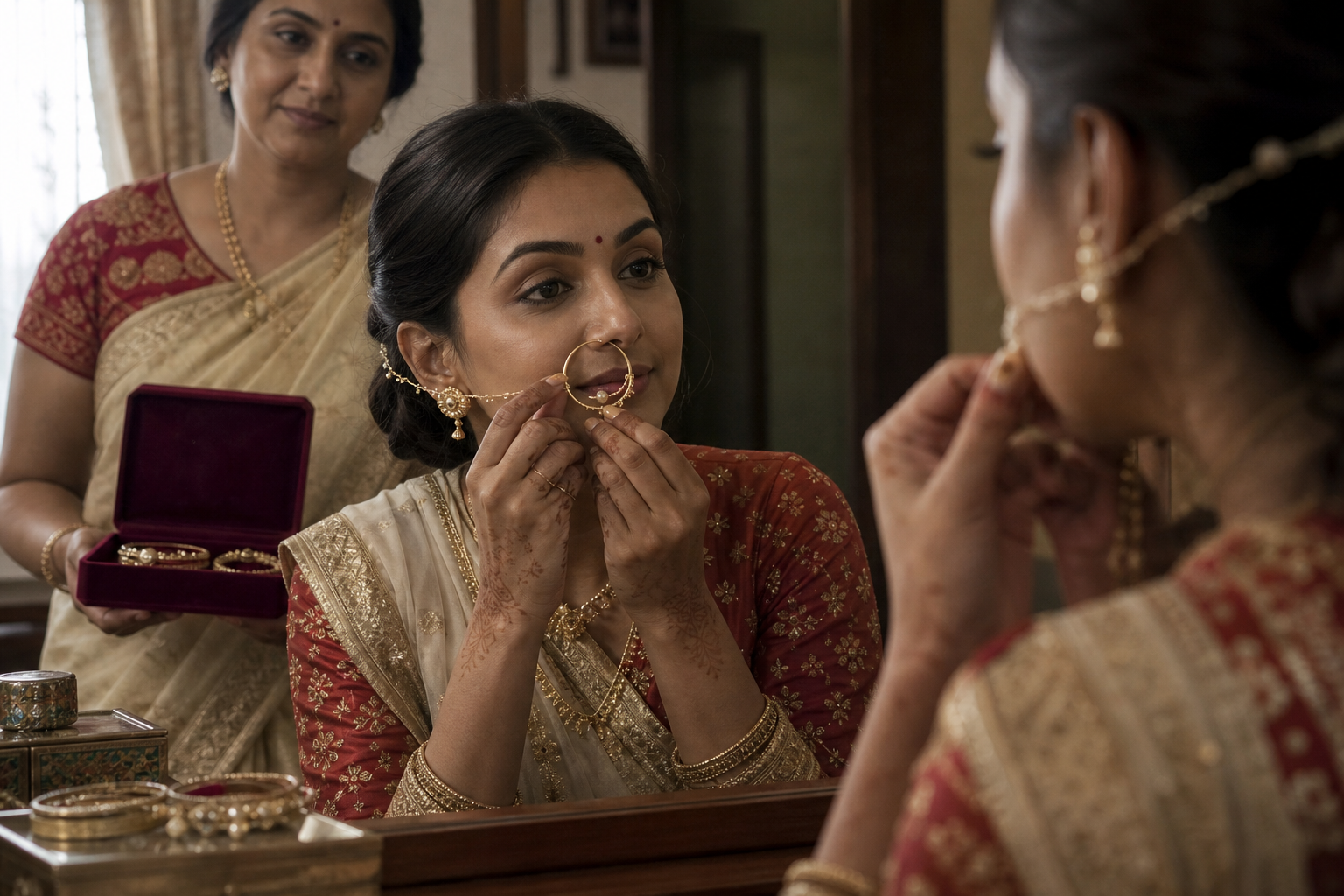
During vivaha, the nath can join the mangalsutra, bangles, and sindoor in the wider language of suhaag, commitment, prosperity, and the continuity of household life. A family may present it as a ceremonial gift, turning the object into both adornment and blessing. When it later reappears at a vrata or a festival such as Navaratri, it can renew that association with auspiciousness and familial bonds.
This is best understood as a samskara of remembrance: an embodied way of recalling ancestry, place, relationship, and responsibility. The meaning does not reside in metal alone. It develops through who gives the ornament, why it is worn, which blessings accompany it, and whether the wearer recognizes the tradition as her own.
Because the nath is culturally powerful but not scripture-mandated, declining to wear one should not be treated as a rejection of Hindu identity or marital commitment. Work requirements, comfort, personal taste, and conviction can all shape the decision. A minimalist form may allow someone to maintain a visible connection with tradition in professional life; another person may reserve an heirloom for ceremonies; someone else may choose not to wear one. Agency is not the enemy of continuity. A custom survives more honestly when it is carried with understanding rather than enforced as proof of belonging.
The same care is needed across the wider dharmic world. Women in Buddhist, Jain, and Sikh communities of South Asia may also wear nose ornaments as part of cultural heritage, particularly at weddings and festivals. This reveals a shared civilizational vocabulary, not a claim that every dharmic religion assigns the ornament the same doctrine. When explaining your own practice, name it precisely: a family custom, a regional form, a bridal symbol, a festival ornament, or a personal invocation of Shakti. Precision shows more respect than claiming universality.
Keep the Ayurvedic association in its proper place
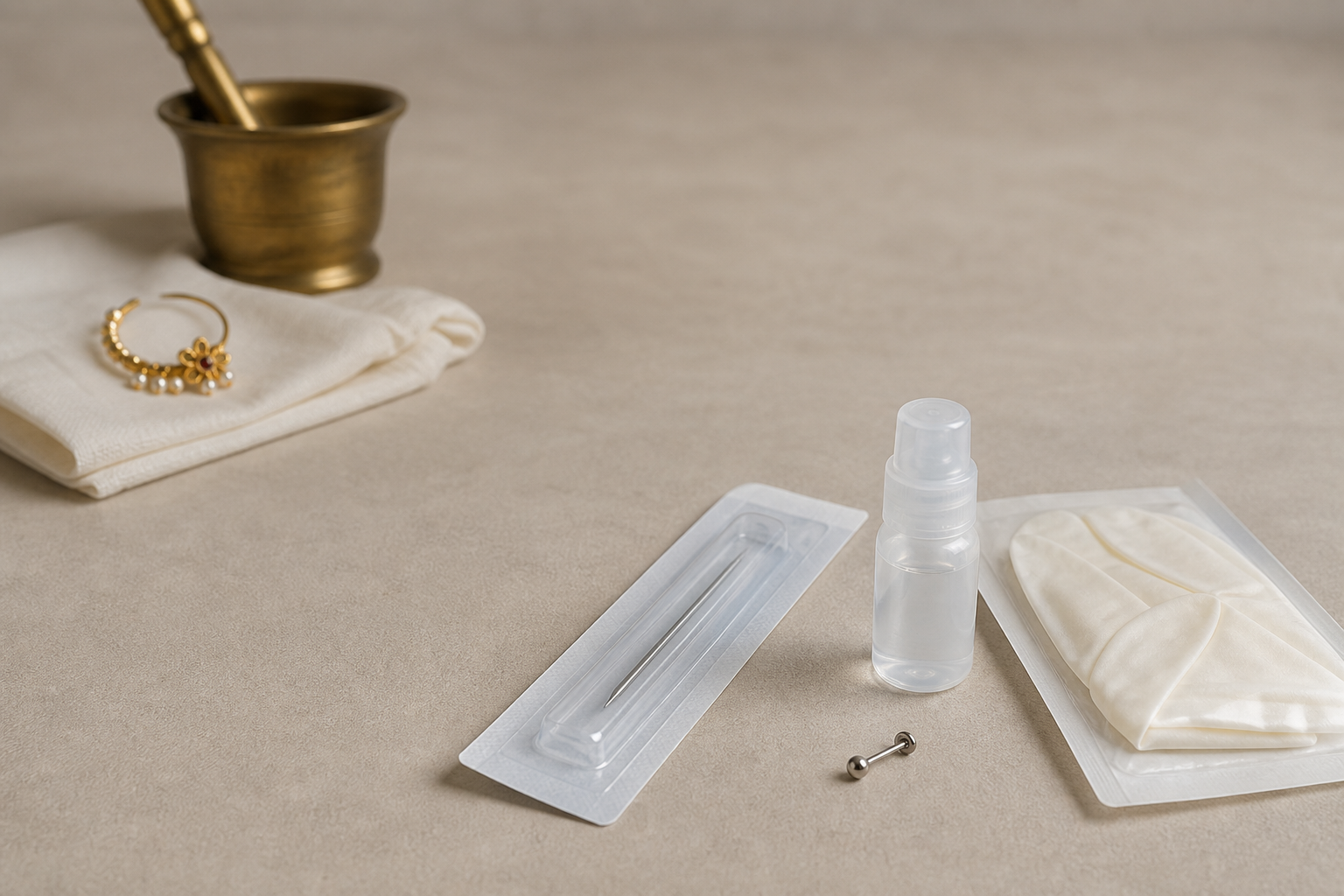
The left nostril is traditionally associated in Ayurvedic discourse and related folk knowledge with reproductive well-being. This has supported a long-standing belief that piercing that side may help with menstrual ease or childbirth. You may honor that belief as part of inherited cultural knowledge, but you should not convert it into a guaranteed medical effect.
The useful distinction is simple: symbolism can guide ritual choice, while health claims require clinical evidence and individual medical judgment. If menstrual pain, pregnancy, childbirth, or another reproductive concern is influencing your decision, discuss the health issue with a qualified clinician. A nath may carry a blessing for well-being, but it is not a treatment or a substitute for care.
The piercing itself is also a physical procedure, not merely a symbolic act. It breaks the skin and can lead to infection or scarring. Use a trained piercing professional who follows appropriate hygiene practices, and follow the aftercare guidance given for your situation. Family custom can help determine the meaningful side and style; it should not replace safe practice.
When gifting a nath, avoid promising a health result. Offer the cultural meaning honestly: a wish for strength, auspiciousness, marital harmony, or the protection of family memory. This preserves the blessing without turning traditional association into medical prescription.
Key takeaways: five questions before you choose a nath
- What is the occasion? A bridal ceremony, vrata, festival, professional setting, and ordinary day do not necessarily call for the same ornament or carry the same meaning.
- Whose tradition is being represented? Identify the family, region, or community before selecting a Maharashtrian nath, South Indian mukkuthi, Punjabi or Rajasthani form, or a septum ornament associated with a particular group.
- What does the placement mean here? Do not impose a universal left-side rule. Verify whether the family uses the left nostril, right nostril, or, in a relevant community, the septum.
- Has the wearer freely chosen it? Explain the symbolism, then leave room for comfort, profession, conviction, and personal preference. Not wearing a nath is not a failure of dharma.
- Will the choice strengthen continuity? When possible, consult elders, preserve an heirloom’s history, and select ethically crafted work that respects regional artisans instead of treating every traditional design as interchangeable.
If you are deciding now, write down three things before buying or piercing: the family or regional tradition, the occasion, and the meaning the wearer wants to carry. Then ask an elder or knowledgeable artisan to check those answers. That small act turns selection into relationship, and adornment into living memory.
References
