
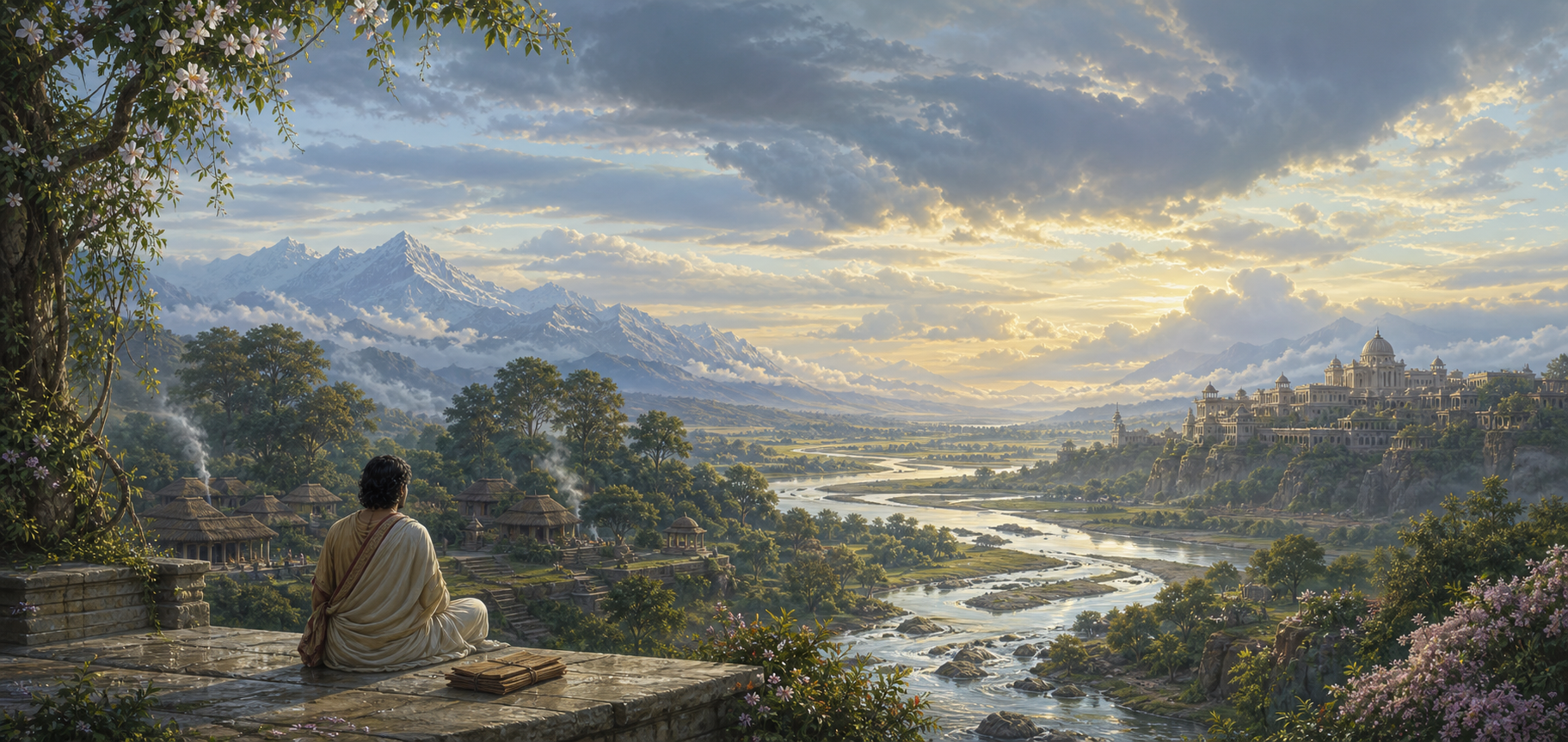
You may know Kalidasa’s name and still be unsure why his writing matters beyond a Sanskrit classroom or a commemorative programme. The most useful way in is not to memorise praise. It is to watch how poetic form, nature, emotion and dharma work together on the page and stage.
You do not need to master his entire corpus before that pattern becomes visible. Choose a short passage, read it slowly, and ask better questions of it. That approach turns Kalidasa from a cultural emblem into a writer you can actually encounter.
Why Kalidasa still belongs to a living culture
A writer’s legacy is not the same as his reputation. Reputation can survive through honorifics, portraits and annual speeches. A literary legacy survives when later readers, performers and thinkers continue to find usable forms of attention in the work.
Kalidasa’s legacy has that breadth. Raghuvamsa, Kumarasambhava, Meghaduta and Abhijnanasakuntalam have influenced literary canons, performing traditions and philosophical reflection. Poetry, drama, ethical thought and public culture therefore meet in his reception. If you read him only for plot, you miss the verbal art. If you read him only for ornament, you miss the moral pressure. If you treat him only as heritage, you stop the work from becoming present.
His refined use of alankara, or poetic figuration, does more than decorate an idea already complete. An image can disclose a relationship that abstract explanation would flatten. Sound can slow your attention before the intellect has named what matters. Nature can carry emotion without being reduced to a scenic background. These are not separate tricks. Together they train you to notice how inner life, human obligation and the more-than-human world touch one another.
This also explains why Kalidasa can serve as a civilizational meeting point without being made into a claim that every Dharmic tradition is identical. Hinduism, Buddhism, Jainism and Sikhism retain their own texts, doctrines and disciplines. Yet language, ethical inquiry and artistic excellence provide a shared field of cultural engagement. Unity here does not require theological uniformity. It asks for serious participation in a common inheritance.
Key takeaways
- Kalidasa’s importance lies in the union of poetic craft, emotional perception, ethical reflection and performable form.
- Begin with the work that matches your question instead of treating the corpus as a ceremonial reading list.
- Read for sound, metre, imagery and rasa as well as for literal meaning; translation alone cannot show every layer at once.
- Treat nature as an active bearer of relation and feeling, especially when reading Meghaduta.
- Preserve the legacy through recitation, discussion, performance and thoughtful adaptation, not praise without study.
Four works offer four practical doors into Kalidasa
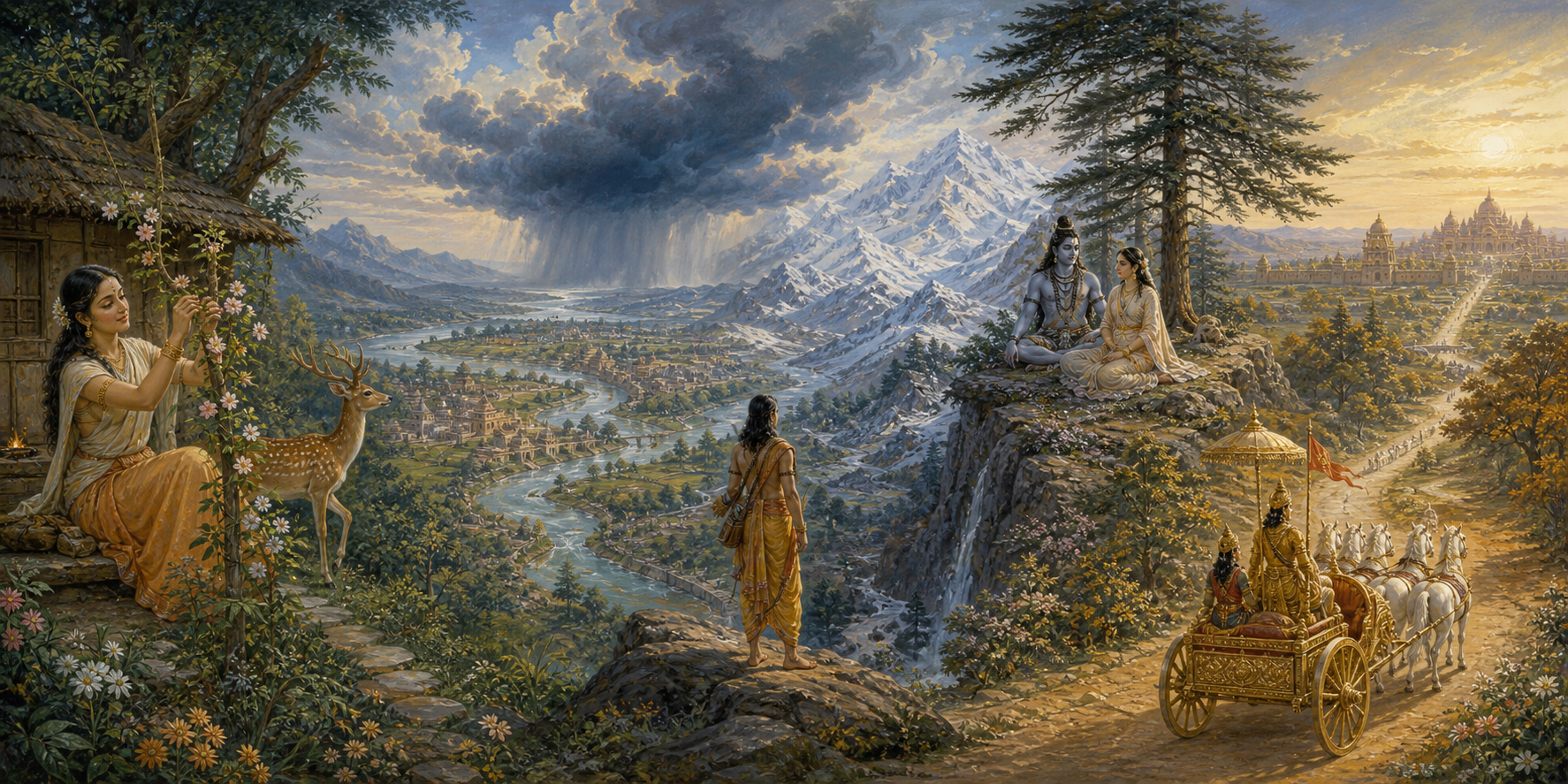
You do not have to choose the supposedly easiest or most prestigious work. Choose according to what you want to understand. The following lenses are starting questions, not substitutes for the texts.
| Work | Use it to investigate | What to mark while reading |
|---|---|---|
| Raghuvamsa | How poetic language examines dharma, inherited responsibility and kingship | Moments when authority is praised, disciplined, tested or placed under an ethical demand |
| Kumarasambhava | How love and dharmic purpose can occupy the same poetic field | Changes in tone, restraint and intensity; images that connect personal feeling with a larger order |
| Meghaduta | How a cloud-messenger allows nature, distance and emotion to become one poetic movement | The work performed by each image, the direction of the address, the pace of the verse and the feeling carried through description |
| Abhijnanasakuntalam | How poetic meaning changes when embodied as drama | Speech, silence, entrance, gesture and shifts of feeling that a staged reading can make perceptible |
Do not turn these lenses into fixed verdicts. Asking about kingship in Raghuvamsa does not mean searching only for approval of rulers. It means observing how authority is made answerable to dharma. Asking about love in Kumarasambhava does not mean stripping away spiritual or ethical significance. It means refusing the modern habit of placing desire and sacred purpose in sealed compartments.
Meghaduta is often the clearest entry for a reader drawn to imagery. Its cloud is not merely an object to visualise and move past. Ask what becomes possible because the message travels through nature. Description then becomes relational: the outer world helps feeling take form. That habit of reading will also sharpen your encounter with nature imagery elsewhere in Kalidasa.
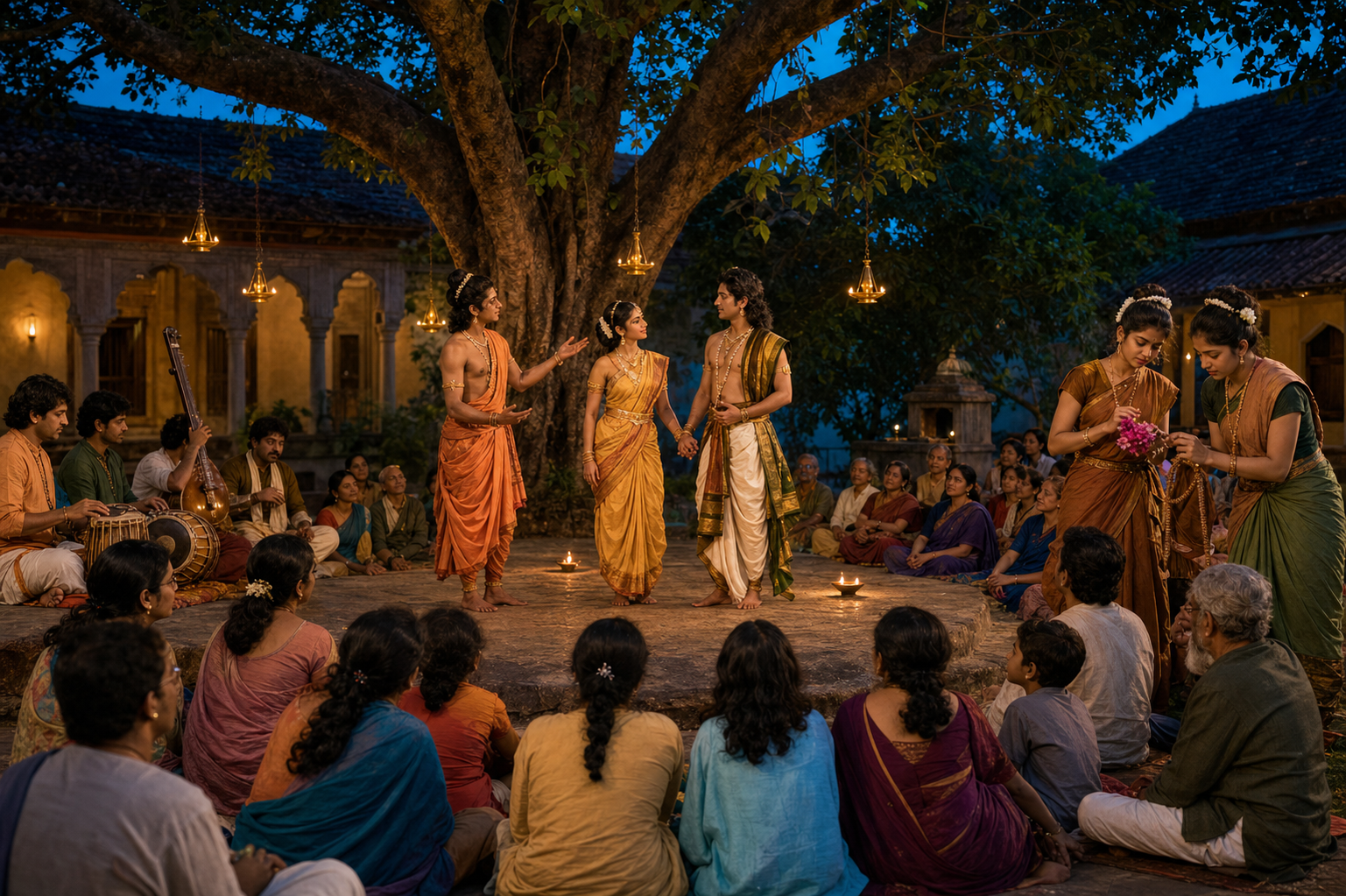
Abhijnanasakuntalam asks for a different discipline. A play is not a poem with stage directions attached. Voice, pause, movement and abhinaya participate in meaning. Even if you are reading alone, speak a scene aloud and imagine where attention shifts between the characters. The exercise reveals choices that silent plot-summary reading conceals.
A reading method that reveals sound, image and dharma
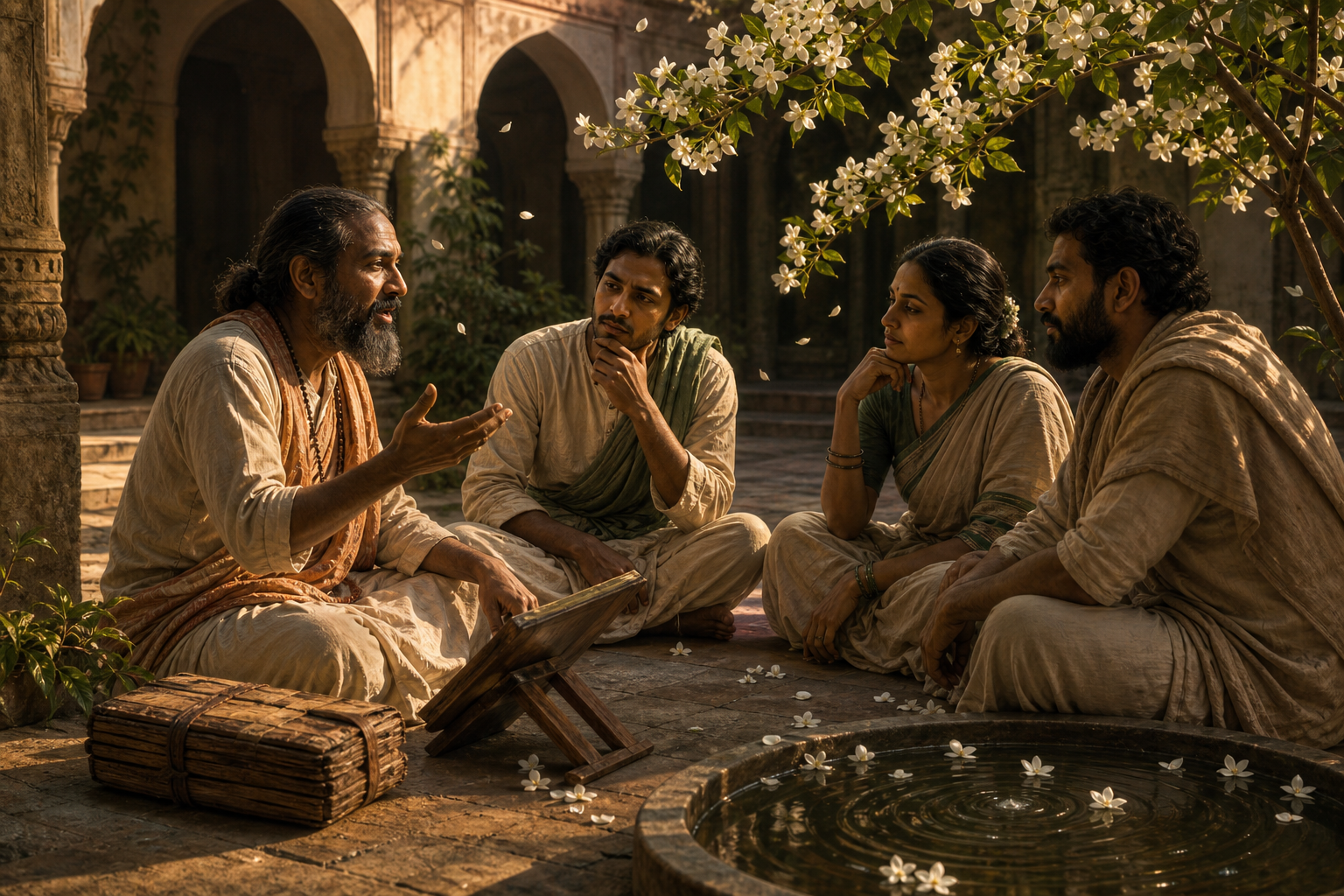
Work with a short, thematically coherent passage. A modest selection gives you enough room to reread, hear the language and test an interpretation. Racing through a large section may tell you what happened while leaving you unable to say how the writing produced its effect.
- Establish the literal movement. State plainly who speaks, what is being described and what changes during the passage. If you cannot do this, keep the interpretation provisional.
- Hear the Sanskrit. Read it aloud if you can, even when your fluency is limited. Listen for repetition, pauses, long and short movements, and places where the cadence changes. Chandas, or metre, organises expectation and emphasis; it is part of the experience rather than packaging around the meaning.
- Locate the governing image. Identify the image you would lose least willingly. Then ask what relationship it makes visible. In Meghaduta, for example, the cloud matters because it can be addressed as a messenger, not merely because it beautifies the landscape.
- Examine the alankara. Do not stop after naming a comparison or figure. Write down its literal terms, the quality transferred between them and the emotional or ethical consequence of that transfer.
- Track the rasa. Rasa is not just a mood label attached after reading. It is the aesthetic experience developed through language, situation and response. Mark where the dominant feeling intensifies, changes direction or becomes complicated.
- Ask the dharmic question. What obligation, restraint, relation or form of right conduct is under pressure? Keep the question open long enough to notice complexity. A poem or play can illuminate dharma without becoming a rulebook.
- Compare the Sanskrit with translations. Note where translators choose different images, rhythms or levels of formality. The aim is not to declare a winner immediately. The differences show you where the original carries more than one plausible emphasis.
- Return through performance. Recite the passage again, or assign voices in a group. Change the pace only where the language supports it. Notice whether the emotional movement you identified can be heard rather than merely asserted.
This method prevents three common misreadings. The first reduces alankara to ornamental excess. The second treats nature as a passive catalogue of beautiful things. The third turns dharma into a slogan placed above the work. Kalidasa’s artistry becomes clearer when form, world and obligation are allowed to disclose one another.
Keep your notes narrow and verifiable. Instead of writing, “This passage shows Indian spirituality,” identify the image, sound pattern or dramatic choice that supports your interpretation. Broad civilizational claims become more credible when they grow from close attention to actual language.
Make the legacy visible in study, observance and adaptation
Build a reading practice that can be shared
A household, class or cultural sabha can use the same basic structure: Sanskrit recitation, a clear translation, close attention to one image, discussion of rasa, and a final question about dharma, love or kingship. Give participants different tasks. One person can follow sound, another can trace imagery, another can watch emotional transitions, and another can test ethical claims against the language. The conversation becomes more precise because everyone is not trying to say everything at once.
For younger or newer readers, do not begin with a lecture that makes reverence the price of admission. Let them hear a passage, picture its movement and notice a striking comparison before introducing technical vocabulary. Once they have encountered the effect, terms such as rasa, alankara, chandas and abhinaya name something they have already begun to perceive.
Use Kalidas Divas as a beginning, not an endpoint
Kalidas Divas is observed in Ashadha through readings, recitations, lectures, educational programmes and dramatic activity. Its place near the beginning of the bright fortnight leading towards Guru Purnima gives the observance a useful rhythm: renew study, then honour the disciplines and teachers that make learning possible.
Use the occasion to begin a commitment you can continue. Select a passage for close reading, arrange a later recitation, or prepare a staged scene with explanatory notes. If your household follows a Saraswati-centred study practice, you can place that commitment within it. If it does not, disciplined reading and respectful discussion remain substantive forms of observance. Cultural continuity should not depend on imposing one ritual pathway on every participant.
Adapt the works without emptying their inner structure
Adaptation is one way a classical legacy remains active, but contemporary costume or language does not by itself make an adaptation meaningful. Test a performance, retelling or classroom project with concrete questions:
- Can the audience experience a developing rasa, or are they only being hurried through events?
- Does nature still act within the emotional world, or has it been reduced to scenery?
- Does the adaptation preserve the ethical tension around dharma, love or kingship, even when the setting changes?
- Do voice, gesture, pace and silence contribute to meaning?
- Can you point to choices rooted in the language, rather than defending every choice with the vague claim that the work is timeless?
Fidelity does not require antiquarian imitation. It requires preserving the artistic problem that gives a scene or passage its force. A responsible adaptation may change surface elements while carrying forward the relationship between beauty, feeling and obligation. That is a more demanding standard than decorative classicism, and a more fruitful one.
Begin now with a short passage rather than another general tribute. Keep the Sanskrit beside a translation, hear the words, mark the image doing the most work, and bring one precise observation to another reader. Kalidasa’s cultural legacy continues at exactly that point: when inherited language becomes disciplined attention again.
References
