
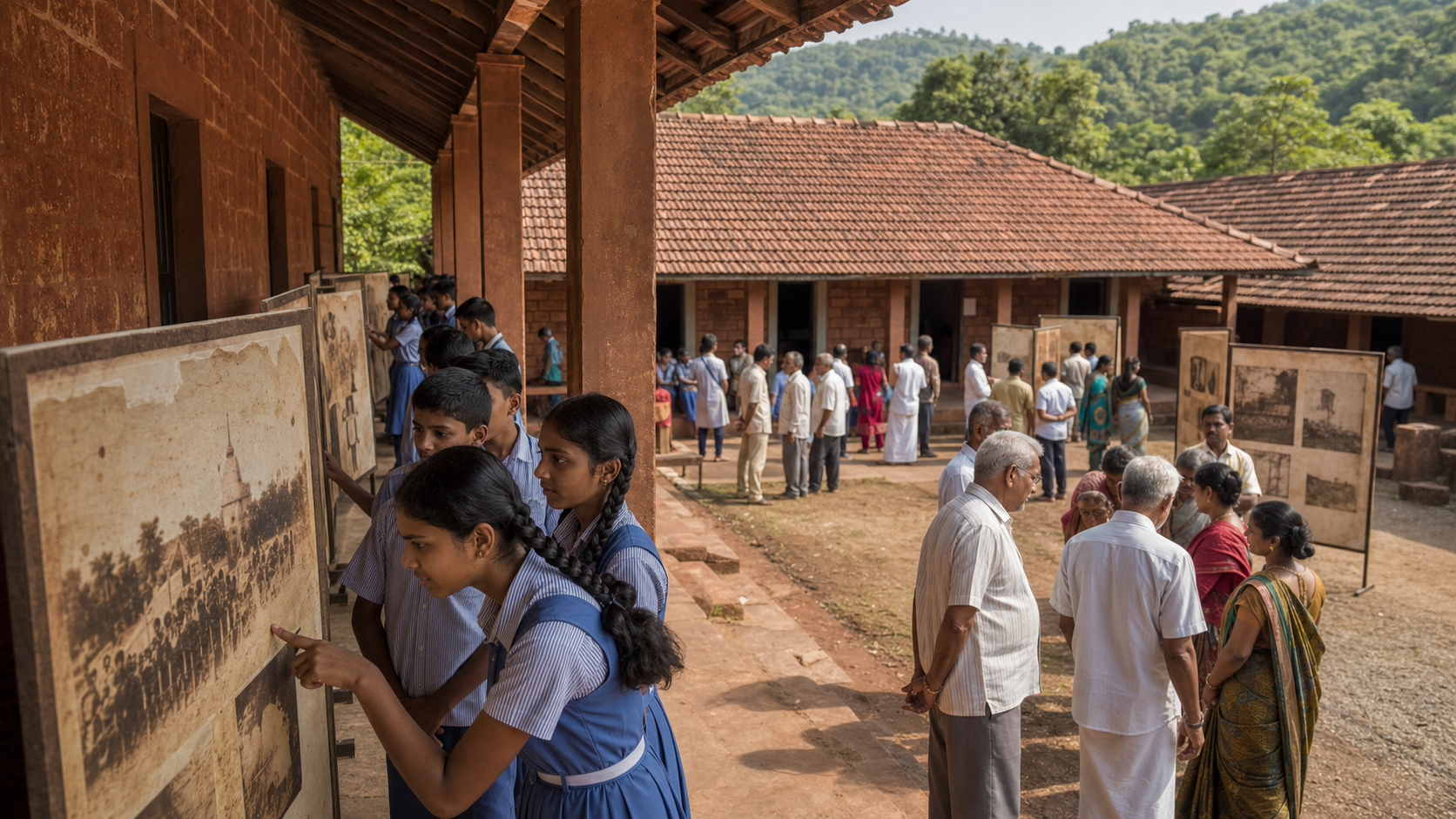
If you heard about Krantigatha in Ayni and are deciding whether it deserves classroom follow-up or merely a ceremonial mention, start with the question students should ask: why did this exhibition take place in this particular school? That question turns a community programme into a practical method for learning history.
On 20 January 2026, the Hindu Janajagruti Samiti organised a Krantigatha exhibition at Hutatma Anant Laxman Kanhere School in Ayni village, Khed taluka, Maharashtra. The programme invited students and residents to engage with India’s revolutionary legacy, Maharashtra’s cultural memory, and the wider freedom struggle. The individual exhibits have not been publicly detailed. That boundary matters: we can understand the event’s significance without inventing an exhibit list.
In Ayni, the venue is part of the history lesson
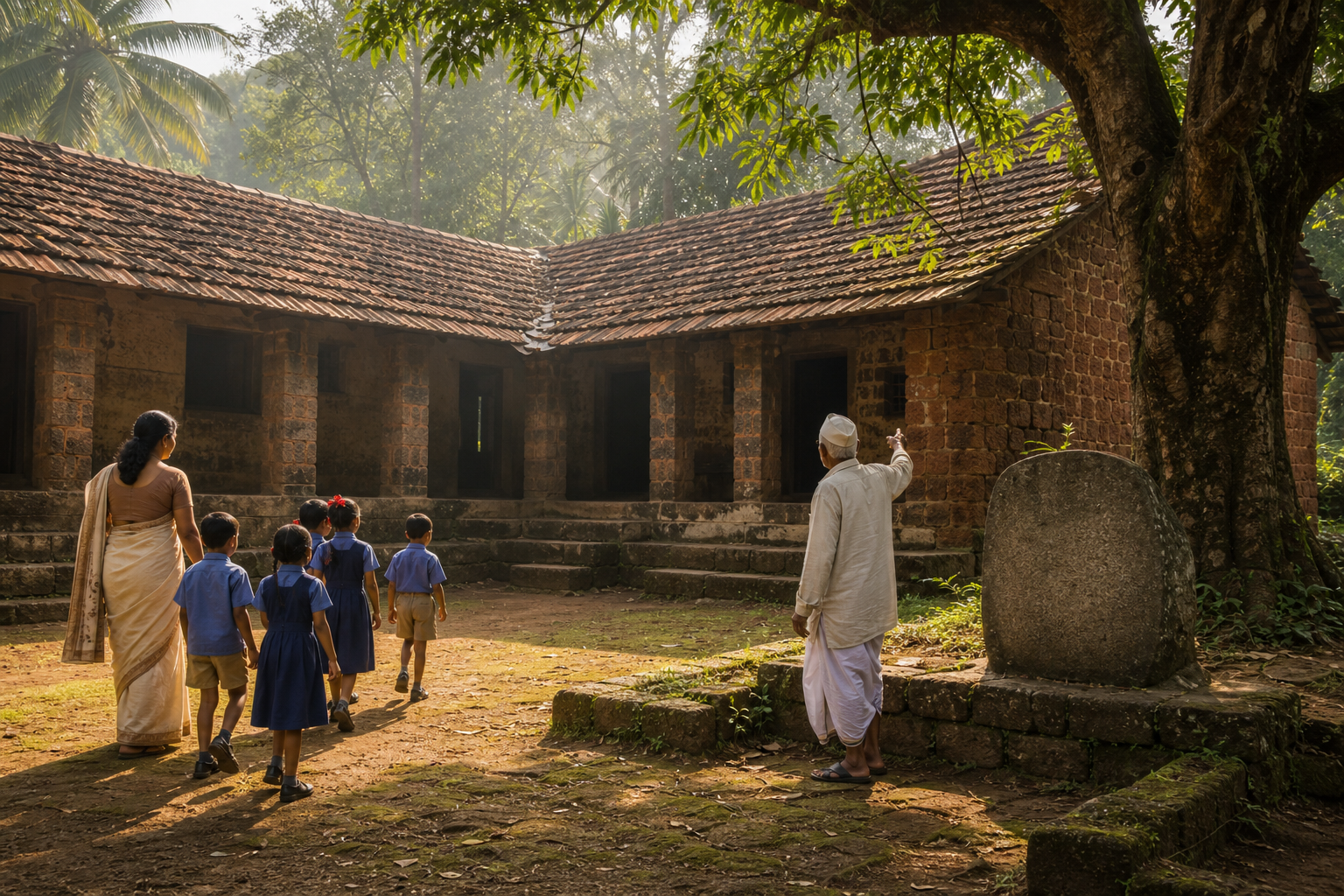
An exhibition hall is usually treated as a container for history. At Ayni, the venue itself carried historical meaning. The school bears the name of Hutatma Anant Laxman Kanhere, who is remembered for sacrifice within Maharashtra’s revolutionary history. A name that students encounter as part of school life can therefore become the beginning of an inquiry rather than remaining an unnoticed inscription.
The useful learning sequence is simple: notice the name, identify the person, establish what can be verified, place the person within regional history, and then connect that history to the larger freedom struggle. Starting locally gives students something concrete to investigate. Moving outward prevents the local story from being isolated from the national movement.
If you are a teacher, parent, or community organiser, use a memorial name to open four questions:
- Who is being remembered, and what is actually known about that person?
- Which choices or sacrifices made the person worthy of public remembrance?
- Which parts of the story are verified facts, later interpretations, or unresolved questions?
- How does this local history connect with the wider freedom struggle without losing its regional specificity?
Do not begin by telling a child what to feel. First ask what the child noticed, what claim was made, and what evidence supported it. Reverence that survives inquiry is stronger than reverence demanded before inquiry.
Place-based history also guards against a common weakness in national storytelling. A revolutionary can become a symbol so quickly that the human being disappears. Preserve the person’s choices, circumstances, and consequences wherever the evidence permits. Leave out dramatic flourishes that cannot be substantiated. The purpose of remembrance is not to manufacture a flawless legend; it is to understand why a life entered public memory.
Read revolutionary heritage in three distinct passes
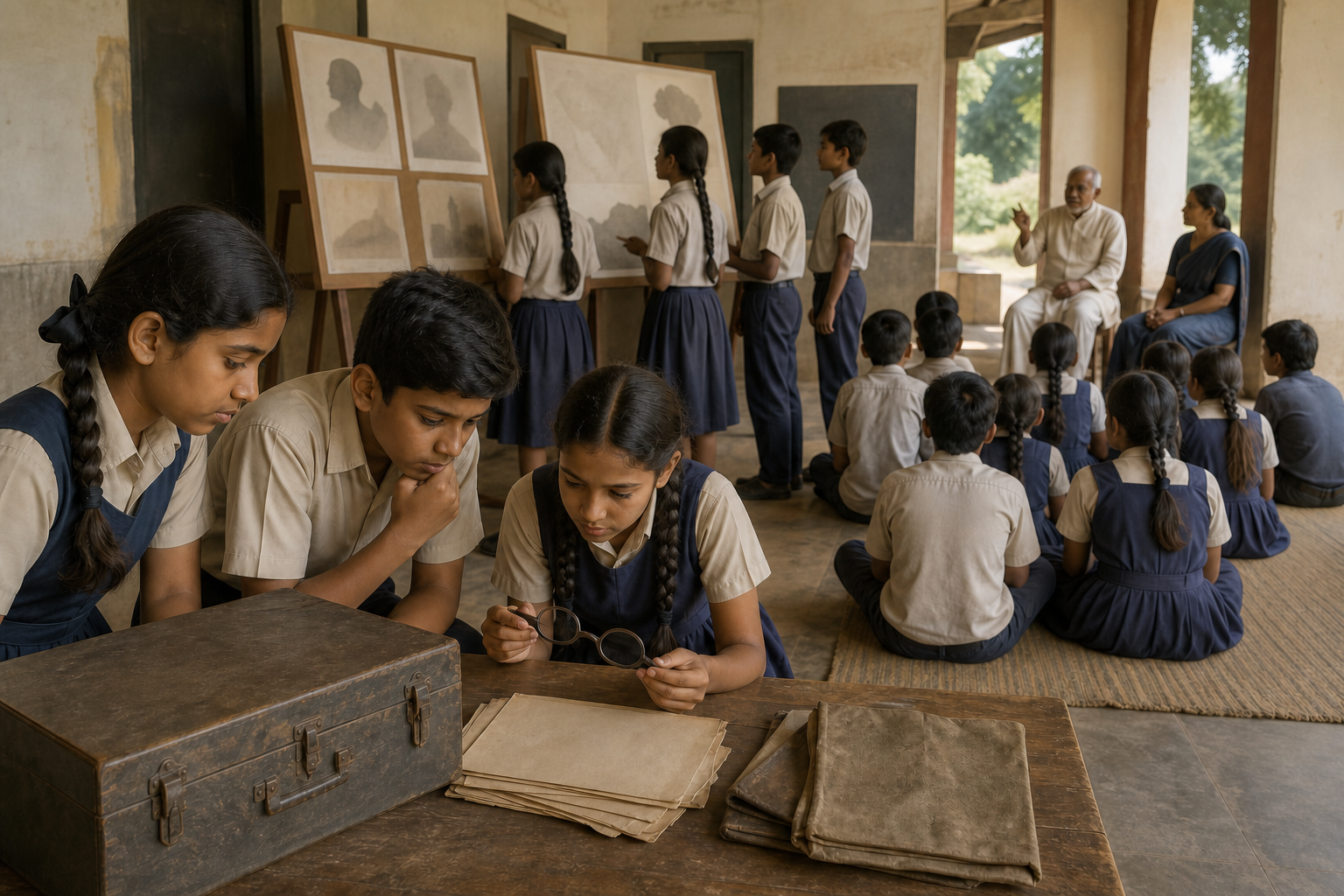
Revolutionary history carries moral force. That makes a disciplined method more important, not less. Whether you are visiting an exhibition or reconstructing its lessons afterward, read the material in three passes: record, evidence, and meaning.
- Record: Write down the names, dates, places, organisations, and events that are explicitly presented. Do not silently add details from memory or assumption.
- Evidence: Ask what supports each claim. Look for a cited text, an identifiable image, an archival record, or another traceable basis. If no citation is present, mark the claim as unverified for your purposes. A missing citation does not automatically make a claim false, but it does mean you should not repeat it as established fact.
- Meaning: Only after recording and checking the claim should you ask what it reveals about courage, duty, sacrifice, political action, or public memory. Moral interpretation becomes more credible when the factual foundation is visible.
A short student response can follow the same structure. Ask for a fact learned, the evidence that supports it, and a question that remains unanswered. If the evidence line is empty, the learning is not finished. The student has encountered a claim but has not yet learned how to assess it.
This distinction is especially important when discussing Ayni. Because the exact displays have not been publicly identified, nobody should later claim that the exhibition contained a particular letter, artefact, photograph, or timeline without preserved proof. Familiar exhibition formats are not evidence of what appeared at this event.
If you are preparing a follow-up lesson, ask those involved for whatever records still exist: the event notice, photographs showing complete panels, handouts, captions, or a catalogue if one was produced. Preserve the original wording and the context of each image. A tightly cropped photograph may look impressive while concealing the very label needed to verify it.
The same discipline helps you avoid two opposite mistakes. Slogan-first teaching asks for loyalty without understanding. Excessively detached teaching treats sacrifice as an inert sequence of dates. A sound history lesson establishes the facts, examines the choices, and then permits moral judgment.
A Dharmic lens should test values, not decorate them
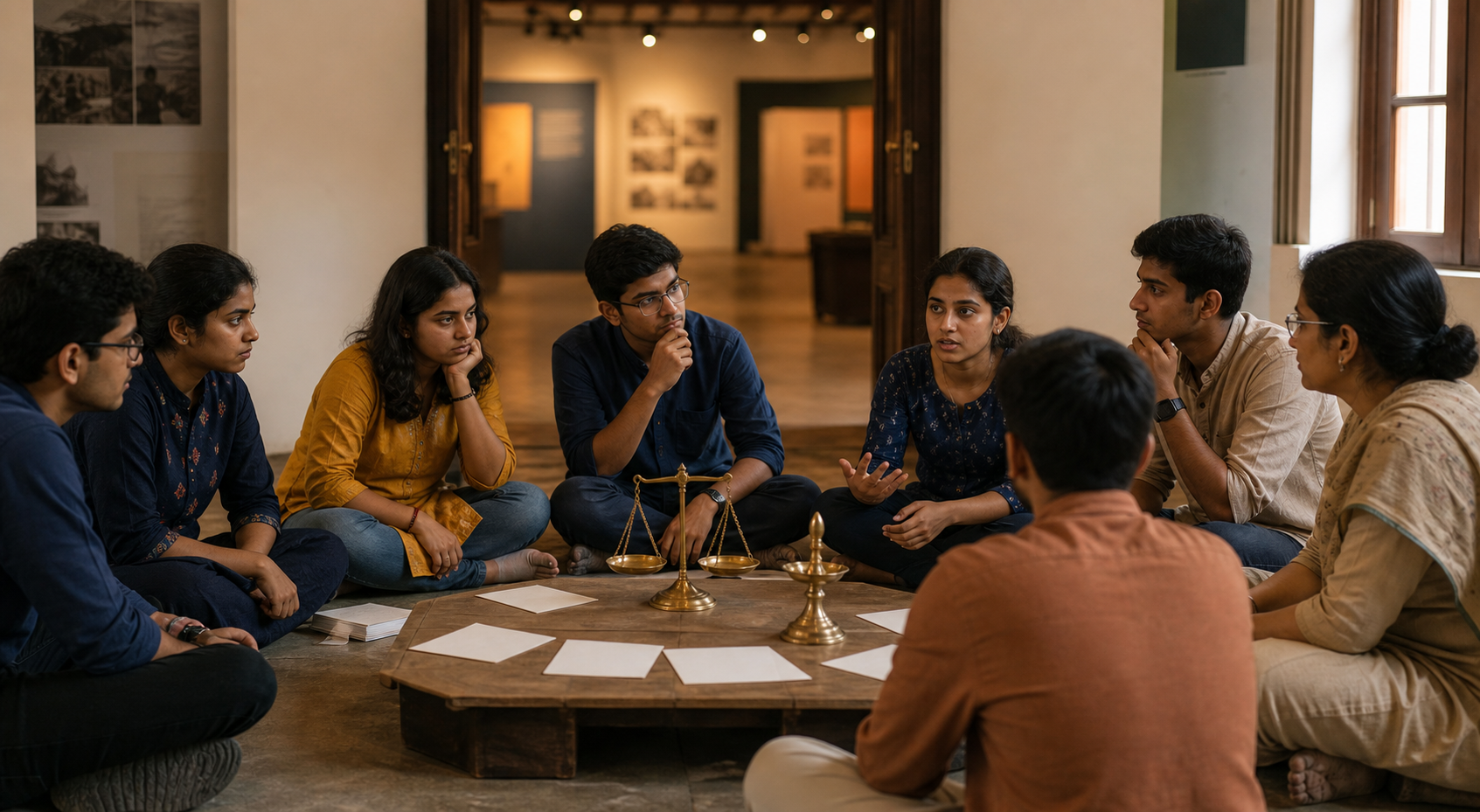
The moral frame surrounding the Ayni programme emphasised courage, compassion, duty, and seva. These values can provide common ethical ground across Hindu, Buddhist, Jain, and Sikh communities. Shared moral language, however, does not mean that these traditions have identical doctrines or historical experiences. Unity in Diversity becomes meaningful when common values are examined carefully rather than used as interchangeable labels.
Each value gives you a different question to bring to revolutionary history:
- Courage: What danger, fear, or personal cost did the person face? Courage is not the same as mere boldness. Ask whether action was guided by a defensible moral purpose rather than assuming that risk-taking is automatically virtuous.
- Duty: What obligation did the person believe had to be fulfilled? Duty to family, community, justice, and the larger social order can conflict. Naming that conflict produces a more serious discussion than simply praising determination.
- Compassion: Whose suffering is visible in the story, and whose suffering may have been left outside the frame? Compassion does not erase responsibility. It prevents remembrance from depending on the dehumanisation of others.
- Seva: What constructive responsibility follows from remembering? Possible answers include preserving reliable records, teaching younger students accurately, caring for places of memory, and correcting an error before it spreads.
This approach keeps a Dharmic reading from becoming ornamental. Courage is tested by purpose. Duty is tested by competing obligations. Compassion examines the human cost. Seva carries memory into present conduct.
It also leaves room for moral complexity. Honouring sacrifice does not require romanticising every act associated with a revolutionary period. Nor does critical examination require cynicism toward those who accepted grave personal costs. Dharma asks us to examine ends, means, context, and consequences together.
For a mixed community audience, this is where historical remembrance can strengthen social cohesion. People need not flatten their religious identities to recognise courage, compassion, duty, and service in one another. They do need to define those values through conduct. Otherwise, Unity in Diversity remains a phrase displayed at an event rather than a habit practised after it.
Carry the Ayni lesson beyond a single exhibition
Key takeaways
- Krantigatha was held in Ayni on 20 January 2026 at a school named for Hutatma Anant Laxman Kanhere.
- The setting connected a familiar local institution with Maharashtra’s revolutionary memory and India’s wider freedom struggle.
- The individual exhibits have not been publicly detailed, so later retellings should not embellish the display.
- The strongest learning method moves from record to evidence, and from evidence to moral interpretation.
- Courage, compassion, duty, and seva are most useful as questions for examining conduct, not as slogans attached to every historical figure.
A practical follow-through plan
A community exhibition becomes durable heritage only when someone preserves an intelligible record. Schools and organisers do not need an elaborate museum system to begin. They need a consistent way to separate verified material from recollection.
- Preserve the event record. Keep the title, date, organiser, venue, surviving programme material, and clearly captioned photographs together. Where permissions allow, include readable images of the complete displays rather than isolated decorative shots.
- Create a verification sheet. Place every important claim under one of three labels: established fact, supporting evidence, or open question. Never fill an open question with a confident guess merely to make the file look complete.
- Give students ownership of inquiry. Let each learner choose a name, event, or claim encountered through the programme. The task is to return with traceable support, a correction, or an honest statement that the point could not yet be verified.
- Keep a correction log. If a date, caption, or identification changes, preserve both the correction and the reason for it. Quietly replacing an error hides the learning process; recording the correction teaches historical responsibility.
- Turn remembrance into seva. Share verified material with the school, help younger learners understand the names around them, and prevent unsupported claims from being copied into future displays.
Parents can reinforce the same habit at home. Instead of asking only what a child saw, ask which fact stayed with them, how they know it, and what they still want to verify. Those questions transform a brief visit into historical thinking.
If you have any connection to the Ayni programme, preserve its surviving record now. A modest file with accurate captions, complete context, and clearly marked uncertainties will serve future students better than a grand retelling assembled after the evidence has disappeared. Give the next learner a firm factual starting point, then let them ask what courage, duty, compassion, and seva demand in their own life.
References
