
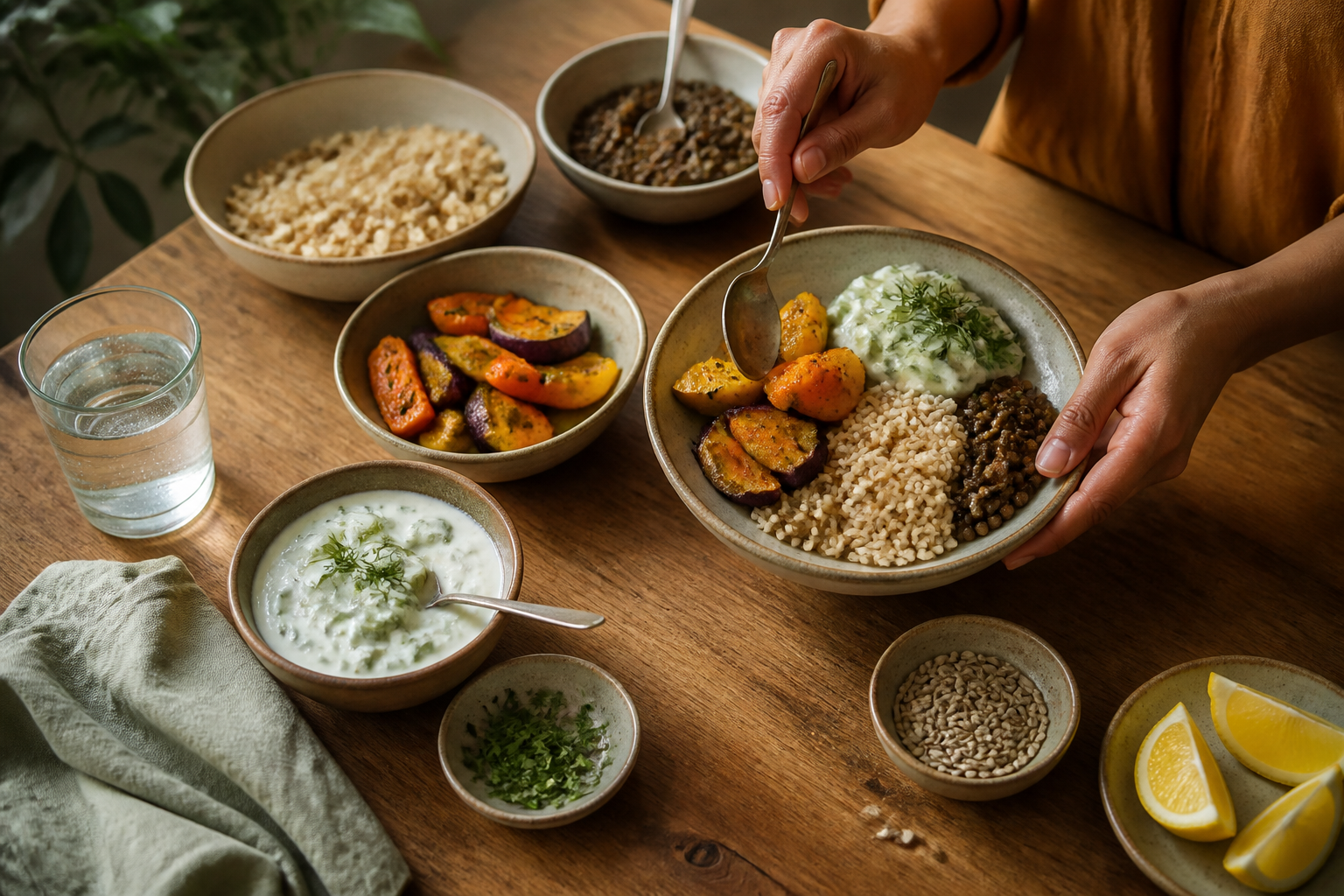
You want meals that leave you comfortable, clear-headed, and able to get through the day without chasing snacks or caffeine. The difficulty usually arrives when you are tired: nutrition advice becomes noise, cooking feels like another obligation, and whatever is quickest wins.
Better food habits do not require a dramatic reset. They require a dependable way to assemble an ordinary meal, a minimum-effort option for difficult days, and enough attention to notice what genuinely agrees with your body.
Stop using food labels as shortcuts for nourishment
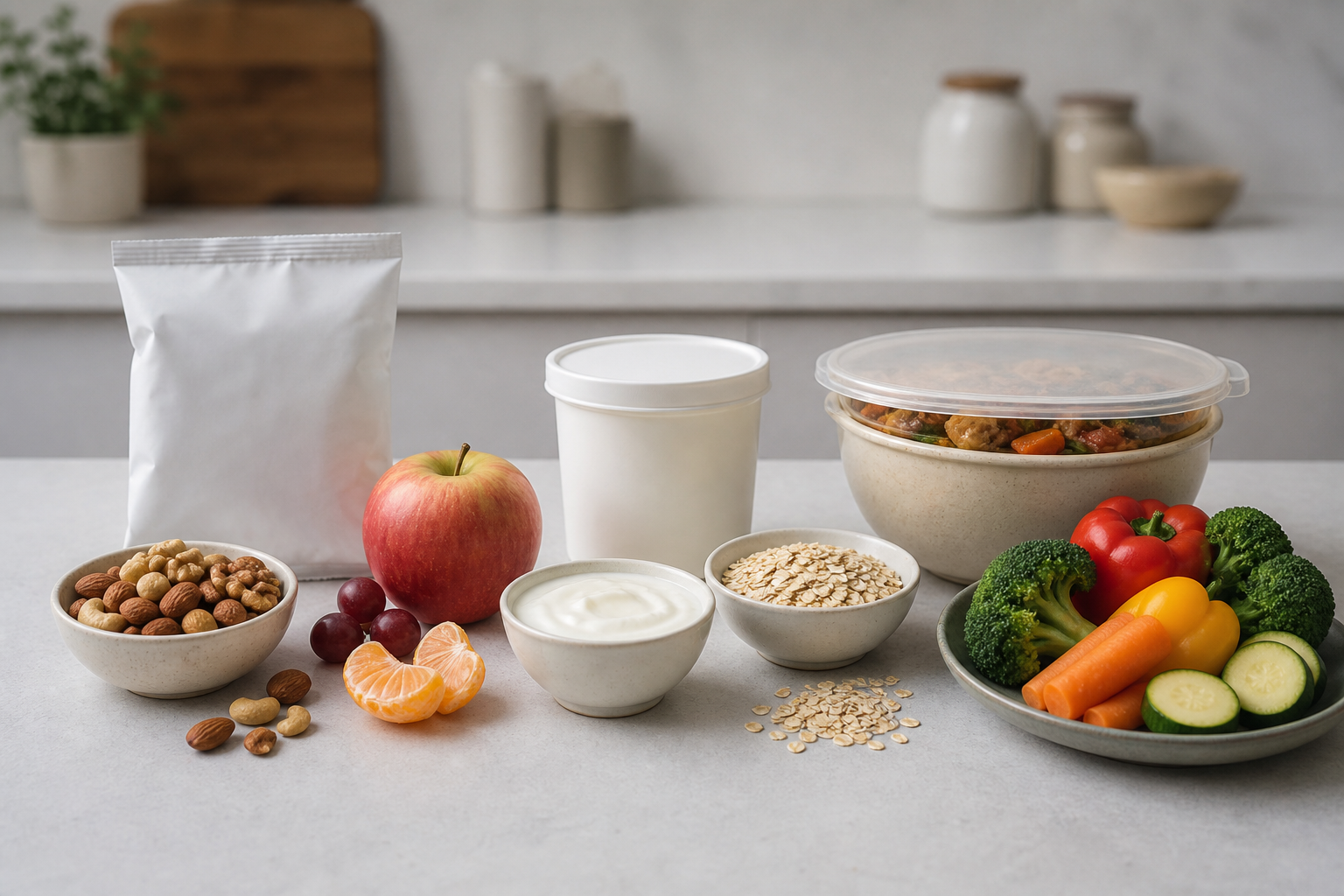
Vegetarian, homemade, low-fat, sugar-free, and sattvic can all describe part of a meal. None automatically tells you whether your overall eating pattern is nourishing. You can avoid meat and desserts while still depending heavily on ultra-processed foods and sugary snacks. You can also turn a respectable dietary ideal into an exhausting list of restrictions.
Use four questions when deciding what belongs in your everyday rotation:
- Is it recognisable food? Favour meals built mostly from grains, pulses, vegetables, fruit, nuts, seeds, dairy if you use it, and other minimally processed ingredients that suit your tradition and household.
- Does it contain plant variety? Do not depend on the same grain and the same vegetable every day. Change one component when convenient rather than rebuilding the whole menu.
- Will it satisfy you? A plate that looks virtuous but leaves you hungry soon afterward is not a useful default. Include a substantial staple and an accompaniment that gives the meal staying power.
- Can you repeat it on a busy day? A nourishing meal you can make regularly is more valuable than an elaborate one that appears only when time, energy, and motivation are perfect.
This shifts the aim from dietary identity to function. You are looking for comfortable digestion, stable appetite, usable energy, and a pattern you can sustain. Some people also notice fewer cravings, calmer focus, or better skin as their meals become more balanced, but those changes are personal responses rather than proof that the gut has been healed.
Food habits are not medical treatment. Persistent or severe abdominal pain, blood in the stool, repeated vomiting, unexplained weight loss, or difficulty keeping fluids down calls for medical care, not another home food experiment. If one food repeatedly seems to trigger symptoms, record what happened and discuss it with a qualified clinician or dietitian before removing whole food groups.
Build a flexible meal instead of chasing perfect recipes
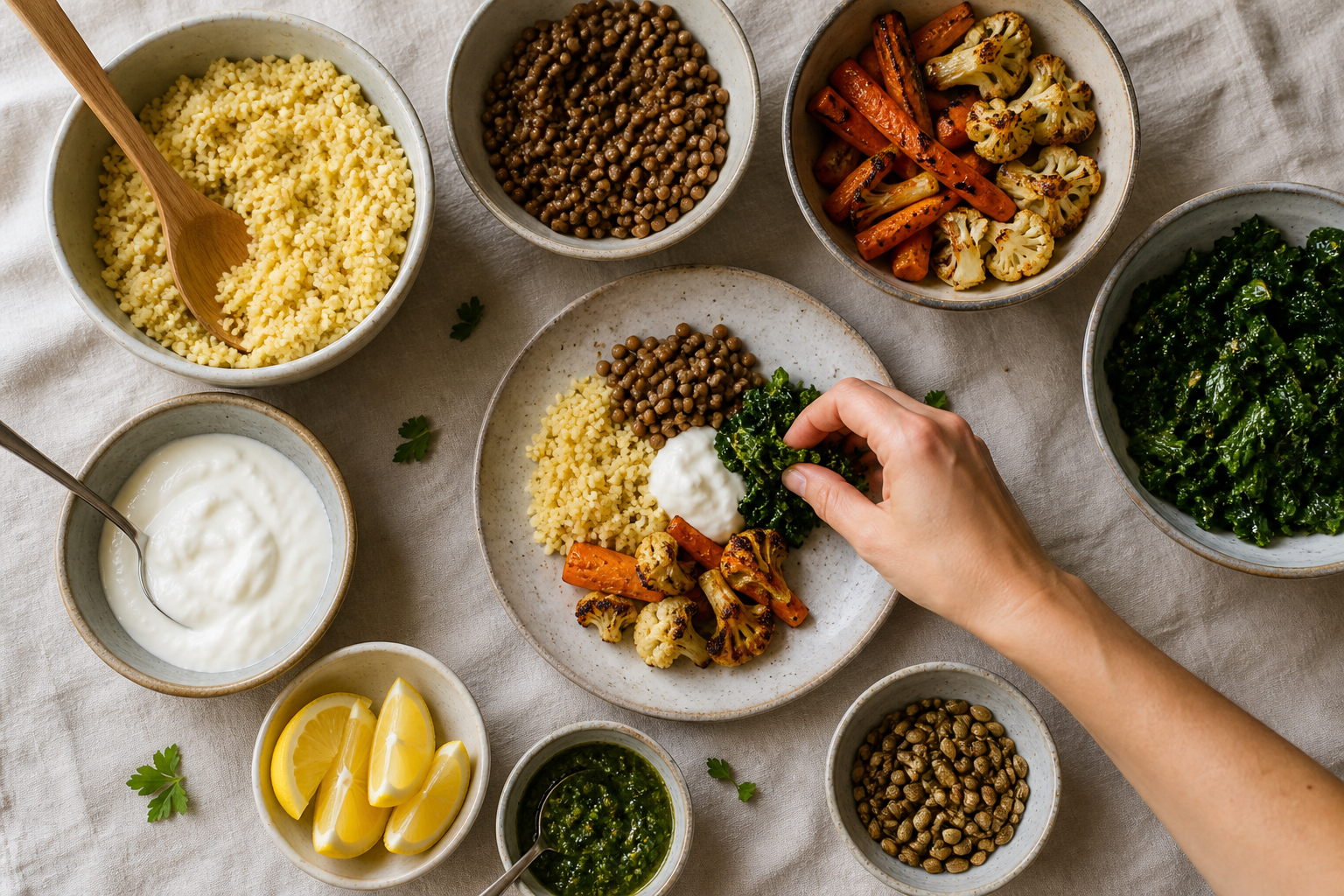
A recipe tells you how to reproduce one dish. A meal framework helps you feed yourself with whatever is available. For a practical plant-forward meal, assemble four parts:
- Begin with a familiar anchor. Rice, roti, another grain, or a simple porridge can provide the structure of the meal. Choose what your household already cooks and what you digest comfortably.
- Add at least one plant ingredient. Use a cooked vegetable, fruit, greens, pulses, or another seasonal option. When variety is limited, change the plant at the next meal rather than trying to crowd everything onto one plate.
- Add a sustaining accompaniment. Dal, chana, rajma, tofu, paneer, curd, nuts, or seeds can make the meal more complete. Select the option that fits your dietary practice, tolerance, and budget.
- Make it pleasant enough to want again. Adjust seasoning, texture, acidity, and moisture to your taste. Healthy eating becomes durable when the food is satisfying, not when every meal feels like penance.
This produces ordinary combinations that need little explanation: dal with rice and a cooked vegetable; roti with chana and seasonal sabzi; porridge with fruit and nuts; or leftover grain combined with vegetables and a suitable accompaniment. The point is not that any one combination is ideal. The point is that you can see what is missing and supply it without searching for a new recipe.
Keep the framework adaptable. A Jain household can select ingredients according to its level of observance, including root-free options where required. Someone following a sattvic pattern can use simpler preparations and avoid ingredients excluded by that practice. A mixed household can share the same base meal while keeping garnishes or accompaniments separate. Values need not turn dinner into several unrelated cooking projects.
Plant diversity is easier when you treat it as a rotation rather than a daily performance. Buy what is available, use it fully, and choose a different pulse, vegetable, fruit, grain, nut, or seed when the next practical opportunity appears. This is a workable way to move toward fiber-rich, minimally processed food and more varied plant ingredients without turning the kitchen into a nutrition spreadsheet.
Design your kitchen for the days when motivation disappears
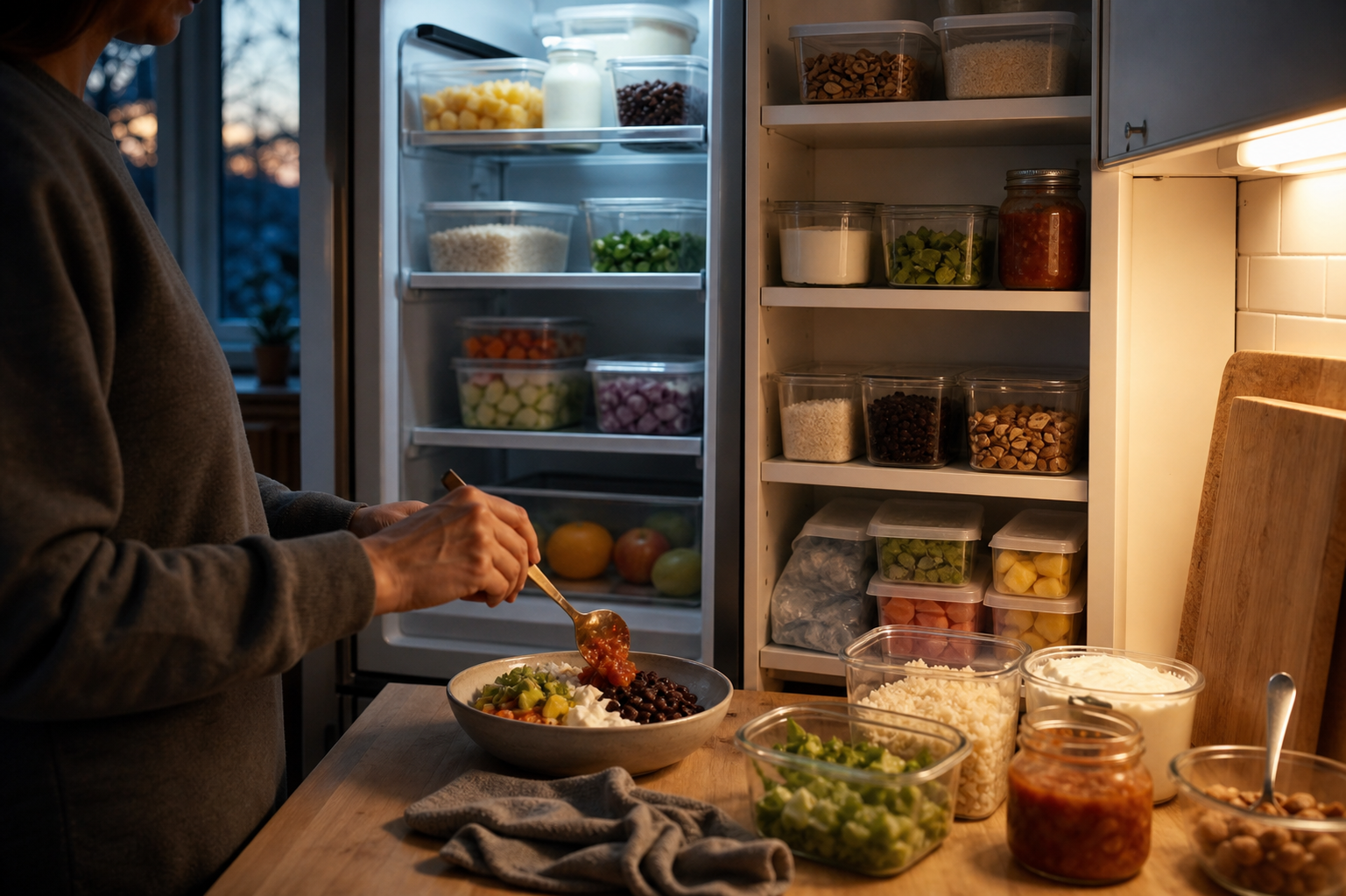
Most eating plans are designed for your energetic self and abandoned by your tired self. Build two levels of cooking instead: a normal meal and a minimum-effort meal. Both should be acceptable. The lower level is not failure; it is what keeps one difficult evening from becoming a week of unplanned eating.
- Name your fallback meal. Choose one combination that uses ingredients you normally keep and requires very few decisions. It may be dal-rice, khichdi with an appropriate accompaniment, curd rice if dairy suits you, or another simple household staple.
- Prepare components, not an ambitious menu. A cooked grain, a pot of dal or beans, and one vegetable can be combined in different proportions and refreshed with a garnish or side.
- Give nourishing food the easiest position. Keep ready-to-use staples visible and accessible. If fruit, nuts, or leftovers disappear behind less useful convenience foods, they will usually be forgotten when you are rushed.
- Use the same framework when ordering food. Look for a familiar staple, a pulse or other substantial accompaniment, and a vegetable. Convenience does not have to suspend the structure you use at home.
- Learn one transferable technique at a time. Become comfortable cooking one grain, one pulse, or one flexible vegetable preparation before adding another. Brief, repeated practice creates more independence than collecting complicated recipes.
Decision fatigue matters. If you ask what to cook only after hunger has become urgent, delivery and packaged snacks will carry an unfair advantage. Decide your fallback meal while calm, keep its ingredients in your regular shopping rotation, and make it the automatic answer when the day runs long.
You can also reduce friction by attaching food preparation to an existing household rhythm. Wash produce after shopping, prepare a component while another meal is already cooking, or decide the next day’s anchor when putting away dinner. The useful habit is the one that fits the life you already have.
Let dharmic attention guide the meal without creating a purity test
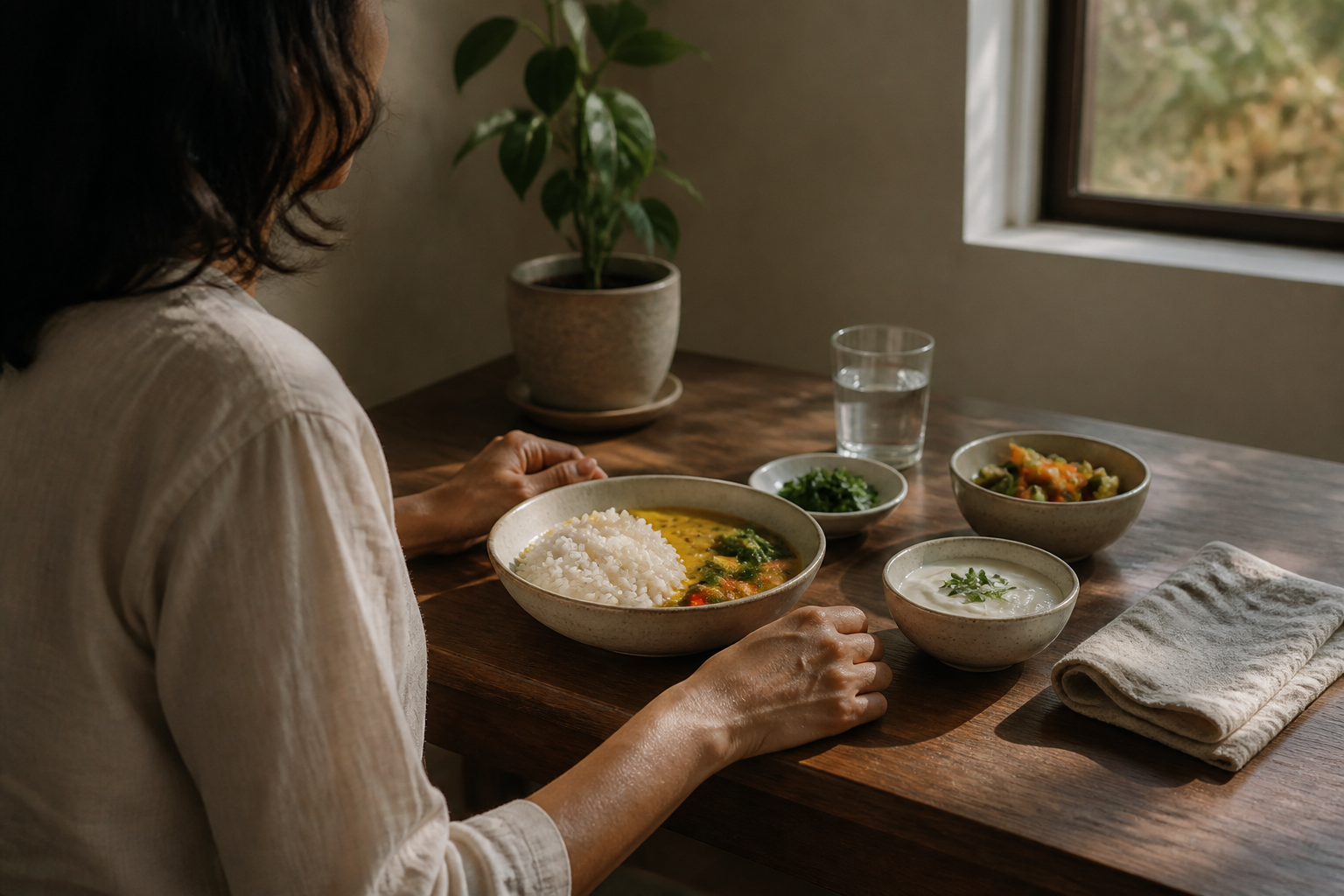
Dharmic traditions offer different but complementary ways to approach food. Ayurveda gives close attention to agni, or digestive capacity. Yoga values moderation and awareness. Buddhist practice can bring presence to eating and loosen compulsive grasping. Jain practice places ahimsa at the centre of food choices. Sikh langar demonstrates simple nourishment, equality, and service through a shared meal. These are distinct traditions, not interchangeable nutrition systems, yet each can help move eating away from impulse and toward conscious care.
Put that orientation into practice without making the meal ceremonial or complicated:
- Pause before beginning. Notice whether you are physically hungry, emotionally agitated, distracted, or simply eating because food is present. You do not need to judge the answer.
- Give the meal your attention. Sit down when circumstances allow. Taste the food before automatically adding more seasoning or reaching for the next item.
- Notice sufficiency. Moderation is not forced under-eating. Serve a reasonable starting portion, eat attentively, and take more if genuine hunger remains.
- Acknowledge relationship. Food carries the labour of growers, transporters, sellers, cooks, and the household. Remembering that web makes waste and careless consumption harder to ignore.
- Make room for others. When cooking for a family or community, use a shareable base and provide respectful adjustments instead of treating one person’s observance as an inconvenience.
A dharmic diet is not a badge of superiority. Ahimsa includes how you treat yourself and the people you feed. A meal that follows a rule while producing anxiety, contempt, or unnecessary conflict has lost something important. Keep the discipline, but examine the state of mind it is cultivating.
It is equally important not to treat agni, sattva, mindfulness, or ahimsa as clinical diagnoses. Traditional frameworks can guide attention and values, but they do not replace individual medical or nutritional care. Children, pregnant people, older adults, and anyone managing illness may have needs that a restrictive household rule does not adequately address.
To learn from your own pattern, keep a brief record when digestion or energy feels inconsistent. Note the meal, your hunger before it, digestive comfort afterward, energy until the next meal, and any recurring symptoms. Do not treat one uncomfortable day as proof against an ingredient. Look for repetition, then bring that information to an appropriate professional if the problem persists.
Key takeaways
- Judge your eating pattern by nourishment, comfort, and repeatability rather than by a label such as vegetarian, homemade, or sattvic.
- Build meals from a familiar anchor, varied plant ingredients, a sustaining accompaniment, and flavours you genuinely enjoy.
- Create a minimum-effort fallback meal before you need it, and keep its ingredients in your normal shopping rotation.
- Change one component at a time to increase variety without multiplying recipes, cost, and kitchen work.
- Use dharmic principles to cultivate awareness, moderation, ahimsa, gratitude, and shared nourishment, not anxiety or dietary pride.
- Seek qualified care for severe, persistent, or worsening digestive symptoms instead of relying on food restriction or traditional terminology alone.
At your next meal, do not attempt a complete transformation. Identify the anchor, add the plant ingredient that is available, choose a sustaining accompaniment, and sit down long enough to notice how the meal serves you. Repeat that modest act until nourishment becomes part of the household rhythm rather than another project waiting for the perfect day.
References
