
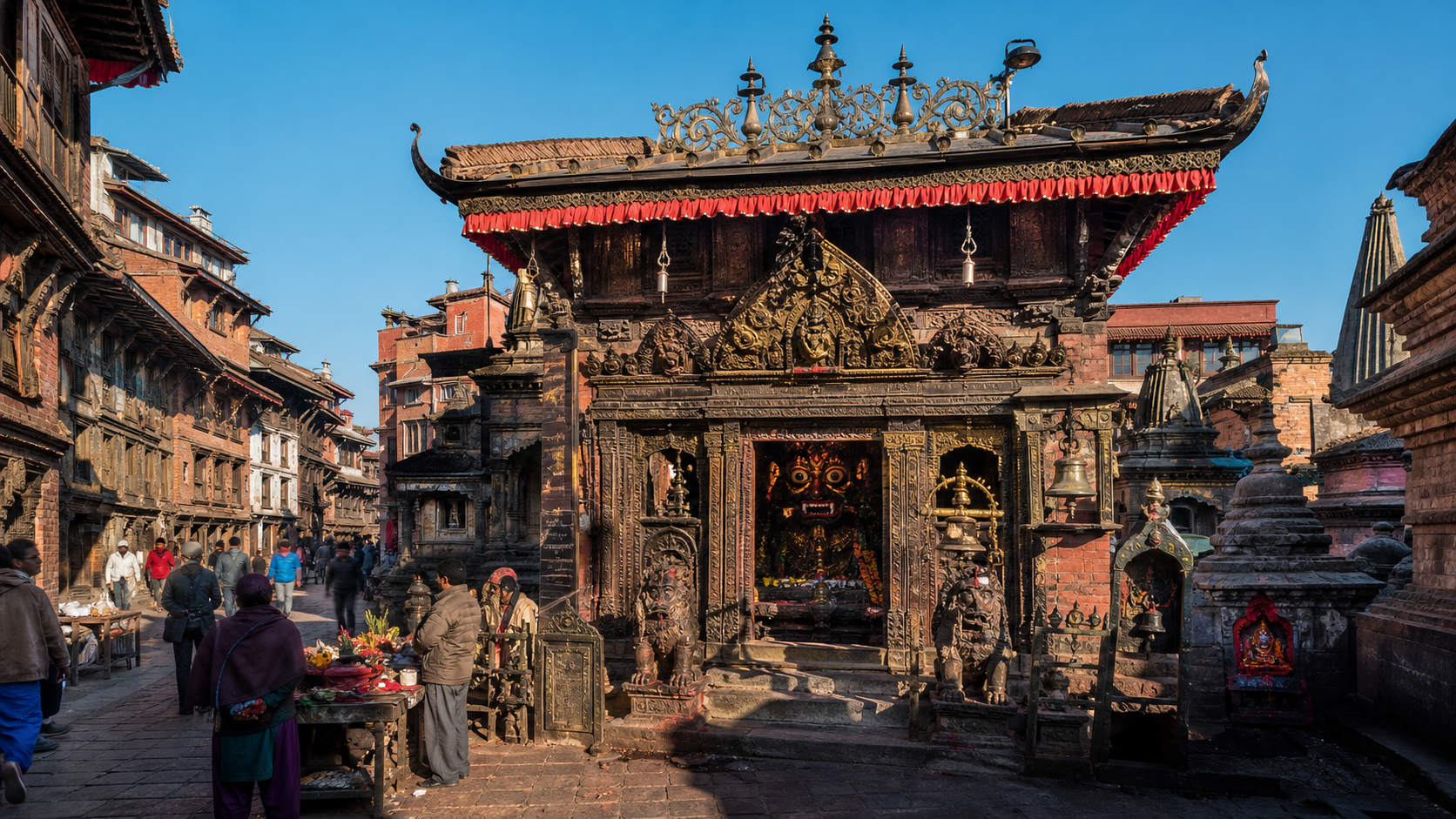
If you are going to Indra Chowk with one practical question—“What am I actually looking at?”—resist reducing Akash Bhairav to either a frightening image or a colourful Kathmandu curiosity. The tradition brings together the sky, Shiva’s fierce presence, and the memory of a warrior king.
That threefold reading gives you a better way into darshan. Understand what each layer contributes, then notice how the temple’s place in the old city’s everyday movement holds those layers together.
Read Akash, Bhairav and the warrior king together
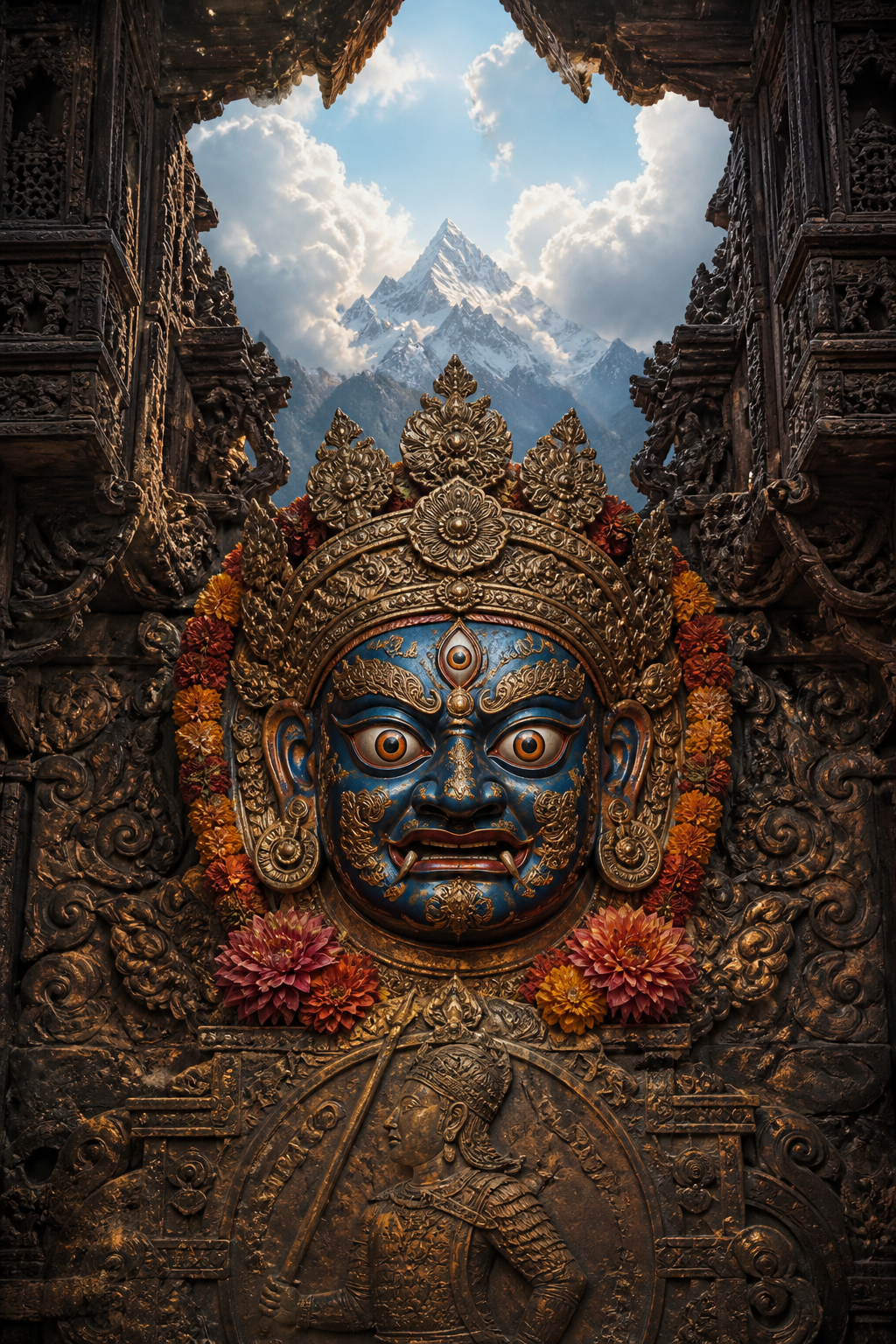
The name is the clearest starting point. Akash means sky, while Bhairav names the terrifying and awe-commanding aspect of Shiva. The sacred story also presents Akash Bhairav as a warrior king who descended from the sky. These are not three competing explanations from which you must select one. They are three dimensions of the same Kathmandu tradition.
Akash directs your attention upward
The safest reading of “sky” is directional rather than technical. The name directs attention upward and makes descent central to the story. It does not, by itself, justify elaborate claims about cosmology, astral beings or secret rites.
This distinction matters when you encounter the temple above the crowded lanes. The vertical relationship is immediately available to your eyes: ordinary movement below and the deity’s fierce presence above. Notice that relationship without pretending that architecture alone proves a complete theology.
Bhairav is fierce, but not an adversary of dharma
A common outsider’s mistake is to see a fearsome sacred form and classify it as evil. That reading fails here because Bhairav belongs to Shiva. Fierceness is part of the divine form being approached, not evidence that the figure stands outside the sacred order.
So do not begin with the question, “Why would anyone worship something frightening?” Ask what a frightening form makes the devotee confront. A serene image can settle the mind; a fierce one can interrupt complacency. Akash Bhairav should be read through that Shaiva capacity to hold what is gracious and what is overwhelming within one sacred reality.
The warrior king belongs inside the sacred memory
The warrior-king narrative should not be treated as a detachable adventure appended to a Shiva temple. It supplies the human and civic register of the tradition: battle, rule, courage, mortality and ascent enter the field of devotion.
You also need not force the story into the modern binary of “deity or historical ruler.” Sacred traditions can layer divine identity and heroic memory without feeling obliged to separate them in the way a modern catalogue would. The responsible questions are narrower: Why is the remembered figure a warrior? What does descent from the sky accomplish in the story? How do local custodians explain the movement from battlefield to heaven’s gate?
Those questions invite the tradition to disclose its own priorities. They are more useful than deciding in advance that every detail must be literal history, pure metaphor or a political slogan.
Indra Chowk is part of the encounter
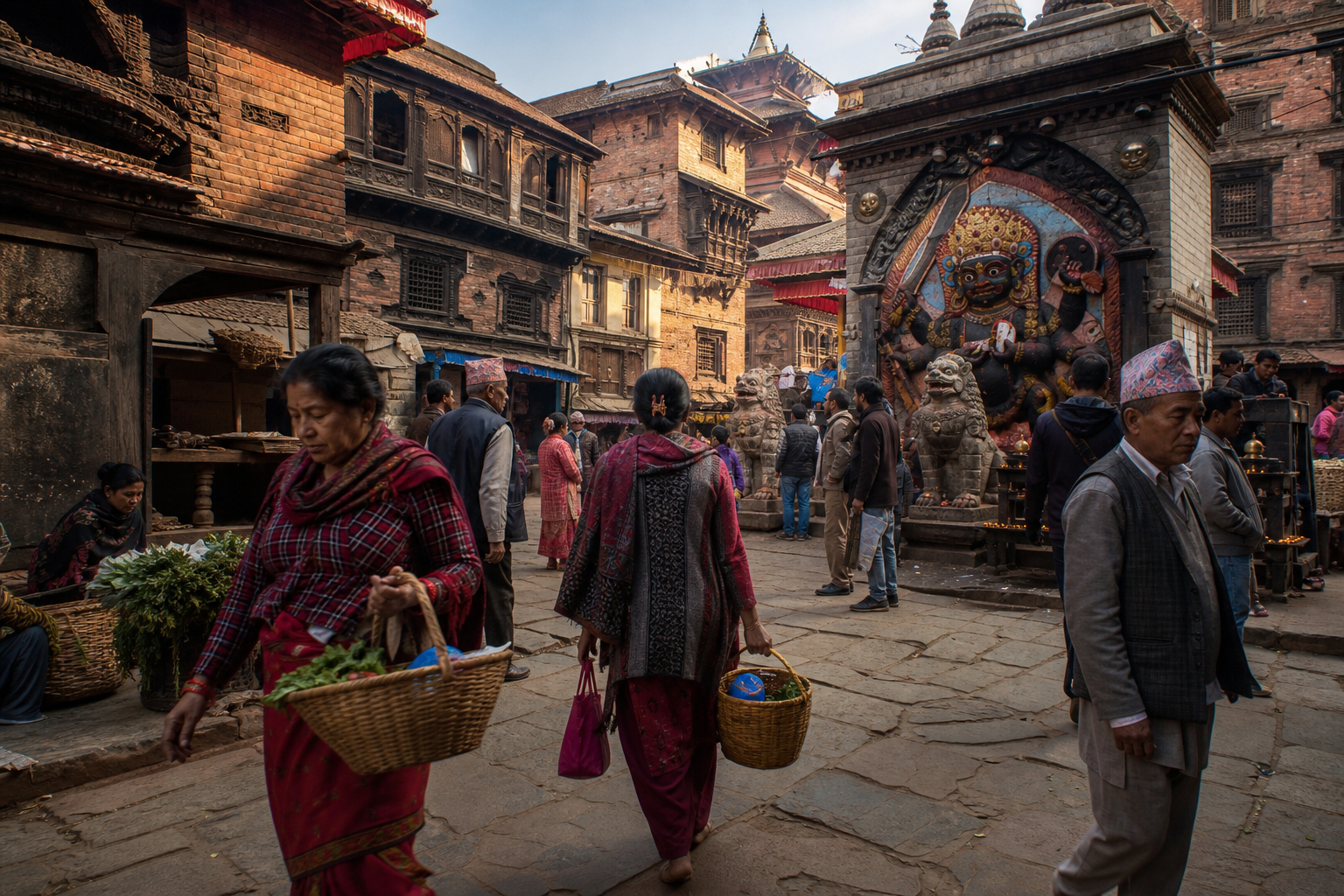
The temple stands over the crowded lanes of Indra Chowk in Kathmandu’s old city. For a visitor, that setting is not background scenery to crop out of a photograph. It places sacred presence amid movement, exchange, noise and daily obligation rather than in an isolated religious compound.
Read the location before searching for hidden symbolism. The useful observations are concrete:
- Step out of the pedestrian flow before looking upward. Do not stop where others must move around you.
- Locate the temple in relation to the lane before concentrating on individual details. Its vertical position is part of what you have come to understand.
- Watch where people pause, where they pass through and where active worship begins. This helps you distinguish public circulation from sacred space without guessing.
- Notice the coexistence of commerce and devotion without treating ordinary city life as a contamination of holiness.
- Keep entrances and thresholds clear, even if the best photograph appears to be available from that spot.
This method prevents two opposite errors. One is to romanticise the old city as a timeless stage set. The other is to dismiss the temple’s surroundings as mere congestion. Indra Chowk is a lived urban space, and Akash Bhairav’s presence must be approached within that life.
Approach darshan without inventing a ritual script
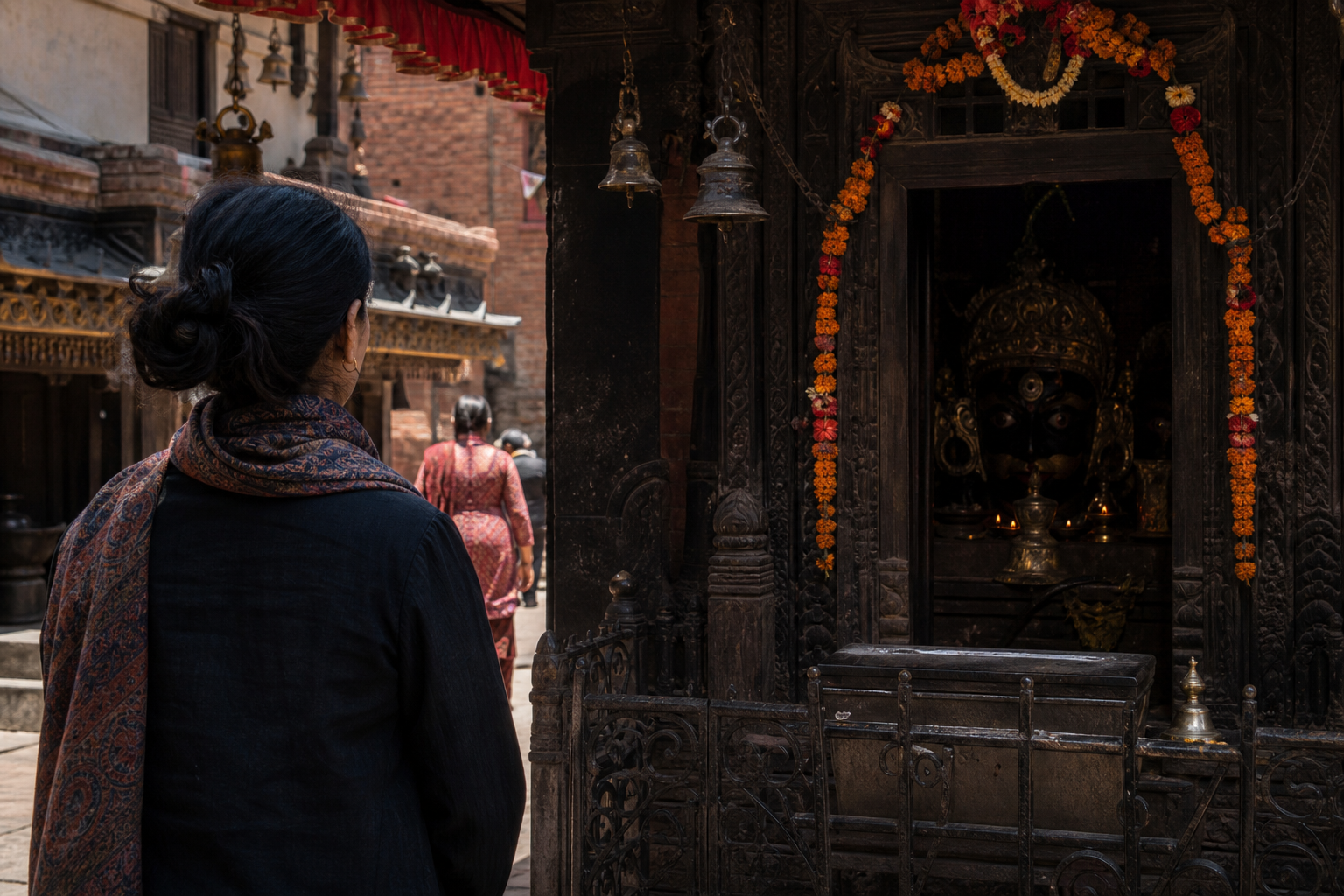
Darshan is devotional seeing, not simply the collection of visual information. You do not need to imitate a temple-specific ritual you do not understand in order to be respectful. In fact, improvisation can turn reverence into performance.
- Learn the name and location before arriving. Remember the three interpretive anchors: sky, fierce Shiva and warrior king.
- Pause before joining any action. Give yourself time to see how worshippers and attendants use the space. Do not copy a gesture merely because you saw it once.
- Ask before entering, offering or photographing. A useful question is specific: “May visitors enter here?” or “Is photography permitted from this point?”
- Do not invent an offering or mantra. If you have received no local instruction, a quiet and respectful pause is better than presenting an unsuitable item or performing words whose use you do not know.
- Ask one question about the living tradition. Try, “How is the warrior-king story told here?” or “What pronunciation do local devotees use?” A narrow question is more likely to produce a meaningful answer than a demand for the temple’s entire history.
- Move away before taking notes. Record what you learned after leaving the threshold so that writing, filming or checking your phone does not obstruct worship.
Opening hours, access arrangements and photography rules can change. Confirm them with a current local authority or at the site rather than building your visit around an undated online claim.
There is also a civilizational balance to keep. The Sanskritic name and Shaiva identity place Akash Bhairav within a wider dharmic world extending across the Himalayas. Yet the temple is not a generic copy of a shrine elsewhere. It is Kathmandu’s living inheritance, sustained by local memory and custodianship. Shared dharmic kinship should deepen your respect for that distinctiveness, not erase it.
Key takeaways
- Read the name as a unity: Akash is sky, Bhairav is Shiva’s fierce form, and the local sacred memory presents him as a warrior king descended from above.
- Do not mistake a terrifying divine appearance for evil. Bhairav’s fierceness belongs within Shaiva sacred identity.
- Look at the temple’s relationship to the crowded lanes of Indra Chowk. The urban and vertical setting helps you understand the encounter.
- Do not rely on improvised rituals. Observe first, ask precise questions and follow current local instructions.
- Recognise both wider dharmic continuity and Nepal’s local custodianship; neither requires denying the other.
When you reach Indra Chowk, look up before forming a theory, then slow down before approaching the sacred space. If you leave with a sharper question for Kathmandu’s custodians rather than an instant verdict of your own, you will have begun to meet Akash Bhairav on the tradition’s terms.
References
