
You have probably seen Ambedkar invoked as if his name settles an argument: against Hindu society, for a particular conversion movement, or in support of a present-day reservation demand. The difficulty is that rival camps often claim the same man while isolating different moments of his life.
You do not have to choose between reverence and dismissal. You need a method that keeps his anti-caste challenge, his long religious inquiry, and his eventual choice of Buddhism in the same frame. That method also helps you notice when a historical claim has quietly become a political slogan.
The 1935-1956 sequence changes the meaning of each statement
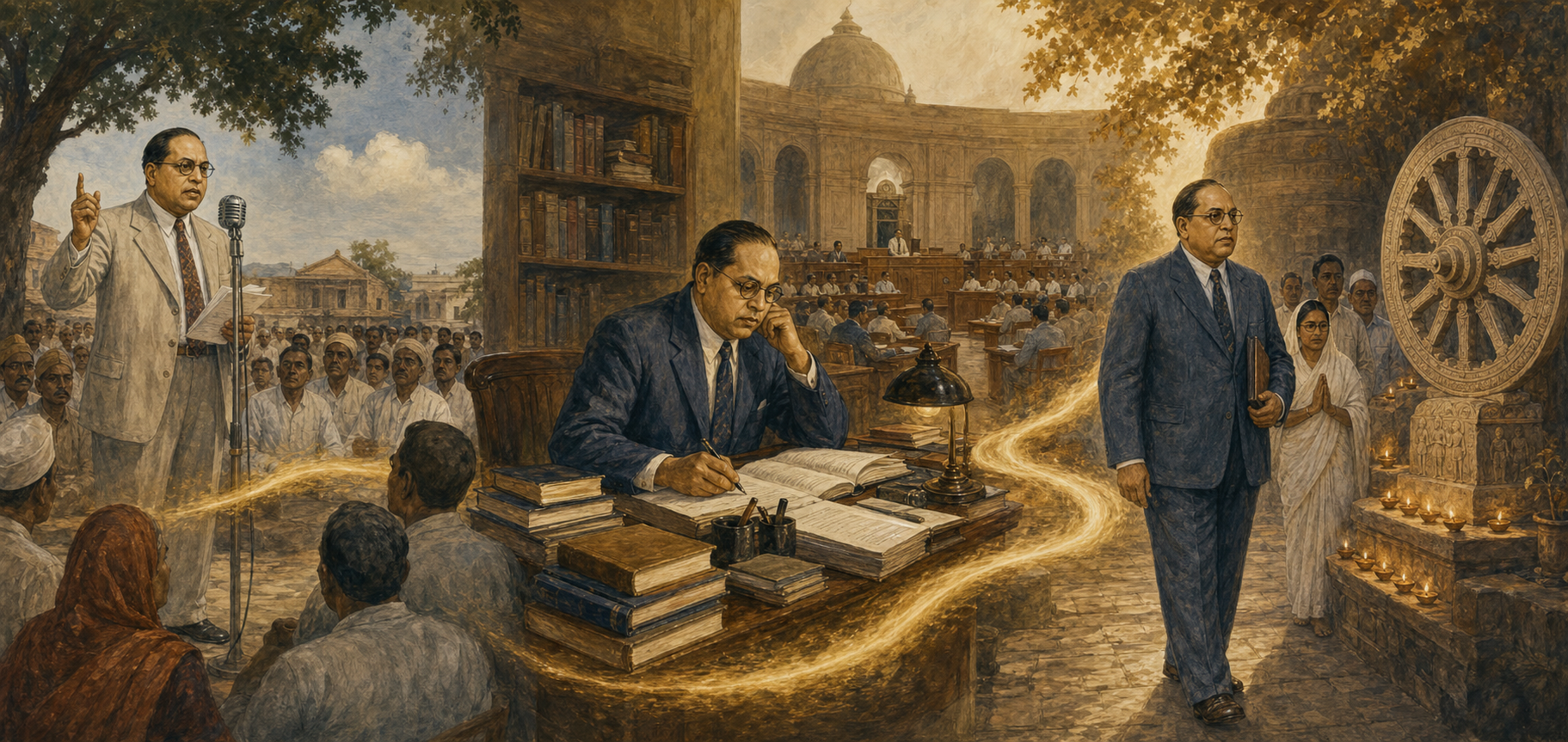
Ambedkar’s declaration at Yeola in 1935 announced that he would leave Hinduism. It did not yet announce where he would go. Treating that declaration as his completed religious judgment erases the inquiry that followed it.
The interval matters. Between 1935 and his conversion in 1956, Ambedkar considered several religious possibilities and asked what each could actually offer oppressed people. His criterion was not merely whether a doctrine sounded egalitarian. He was concerned with whether a religious community could provide genuine moral and psychological release from degradation.
- Sikhism received serious consideration because of its explicit doctrinal rejection of caste. His hesitation concerned practical and political questions, including how a large new community would be absorbed institutionally.
- Islam and Christianity were not options he overlooked. He examined both and ultimately declined to recommend either as the collective destination of the Dalit community he led.
- In 1956, he converted to Buddhism. The destination was therefore neither a return to the Hindu social order he had condemned nor an embrace of Islam or Christianity.
Read this chronology as an argument conducted through study and decision. The 1935 declaration identifies the intolerable condition. The intervening years show the alternatives being tested. The 1956 conversion records the choice. No single stage can honestly stand in for all three.
What Ambedkar’s choices establish – and what they do not
Ambedkar’s legacy becomes distorted when an inference is made to carry more weight than the evidence permits. His decisions support several firm conclusions, but they also impose limits on every camp claiming him.
- His departure establishes a profound rejection of caste oppression. A pro-Dharma account cannot reduce his conversion to personal eccentricity or political theatre. He spent roughly two decades searching for a path that he believed could liberate the oppressed.
- His final choice establishes that he distinguished among religious alternatives. Leaving Hinduism did not make Islam, Christianity, Sikhism, and Buddhism interchangeable destinations.
- His rejection of Islam and Christianity limits claims made in his name. It is difficult to describe conversion to either faith as the straightforward completion of his own religious project when he investigated both and chose neither.
- His choice of Buddhism does not vindicate Hindu caste practices. One cannot use his selection of an Indic religion to erase the conditions that drove him out of Hindu identification.
- His personal decision does not automatically decide current law. A historical conclusion about what Ambedkar chose is not, by itself, a complete constitutional, social, or policy argument.
The Dharmic implication requires honesty in both directions
For a Dharmic reader, the Buddhist destination is significant. Ambedkar did not conclude his search by entering Islam or Christianity; he entered an Indic tradition with its own account of suffering, ethics, discipline, and liberation. That complicates the familiar picture of conversion as a simple movement from an Indian religious world into a non-Indic one.
But Buddhism must not be collapsed into the Hindu identity Ambedkar deliberately renounced. Saying that both belong to the wider Dharmic family can illuminate civilizational relationships. Saying that the distinction therefore did not matter to him would conceal the very choice being discussed.
A credible pro-Dharma response should hold both truths at once: his final path remained within India’s Dharmic inheritance, and his break with Hindu society was meant as a serious indictment of caste humiliation. The first truth resists attempts to conscript him into an inevitable Abrahamic conversion story. The second prevents Hindu self-congratulation from replacing reform.
The policy implication must be argued separately
Campaigns to extend Scheduled Caste status to Dalit converts to Christianity and Islam have sometimes presented their demand as Ambedkar’s unfinished project. That description bundles three different propositions together:
- A historical proposition: Ambedkar wanted Dalits to adopt Christianity or Islam, or regarded either conversion as the path he left incomplete.
- A social proposition: discrimination associated with caste may continue after a person changes religion.
- A policy proposition: the state should respond to that continuing disadvantage through a particular reservation rule.
These propositions require different evidence. Ambedkar’s religious chronology bears directly on the first, but it cannot by itself prove or disprove the second. Neither historical intention nor social persistence automatically dictates the third. A policy advocate must still defend the proposed rule on its present merits, consequences, and constitutional reasoning.
This separation gives you a precise response to appeals to authority. You can reject an inaccurate account of Ambedkar’s intention without pretending that you have thereby settled every question about discrimination or public policy. Conversely, someone may defend a policy change without claiming that Ambedkar personally endorsed a religious route he declined to take.
A five-step test for claims made in Ambedkar’s name

When you encounter a quotation, speech clip, campaign poster, or political claim, use the following test before accepting its conclusion.
- Rewrite the claim as one exact sentence. Ambedkar opposed caste, Ambedkar rejected every part of Indian civilization, and Ambedkar would support a particular law are three different claims. If the speaker moves between them, stop the argument at the point of transition.
- Locate the statement within his intellectual sequence. Ask whether it belongs before the 1935 Yeola declaration, during the religious inquiry that followed, or near the 1956 Buddhist conversion. A position at the beginning of a search cannot automatically be treated as its final result.
- Classify the evidence. Direct words show what he stated at a particular time. A sustained work shows developed reasoning. An institutional or religious decision shows what he ultimately did. A later activist’s interpretation shows how Ambedkar is being used, not necessarily what Ambedkar intended.
- Check the alternatives he actually considered. If a claim concerns conversion, you should expect it to account for his consideration of Sikhism, his examination of Islam and Christianity, and his choice of Buddhism. An argument that hides the comparison set is usually steering you toward a predetermined answer.
- Separate historical description from present prescription. After establishing what Ambedkar believed, ask what additional evidence is needed to decide today’s issue. Demographics, law, institutional incentives, and present social conditions cannot be supplied by a quotation from a revered figure.
One text deserves particular attention when claims concern Islam, Muslim politics, or Partition. Ambedkar set out substantial parts of his analysis in Pakistan or the Partition of India, published in 1940. You need not assume that every judgment in that work settles a modern dispute. You should, however, require anyone presenting a simple account of his view of Islam to deal with the analysis he actually developed there.
Watch especially for three warning signs: a 1935 declaration used as if nothing happened by 1956; his Buddhist conversion used to absolve caste hierarchy; or his moral authority used in place of a current policy argument. Each move removes the part of his record most inconvenient to the speaker.
Key takeaways
- Ambedkar’s 1935 decision to leave Hinduism began a religious search; it did not identify his destination.
- He evaluated Sikhism, Islam, Christianity, and Buddhism as distinct possibilities rather than treating conversion itself as sufficient liberation.
- His 1956 conversion to Buddhism matters both as a rejection of caste-bound Hindu society and as a refusal to choose Islam or Christianity.
- A Dharmic reading must neither erase his break with Hinduism nor erase the Indic character of the tradition he finally entered.
- Historical intention, continuing social disadvantage, and present reservation policy are separate questions requiring separate evidence.
- The safest way to read Ambedkar is chronologically: identify the problem, follow the inquiry, and then examine the final decision.
Read Ambedkar as a thinker, not as political property
Ambedkar’s contested legacy will not become clearer by assigning him permanently to a Hindu, anti-Hindu, Buddhist, secular, nationalist, or missionary camp. Those labels may identify part of a dispute, but they cannot substitute for his sequence of questions and choices.
The next time his name is offered as the conclusion of an argument, write down the exact claim and place its evidence on the 1935-1956 timeline. Then ask what is direct evidence, what is inference, and what belongs to today’s policy debate. That small discipline turns Ambedkar from a borrowed symbol back into an intellectual interlocutor – and gives us a more serious basis for Dharmic reform and public judgment.
References
