

If you have landed here because someone asked whether Sikhs and Hindus are the same, the yes-or-no framing is already causing trouble. Sikhism is a distinct religious path. It also arose within the Bharatiya civilizational world in which Hindu traditions were deeply rooted, so the two cannot be understood as strangers with no meaningful connection.
Whether you are speaking in a family, a classroom, a mandir, a gurdwara, or an online discussion, hold two truths together: kinship deserves acknowledgment, and distinct identity deserves respect. That is the clearest basis for an honest Hindu-Sikh relationship.
The clearest answer separates identity from civilizational kinship
Hinduism and Sikhism both emerged in Bharat and have a close, often intertwined relationship. Hinduism carries an ancient and internally diverse inheritance associated with the Vedas, Upanishads, Puranas, Ramayana, and Mahabharata. Sikhism begins as a distinct path with Guru Nanak. Those different points of formation matter.
The relationship becomes clearer when you stop asking one label to answer every kind of question. Separate three layers:
- Religious identity: Hinduism and Sikhism are distinct traditions, with their own authorities, forms of worship, disciplines, and community identities.
- Civilizational location: both belong to the religious history of Bharat and developed in proximity rather than isolation.
- Human relationship: Hindus and Sikhs can recognize kinship, cooperate, visit one another’s institutions respectfully, and defend one another’s dignity without pretending that every belief is interchangeable.
This distinction resolves two common errors. Calling Sikhs simply Hindu may be intended as an affirmation of closeness, but it can be heard as the erasure of Sikh identity. Calling the traditions completely unrelated may be intended to defend distinctiveness, but it obscures their shared civilizational setting. Civilizational kinship is not religious ownership, and religious separateness is not hostility.
Before answering a disputed claim, ask what is actually being discussed: theology, religious membership, ancestry, family custom, civilizational history, or present-day politics. An answer about shared history does not settle a question about doctrine. A doctrinal difference does not prove civilizational estrangement.
Recognize shared moral ground without claiming equivalence
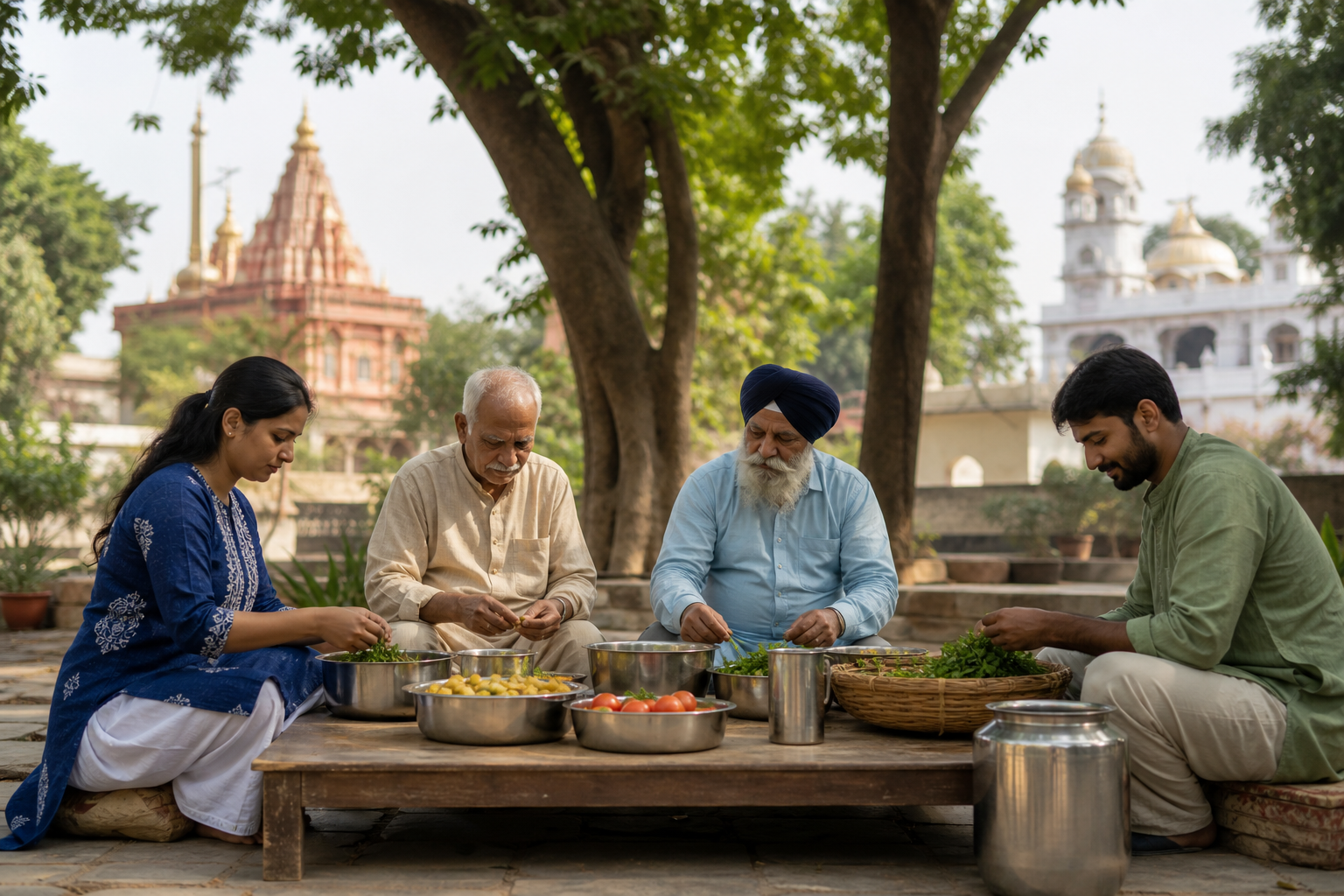
Hindus and Sikhs can recognize a substantial moral vocabulary in one another. Devotion should shape conduct. Ego requires discipline. Truthfulness matters. Service is more than a slogan. Spiritual life should affect the way you work, share, speak, and treat other people.
That common ground is useful because it creates places where cooperation does not depend on theological agreement:
- Practice service together. Feeding people, supporting neighbors, helping during hardship, and protecting places of worship turn mutual regard into conduct.
- Defend each community’s right to describe itself. You do not honor your own tradition by denying another community the vocabulary with which it understands itself.
- Discuss ethical teachings through their consequences. Ask how devotion produces humility, how discipline restrains ego, or how service protects human dignity.
- Let hospitality remain hospitality. A respectful visit to another community’s place of worship does not require either side to conceal its convictions.
Use a precise comparison formula: Both traditions value this principle, while each interprets and practices it through its own authorities. That sentence allows you to notice a genuine resemblance without turning resemblance into sameness.
The same care applies to religious vocabulary. A word such as guru may be intelligible in both settings, but its place within Sikh religious authority should not be reduced to the way the word functions in every Hindu lineage. Shared language can open a conversation; it cannot finish the theological work for you.
Respect the boundaries that make dialogue honest

Do not treat sacred authorities as interchangeable
Hinduism contains many schools, lineages, texts, devotional forms, and philosophical approaches. It does not operate through one uniform creed or one historical founder. Sikhism has its own sacred authority and a path originating with Guru Nanak. These are not minor institutional variations within a single organization.
When discussing doctrine, explain a tradition from within its own framework. A passage revered by Hindus cannot, by itself, settle an internal Sikh question. A Sikh teaching cannot be used as though it automatically defines every Hindu school. Comparison comes after accurate description, not before it.
Do not mistake a respectful visit for theological agreement
A mandir and a gurdwara are not interchangeable spaces. If you visit either, follow the host community’s practice instead of relying on assumptions carried over from somewhere else.
- At a gurdwara, arrive prepared to remove your shoes and cover your head. Follow local directions for washing, seating, entering the prayer space, and joining the community meal. If sitting on the floor is difficult, ask about accessible seating rather than silently leaving.
- At a mandir, remove footwear where directed, follow the local queue and ritual order, and stay outside any area marked as restricted. Ask before taking photographs, especially near worship or the sanctum.
- In either place, dress respectfully, silence your phone, avoid interrupting prayer, and ask a host when you do not know what to do.
These acts are basic religious literacy. They neither erase your identity nor entitle you to redefine the community receiving you.
Let people state their own religious identity
Family history, social proximity, or a shared custom may explain why two people feel close. None of them gives an outsider permission to overrule a person’s stated religious identity. If someone identifies as Sikh, call that person Sikh. If someone identifies as Hindu, call that person Hindu. If a family contains more than one religious practice, ask how its members describe the arrangement.
This is especially important when using broad terms such as Dharmic or Bharatiya. Explain what you mean. You may be naming a civilizational family rather than asserting theological identity, but the other person cannot know that unless you say so. If the term is unwelcome, continue the substantive discussion with more precise language.
A practical method for difficult Hindu-Sikh conversations

When a discussion becomes tense, more historical or theological claims rarely help until everyone knows what kind of claim is being made. Use this sequence:
- Name the question. Ask whether the disagreement concerns theology, religious membership, civilizational history, family practice, institutions, or politics.
- State the paired truth. Say that Sikhism is distinct and that Hindu-Sikh civilizational proximity is real. Do not sacrifice one half to emphasize the other.
- Define loaded terms. If you use Hindu, Sikh, Dharmic, Bharatiya, sect, or religion, explain the sense in which you are using it.
- Give self-identification priority. Ask participants how they describe their own religious belonging before assigning them a category.
- Compare one point at a time. Discuss service, devotion, scripture, worship, or identity separately. A bundle of loose similarities proves very little.
- Separate political grievances from theology. If the dispute concerns power, representation, violence, or a political movement, address that issue with relevant evidence. Do not smuggle a political conclusion into a religious label.
A useful opening sentence is: Sikhism is a distinct religious path that arose in the same Bharatiya civilizational world as Hindu traditions. A useful follow-up question is: When you say separate, do you mean theology, institutions, culture, family identity, or politics?
Avoid claims built around just or really: Sikhs are not just members of somebody else’s category, and civilizational connections are not really meaningless simply because a separate identity exists. Those words usually announce that you are about to tell another community what it is.
A confident pro-Dharma outlook does not need forced uniformity. It can recognize that a tradition formed in sustained proximity to Hindu civilization while taking Sikh claims of distinct identity seriously. Confidence shows itself through accuracy, restraint, and the willingness to protect a relationship from careless slogans.
Key takeaways
- Sikhism is a distinct religion; acknowledging that does not require denying its close civilizational relationship with Hindu traditions.
- Shared roots explain proximity, not complete theological identity.
- Compare teachings through each tradition’s own authorities rather than treating scriptures, worship, or religious vocabulary as interchangeable.
- In a mandir or gurdwara, follow the host community’s rules and ask when you are uncertain.
- In family or public debate, separate theology, identity, history, and politics before attempting to resolve the disagreement.
- Mutual service is a stronger expression of kinship than an argument over who is allowed to define whom.
Before your next Hindu-Sikh conversation, write down a two-sentence description of the relationship. If it clearly affirms both Sikh distinctiveness and Bharatiya civilizational kinship, you have a sound starting point. Then move from labels to the conduct that sustains trust.
References

Leave a Reply
You must be logged in to post a comment.