
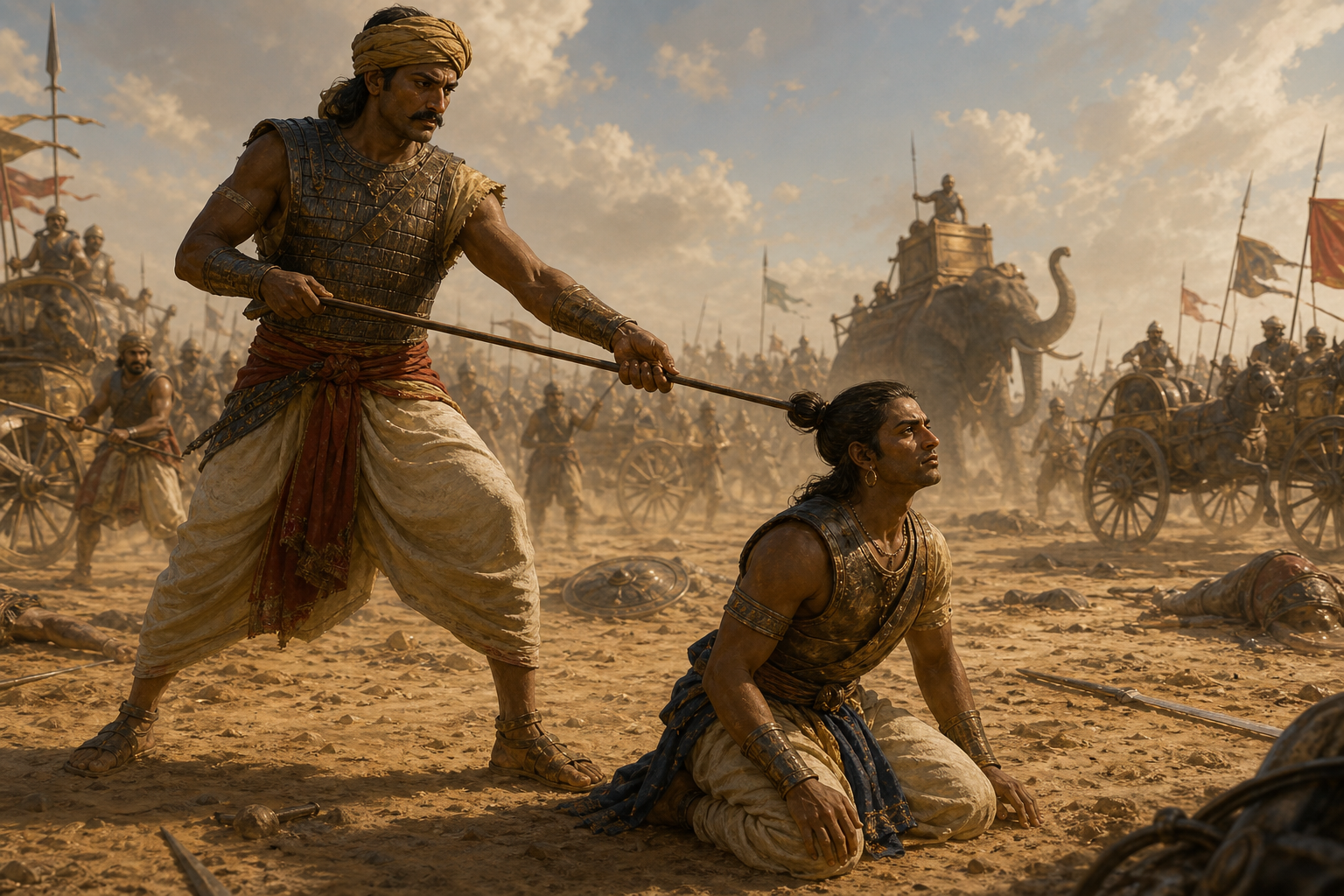
If you encountered kachagrahas in a list of Mahabharata weapons and pictured another blade, missile, or celestial weapon, the name points in a different direction. A kachagraha was a hair-seizing implement associated with capturing and restraining an opponent.
That distinction matters. It shows you a battlefield concerned not only with delivering destructive force, but also with controlling a living adversary. Yet the term tells us much more about function than construction. Reading it responsibly means holding on to that clear function without turning a sparse description into an elaborate mechanical reconstruction.
The name gives us a function, not a complete blueprint
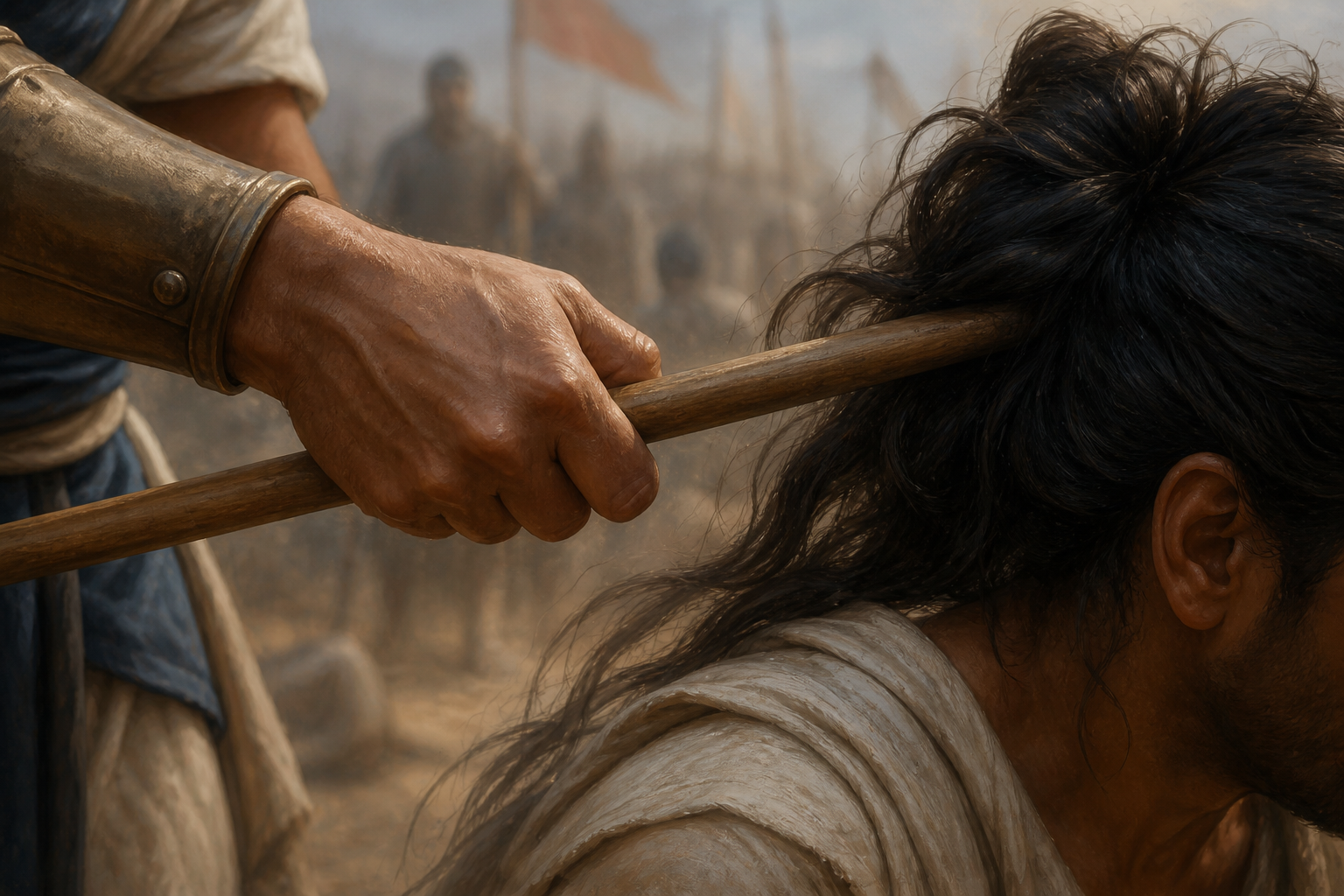
The safest definition is deliberately narrow: a kachagraha is a weapon or implement intended to seize an enemy by the hair. The definition identifies three connected elements: the bodily target, the act of grasping, and the immediate purpose of gaining control.
- Target: the opponent’s hair.
- Action: seizing or holding rather than merely striking.
- Tactical purpose: capture, restraint, or control of the opponent’s movement.
What the name does not give you is equally important. It does not, by itself, establish the implement’s material, dimensions, exact shape, reach, method of manufacture, or manner of carriage. A detailed picture featuring a particular hook, loop, clamp, shaft, or chain may be a modern reconstruction. It should not be mistaken for a detail contained in the term.
The English word weapon can also mislead if you take it to mean only an object designed to wound or kill. In this context, it is more useful to think of a combat implement. The kachagraha belonged to the practical equipment of confrontation, but its defining action was control through seizure.
Capture changes how you should picture the battlefield
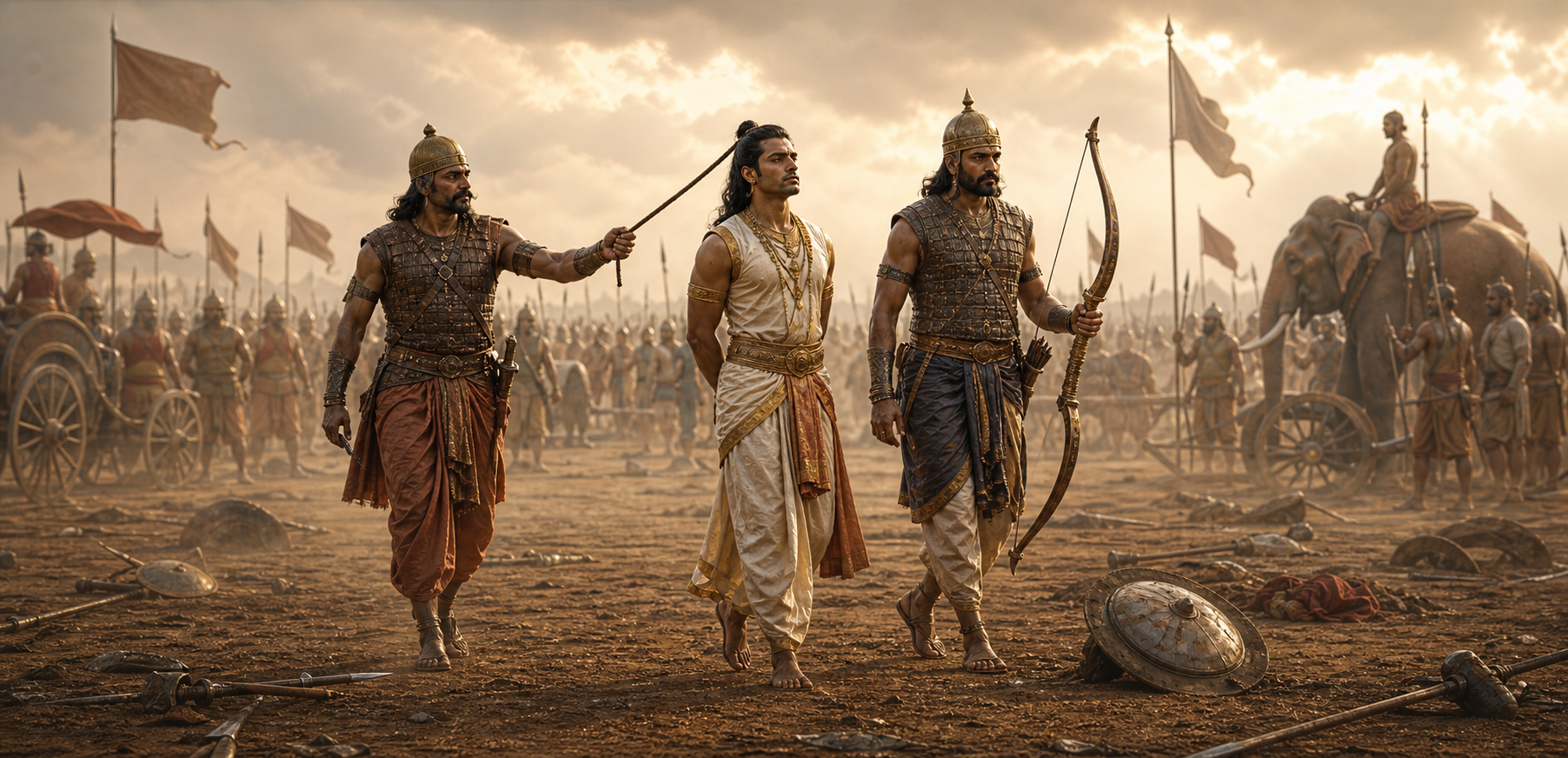
Popular retellings often compress Mahabharata warfare into duels involving bows, maces, swords, and astras. Kachagrahas bring another tactical layer into view. A combatant could be made ineffective not only by being wounded or killed, but also by being restrained, displaced, separated from effective action, or taken captive.
A hair-seizing function carries several basic mechanical implications. The user had to gain access to the opponent’s hair, establish a secure hold, and create enough leverage to interfere with resistance. Timing and bodily position would therefore matter. These are consequences of the stated function, not a preserved catalogue of named maneuvers.
If you are evaluating an illustration, reenactment, or narrative reconstruction, ask concrete questions. Is the opponent’s hair actually accessible? How does the user obtain and maintain the hold? Does the depicted design support restraint, or has the artist simply drawn a conventional striking weapon and attached an exotic name to it? These questions help you separate a plausible use from decorative invention.
Do not equate capture with gentleness. Seizing a person by the hair can inflict pain, cause injury, compromise balance, and expose the captive to further violence. A restraint function tells you what the implement was meant to accomplish tactically; it does not prove humane treatment, mercy, or a nonviolent intention.
Nor does the existence of a capture implement establish what happened after capture. Detention, release, humiliation, interrogation, exchange, or death are separate questions. They must be answered from the relevant episode, not inferred from the weapon’s name.
What kachagrahas reveal about a codified martial system
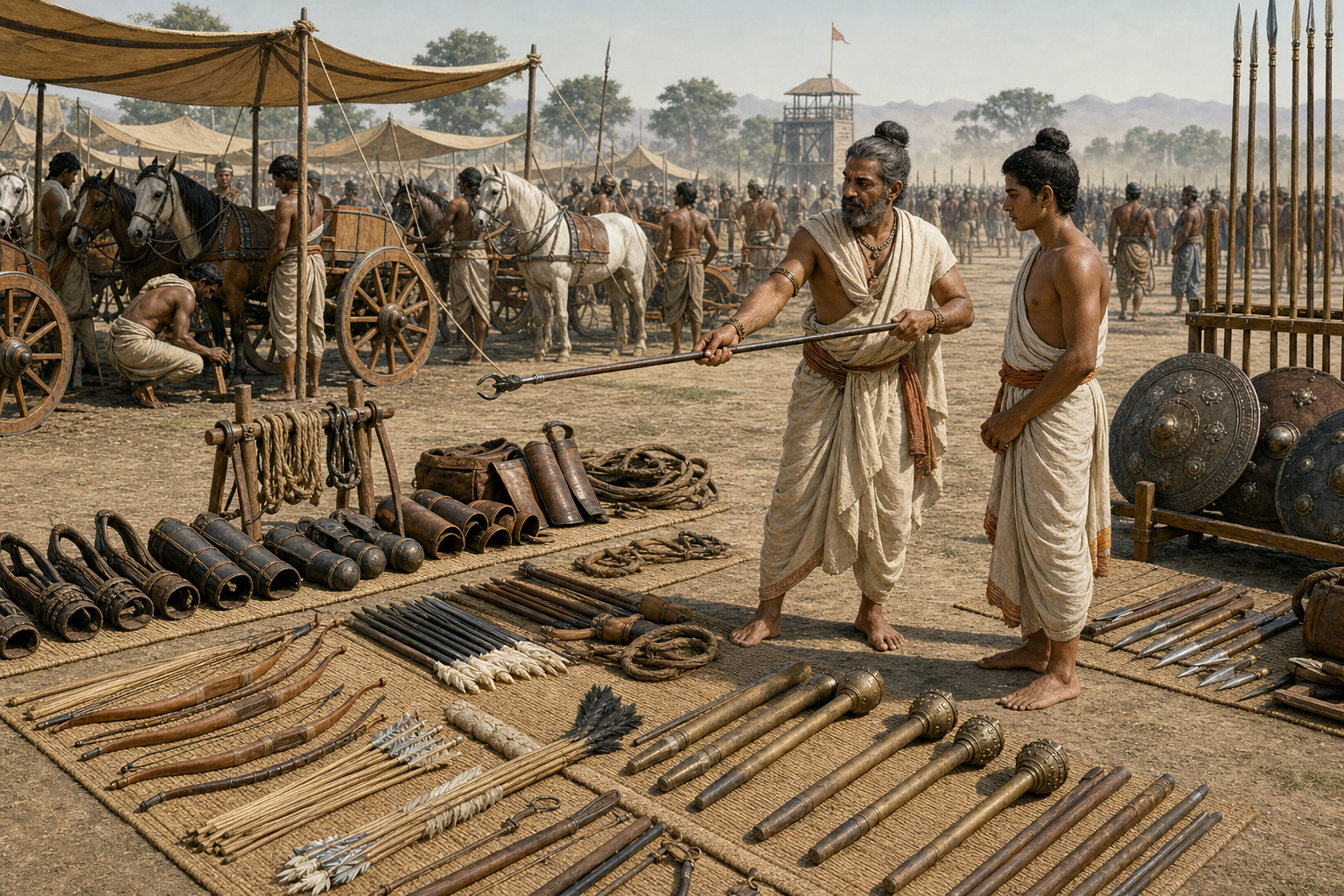
The significance of the kachagraha lies partly in specialization. A martial vocabulary that distinguishes an implement of restraint from destructive arms recognizes that different battlefield problems call for different tools. Here, sophistication means functional differentiation: equipment could be classified by the task it performed, including capture and tactical control.
That is a meaningful conclusion, but it has limits. The mention of a specialized weapon does not prove that every warrior carried one, that its design was uniform, or that it appeared frequently in battle. It also does not tell us whether the implement belonged to a particular class of combatant or was used from a chariot, on horseback, or on foot.
You should be especially cautious about attaching an ethical rule to the object. A tool of capture may operate within a codified martial culture, but function is not the same as moral authorization. Calling the kachagraha a weapon of dharmayuddha, or treating it as proof of a particular rule governing prisoners, would require support from the relevant textual context. The implement alone cannot carry that argument.
The sound historical conclusion is narrower and stronger: Mahabharata warfare included a conceptual place for specialized means of taking control of an adversary. That corrects the familiar image of ancient battle as an undifferentiated exchange of lethal blows without claiming more than the term can bear.
Use three levels when interpreting an obscure weapon name
Kachagrahas offer a useful method for reading other unfamiliar martial terms. Separate what a word establishes from what mechanics make plausible and what a modern creator has reconstructed.
- Begin with the lexical floor. State the smallest secure meaning. For kachagraha, that is a hair-seizing implement associated with capture or restraint.
- Add tactical inference carefully. A secure hold would be intended to limit resistance or movement. Present that as a functional inference, not as a quoted battlefield procedure.
- Label visual reconstruction honestly. Any precise design requires more support than the name alone supplies. If a model or illustration chooses a particular mechanism, call it an interpretation.
A careful description would say: “Kachagrahas were hair-seizing implements used for capture and tactical control in Mahabharata warfare.” That sentence preserves the distinctive fact while keeping the uncertainty visible.
An overconfident description might identify a specific metal, fastening system, shaft length, deployment platform, or standard maneuver without textual support. Each extra detail can make the object feel more vivid, but vividness is not verification. Several small assumptions can quietly harden into a fictional technical specification.
If you need to make a more precise claim for teaching, publication, or historical art, return to the Mahabharata passage and the edition or translation you are using. Record the book, chapter, and verse; check whether the Sanskrit term is retained or interpreted; and distinguish information in the passage from a translator’s explanatory choice. Do not backfill missing details from an unattributed modern image.
Key takeaways
- A kachagraha was defined by hair-seizing and belonged to the capture, restraint, and control side of warfare.
- The term identifies its target and immediate purpose more securely than its exact physical design.
- Access, grip, timing, and leverage are reasonable mechanical implications, but they should not be presented as recorded maneuvers.
- A restraint weapon was not necessarily painless, merciful, or governed by a special ethical rule.
- The kachagraha supports a picture of functionally differentiated warfare, not claims about universal issue, frequency, material, or standard construction.
When you next encounter an obscure Mahabharata weapon, resist the urge to turn its name immediately into a hardware drawing. Begin with the action the term actually names. Add tactical reasoning as reasoning, and add physical detail only when the passage supports it. For kachagrahas, that discipline preserves the most revealing point: control of an opponent was itself a distinct problem of warfare, with an implement named for the task.
References
