
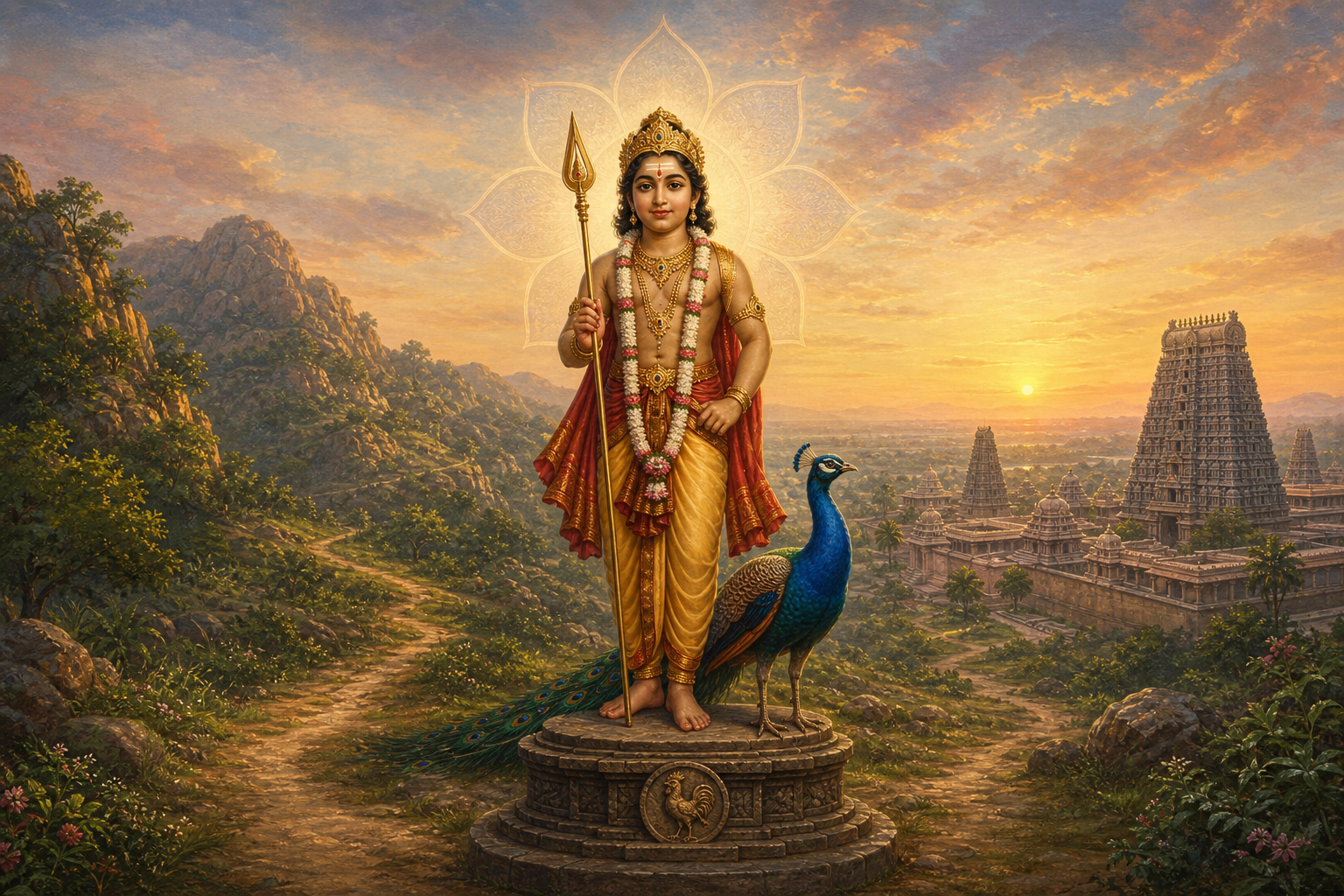
You may have encountered a neat claim: Murugan began as the Tamil hill deity Seyon, while Skanda or Karttikeya was a northern Sanskritic god imposed on him later. It sounds decisive because it turns genuine regional differences into a story of conquest and replacement.
If you are trying to decide whether that story is history, theology, or modern politics, do not begin by choosing between Tamil identity and Hindu continuity. Begin with a more disciplined question: what evidence would distinguish a distinct regional expression of one deity from two unrelated gods who were subsequently merged?
State the separation claim without letting it prove itself
The strongest version of the separation narrative makes a sequence of claims. Murugan first appears as Seyon, the red deity of the Tamil kurinji, or hill, landscape. His worship involves the possession-dance of the Velan priest. This early form supposedly lacks six faces, the Krittikas, and Vedic parentage. Skanda is then presented as a northern war god from Sanskrit literature whose biography was attached to Seyon when Brahminical religion expanded south.
- Claim one: Early Tamil worship had its own name, landscape, priestly role, and ritual manner.
- Claim two: Some attributes prominent in epic and later iconography are not explicit in every early Tamil description.
- Claim three: Puranic genealogy became increasingly important in the way the deity was narrated.
- Conclusion: Murugan and Skanda must therefore have begun as unrelated gods, and their identification must have been an external appropriation.
The conclusion does not automatically follow from the preceding claims. A local form can possess a distinctive landscape, ritual vocabulary, and name without being outside a wider religious family. A biography can become fuller over time without replacing an unrelated deity. The absence of an attribute from one surviving description also does not prove that the worshippers rejected, or had never encountered, that attribute.
This is the first distinction to insist upon whenever someone uses the word “originally.” Earlier attestation of one description is not by itself evidence of an originally separate divine identity. To establish separation, the argument needs positive evidence that two communities treated Murugan and Skanda as unrelated before an identifiable merger occurred. Differences alone establish variation; they do not establish rupture.
Follow the recurring cluster, not a spelling test
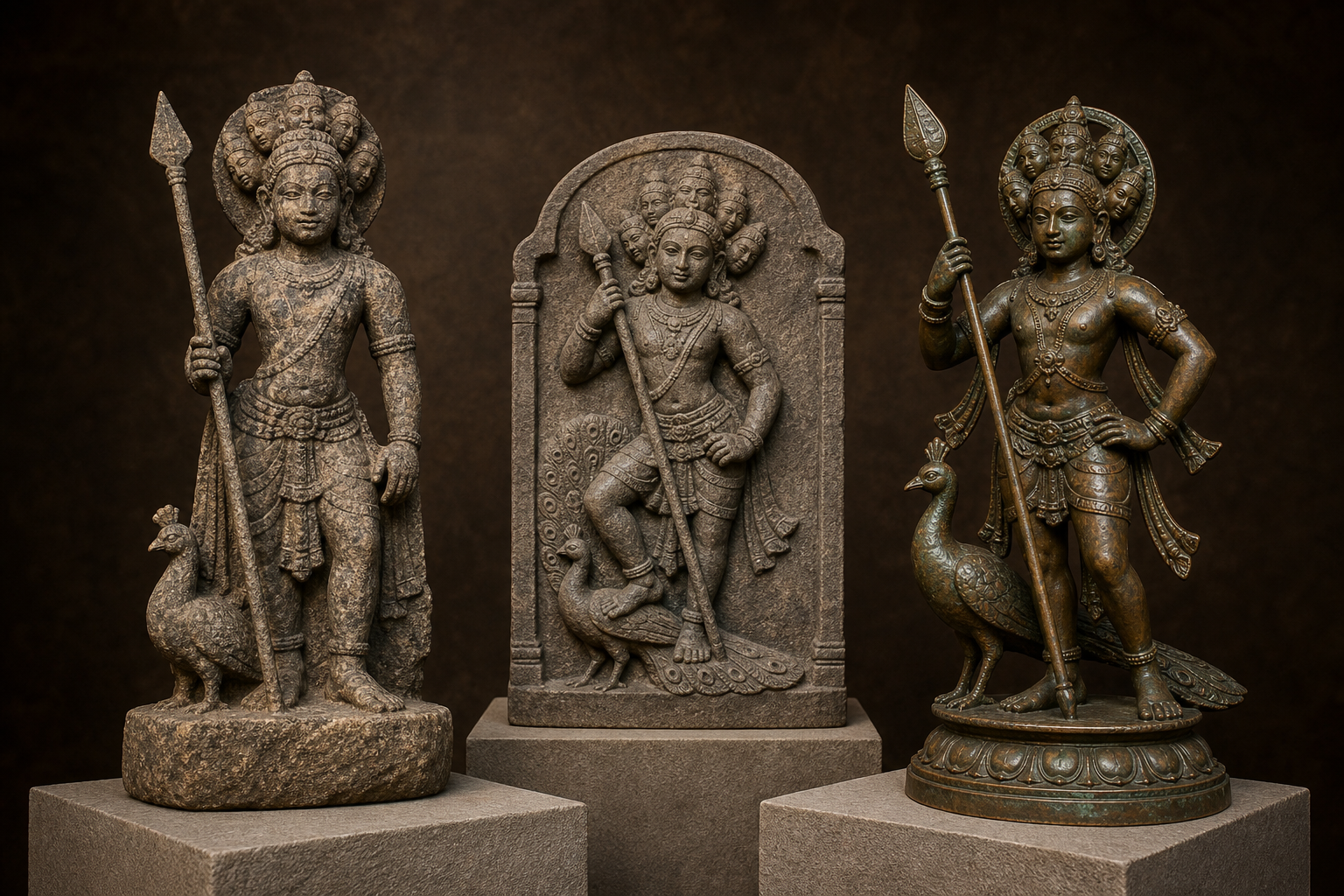
A divine identity is rarely preserved by one invariant name. Murugan, Skanda, Guha, Kumara, and Karttikeya belong to different linguistic and devotional settings, so a name-by-name comparison settles little. The more useful test is whether a distinctive cluster of images and relationships recurs across the relevant bodies of tradition.
| Material to examine | Recurring marker | What it contributes | What it cannot prove alone |
|---|---|---|---|
| Rigvedic imagery | A fiery child connected with seven river-mothers | An early Indic reservoir joining divine childhood, fire, and plural motherhood | The complete identity of every later regional form |
| Harappan seal interpretation | A proposed six-star figure | A possible early appearance of the sixfold motif | A named deity or an uninterrupted cult, because an image without an explicit identification remains open to interpretation |
| Mahabharata account | A six-faced infant nursed by the Krittikas | A joined narrative of divine childhood, multiple mothers, and sixfold form | The date or meaning of every Tamil ritual associated with Murugan |
| Sangam Tamil poetry | The lord associated with six abodes | A Tamil sacred geography in which sixness is integral rather than incidental | Uniform practice across every Tamil region or community |
| Early Tamil devotion | Vedic ritual and village possession practice appearing side by side | Evidence that liturgical and local modes could coexist within the same devotional world | Identical rites, social roles, or theological emphasis in every setting |
No single row should be asked to carry the whole case. The Harappan identification is necessarily more interpretive than a literary account that supplies relationships and attributes. A verbal resemblance by itself may be accidental. Even the number six, taken in isolation, would not establish identity.
The cumulative pattern is more significant. Divine childhood, fiery character, plural motherhood, sixfold imagery, and a Tamil geography of six abodes do not amount to a mere shared syllable. The recurrence makes a simple story of two wholly disconnected gods harder to sustain. If someone disputes one connection, especially the seal interpretation, ask whether the remaining constellation still requires explanation. Historical reasoning should neither depend on its most uncertain item nor discard an entire pattern because one item is contestable.
This approach also prevents an easy mistake made by defenders of continuity: declaring that every early image must already contain the entire later Puranic biography. Continuity does not require every feature to appear everywhere at once. It requires enough persistent relationships, symbols, and devotional identifications to make development within a tradition more plausible than a merger of strangers.
Ritual diversity is not evidence of religious conquest
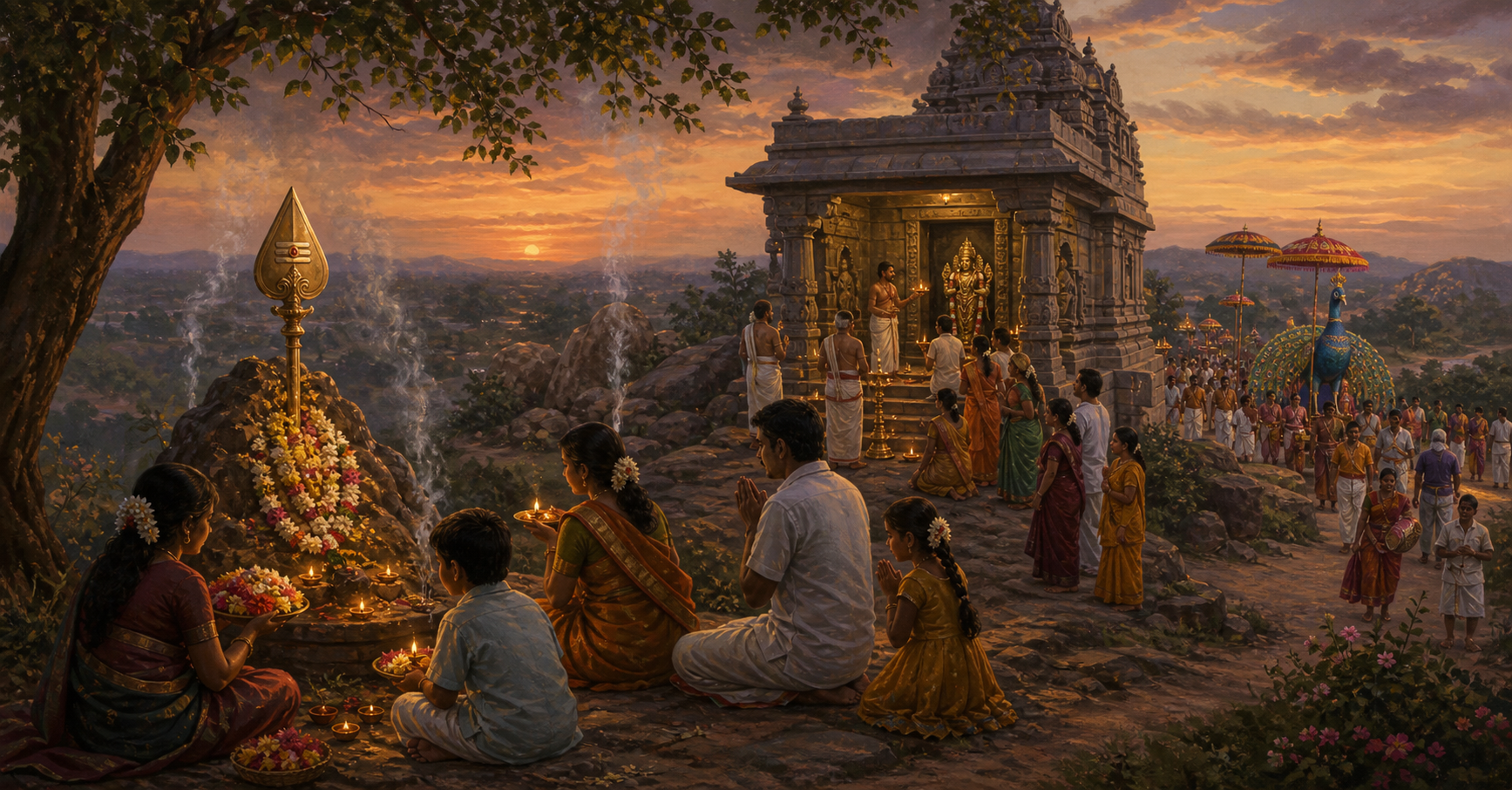
The separation narrative gains much of its force by contrasting the possession-dance of a Tamil Velan priest with Vedic ritual. One is labelled local, ecstatic, and tribal; the other is labelled Sanskritic, textual, and foreign. Once those labels are accepted as mutually exclusive, the conclusion has already been built into the categories.
Yet Hindu practice routinely permits several ritual registers around one deity. Temple liturgy, household worship, pilgrimage, festival vows, oral praise, and community-specific rites need not share one texture before they can share a sacred centre. Different ritual forms may reflect setting, community, purpose, and lineage rather than competing divine identities.
The relevant Tamil evidence is therefore not merely that a local possession practice existed. It is that Vedic ritual and village practice are presented as coexisting from the earliest attested Tamil devotional setting. Coexistence does not prove that every rite had a Vedic origin. It does, however, challenge a model that treats the two ritual worlds as natural enemies, one of which could appear only after subduing the other.
When you encounter an appropriation claim, ask for its mechanism. Who introduced the supposedly foreign identification? When did it happen? Which text, inscription, institution, or change in worship records the transition? Is there evidence that devotees previously treated the two gods as unrelated? Did a new genealogy displace an older identity, or did it elaborate relationships already accepted in practice?
If those questions receive only another list of regional differences, the argument has not demonstrated a merger. It has redescribed diversity as conflict. A serious historical case must show the boundary before it can claim that someone crossed or erased it.
Keep ancient identity and modern political purpose separate
The modern separation narrative has consequences beyond the dating of a myth. By defining Murugan as authentically Tamil only after removing Skanda, Karttikeya, the Krittikas, and Vedic connections, it turns Tamilness and Hindu civilisational continuity into opposing choices. That binary can then be used to portray shared Hindu forms as evidence of cultural intrusion rather than exchange, development, or internal plurality.
A contemporary Hindu critique further alleges that a roughly 50-year academic and evangelical campaign has sought to detach Murugan from Skanda so that Murugan can be reinterpreted as a “misremembered Christ”. This is a serious allegation about modern motives and institutional use. It should be examined independently rather than treated as automatic proof of ancient continuity.
Two shortcuts should be refused. The first dismisses continuity because its defenders care about Hindu unity. A person’s political commitment does not make recurring textual and ritual markers disappear. The second proves continuity by presuming an evangelical conspiracy. Even a documented modern campaign would show how an identity is being used now; it would not, by itself, establish what a Rigvedic image or Sangam expression meant in its original setting.
You can keep the questions separate with a three-pass reading method:
- Mark the historical evidence. Identify the actual name, image, relationship, ritual description, or sacred geography being discussed.
- Mark the interpretation. Notice where a writer moves from “these forms differ” to “these forms were unrelated,” or from “this feature appears later” to “this feature was imposed from outside.” That move requires an argument.
- Mark the motive claim. If an academic, Dravidianist, evangelical, or political program is alleged, look for named actors, dates, publications, institutions, and a traceable pattern of reinterpretation. Treat an unsupported attribution of motive as an allegation, even when you find it plausible.
This audit prevents archaeology, theology, and present-day political suspicion from being blended into one unfalsifiable story. It also makes a pro-Hindu response stronger. You can defend civilisational continuity without asking readers to accept every archaeological interpretation or every claim about an opponent’s intentions.
Key takeaways for evaluating the claim
- You do not have to choose between Murugan’s Tamil distinctiveness and his identity as Skanda. Regional specificity and wider sacred continuity can coexist.
- Define what “separate” means. Different names, rites, landscapes, or degrees of narrative detail do not by themselves establish unrelated origins.
- Evaluate the full constellation: divine childhood, fire, plural motherhood, the Krittikas, sixfold form, six abodes, and the coexistence of Tamil and Vedic modes.
- Do not make one disputed image carry the argument. The case is strongest when several independent markers converge.
- Ask for positive evidence of a merger: a prior boundary, an identifiable transition, and some indication that worshippers once regarded Murugan and Skanda as different gods.
- Test modern motive claims separately. A political or evangelical use of separation may matter greatly, but it neither proves nor disproves ancient identity on its own.
The next time someone says Murugan was “originally” separate, put the evidence into five columns: corpus or setting, divine name, attributes, ritual context, and direct evidence of merger. If the fifth column remains empty, you are looking at a hypothesis of rupture, not a demonstrated historical event. Tamil devotion deserves better than being reduced to an anti-Vedic slogan, and Hindu continuity is best defended by questions precise enough to expose where evidence ends and ideology begins.
References
