

If you came looking for the simple answer, the Akshaya Patra is the inexhaustible food vessel Bhagwan Surya gave the Pandavas and Ma Draupadi when they faced hunger during their forest exile. But if you remember it only as a wondrous bowl, you miss the part of the episode that can change how you receive, use, and share food.
The vessel joins bodily need to divine grace. It also asks what a person should do when scarcity gives way to sufficiency. That is why the Akshaya Patra belongs not merely to the marvels of the Mahabharata, but to a larger Dharmic understanding of gratitude, stewardship, and annadanam.
Tell the episode by beginning with hunger, not magic
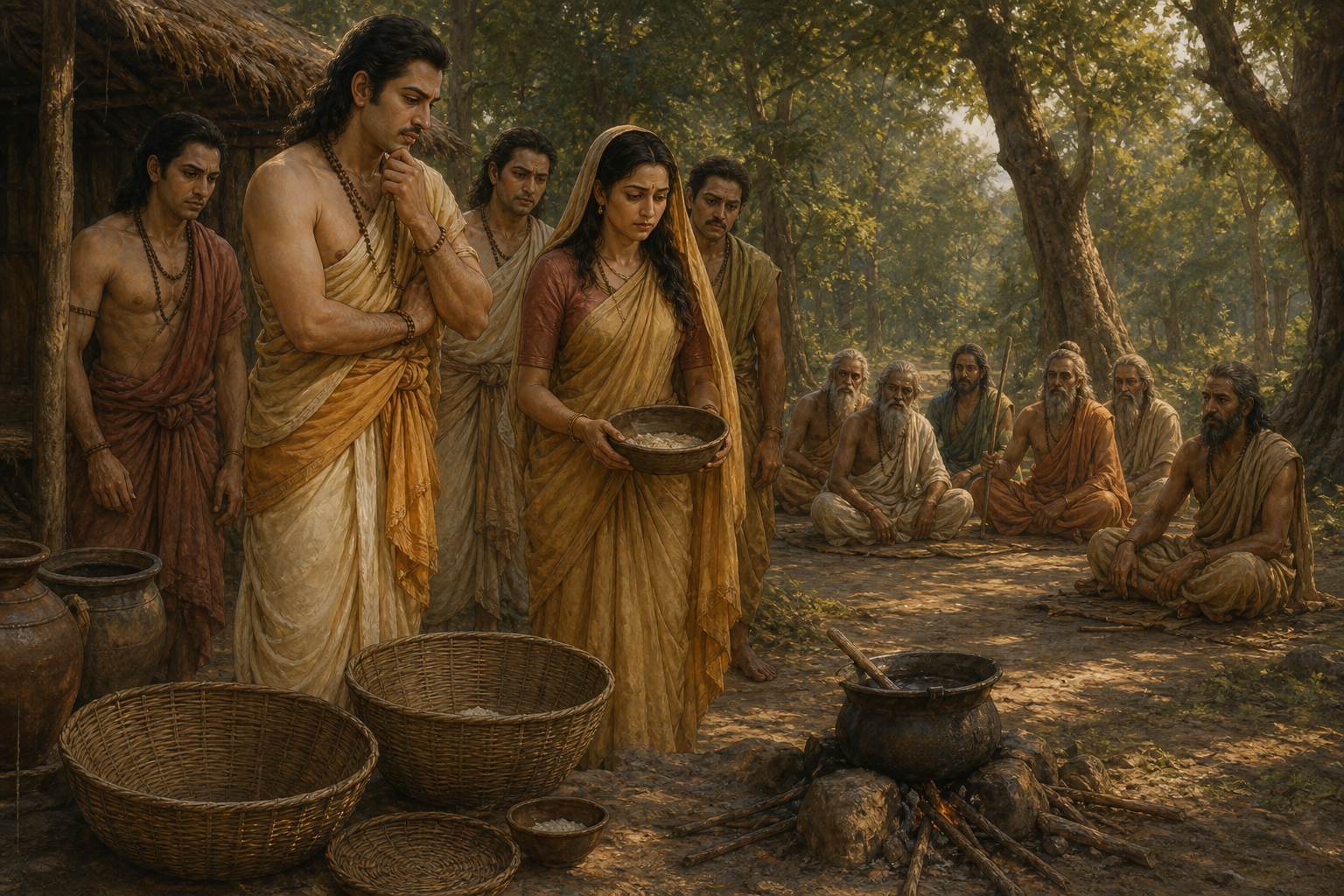
A clear retelling has three essential movements:
- The Pandavas and Draupadi are living in the forest during their exile, where hunger has become part of their hardship.
- Bhagwan Surya grants them the Akshaya Patra as a boon.
- The vessel provides the food that keeps hunger from overwhelming them thereafter.
This order matters. Begin with deprivation and the vessel appears as an answer to a real human need. Begin with the miraculous object and the episode can shrink into entertainment: heroic people acquire an enchanted possession. The Mahabharata setting makes the more serious point. Even celebrated warriors and a royal household remain dependent on food, the natural order, and divine grace.
If you are explaining the episode to a child, student, or congregation, ask one question before discussing symbolism: what problem did the gift solve? The answer is hunger. That keeps the interpretation anchored in the narrative rather than turning the Akshaya Patra into a vague symbol of getting whatever one wants.
If you are writing or teaching from a particular Mahabharata edition, make another distinction: a faithful paraphrase is not an exact quotation. Do not place invented dialogue in quotation marks or attach a verse number unless you have checked the parva, chapter, edition, and translation. You can communicate the central event accurately without manufacturing textual precision.
Akshaya describes a responsibility, not just a supply
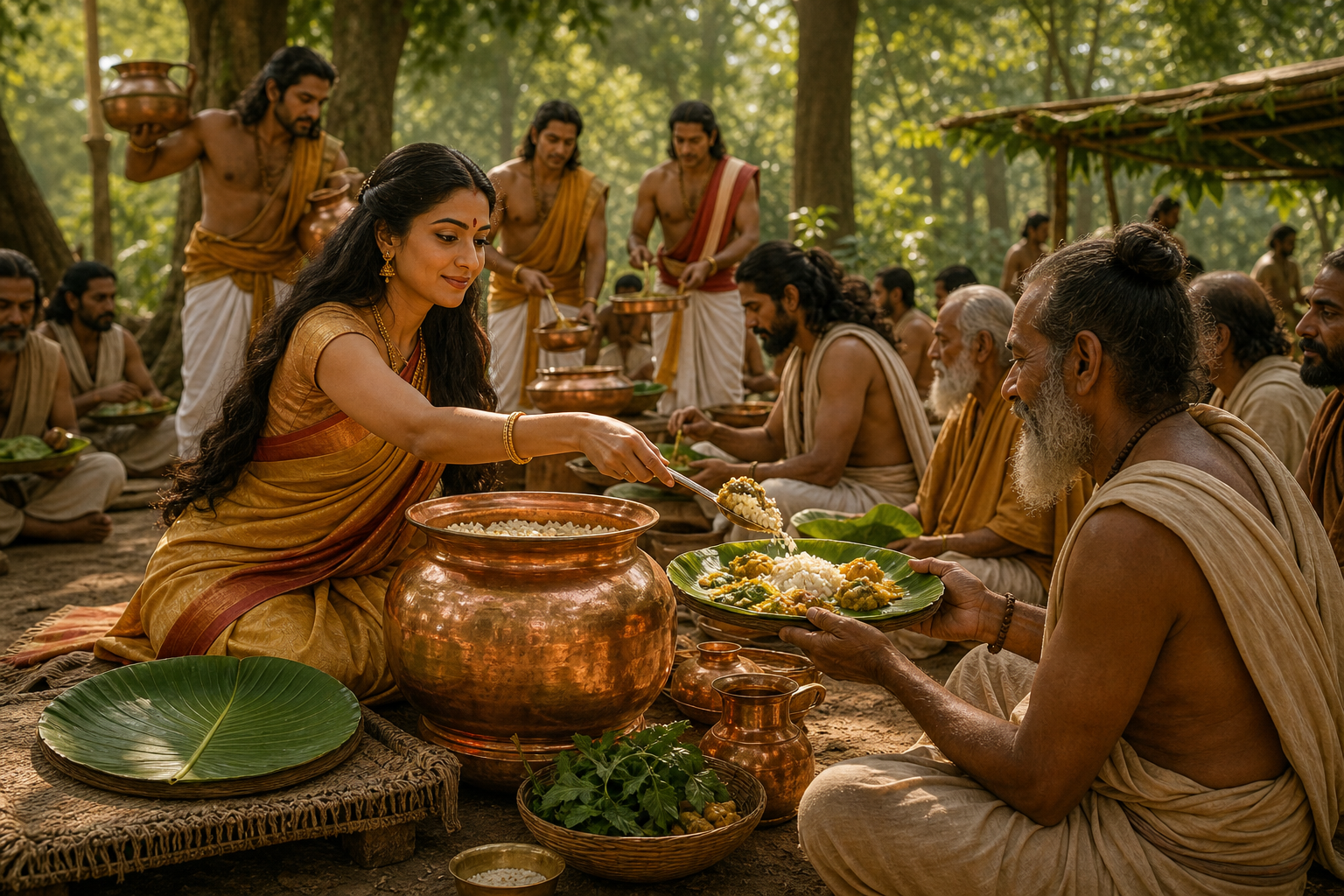
Akshaya carries the sense of something that is not exhausted or diminished, while patra means a vessel. Yet the moral importance of the name does not rest on quantity alone. The vessel is given in a crisis and directed toward sustaining life. Its abundance has a purpose.
You can read that purpose through three relationships:
- Dependence: human strength does not abolish bodily need. Hunger can humble a king, warrior, ascetic, or householder.
- Grace: Surya’s boon meets a material need. The episode does not ask you to despise food in order to become spiritual.
- Stewardship: receiving enough creates an obligation to use that sufficiency well. Abundance becomes Dharmic when it protects life rather than merely displaying status.
A parallel tradition makes the outward movement especially clear. Bhagwan Brahma gave Prahlada an Akshaya Patra at his coronation, and Prahlada used it to relieve hunger among his people. The setting has changed from forest hardship to royal responsibility, but nourishment remains the measure of the gift.
That parallel gives you a practical test for any claim about prosperity: who besides the possessor is sustained by it? If abundance ends in private accumulation, it has preserved the image of akshaya while losing its ethical direction. If it moves toward hungry people, dependants, guests, or a wider community, it begins to resemble the purpose for which these vessels are remembered.
Keep Surya’s gift distinct from Annapurna’s vessel
Two related images are often placed together, but they should not be collapsed into one event. Surya is the giver of the Pandavas’ Akshaya Patra. Mata Annapurna, a form of Mata Parvati, is depicted holding a golden food vessel and offering nourishment to living beings. Their connection is the sacredness of nourishment; their roles in the traditions are not interchangeable.
This distinction is useful whenever you prepare a caption, lesson, festival talk, or devotional post. Do not say that Annapurna gave the vessel to the Pandavas. A more accurate explanation is simple: Surya grants the vessel in the Mahabharata episode, while Annapurna embodies the divine fullness that nourishes life.
Annapurna’s iconography also helps you notice that a vessel fulfils its purpose through giving. One hand holds food; the other serves it. Possession and distribution belong together. Her traditions extend nourishment beyond food to knowledge, wisdom, courage, spiritual energy, and strength of mind and body. The extension does not make physical hunger less important. It recognises that a well-sustained life requires more than accumulation.
The same connection explains why gratitude belongs at the meal itself. Annapurna shlokas composed by Adi Shankaracharya are recited in thanksgiving for food. If you know a prayer from your family or sampradaya, preserve it. If you do not, use plain words rather than passing off a newly composed sentence as scripture: “May this food sustain right action, and may nourishment reach those who need it.”
Carry the Akshaya Patra from memory into practice

You do not honour this teaching merely by admiring a representation of the vessel. Bring its sequence into ordinary life: recognise dependence, receive food with gratitude, prevent needless loss, and move part of your sufficiency outward.
- Pause before the first bite. Thank the divine, the earth, and the people whose work brought the meal to you. The timing matters: gratitude before consumption trains attention better than a vague intention to be thankful later.
- Serve a modest first portion. Anyone who needs more can take more; food discarded from an overloaded plate cannot nourish another person. This small household rule turns reverence into a repeatable habit.
- Give annadanam on a fixed rhythm. Choose a weekly, monthly, or festival commitment and decide its place in your budget before discretionary spending absorbs the money. You might support a temple meal, an established community kitchen, or a household facing difficulty.
- Ask what will actually help. When giving ingredients or groceries, find out what the recipient can cook, store, and eat. Generosity is measured by nourishment delivered, not by the convenience of the giver.
- Connect Akshaya Tritiya with provision as well as acquisition. The observance is associated with Annapurna, the purchase of gold, and the beginning of new ventures. If you mark the day materially, pair that act with a food offering or donation so that akshaya does not come to mean personal increase alone.
None of these actions requires a grand public gesture. A practice becomes dependable when its trigger is precise: before each meal, when portions are served, on the first day of each month, or as part of a named festival. Choose one trigger you will remember and attach one action to it.
Key takeaways
- The Akshaya Patra in the Mahabharata is a boon from Bhagwan Surya to the Pandavas and Draupadi during their forest exile.
- The episode begins with hunger, so the vessel should be understood first as sacred provision rather than a generic wish-granting possession.
- Surya’s role in the Pandava episode should not be confused with Annapurna’s broader iconography as the divine giver of nourishment.
- Prahlada’s use of an Akshaya Patra for his people shows how abundance can move from private relief to public duty.
- Gratitude before meals, careful portions, and recurring annadanam are concrete ways to carry the teaching into daily life.
At your next meal, do one thing before you eat: identify the nourishment as received, not self-created. Then choose where a portion of your own sufficiency will go. That movement—from grace received to food shared—is where the Akshaya Patra stops being only an object in an ancient narrative and becomes a living discipline.
References
