

If you have encountered the claim that Tryambaka chose Lava and Kusha, your first question may be what kind of choice this was. Is it a statement about genealogy, a divine event, a symbol of rightful succession, or all three?
The most useful reading keeps those layers distinct without tearing them apart. Tryambaka belongs to the Ikshvaku inheritance, but heredity alone does not explain its passage to the next bearers. Recognition does. That difference turns a story about possession into a lesson about who is fit to carry inherited power.
Hereditary and chosen are not contradictory
The secure core of the tradition is precise: Tryambaka is presented as a hereditary divine weapon of the Ikshvaku dynasty, with Lava and Kusha recognized as its heirs. Retellings may also render the name as Trayambaka. The spelling variation should not distract you from the relationship among the weapon, the lineage, and the chosen bearers.
The words hereditary and chosen answer different questions. Hereditary tells you where the claim originates: the weapon belongs to an established dynastic inheritance. Chosen tells you whether descent automatically completes that claim. It does not. The heirs must be recognized as capable of receiving what the lineage carries.
- Lineage establishes continuity. Lava and Kusha do not encounter Tryambaka as unrelated seekers of power.
- Recognition establishes fitness. The inheritance is not reduced to an object passing mechanically from one owner to another.
- The weapon establishes responsibility. What is received is power joined to the memory and obligations of the dynasty.
This distinction corrects two opposite mistakes. One is to treat birth as sufficient proof of worthiness. The other is to treat ancestry as irrelevant once personal virtue enters the story. The motif holds both together: descent places the heirs within a field of responsibility, while recognition confirms their ability to bear it.
When you meet another Dharmic account of succession, ask two separate questions: Who belongs to the inheritance, and who proves able to carry it? If you collapse those questions, you will miss the moral work being done by the narrative.
A sacred weapon carries more than destructive force
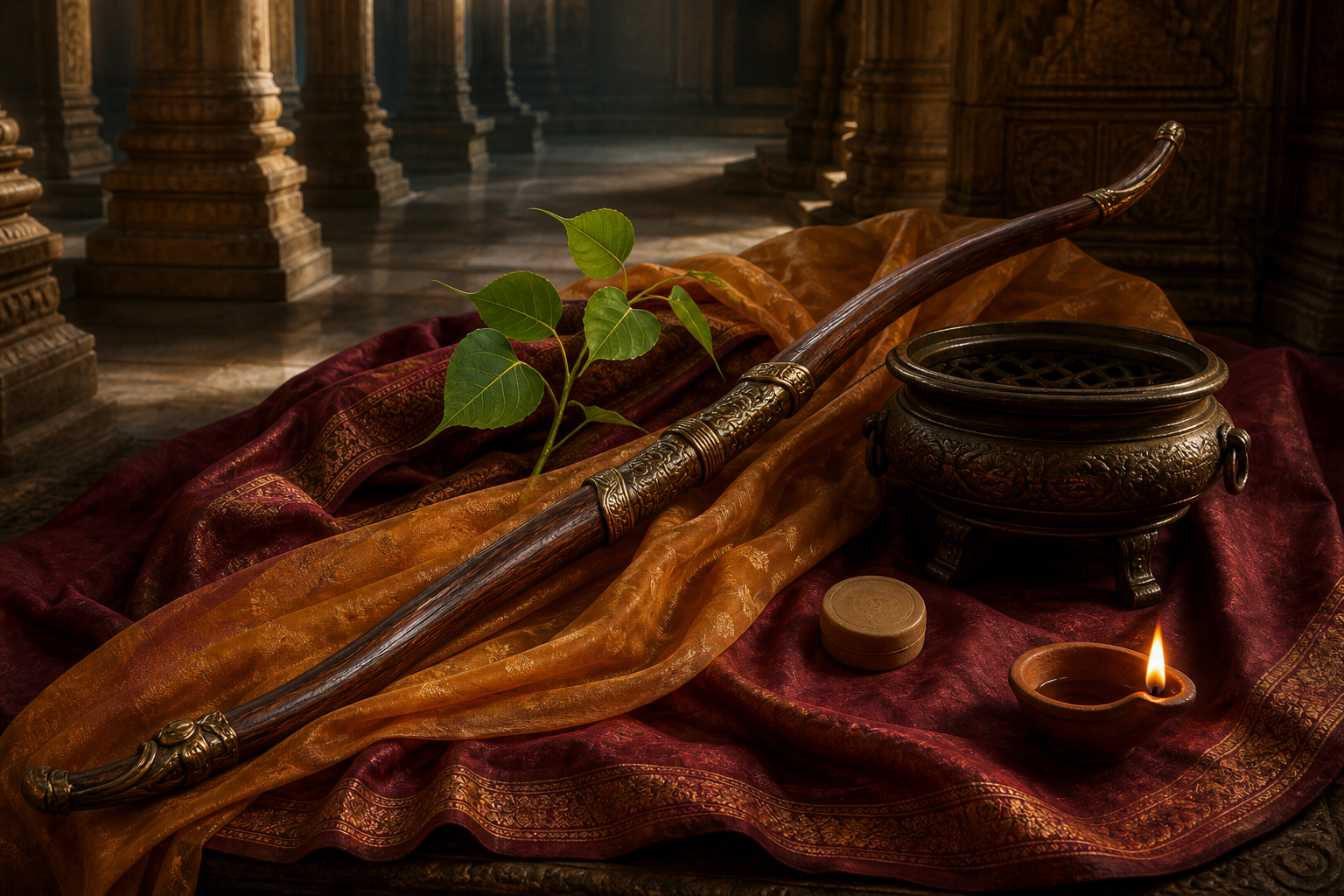
A modern reader can easily imagine a weapon as equipment: valuable, dangerous, and transferable. Tryambaka does not fit comfortably into that category. Sacred weapons in this Dharmic frame are understood as expressions of cosmic purpose, bearers of lineage, and witnesses to dharma. Their meaning therefore depends on the relationship among power, bearer, and rightful use.
Tryambaka can be read in three connected ways. A devotional reading receives it as a divine weapon capable of recognizing its heirs. A literary reading sees it as an active embodiment of the Ikshvaku mandate. An ethical reading asks why power should acknowledge one bearer rather than simply submit to whoever seizes it.
You do not have to destroy one level to make room for another. A symbolic meaning does not require a devotee to deny the sacred reality of the weapon. A devotional meaning does not prevent you from noticing the story’s teaching about authority. The layers reinforce the same principle: possession and legitimacy are not identical.
- As memory, Tryambaka joins a present heir to the obligations of an ancestral line.
- As a test, its recognition separates a rightful bearer from a mere claimant.
- As power, it makes the bearer’s moral condition consequential rather than private.
- As witness, it places the exercise of force under dharma instead of allowing force to define what is right.
This is why reducing Tryambaka to a piece of superior military technology leaves the central question unanswered. The important issue is not merely what the weapon can do. It is what kind of person may bear it without severing power from dharma.
The motif should not be used to romanticize violence. Its decisive moment is recognition, not destruction. If you teach this tradition to children or discuss it in a study circle, begin with stewardship: the greater the inherited capacity, the greater the obligation to govern its use.
Why the recognition of both Lava and Kusha matters
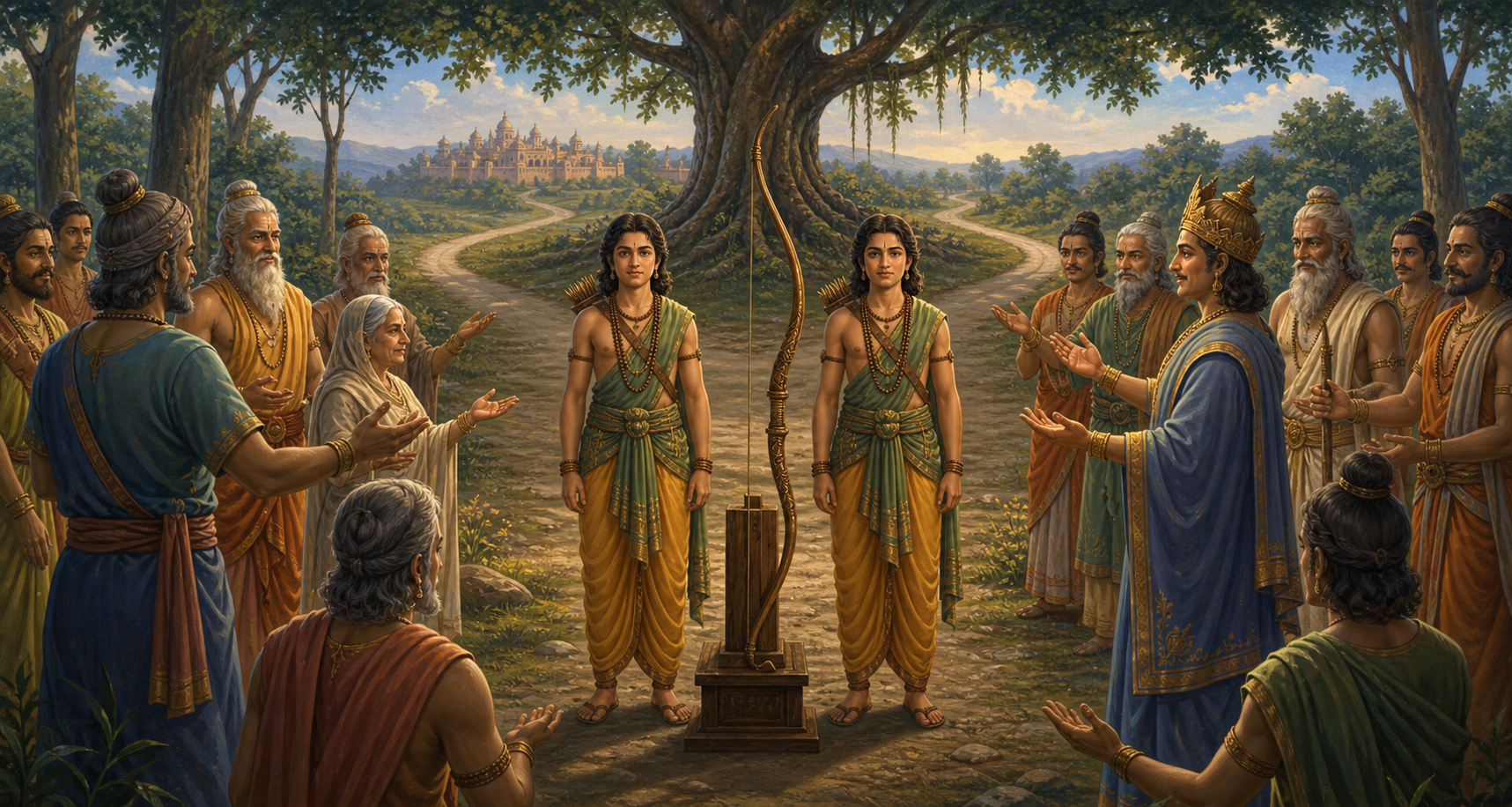
Lava and Kusha are named together. That grammatical detail matters. A careless retelling can flatten the episode into the familiar pattern of one object, one winner, and one exclusive successor. Tryambaka’s recognition instead places both heirs within the continuation of the Ikshvaku inheritance.
You should not build more history on that wording than it can support. The claim by itself does not establish a contest between the two, a sequence in which one was chosen before the other, a territorial settlement, or a detailed ceremony of transfer. If a fuller narration supplies such particulars, they can be examined there. They should not be invented merely to make the episode resemble a modern succession drama.
What the plural recognition does establish within this frame is more important: dynastic continuity need not be understood only as an exclusive prize. A sacred inheritance can recognize a shared fidelity to the lineage’s responsibilities. The emphasis shifts from defeating another claimant to proving able to preserve what has been entrusted.
This also changes how you should speak about Lava and Kusha. Do not casually turn them into rivals when the point before you is their recognition. Do not silently replace both heirs with an unnamed singular successor. Preserve the plurality unless you have a clear textual reason not to do so.
The lesson reaches beyond royal genealogy. Families, temples, cultural institutions, and teaching lineages all face the same temptation: to confuse control of an inheritance with fitness to sustain it. A name, title, archive, office, or ritual role can be transferred formally while its purpose is lost. The Tryambaka motif asks whether the recipient can carry the inner obligation as well as the outer possession.
How to read and teach the motif responsibly

You can keep a discussion of Tryambaka both faithful and intellectually disciplined by moving through five steps.
- State the narrative kernel first. Tryambaka is the hereditary divine weapon of the Ikshvaku line, and it recognizes Lava and Kusha.
- Separate descent from fitness. The heirs belong to the lineage, but the language of choice prevents belonging from becoming automatic moral approval.
- Mark interpretation as interpretation. It is reasonable to read recognition as a sign of dharmic eligibility; it is not reasonable to invent an undocumented ritual, battle, construction, or chronology.
- Preserve the plural. Any explanation should account for the recognition of Lava and Kusha together rather than quietly rewriting the inheritance around one bearer.
- Translate the principle into a question. Ask what responsibility accompanies the inherited power and how the successor demonstrates fitness to carry it.
A simple three-sentence discipline is especially useful when you write or speak about the episode. Your first sentence should identify the received claim. Your second may explain its meaning. Your third may apply that meaning to present conduct. Keeping those sentences separate prevents an attractive interpretation from masquerading as an additional historical detail.
For example, the received claim is that Tryambaka belongs to the Ikshvaku inheritance and recognizes Lava and Kusha. The interpretation is that rightful succession requires more than biological descent. The application is that anyone receiving cultural, institutional, or familial authority should treat it as a duty to be justified through conduct, not as immunity granted by a name.
This method also guards against two modern distortions. The first uses lineage to excuse an unworthy heir. The second rejects lineage altogether and treats every inheritance as arbitrary possession. Tryambaka permits neither move. Lineage is real enough to carry memory, while dharmic recognition is necessary enough to judge the bearer.
Key takeaways
- Tryambaka is the divine hereditary weapon in the Ikshvaku lineage; it should not be treated as a generic weapon detached from that inheritance.
- Hereditary identifies the field of succession, while chosen identifies the heirs’ fitness. The two ideas perform different work.
- A sacred weapon carries dynastic memory and moral responsibility as well as power.
- The recognition of Lava and Kusha is plural. Do not add an unsupported rivalry or reduce both heirs to a single successor.
- The motif’s practical lesson is stewardship: receiving an inheritance creates an obligation to become worthy of its purpose.
The next time you encounter a claim about a divine weapon or royal lineage, write down two things before interpreting it: what was inherited and what qualified the heir. That small distinction will help you read Dharmic narratives with devotion, precision, and fewer assumptions.
References
