
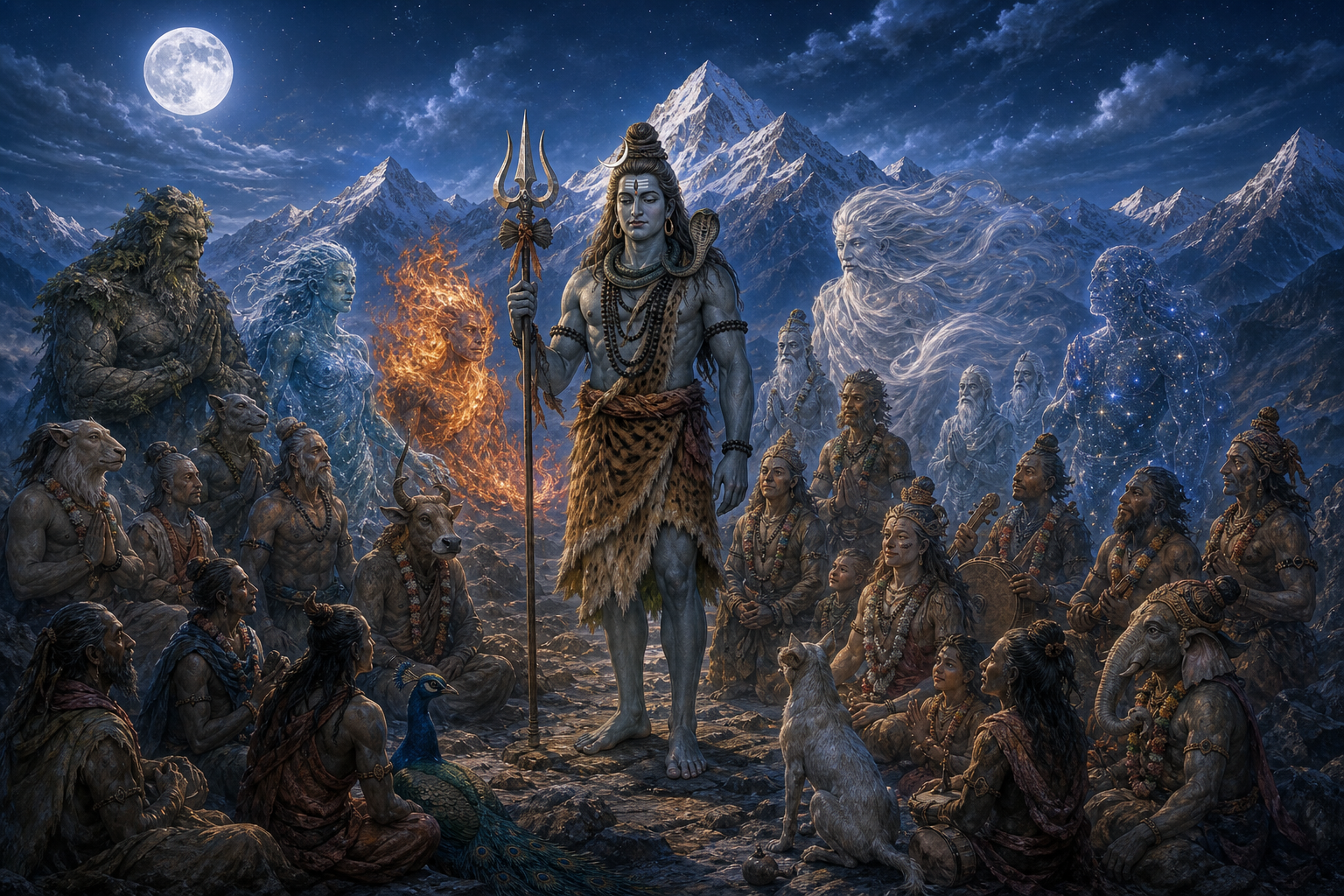
If you searched for “Shiva bhootas” after seeing a fierce image, hearing the title Bhootadhipati, or encountering the word bhoota in a story, you may be wondering whether it simply means that Shiva commands ghosts. That translation is memorable, but it is too narrow to carry the idea.
The more useful question is not, “Are the bhootas ghosts?” It is, “What does bhoota mean in this particular context, and what does Shiva’s lordship over it reveal?” Once you ask that, the imagery stops looking like an isolated supernatural curiosity and begins to disclose a coherent vision of existence.
Do not let one English word decide the meaning

Bhoota is connected with the sense of that which has come into existence. Its range can therefore be broader than the English word “ghost.” Depending on context, it can point toward beings, manifested existence, or elemental forces. The correct reading must come from the sentence, story, image, or teaching in which the word appears.
This matters because a narrow translation quietly changes the theology. If bhoota is reduced to a frightening dead spirit, Bhootadhipati becomes little more than a title for the commander of a supernatural troop. If bhoota retains its wider sense, Shiva’s title points toward sovereignty over beings and forces that have entered manifestation, including powers that human beings find difficult, unsettling, or impossible to control.
You do not need to deny the spectral meaning wherever a particular context clearly requires it. You only need to resist making that one meaning universal. Translate after reading the context, not before it.
Bhootadhipati presents Shiva as lord of the whole field

Shiva is worshipped as Bhootadhipati: the ruler of bhootas, understood as beings and elemental powers. These forces are not portrayed as decorative attendants with no function. They can participate in protection as well as punishment, affecting the earth and the living and non-living world within it.
The crucial point is the relationship. Shiva is not merely another uncontrolled force among uncontrolled forces. He is their adhipati, their lord. The title places even troubling, fierce, or disruptive powers within a larger order. What appears chaotic from a limited human viewpoint is not necessarily outside sacred governance.
That gives you a precise way to read the symbolism. Do not begin with the appearance of the bhootas and decide that the scene represents evil. Begin with Shiva’s position in the scene. Ask what it means that the powers people fear are gathered under, restrained by, or related to divine lordship.
This is also why the title should not be turned into a crude opposition between a pure deity and an impure world. Shiva’s sovereignty is meaningful precisely because it is not confined to what society finds polished, comfortable, or easy to classify. The title directs attention to the breadth of divine rule, not to a small and socially approved corner of existence.
Three layers of symbolism can be held together

You will often understand Shiva’s bhootas more clearly if you hold three interpretive layers together. They are not competing definitions, and not every passage will emphasize them equally. They are practical questions to bring to what you are reading or viewing.
The cosmic layer: manifestation includes more than human life
The broad sense of bhoota prevents you from treating humanity as the measure of all existence. Living beings, non-living realities, and elemental powers belong to a field larger than personal preference. Shiva as Bhootadhipati signifies lordship across that field.
When a depiction feels strange, first notice whether its strangeness is challenging a human-centred idea of the sacred. A deity need not be surrounded only by familiar, attractive, or socially prestigious figures in order to be divine. The unfamiliar entourage may be precisely what communicates the scope of Shiva’s sovereignty.
The moral layer: fierceness is not the same as evil
A power capable of punishment is not automatically malicious, just as a power capable of protection is not automatically gentle in appearance. The relevant distinction is not pleasant versus unpleasant. It is whether the force stands inside an ordering relationship and what function it performs there.
This keeps you from applying a simplistic visual code in which serene forms are good and fierce forms are bad. In Shiva’s world, severity can have a protective boundary-setting function. That does not make every act of violence sacred, nor does symbolism provide a licence for human cruelty. It means only that divine order cannot be understood by appearance alone.
The contemplative layer: nothing manifested is outside the question of order
For personal reflection, Bhootadhipati can become a question rather than a slogan: which parts of existence do you assume must be excluded before the sacred can be present? Fear, change, decay, unfamiliarity, and forces beyond personal command can make the world feel divided into acceptable and unacceptable regions. Shiva’s title challenges that division.
This is an interpretive practice, not a claim that every discomfort should be welcomed or every danger ignored. The practical movement is from denial to discernment. You can acknowledge a difficult force, determine its actual character, set necessary boundaries, and still refuse to imagine that it exists beyond every possibility of order.
Use this method when you meet a reference to bhootas

The word appears in settings that may not be using it identically. A disciplined reading is better than importing the first dictionary equivalent you remember. Work through these steps:
- Locate the exact context. Is the term part of a divine title, a narrative, an explanation of nature, a ritual setting, or a description of particular beings? Do not assume that usage in one setting settles every other usage.
- Test the broad meaning first. Ask whether “that which has come into existence,” “being,” or “manifested force” makes the passage more coherent before narrowing the word to “ghost.”
- Identify the function. Are the bhootas protecting, punishing, accompanying, or simply being named as part of the manifested order? What they do is often more informative than how an illustration makes them look.
- Identify Shiva’s relationship to them. The title Bhootadhipati emphasizes lordship. Keep that ordering relationship at the centre rather than treating the bhootas as an independent spectacle.
- Separate a local telling from a universal definition. If you encounter a specific account of where certain bhootas came from, identify the text, sectarian setting, temple tradition, or regional context before presenting it as the single Hindu account.
- State the meaning without sensationalism. A sound short explanation is: “Bhoota can mean a being or manifested force; Shiva as Bhootadhipati is lord over such beings and powers.” Add “ghost” only when the immediate context supports it.
This method is especially useful when explaining the subject to someone encountering Hindu imagery from outside the tradition. It gives them enough clarity to avoid the false conclusion that unfamiliar or fearsome forms amount to the worship of evil. It also avoids the opposite mistake of erasing every unsettling feature and turning the symbolism into vague positivity.
There is an ethical reason to keep the language precise. Bhoota should not become a casual label for people you dislike, fear, or consider socially marginal. The symbolism expands the field of sacred sovereignty; it should not be used to strip human beings of dignity.
Key takeaways
- Bhoota has a wider semantic range than the English word “ghost” and carries the sense of something that has come into existence.
- In the title Bhootadhipati, Shiva is the lord of beings and elemental forces, not merely the commander of frightening spirits.
- The bhootas can represent powers associated with protection and punishment; a fierce appearance alone does not establish an evil nature.
- The central symbol is ordered relationship: difficult or unsettling forces remain under Shiva’s sovereignty.
- When reading a specific story or viewing an image, let its context determine which sense of bhoota is active.
- Do not convert one regional, sectarian, or narrative explanation into the only Hindu understanding without identifying its setting.
The next time you encounter Shiva with the bhootas, pause before translating the scene into the language of horror. Look first at the title, the function of the surrounding powers, and their relationship to Shiva. That small change in reading preserves both the fierceness of the image and the deeper claim it makes: no part of manifested existence becomes sovereign merely because human beings find it difficult to face.
References
