
If you want one country named as the inevitable winner in 2040, you are asking the future for more certainty than it can give. The United States, China and Bharat are powerful in different ways, and none has yet solved every weakness that could limit it.
The useful answer is conditional. The United States begins with the broadest combination of military, technological, financial and alliance power. China is the strongest industrial challenger. Bharat has the greatest opportunity to rise into an independent third pole, but only if it converts demographic promise into skills, production, technology and strategic capacity.
Key takeaways
- Power in 2040 will not be decided by gross economic size or military hardware alone. The decisive advantage will come from combining economic, industrial, technological, military, demographic, energy and diplomatic strength.
- The United States has the most complete starting position, but political division and economic pressure could weaken its ability to preserve that advantage.
- China can challenge American leadership through manufacturing, infrastructure and state-directed strategy, provided ageing, debt and technological friction do not erode its momentum.
- Bharat can become a major independent pole, but population is an input, not an achievement. Skills, productivity, industrial depth and energy security will determine the result.
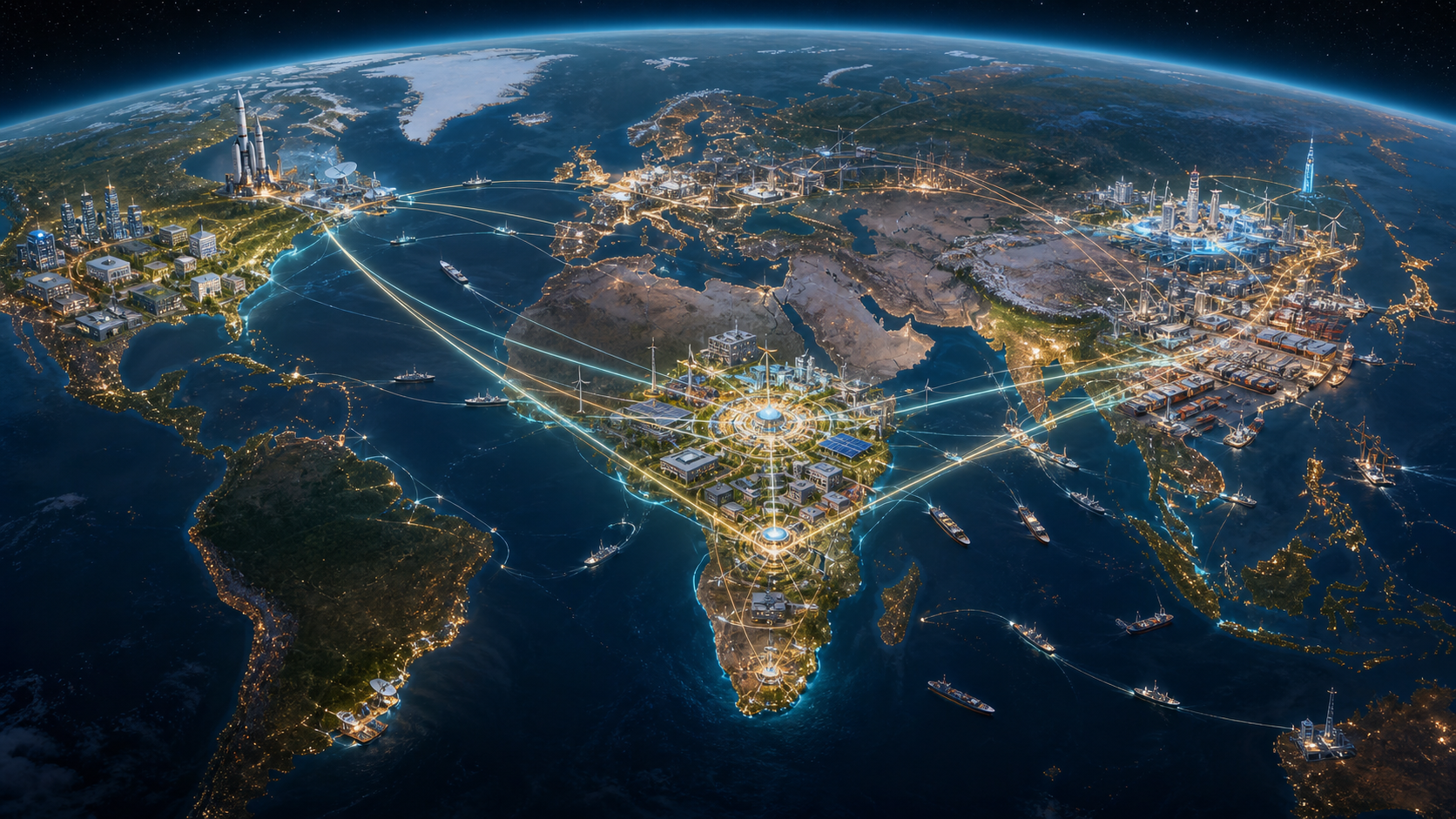
- The most plausible 2040 order is not a single-country empire. It is a three-power system in which the United States, China and Bharat lead in different domains and compete to connect those strengths.
Expect a power triangle, not a single finishing line
The question “Who will be number one?” hides an important distinction. A country can lead in military reach without leading in manufacturing. It can dominate industrial production while depending on technologies controlled elsewhere. It can have a vast domestic market without possessing the skills, energy or institutions needed to turn that market into strategic influence.
The three contenders therefore enter the race with different combinations of advantages and constraints:
| Country | Principal starting advantage | Central constraint | Decisive test before 2040 |
|---|---|---|---|
| United States | Advanced technology, military reach, alliances and financial influence | Political polarisation, social division and economic pressure | Preserve its technological and diplomatic edge while adapting to stronger rivals |
| China | Manufacturing scale, infrastructure capacity and coordinated strategic planning | Ageing, declining birth rates, debt, property pressures and external technology tensions | Turn industrial scale into durable innovation and strategic influence |
| Bharat | A large young population, expanding economy, technology sector, domestic market and flexible diplomacy | Less manufacturing scale than China and less global military reach than the United States | Convert people and growth into skills, production, advanced technology and deployable national power |
The United States: the broadest incumbent
The American advantage is not one isolated capability. It is a system. Leading companies, universities and research institutions support strength in artificial intelligence, advanced computing, aerospace, semiconductors and defence technology. Military capability is reinforced by an extensive alliance network, while the dollar remains central to international trade and finance.
That combination matters because one kind of power amplifies another. Research can become a commercial platform, a defence capability or an international standard. Alliances extend reach without requiring the United States to act alone. Financial centrality creates influence far beyond the size of its armed forces.
America’s 2040 problem is preservation under pressure. When judging whether it is succeeding, do not look only for another impressive technology. Ask whether innovation is still reaching industry and defence, whether alliances remain strategically useful, and whether internal division is impairing long-term decisions. The United States does not need to dominate every field to remain the broadest power. It does need its different advantages to keep reinforcing one another.
China: the industrial-strategic challenger
China’s central strength is the ability to connect an enormous manufacturing base with infrastructure capacity and state-directed planning. Its positions in electric vehicles, batteries, solar energy and advanced manufacturing are joined by investment in artificial intelligence, space, telecommunications and modern military systems.
This makes China more than a low-cost producer. Industrial depth can accelerate deployment, shorten the path from design to mass production and support military modernisation. In a prolonged strategic contest, the ability to manufacture essential systems at scale can matter as much as inventing them first.
But scale does not cancel structural pressure. An ageing population and declining birth rates can narrow the workforce and increase burdens elsewhere in the economy. Debt and property-sector difficulties can consume resources that might otherwise support innovation. Trade and technology tensions with the United States can also restrict access to critical capabilities.
The signal to watch is not another headline about factory output. It is whether China can sustain innovation while managing those pressures. If industrial capacity continues to move into advanced, defensible technologies, China’s claim strengthens. If manufacturing scale remains large but becomes less innovative, more indebted or more dependent on contested technologies, the apparent lead will be less secure than it looks.
Bharat: the high-potential third pole
Bharat’s opening position is different. It does not yet match American global military reach or Chinese manufacturing scale. Its opportunity comes from the interaction of a huge population, a relatively young workforce, an expanding economy, a growing technology sector and a vast domestic market.
Its diplomatic position adds unusual leverage. Bharat can deepen ties with the United States and other Western powers while maintaining longstanding relations with Russia. It can also expand its role in the Indo-Pacific, the Middle East and the developing world. This flexibility allows Bharat to work with multiple centres of power without automatically becoming an extension of any one of them.
Do not confuse that flexibility with guaranteed influence. Strategic autonomy has value only when Bharat can bring capabilities to the relationship: a productive market, advanced technology, reliable defence capacity, energy options and diplomatic initiatives others want to join. The opportunity is real, but the conversion still has to happen.
Use a seven-part scoreboard for claims about 2040

Predictions become misleading when they select the one measure that favours a preferred country. A large economy can coexist with weak industrial depth. A large population can coexist with low productivity. A sophisticated weapon can coexist with dependence on imported components. Before accepting any 2040 forecast, test it across the following dimensions.
- Economic capacity: Is growth creating productive firms, public capacity and durable household demand, or merely increasing the headline size of the economy? Economic scale matters most when it can finance research, infrastructure, energy and defence without becoming unstable.
- Industrial depth: Can the country design, manufacture, maintain and replace essential systems at scale? Pay particular attention to advanced manufacturing, semiconductors, batteries, aerospace and defence production. A prototype demonstrates knowledge; repeatable production demonstrates power.
- Technological control: Does the country possess advanced computing, large-scale compute, critical semiconductor capability and the talent to develop artificial intelligence? Then ask whether it can deploy those capabilities through industry, defence, healthcare and government. Laboratory excellence without broad adoption creates prestige, not a decisive national advantage.
- Military capability: Look beyond the number of platforms or missiles. The real test is whether industrial, technological and energy systems can support readiness, modernisation and sustained operations. Military power that cannot be replenished rests on a narrow foundation.
- Human capital: A young population is valuable only when people are healthy, skilled and productively employed. The crucial transition is from demographic scale to a workforce able to build, operate and improve advanced systems.
- Energy security: Nuclear power, solar energy, batteries, electric vehicles and emerging technologies can alter strategic dependence as well as economic competitiveness. Ask whether a country’s energy system is reliable enough to support digital infrastructure, industry and defence, not merely whether it has announced capacity.
- Diplomatic and financial reach: Alliances, strategic partnerships and influence over international finance can multiply domestic strength. Count what relationships actually provide – technology access, markets, energy, security cooperation or political support – rather than counting summits and declarations.
For each dimension, assign a plain-language judgement: leading, competitive, dependent or weakening. Then examine the links between dimensions. The country with the most leading categories is not automatically the strongest. The stronger country is the one whose technology improves industry, whose industry supports defence, whose energy keeps both operating, and whose diplomacy turns national capability into international influence.
Bharat’s real contest is conversion
For a Bharat-first reader, the temptation is to treat favourable demographics and economic momentum as proof that superpower status will arrive with time. That claim does not hold up. Time magnifies whatever a country repeatedly does well; it does not turn unused potential into power by itself.
The practical question is whether Bharat can complete several conversions before 2040.
Convert population into productive capability
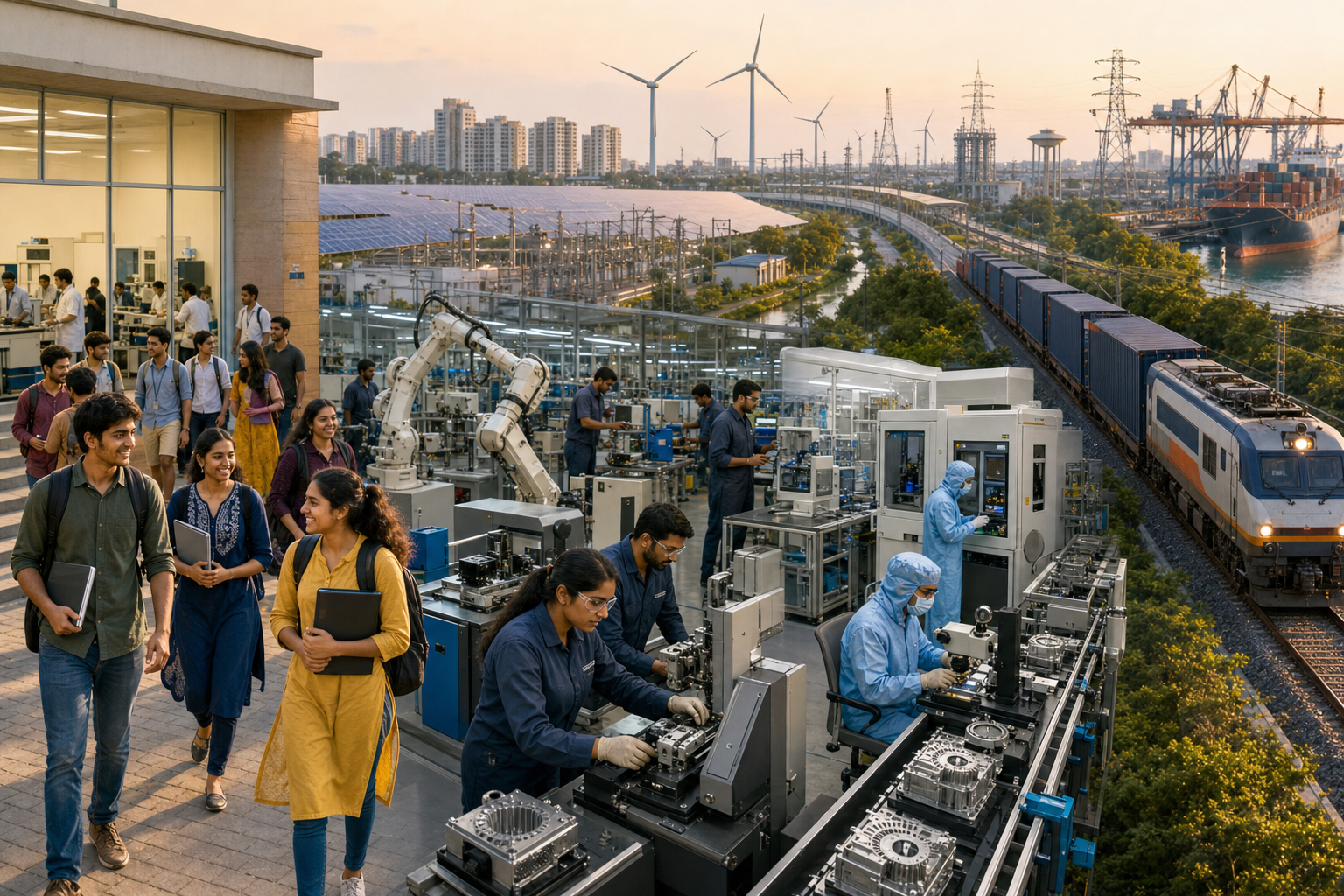
A young workforce is a strategic advantage only if education and training produce skills that modern industry can use. Watch whether workers can move into advanced manufacturing, artificial intelligence, aerospace, energy and defence supply chains. Employment by itself is not the finish line; rising capability and productivity are.
This distinction changes how you should evaluate demographic claims. A population forecast tells you how many potential workers and consumers may exist. It does not tell you what they will be able to design, build or operate. Look for evidence of skill formation and productive absorption whenever someone invokes Bharat’s population as a sufficient reason for future dominance.
Convert the domestic market into industrial depth
A vast market gives firms room to scale, but demand can be satisfied by imported systems as easily as by domestic capability. The strategic gain appears when local demand supports design, manufacturing, component ecosystems, maintenance and continued improvement inside Bharat.
Judge industrial progress by the difficult middle of the value chain. Final assembly is visible, but components, tools, specialised materials, engineering knowledge and reliable production determine whether a country can sustain output under pressure. Bharat does not need to duplicate China’s model in every respect. It does need sufficient depth in systems that are essential to economic and national security.
Convert digital strength into AI sovereignty
Bharat’s expansion in digital infrastructure and technology creates a foundation, not a completed advantage. The next test is whether it can secure computing capacity, semiconductor access and advanced talent, then integrate artificial intelligence into productive and strategic systems.
AI becomes geopolitical power when it is deployed across industry, defence, healthcare and government. Consumer applications may show adoption, but they do not by themselves establish sovereignty. Look for control over critical infrastructure, the ability to adapt systems to national needs and enough domestic competence to avoid a single external point of failure.
Convert energy expansion into resilience
There is no technological power without abundant, dependable energy. Computing facilities, advanced factories, transport systems and military infrastructure all rely on it. Bharat’s strategic assessment should therefore connect nuclear power, solar energy, batteries, electric vehicles and emerging energy technologies rather than treating each as a separate achievement.
The right question is not which energy technology wins an ideological argument. It is whether the combined system can supply growth reliably, reduce dangerous dependencies and support industrial scale. Announced capacity matters less than dependable delivery, storage, integration and the ability to manufacture or secure critical equipment.
Convert defence and space progress into an ecosystem
Progress in space research, defence and advanced technology can strengthen both security and economic capability. The lasting advantage comes when these areas share talent, computing, materials, electronics and manufacturing capacity. A successful mission or platform is important. A system that can produce successive generations, maintain them and supply them at scale is more important.
This is where aerospace self-reliance should be judged carefully. The meaningful test is not whether every component is domestic. It is whether Bharat retains control over capabilities whose interruption would constrain national choices, while using international cooperation where it increases strength without creating a crippling dependency.
Convert multi-alignment into concrete leverage
Bharat’s ability to work with the West, preserve ties with Russia and widen engagement across several regions is a genuine strategic asset. Yet balanced relationships are a method, not the objective. They must deliver technology, energy options, market access, defence cooperation and diplomatic room for independent decisions.
When evaluating a partnership, ask what Bharat can still decide for itself after the agreement is signed. Strategic autonomy does not require isolation or equal distance from every power. It requires enough national capability and diversified relationships to prevent one partner from acquiring a veto over essential choices.
Read every 2040 forecast as a conditional scenario

A serious forecast should tell you what must happen for it to be right and what evidence would weaken it. Four scenarios deserve attention.
The United States retains the broadest lead
This outcome becomes more convincing if American technological leadership continues to feed commercial and military capability, alliances remain cohesive, and internal divisions do not prevent long-term strategy. It becomes less convincing if political polarisation disrupts investment and diplomacy, or if technological advantages fail to reach production at scale.
China gains the strongest industrial-strategic position
This outcome strengthens if China keeps moving from manufacturing scale into advanced innovation while managing demographic, debt and property pressures. It weakens if ageing constrains economic dynamism, financial burdens divert resources, or technology restrictions expose dependencies that domestic capability cannot replace.
Bharat emerges as an independent third pole
This is more than a scenario in which Bharat’s economy becomes larger. It requires the country to turn its young population into a skilled workforce, deepen industrial production, expand advanced technology, secure energy, strengthen defence and translate diplomatic flexibility into influence. The case weakens if growth remains insufficiently productive or critical systems remain dependent on decisions made elsewhere.
No country dominates the complete system
This may be the most useful base case. The United States could retain the strongest global military and alliance network, China could preserve the deepest manufacturing position, and Bharat could become the most consequential rising and balancing power. Leadership would then depend on the issue: computing, industrial supply, maritime security, energy, finance or access to large markets.
Such a world would not be stable merely because three major powers exist. It would reward countries able to cooperate in one domain without surrendering their options in another. Bharat’s advantage would lie in being valuable to several groupings while remaining capable of independent action. Its risk would be confusing diplomatic courtship with actual national power.
Between now and 2040, apply three questions whenever you encounter a triumphalist prediction: What capability is being measured? What converts it into power? What dependency could interrupt that conversion? Those questions will filter out most empty claims.
For Bharat, the standard should be equally clear. Celebrate growth, technology and civilisational confidence, but demand evidence that they are becoming productive capacity, strategic resilience and freedom of action. If Bharat keeps completing those conversions, it will not need someone else’s definition of superpower status. Other powers will reveal its position through the choices they must make around it.
References
