

If the forest years of the Ramayana feel like one long interval between Ayodhya and Lanka, you are missing the part of the epic in which exile changes its meaning. Dandakaranya is where a royal duty surrendered in obedience becomes a moral duty exercised without a throne.
The useful question is therefore not merely, “What happened in this forest?” It is, “What changed because it happened here?” Follow that question and the encounters with rishis, rakshasas, Agastya, Shurpanakha, Maricha, Ravana, and Jatayu become a connected progression rather than a collection of forest tales.
Dandakaranya is a region, a journey, and a moral setting

Dandakaranya should not be imagined as one clearing or one brief stop. It is a vast wilderness associated with central Bharat, traversed during a substantial phase of Rama, Sita, and Lakshmana’s exile. Within the Ramayana, its importance comes from being both a setting for spiritual transformation and a field on which dharma is tested against adharma.
This distinction prevents two common errors. The first is to reduce Dandakaranya to modern administrative boundaries. The second is to treat it as scenery surrounding the famous episodes at Panchavati. A modern map may help you visualize the broad central Indian landscape, but it cannot replace the epic’s narrative geography. Different recensions and retellings may also emphasize or group locations differently.
Read the forest at three levels. As a place, it contains ashramas, dangerous tracts, paths, rivers, and settlements. As a stage of exile, it removes the protections of court and kingdom. As a moral setting, it forces every character to reveal what remains when status, familiarity, and institutional power fall away.
The pivotal incidents form one continuous chain
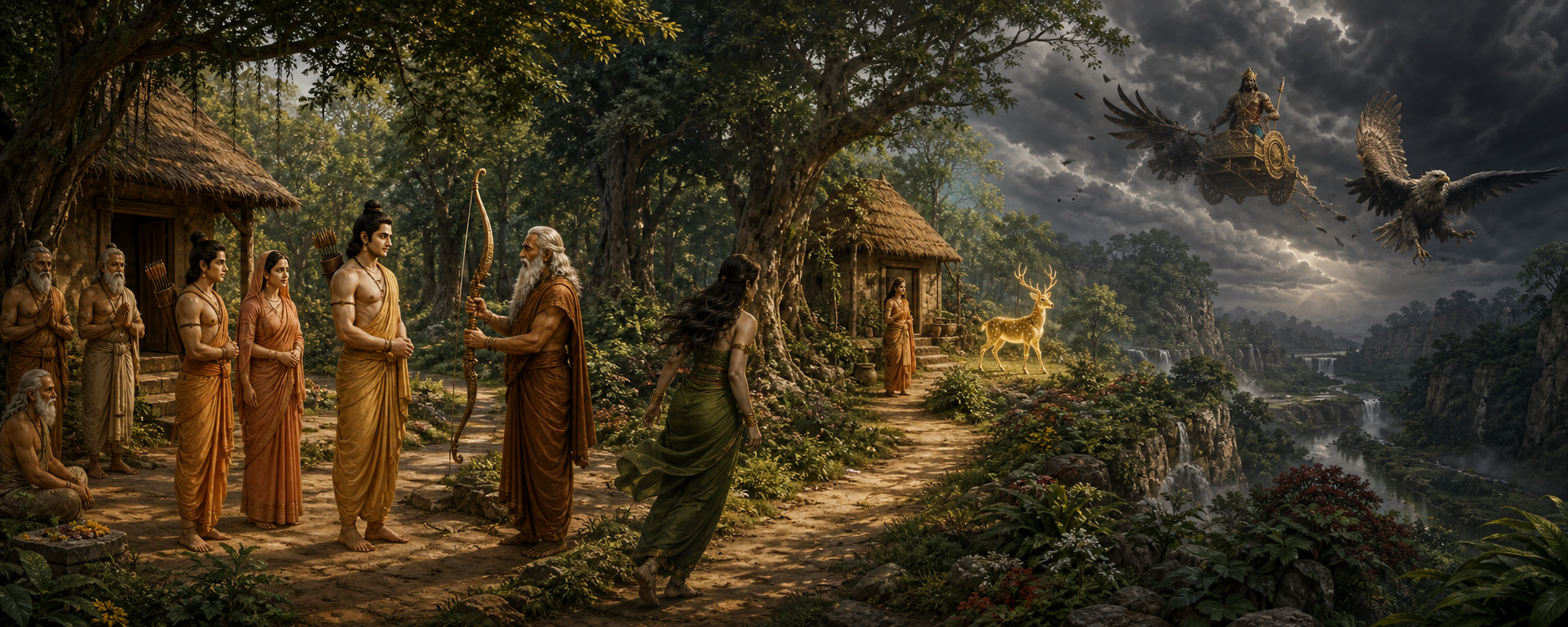
You will understand Dandakaranya more clearly if you organize its incidents by what each one changes. The exact emphasis can vary across Ramayana traditions, but the main narrative movement is stable.
- The exile enters a deeper phase. Rama, Sita, and Lakshmana move away from the social world of Ayodhya and into a landscape where royal authority cannot be exercised through officials, armies, or law courts. Their conduct must carry dharma without those supports.
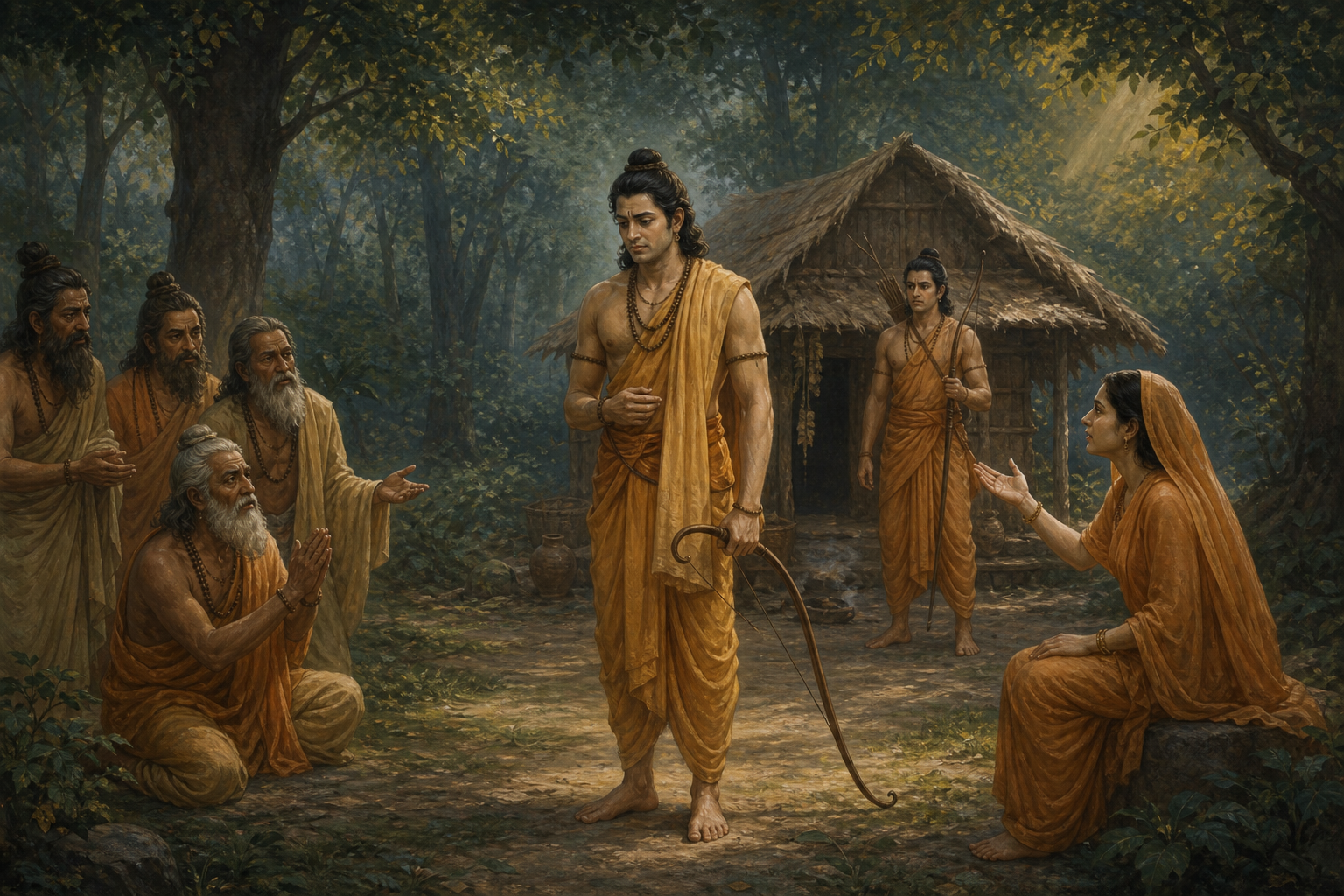
- The suffering of the rishis creates a new obligation. Ascetics living in the forest face attacks from rakshasas. Their appeal to Rama turns his presence in Dandakaranya from private exile into protective service. He may no longer rule Ayodhya, but he has not ceased to be responsible for the vulnerable.
- Encounters with Viradha and the forest sages reveal two kinds of danger. Viradha represents direct violence. The rishis and their ashramas represent disciplined spiritual life maintained amid that danger. Dandakaranya contains both, and Rama must learn to distinguish what deserves protection from what must be resisted.
- Agastya gives direction to the next phase. The meeting with Sage Agastya joins tapas and kshatra rather than setting them against each other. Spiritual authority does not require helplessness before aggression; protective strength does not have to reject spiritual discipline. The movement toward Panchavati follows within this larger forest journey.
- Panchavati concentrates the conflict. The encounter involving Shurpanakha leads to the confrontation with Khara and Dushana. What had been a continuing duty to protect forest communities now becomes a conflict with consequences extending beyond the immediate locality.
- Maricha and Ravana replace open attack with deception. The golden-deer episode divides the attention of Rama, Sita, and Lakshmana. Ravana then abducts Sita, while Jatayu resists him. The forest exile ceases to be mainly about dwelling faithfully outside Ayodhya and becomes a search that will eventually connect Dandakaranya to the larger struggle against Ravana.
That sequence is the key. The abduction does not arrive as an unrelated plot twist. It follows Rama’s assumption of protective responsibility, the defeat of violent adversaries, and an adversary’s decision to use misdirection where direct force has failed. Cause and consequence accumulate through the forest.
When reading these episodes, keep the epic’s categories within their narrative context. Rakshasa is not a label you should casually transfer to a modern tribe, region, or community. The Ramayana asks you to judge conduct, intention, discipline, protection, cruelty, and deception; it does not give permission for careless present-day ethnic equations.
Three dharmic questions are tested in the forest
Does duty survive the loss of office?
Rama has left the capital and accepted the conditions of exile. He could interpret that condition narrowly: remain in the forest, avoid wider obligations, and wait for the allotted period to end. Dandakaranya tests that narrow reading. When those living under threat seek protection, the moral substance of kingship remains relevant even though Rama possesses none of its machinery.
This gives you a practical way to read his vow. Do not ask only whether Rama has formal jurisdiction. Ask whether dharma permits a capable person to ignore sustained aggression merely because he holds no office. The forest separates authority as a title from responsibility as a principle.
Can an ascetic life include armed protection?
Sita raises the tension between forest austerity and the carrying or use of weapons. Rama’s commitment to protect the rishis raises the other side: withdrawal from courtly life does not make violence against the innocent morally irrelevant. The exchange matters because the Ramayana does not present dharma as an automatic reflex. It allows a serious concern to be voiced before a course of action is defended.
A careful reading should preserve both claims. Force can corrupt when it is driven by appetite, anger, or imagined enemies. Refusal to protect can also become a moral failure when real aggression is allowed to continue. The relevant questions are therefore specific: Who is being harmed? What promise has been made? Is the response protective or self-serving? Is the threat real, or merely assumed?
How does adharma exploit attention?
Open violence is not the only danger in Dandakaranya. The scheme involving Maricha works by producing a compelling appearance, separating protectors, and creating a moment of vulnerability. Ravana’s plan succeeds through manipulation before physical force completes it.
Notice the mechanism rather than reducing the episode to a warning about desire. A deceptive appearance draws attention outward. Urgency then disrupts coordination. Separation follows. The decisive attack lands only after those conditions have been created. This is one reason the golden deer remains such a durable image: what looks wondrous may be designed to control where you look and how quickly you act.
A reading method that keeps the episodes connected
If you are studying the Aranya Kanda, teaching it, or returning to the Ramayana after many years, use a simple four-step method. It will keep the famous incidents from floating free of their ethical setting.
- Mark every change of role. Note when Rama is acting as an obedient son, forest-dweller, protector, husband, warrior, or seeker. Several roles can operate at once, and the difficulty of dharma often lies in their collision.
- Record the request or promise before the action. Rama’s response to danger makes more sense when you remember the appeal of the rishis and his commitment to them. A battle read without its preceding obligation can look like an isolated adventure.
- Pair every victory with its consequence. The defeat of an aggressor can protect the innocent and still provoke retaliation. Consequences do not by themselves prove that an action was adharmic; they show that right action does not guarantee an easy aftermath.
- Separate the Valmiki narrative from later popular memory. If a familiar detail is central to your interpretation, check whether it appears in the version you are actually reading. Devotional retellings enrich the tradition, but combining them unconsciously can produce false certainty about sequence, dialogue, or geography.
You can make this concrete with two columns in your notes. In the first, write the visible event: a request for help, an encounter, a promise, a battle, a deception, or an abduction. In the second, write the dharmic pressure created by that event. By the end of the forest sequence, you will see a chain of obligations and consequences rather than a travel diary.
Key takeaways
- Dandakaranya is not a single stop. It is the broad forest setting in which Rama’s exile acquires public and protective obligations.
- The appeal of the rishis is a decisive turn: Rama has surrendered a kingdom, not his responsibility to uphold dharma.
- Agastya represents the meeting of spiritual discipline and protective strength, not a choice between the two.
- The Panchavati conflict, the golden deer, Sita’s abduction, and Jatayu’s resistance belong to a connected escalation.
- The forest tests whether power can remain disciplined, whether restraint can avoid becoming passivity, and whether attention can withstand deception.
- Different Ramayana traditions may vary in detail, so identify the recension or retelling before making claims about exact dialogue, sequence, or geography.
On your next reading, begin with the rishis’ appeal rather than jumping directly to the golden deer. Track each promise and each consequence from that point onward. Dandakaranya will then appear as the Ramayana intends it to function: not empty space between two kingdoms, but the testing ground in which the coming struggle becomes morally intelligible.
References
