

You may have encountered an unsettling claim: in a Jain Ramayana, Sita is abandoned because of a parrot’s curse. The claim is broadly right, but it becomes misleading when the curse is treated as a magical accident, a complete defence of Rama, or the Jain explanation for every version of Sita’s story.
The episode belongs to the Pauma Chariyam, composed by the Jain poet Vimala Suri. Read in its own ethical frame, the curse connects Sita’s suffering with karma and an earlier failure of compassion. That distinction helps you understand the episode without blaming Sita, erasing Rama’s agency, or forcing a Jain retelling to answer questions posed by another Ramayana.
The short answer: the curse supplies moral causation
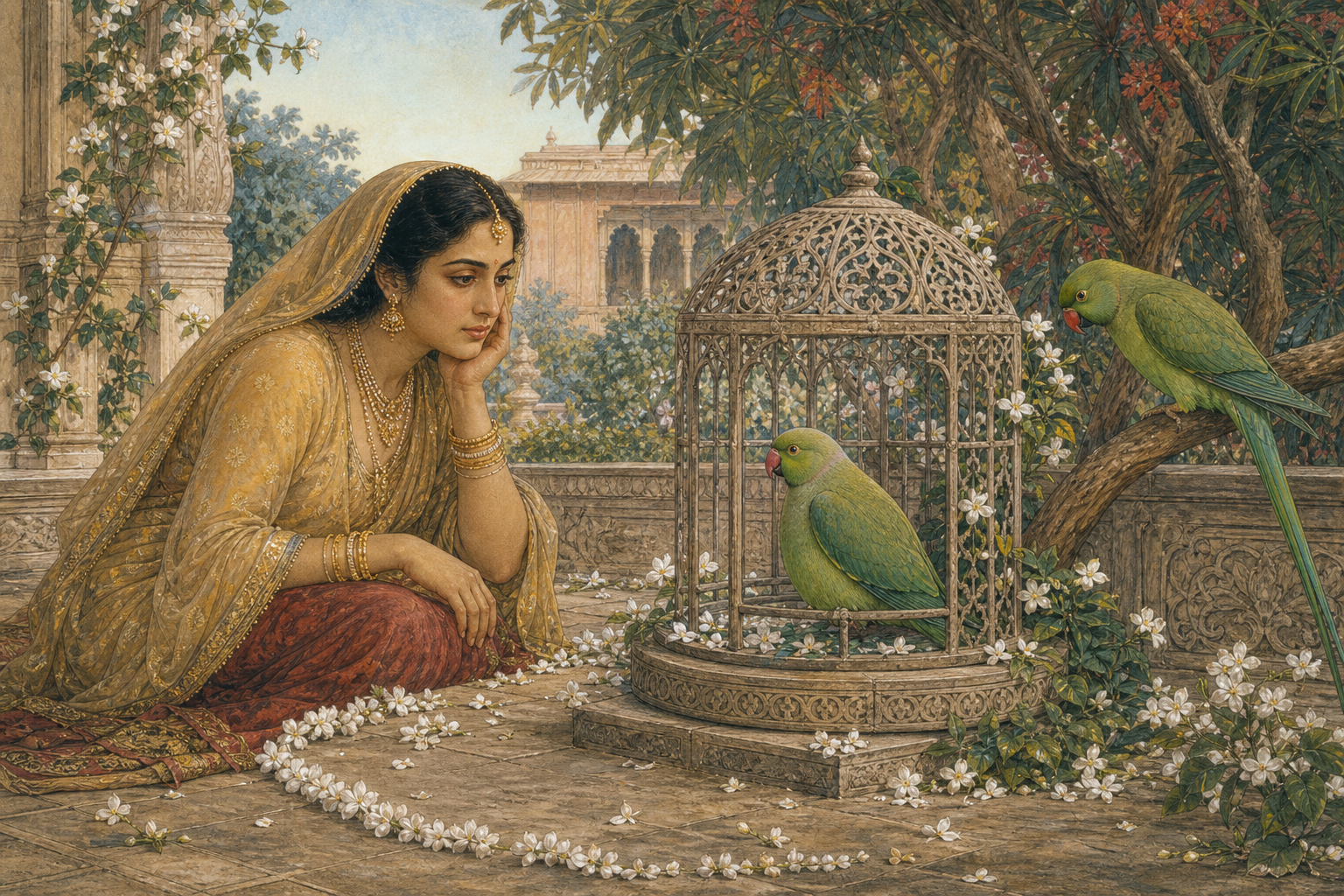
Within the Pauma Chariyam, a parrot’s curse provides the narrative explanation for Sita’s abandonment by Rama. Its purpose is not exhausted by the simple formula that a curse was spoken and therefore a misfortune had to occur. The motif places the abandonment within a chain of moral cause and consequence.
Three different questions therefore need three different answers:
- What explains the event inside this telling? The parrot’s curse establishes the link between an earlier action and Sita’s later suffering.
- What gives that link its ethical meaning? Karma turns a failure of compassion into a consequence that cannot simply be forgotten once the immediate moment has passed.
- Who remains responsible when the abandonment occurs? The people who act in that later moment still have moral agency. A karmic antecedent explains a chain; it does not automatically justify every link in it.
If you need a precise one-sentence answer, use this: In Vimala Suri’s Pauma Chariyam, Sita’s abandonment is linked to a parrot’s curse, making the episode a lesson about karmic consequence and compassion rather than an isolated act of misfortune.
Karma explains suffering without making suffering deserved

Karma in a Jain frame is not best imagined as a deity handing down a sentence. It is moral causation: actions and the passions surrounding them bind the actor to consequences. The curse gives that causal structure a memorable narrative form. What appears small or temporary to a powerful person can remain morally unfinished.
This is where a careless reading can go wrong. A karmic explanation is easily converted into victim-blaming: Sita suffers, therefore Sita must deserve what happens to her. That conclusion does not follow. Knowing that a story connects suffering to an antecedent does not give a reader permission to calculate another person’s guilt, declare the pain proportionate, or become indifferent to it. The ethical demand remains compassion.
The same distinction prevents the curse from becoming a blanket acquittal of Rama. The curse answers why the narrative links two moments. Rama’s conduct answers a separate question: what does a person do when faced with a morally charged choice? If we let karma erase agency, every later decision becomes inevitable and ethical judgement becomes pointless. That would hollow out the very lesson the karmic frame is meant to sharpen.
When reading the episode, hold both levels at once. Sita’s abandonment belongs to a causal history, and the abandonment is still an act with its own moral weight. Explanation and justification are not synonyms.
The parrot changes whose suffering you are asked to notice
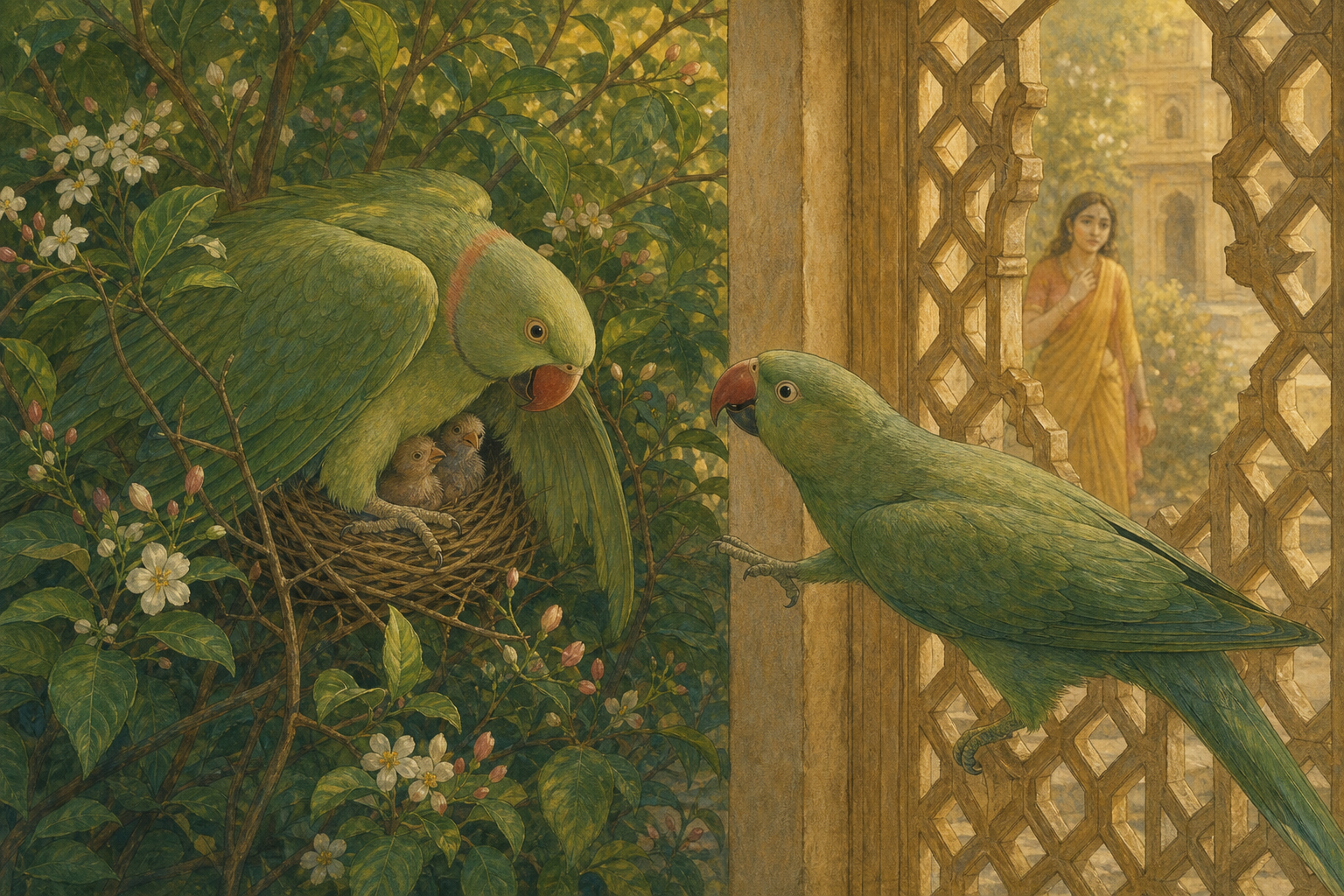
A royal narrative naturally draws your attention toward kings, queens, succession, reputation, and public duty. The parrot motif interrupts that scale. A nonhuman and comparatively powerless being becomes morally significant enough to alter how the suffering of a celebrated human figure is understood.
That reversal is especially important in a Jain ethical setting. Ahimsa does not reserve moral concern for the socially important or even for human life alone. The vulnerability of a living being matters before anyone knows whether neglecting it will produce a visible consequence. Compassion offered only after suffering reaches a queen is compassion offered too late.
You can use the episode as a practical examination of power. When another being depends on your restraint, ask three questions:
- Am I treating this being’s distress as insignificant because the being has less power, status, or voice?
- Am I assuming that harm disappears once it is no longer visible to me?
- Would I recognise the same conduct as serious if its consequence later reached someone I honour?
These questions move the story beyond curiosity about a curse. The narrative trains attention on the first neglected harm in a chain, not only on the final suffering that commands public sympathy.
How to discuss the episode without flattening the tradition

The phrase the Jain Ramayana is convenient but too broad when you are making a claim about a particular episode. Jain authors participate in a diverse Ramayana tradition; a named work should not be made to speak for every Jain telling. Four habits keep the discussion accurate.
- Name the text. Say that the parrot’s-curse explanation belongs to the Pauma Chariyam associated with Vimala Suri. If someone says only that the story occurs in the Jain Ramayana, ask which work or telling is meant.
- Separate plot cause from moral judgement. The curse explains the narrative connection. It does not, by itself, prove that Sita deserves abandonment or that Rama has no responsibility.
- Read the motif through karma and compassion. Asking whether parrots can literally determine royal events misses the ethical work of the episode. The useful question is why harm involving a vulnerable being is made consequential.
- Compare traditions only after understanding each one on its own terms. A retelling is not defective because it changes a familiar explanation. Its changes disclose the ethical questions its community wants the Ramayana to carry.
This discipline also prevents a needless sectarian contest. The episode is not evidence that one Dharmic community honours Sita while another condemns her. Nor does variation make the shared Ramayana inheritance incoherent. An enduring narrative can hold different theological and ethical emphases without every telling becoming interchangeable.
For a comparative reading, build a simple record for each version: identify the named text, note the immediate plot mechanism, identify the ethical principle activated by that mechanism, and then ask which characters retain meaningful choice. Only after those four steps should you compare what different tellings make central.
Key takeaways
- The parrot’s curse is the narrative link used to explain Sita’s abandonment in Vimala Suri’s Pauma Chariyam.
- The curse is most usefully read as a dramatization of karmic consequence, not as an arbitrary supernatural interruption.
- The episode gives ethical visibility to vulnerable, nonhuman life and makes neglected harm part of a larger moral chain.
- Karmic causation neither proves that Sita deserves suffering nor cancels the agency of Rama and other actors.
- Accurate discussion should name the Pauma Chariyam rather than treating one episode as the uniform position of every Jain Ramayana.
The next time this episode comes up, begin with the name of the text, state the parrot’s curse as its karmic link, and refuse to turn either karma into blame or causation into an excuse. Then ask the question the motif leaves with you: where does power make another being’s pain easy to overlook? That is where Sita’s story becomes an ethical practice rather than an unusual piece of Ramayana lore.
References
