
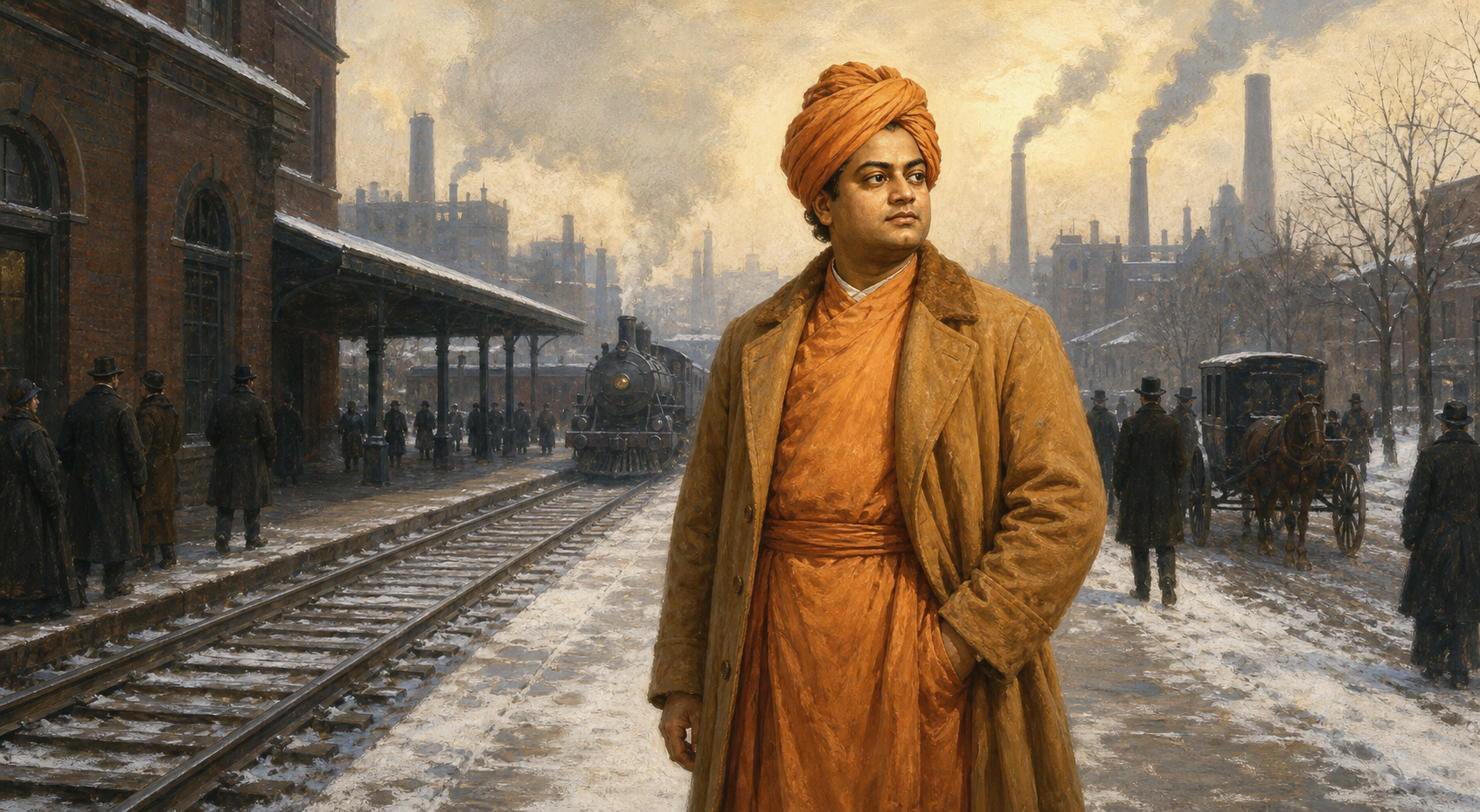
You may know Vivekananda’s American journey through Chicago and wonder whether Detroit is merely a footnote. It isn’t. Detroit shows what happened when a celebrated voice encountered a stalled winter journey, an exhausting speaking schedule, and a business arrangement he came to regard as exploitative.
That makes Detroit useful to you now. The city teaches us to look beyond speeches and applause. Discipline carried Vivekananda through the door, friendship gave him practical protection, and independence enabled him to continue the work without surrendering control of it.
Key takeaways
- Detroit was not a single appearance. Vivekananda stayed there from February 13 to 22 and again from March 7 to 31, 1894; he delivered five lectures during the first visit.
- His arrival at 1 a.m. after a seven-hour snow delay places the public lectures inside the physical strain of winter travel.
- Paul F. Bagley, Mrs Bagley, and Thomas W. Palmer demonstrate that hospitality becomes historically important when it develops into advocacy and practical assistance.
- Vivekananda’s charges against the Slayton Lecture Bureau came through his correspondence. His financial estimates and his report of judges’ opinions should be presented as his contemporaneous claims, not as a later court judgment.
- For Dharma institutions today, Detroit’s clearest lesson is operational: noble teaching still requires fair terms, transparent finances, humane schedules, and trustworthy people who will intervene when something is wrong.
A winter itinerary reveals the person behind the icon
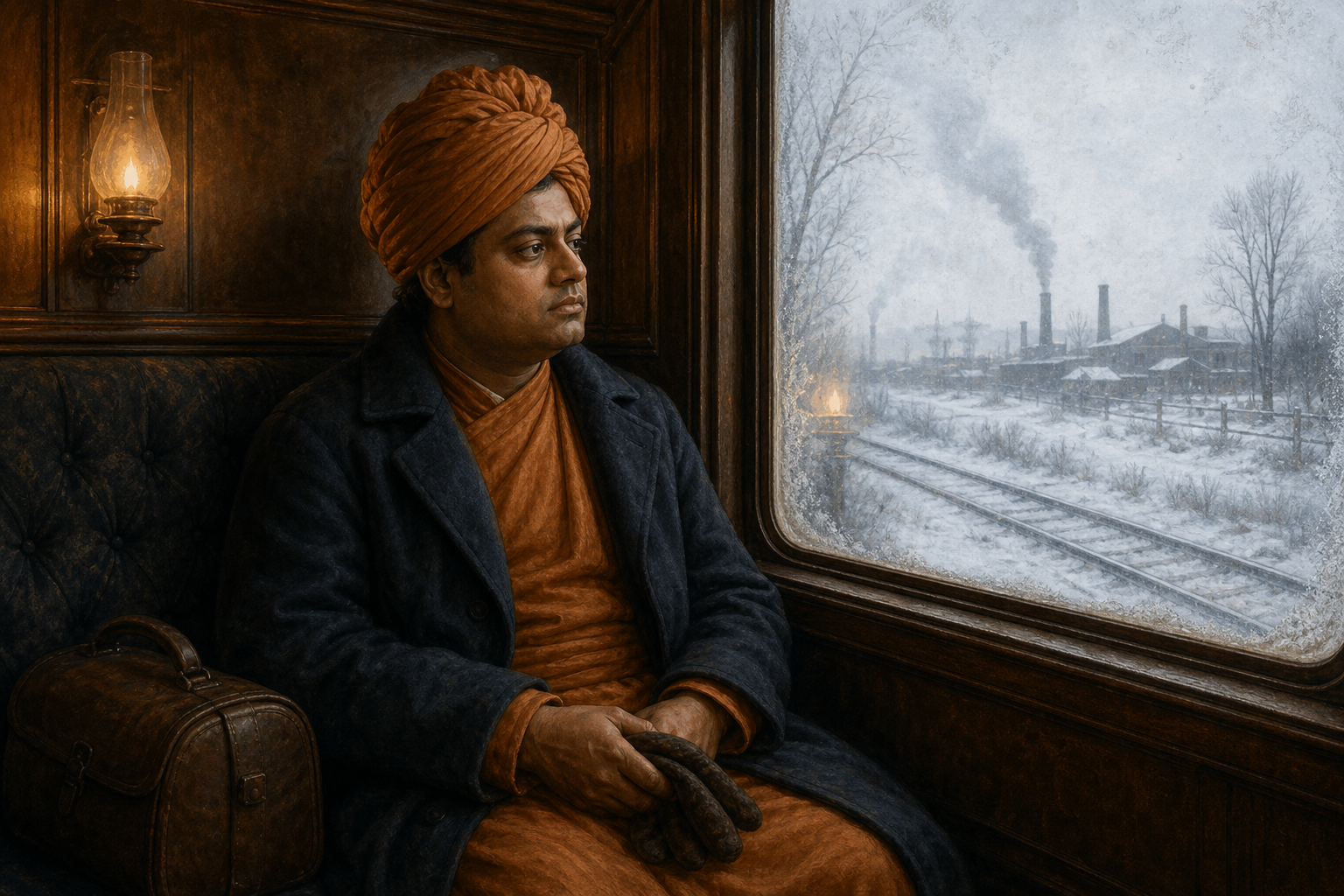
Vivekananda reached Detroit for his first stay on February 13, 1894. His train had been blocked by snowdrifts and arrived seven hours late, at about one in the morning. Paul F. Bagley met him at the station. Between that arrival and February 22, Vivekananda delivered five lectures. He returned less than two weeks later and remained in Detroit from March 7 through March 31.
Those dates correct two easy misreadings. First, Detroit was not a convenient pause on an effortless tour. Reaching the city required endurance before the speaking even began. Second, the return visit shows that Detroit was not a one-night engagement remembered only because a famous monk happened to pass through. It became a place to which he came back and in which relationships deepened.
The snow delay also belongs within a larger pattern. Under the Slayton Lecture Bureau arrangement, Vivekananda was moved repeatedly between cities, often on overnight trains in severe winter weather. The schedule reportedly required 12 to 14 or more extempore lectures in a week, while leaving inadequate time for food and rest. Extempore speaking meant that the intellectual work did not end when he left the stage; he continually had to gather his thoughts and address new audiences without relying on a fixed script.
We should resist turning this exhaustion into a romantic test of spiritual greatness. The meaningful fact is not that a monk could be pushed without consequence. It is that the public achievement had a bodily cost. When you teach this episode, keep two records side by side: what the audience received and what the speaker had to absorb. That simple practice produces a more truthful history than a list of triumphant appearances.
Detroit’s decisive asset was practical friendship
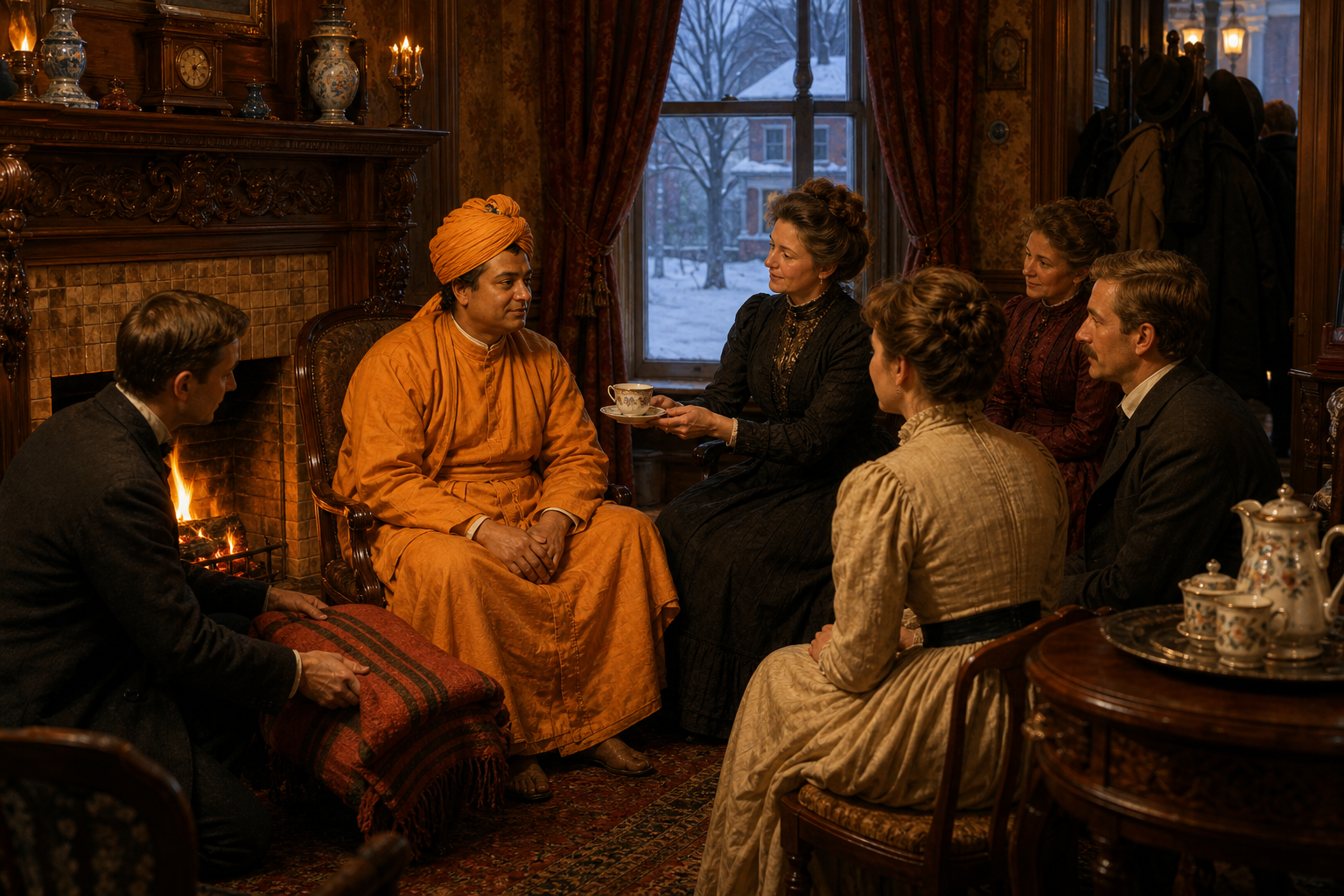
Detroit’s importance cannot be measured only by counting lectures. The more revealing measure is the network that formed around Vivekananda. Paul F. Bagley received him after the delayed journey. The Bagley household provided hospitality. During the second visit, Vivekananda spent his first day with Mrs Bagley before moving to the home of Thomas W. Palmer.
Palmer brought more than social prestige. He was a former United States senator and diplomat who had served as president of the World’s Fair Commission. When Vivekananda wanted to escape his lecture-bureau arrangement, Palmer travelled to Chicago to help him secure his release. Admiration had become intervention.
This gives you a practical way to evaluate any account of a spiritual movement. Do not ask only who occupied the platform. Ask four additional questions:
- Who met the traveller when the journey went wrong?
- Who provided food, lodging, and time to recover?
- Who possessed the civic credibility or professional connections the teacher lacked?
- Who acted when admiration alone was no longer enough?
These questions bring apparently secondary people back into view without displacing Vivekananda from his own mission. The Bagleys and Palmer did not become owners of his teaching. They helped create the social conditions in which he could exercise agency. That distinction matters whenever we tell the history of Dharma outside Bharat: local allies can assist transmission without appropriating the authority of the tradition or the teacher.
Friendship, in other words, is not sentimental decoration around the Detroit story. It is infrastructure. Reception, hospitality, credibility, and advocacy each met a different need. A community commemorating Vivekananda should therefore document its hosts and helpers as carefully as it documents its lectures. Otherwise, it preserves the visible event while losing the human system that made the event possible.
The lecture-bureau dispute changes how the legacy should be read
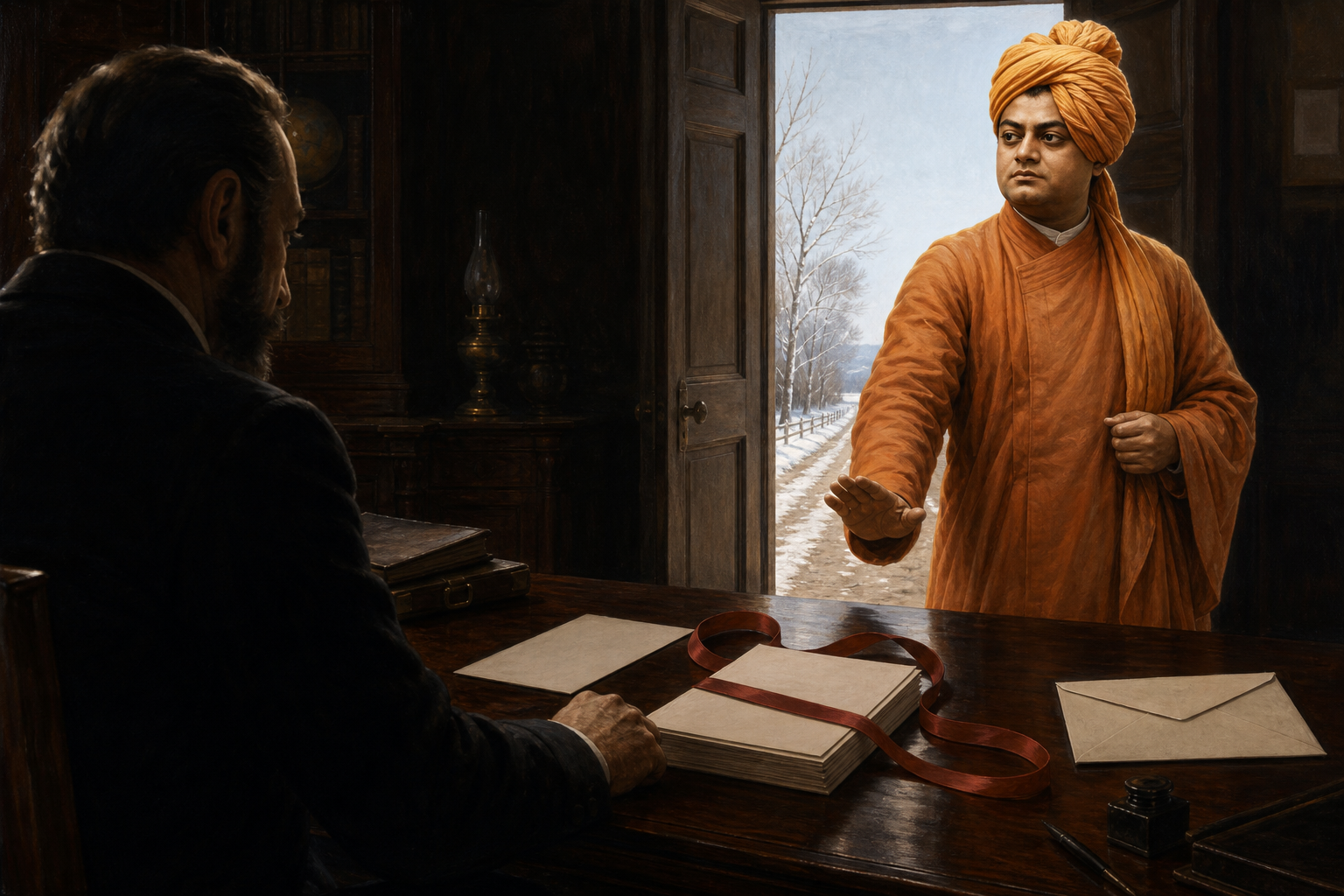
The conflict with the Slayton Lecture Bureau belongs near the centre of Vivekananda’s Detroit legacy because it joined spiritual purpose to institutional power. His growing popularity generated income, but he believed the bureau was failing to perform its obligations and withholding what he was entitled to receive. Sometime between his two Detroit visits, he freed himself from the arrangement.
Precision is important here. In a letter dated February 20, Vivekananda estimated that joining Slayton had cost him at least $5,000. He also claimed that the person who arranged the Detroit lectures received at least $1,000. These figures express Vivekananda’s own contemporaneous understanding; they are not an audited accounting presented in the surviving narrative.
In the same letter, he reported that several judges had examined his contract, regarded it as a shameful fraud, and believed it could be broken. He also described Palmer’s attempt to help him. That is strong evidence of how Vivekananda and his advisers viewed the arrangement, but it should not be inflated into a court ruling that the available record does not establish.
I am a monk—no self defense.
Swami Vivekananda, letter to Mrs George Hale, February 20, 1894
Read in isolation, that sentence can sound like an endorsement of helplessness. Vivekananda’s conduct points in a more demanding direction. He was disgusted by the arrangement, tried to end it, consulted people who could assess the contract, and accepted Palmer’s help. Renunciation did not require him to treat exploitation as virtue. Nor did surrender to the Divine require surrendering judgment to a commercial intermediary.
That distinction remains relevant wherever Dharma travels through paid events, touring organizations, publishers, or digital platforms. Sacred purpose does not automatically purify an institution’s methods. Money dedicated to Dharma still requires accounting. A respected organizer still requires defined responsibilities. A popular teacher still requires rest and the freedom to question an arrangement.
A responsible host can translate the Detroit lesson into five ordinary safeguards:
- Put responsibilities, compensation, expenses, and payment timing in writing before the tour begins.
- Give the speaker or representative a clear statement of receipts and deductions.
- Build travel, meals, and recovery time into the schedule rather than treating them as gaps available for another engagement.
- Arrange independent review before a teacher signs a touring contract whose terms are unfamiliar.
- Name a trusted local person who has enough authority to stop or change arrangements when the agreed conditions are not being honoured.
These are governance principles, not a conclusion about modern contract law. Any present contractual dispute must be assessed under the applicable law by a qualified professional. The historical lesson is narrower and sturdier: spiritual status should never be used to pressure someone into silence about unfair treatment.
Four ways to carry Detroit’s legacy forward
- Teach the two-visit chronology. Put February 13–22 and March 7–31, 1894, on one line. Add the five lectures from the first stay, the seven-hour snow delay, and the move from Mrs Bagley’s home to Palmer’s during the second visit. A compact chronology immediately shows continuity, difficulty, and developing trust.
- Label claims by their evidentiary status. Distinguish itinerary facts from Vivekananda’s financial estimates, his description of Slayton, and his report of what unnamed judges told him. Careful attribution does not weaken the account. It prevents devotion from turning a real grievance into a claim broader than the surviving record can carry.
- Name the support network. Include Paul F. Bagley, Mrs Bagley, and Thomas W. Palmer whenever you present Detroit as part of Vivekananda’s American work. Then ask who performs comparable acts of welcome, logistical care, professional counsel, and advocacy in your community. Honour those roles openly.
- Make commemoration change one practice. A temple, study circle, cultural association, or conference can review its speaker policy after teaching this episode. Check whether payment terms are visible, schedules permit recovery, travel problems have a named contact, and a guest can raise concerns without jeopardizing the entire engagement.
Detroit gives us a way to remember Vivekananda without reducing him either to a disembodied voice or to a passive victim. He arrived under punishing conditions, spoke repeatedly, formed consequential friendships, recognized an arrangement he believed was wrong, and worked to leave it. His hosts mattered because their service strengthened rather than replaced his agency.
If you are planning a lecture, class, temple program, or local commemoration, begin with three things: the two visits, the people who stood beside him, and the contract crisis. Then adopt one concrete safeguard for the people serving Dharma in your own institution. That is how Detroit moves from remembered history into present conduct.
References
