
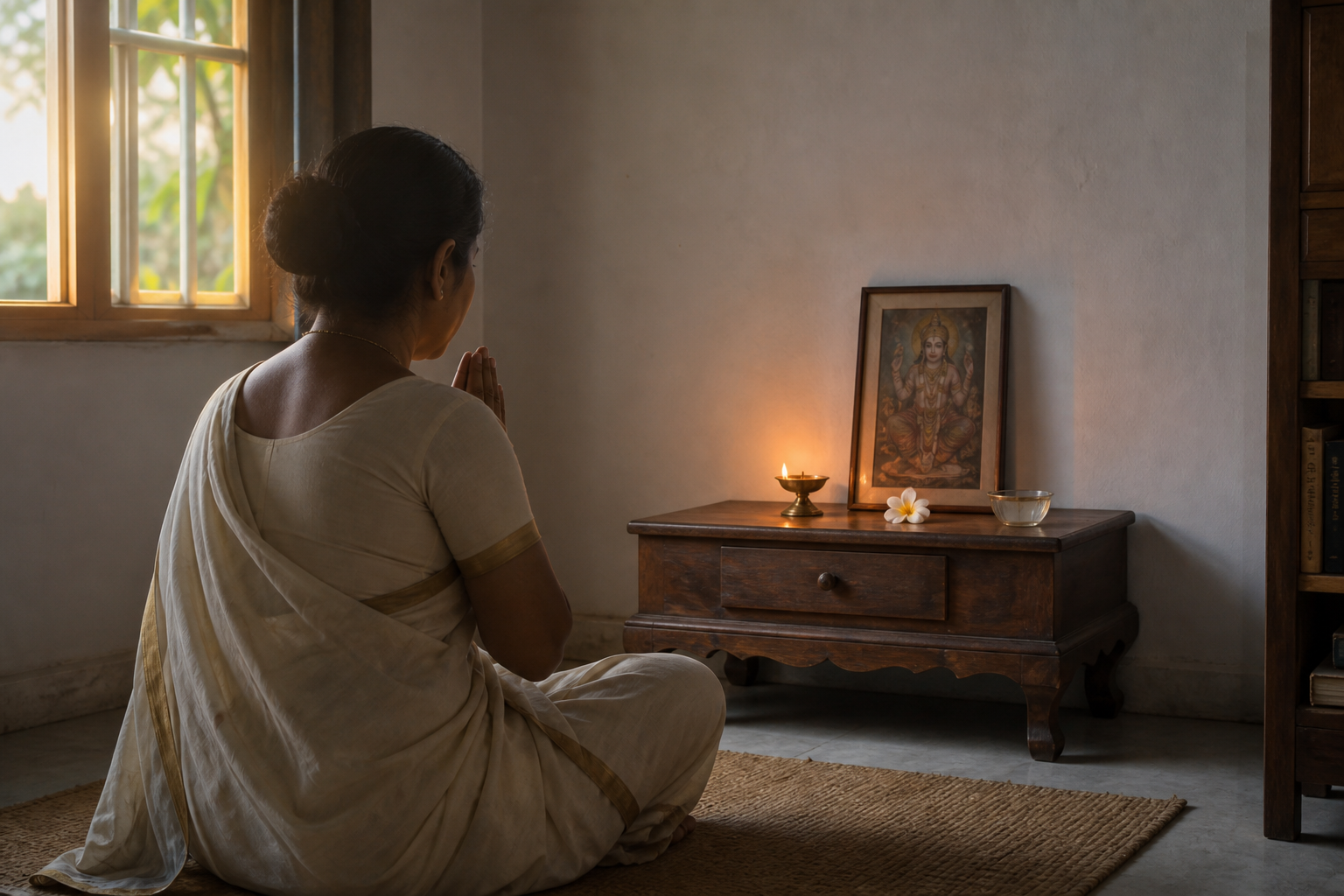
If your puja keeps getting postponed because you do not have the right flowers, enough time, a full tray of ingredients, or an impressive arrangement, the preparation has begun to obstruct the worship. You do not need to wait for ideal conditions before turning toward the Divine.
A small act of worship that you can complete with attention is more honest than an elaborate plan you rarely perform. This does not make every ritual interchangeable or every traditional instruction optional. It means your regular home puja should be simple enough to practise and meaningful enough to gather your mind.
The real test is where your attention goes
Before adding another item to your puja, ask a direct question: does this help you attend to the deity, or does it mainly help the puja look impressive?
Flowers, lamps, vessels, garlands, incense, food, music, and decoration can all be genuine expressions of love. The difficulty begins when acquiring and arranging them becomes the centre of the occasion. You may then spend the entire puja checking the display, comparing it with another household, worrying about expense, or photographing the arrangement. The deity remains before you, but your mind stays with the production.
This is why a basic offering can carry deeper devotion than a crowded plate. Its value does not come from being inexpensive. It comes from leaving less room for performance and more room for surrender.
Do not measure your puja by the number of objects you used. Notice instead whether you were present, whether you offered each thing deliberately, whether gratitude arose, and whether you left with a clearer intention for your conduct. Those are more useful signs of worship than cost or visual scale.
Build a minimum puja you can maintain
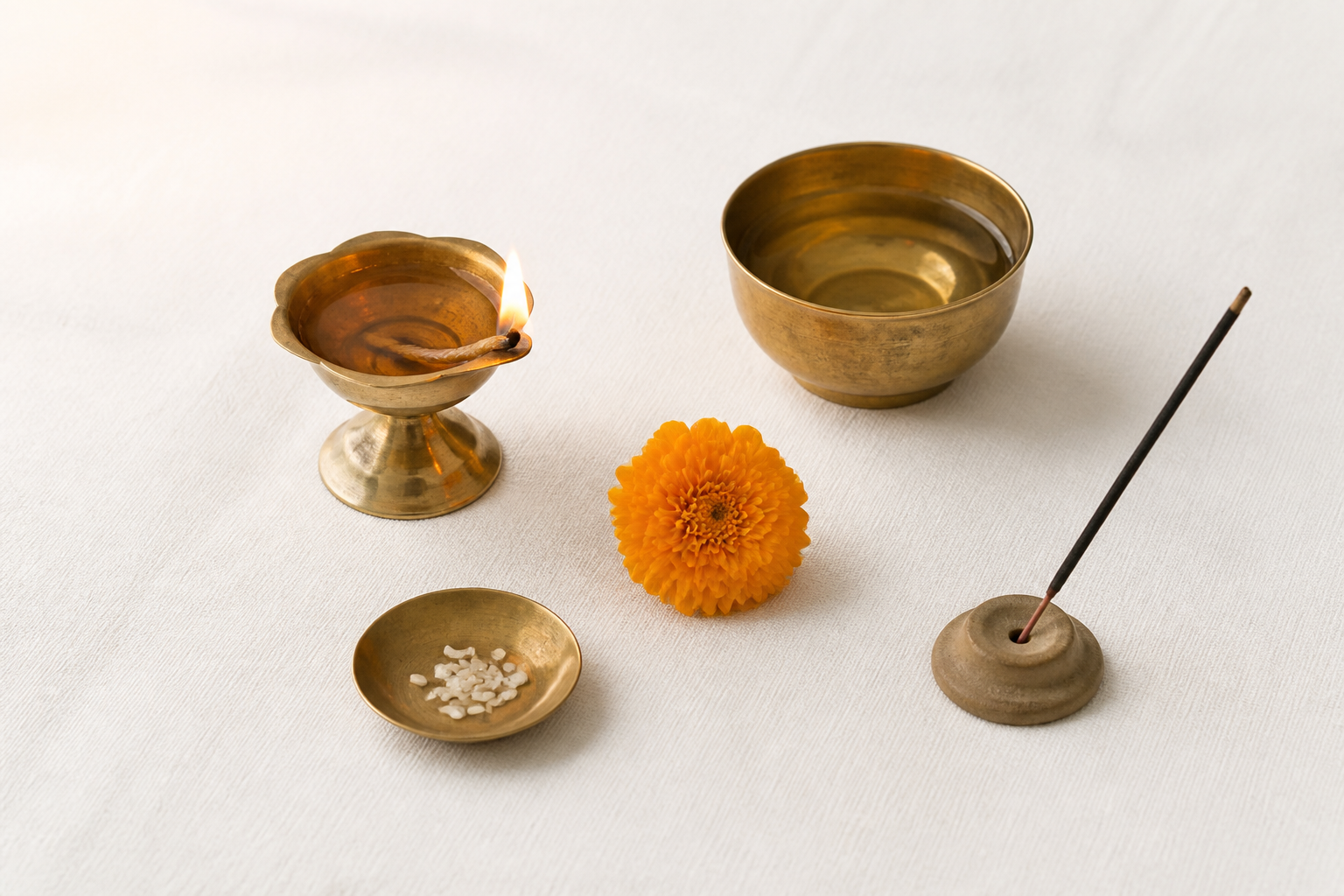
No single checklist applies to every Hindu family, deity, or sampradaya. If your household tradition, guru, or lineage gives you a form of daily worship, use that as your foundation. Simplification should remove unnecessary pressure, not erase instructions that define the practice.
For an ordinary home puja without a separately prescribed procedure, think in three layers:
- The centre: the deity or sacred form toward which you direct your attention, together with a known Divine Name, prayer, or mantra.
- The basic offering: something clean and respectfully presented, such as water, a flower or leaf that is available to you, or food appropriate to your household custom.
- The optional expression: a lamp, incense, garland, additional food, music, decoration, or longer recitation when these genuinely support the worship.
The third layer may change from day to day. The first should remain clear. This distinction prevents you from treating an unavailable accessory as a reason to abandon the whole puja.
Choose offerings you can handle responsibly. A clean cup of water is better than perishable items left neglected on the altar. A local flower is enough; imported flowers do not carry a higher measure of bhakti. If a flame is unsafe in your room or prohibited where you live, do not improvise with fire. Worship without it and retain the intention of offering light.
Your minimum should answer three practical questions: What do you already have? What do you know how to offer respectfully? What can you clean, replace, or distribute properly afterward? If the arrangement fails any of these tests, reduce it until the practice becomes sustainable.
A simple sequence for regular home worship
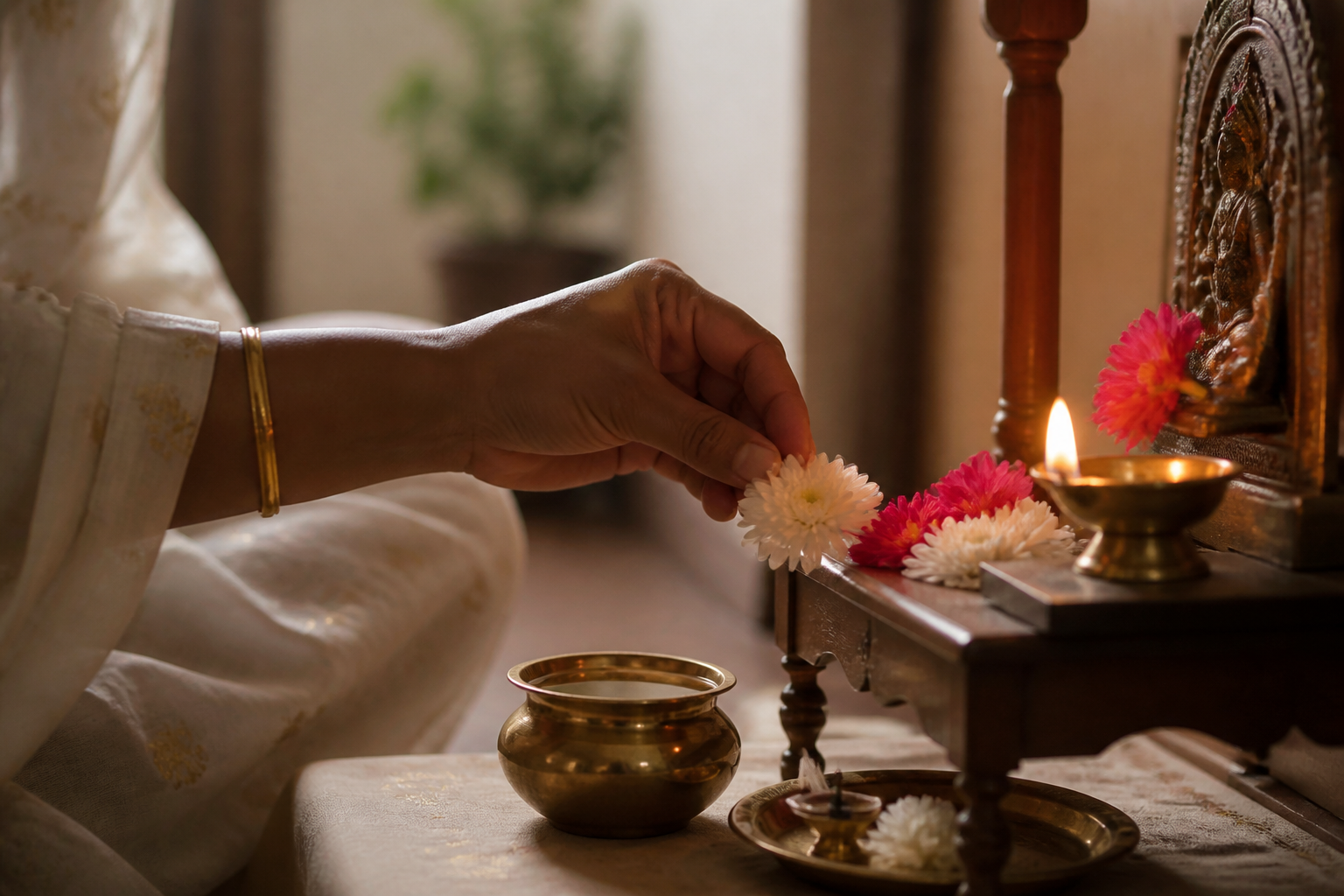
Use your inherited procedure wherever you have one. Otherwise, the following sequence can give an unstructured personal puja a clear beginning, centre, and close:
- Prepare the place and yourself. Wash your hands, clear the worship surface, arrange the few things you intend to offer, and put your phone aside. Cleanliness here is an act of attention, not a demand for luxury.
- Become still before beginning. Sit or stand before the sacred form and let the rush of the previous activity settle. Remember whom you are worshipping. This short pause keeps the first prayer from becoming a mechanical continuation of the day.
- Offer what is present. Present water, a flower, a leaf, food, light, or another customary item one at a time. Let each action mean something. There is no advantage in moving through many objects while thinking about something else.
- Recite what you genuinely know. Use a familiar Divine Name, mantra, stotra, or prayer associated with your practice. If you do not know a long recitation, do not assemble impressive-sounding words from fragments. A known name repeated attentively gives the mind a steadier centre.
- Speak plainly to the Divine. Express gratitude, admit where your conduct needs correction, and place your concern or aspiration before the deity. Personal prayer need not be ornate to be sincere.
- Leave room for silence. Stop speaking for a while. Allow the offering and recitation to settle rather than rushing immediately to the next task.
- Close deliberately. Offer pranam or another customary gesture of reverence. Receive or distribute prasad according to your household practice, remove perishables appropriately, and leave the worship place clean.
A short puja can still feel complete when it has a deliberate opening and closing. Brevity becomes careless only when you treat worship as an interruption to be cleared away. Give the smaller form your full presence, and it will not feel like a defective version of a larger ceremony.
Keep simplicity from becoming neglect
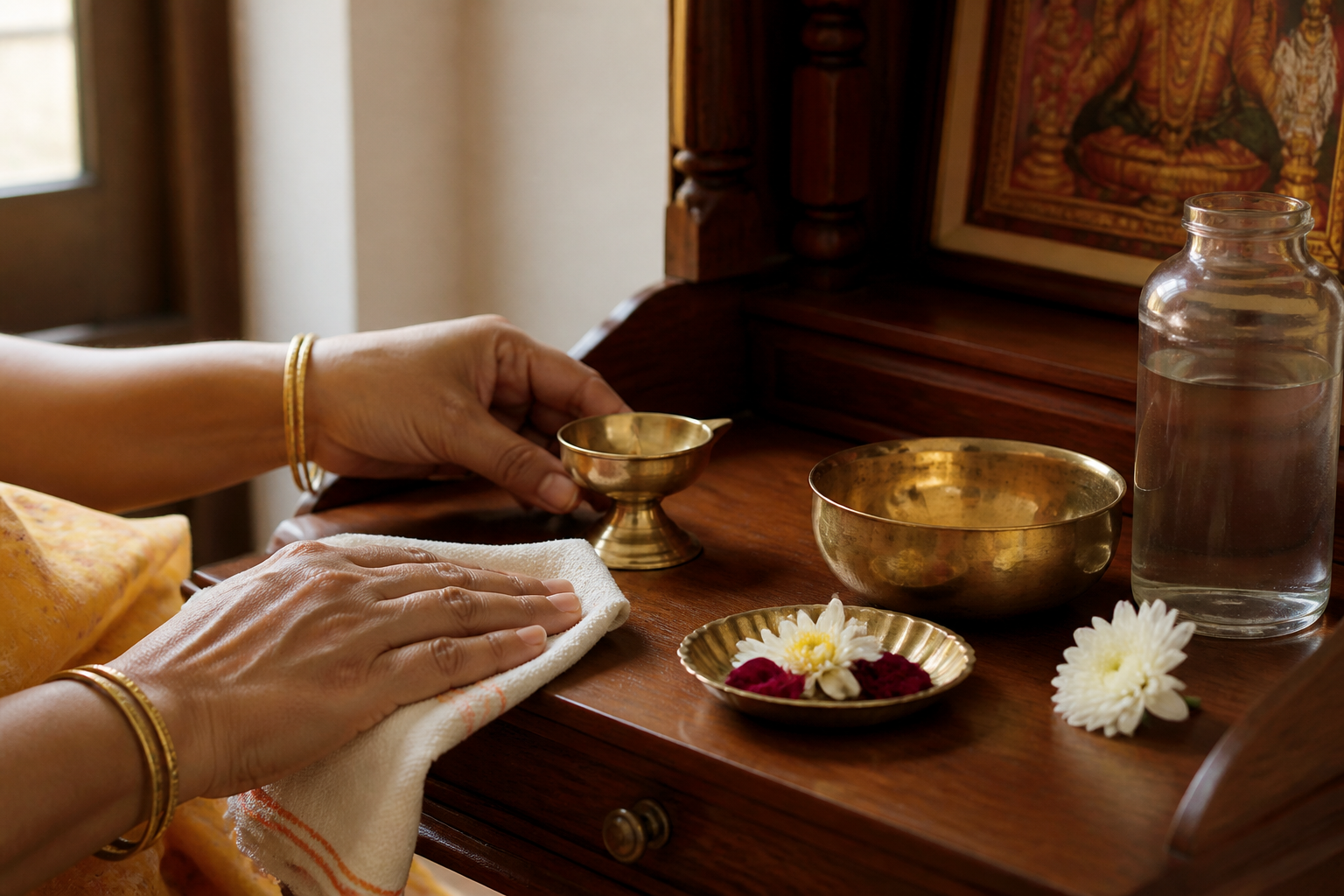
Simple puja means fewer elements carried with care. It does not mean a dusty altar, stale offerings, distracted recitation, or casual handling of sacred objects. Removing excess should make your attention more exact, not lower the standard of reverence.
It also does not require you to reject beauty. If arranging a garland quiets your mind, if preparing food is part of your devotion, or if the family gathers meaningfully around a fuller puja, those elements have a place. Simplicity is not an aesthetic competition in which the barest altar wins. The aim is to remove whatever turns worship into anxiety, status, or display.
Do not simplify a prescribed observance by guesswork
A flexible daily home puja is not the same as a vrata, festival observance, samskara, temple ritual, or practice received from a guru. Such worship may have a defined sequence, specific offerings, or rules that carry meaning within a particular tradition. Calling every detail unnecessary would confuse personal convenience with spiritual simplicity.
If you undertake a prescribed observance and cannot obtain an item or complete a step, ask a knowledgeable priest, teacher, or family elder from the relevant tradition what substitution or adaptation is accepted. Do not invent a universal rule from one household’s custom. Simplicity works best when paired with humility about what you do not know.
Likewise, do not use this principle to judge someone whose worship is elaborate. Abundance can be a sincere offering when it is freely given, responsibly managed, and rooted in bhakti. The problem is not the large puja. The problem is allowing size, novelty, or expense to become evidence of spiritual worth.
Key takeaways for your next puja
- Begin with a form of worship you can complete regularly instead of waiting for ideal materials or a grand occasion.
- Keep the deity, attentive prayer, and sincere offering at the centre; treat most accessories as optional supports.
- Use clean, available items and present them deliberately. Price and rarity do not measure devotion.
- Preserve the instructions of your family tradition, sampradaya, guru, or prescribed observance where they apply.
- Make simplicity more careful, not more casual: prepare the space, avoid distraction, close properly, and clean afterward.
- Whenever your puja expands, ask whether each addition deepens attention or merely increases display.
Before your next puja, choose the smallest complete form you can offer without resentment, hurry, or pretence. Prepare that version and perform it once with your full attention. Add something later only when it strengthens devotion. The goal is not to conduct the smallest possible puja; it is to leave the least possible clutter between you and the Divine.
References
