
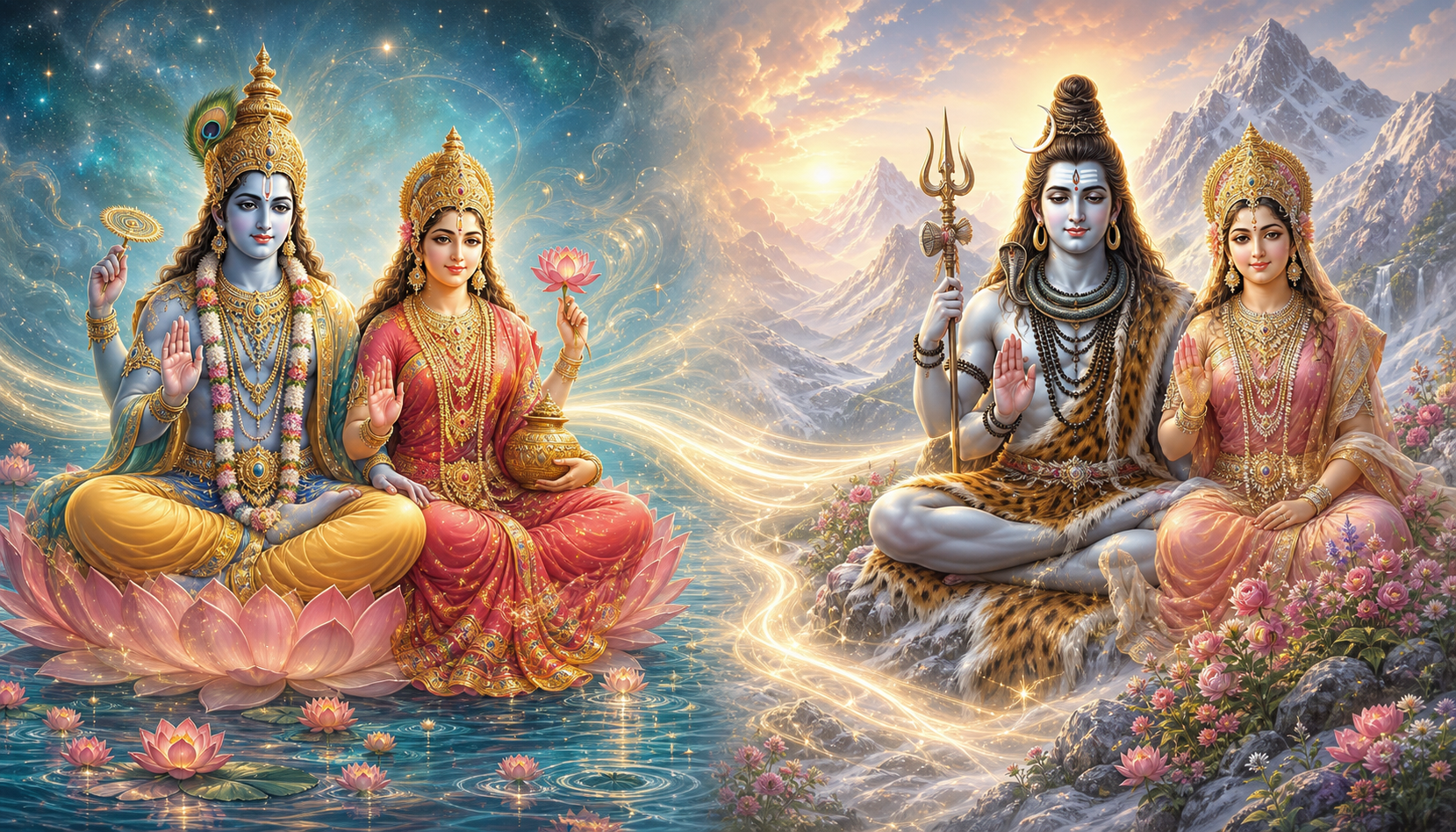
If you have heard Lakshmi or Sita described as Vishnu’s Shakti, and Parvati or Durga described as Shiva’s Shakti, the obvious question is whether Hindu traditions are speaking about different powers or giving different names to the same divine reality.
The most useful answer preserves both unity and distinction. Shakti is one, while Vaishnava and Maheswari traditions encounter her through different divine relationships. Understanding that distinction lets you read theology, enter a temple, or discuss another sampradaya without turning difference into rivalry or unity into sameness.
One Shakti can appear in different devotional grammars
Before comparing the two conceptions, ask what the word Shakti is doing in the passage before you. It can indicate the universal principle of divine power, a personal Goddess, or the particular potency of a named deity. Those meanings overlap, but they are not interchangeable.
- As a universal principle, Shakti is the power through which divine reality manifests, sustains, transforms, and acts.
- As a personal deity, Shakti is worshipped as a conscious divine presence, not treated as an impersonal force.
- As relational language, Shakti identifies the inseparable power of Vishnu, Shiva, or another divine form within a particular theology.
Many apparent contradictions arise because one statement concerns metaphysics while another concerns worship. Saying that divine power is ultimately one does not make every name, mantra, icon, or ritual interchangeable. Conversely, distinct forms of worship do not require us to imagine several rival cosmic energies.
The relation between Shakti and the one who possesses power is sometimes expressed through the term shaktiman. The point is not that a complete male deity acquires energy from an external female assistant. Power is intrinsic to divinity. The theological question is how a tradition understands the distinction, inseparability, and loving relationship between the divine person and divine power.
Use a simple test whenever you encounter the term: replace Shakti with either universal divine power, the Goddess as a person, or the power of this named deity. The surrounding prayer or argument will usually reveal which meaning is intended.
Vaishnava Shakti reveals the power of Bhagavan in relationship
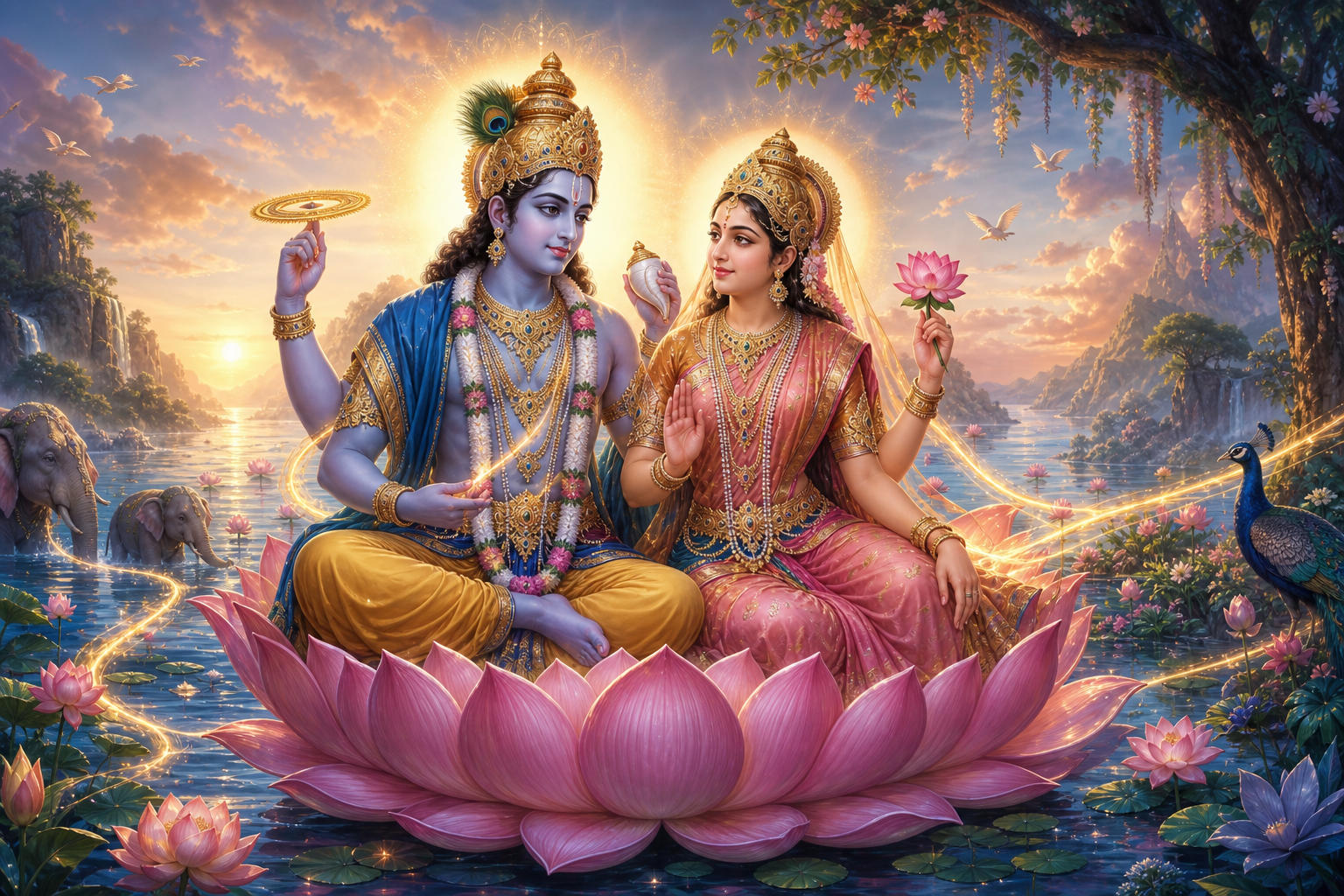
Vaishnava language begins with Vishnu, Narayana, or a form such as Rama or Krishna. Shakti is then encountered in relation to that form of Bhagavan. Sri or Lakshmi, Sita, and Radha are prominent expressions of this divine feminine presence in different Vaishnava settings.
These names should not be collapsed into one interchangeable profile. Lakshmi-Narayana, Sita-Rama, and Radha-Krishna each carry a distinct devotional relationship. A tradition may emphasize majesty and auspiciousness in one setting, fidelity and dharma in another, or intimate devotion in another. The shared classification tells you that the feminine figure belongs within a Vaishnava understanding of divine reality; it does not erase the particular form through which devotees approach her.
This also corrects several common reductions. Lakshmi is not merely a symbol for money. Sita is not merely an accessory to Rama’s story. Radha is not simply a literary emblem for human romance. In worship, each is approached as a divine person whose relationship with Bhagavan discloses something that an isolated description of power cannot.
Vaishnava schools do not all define that relationship in identical metaphysical terms. A particular sampradaya may stress dependence upon Bhagavan, eternal companionship, inseparability, or a form of unity that preserves difference. You therefore should not use the broad label Vaishnava Shakti to settle a finer question about rank or ontology. First identify the sampradaya and the divine pair under discussion.
A dependable reading rule is this: if a prayer begins from Vishnu, Narayana, Rama, or Krishna and asks how divine grace, protection, order, nourishment, or devotion becomes present, read its feminine form within that Vaishnava relationship. Do not detach the Goddess from the Bhagavan with whom the prayer presents her, and do not reduce her to an abstract function.
Maheswari Shakti makes Shiva’s power manifest

Maheswari means that which belongs or relates to Maheshvara, a name of Shiva. In this broad usage, Maheswari Shakti is Shiva’s dynamic power, personally encountered through forms such as Uma, Parvati, Durga, or Kali according to the context.
A common Shaiva formulation treats Shiva and Shakti as inseparable dimensions of divine reality: consciousness and its power of expression. The distinction allows devotion, relationship, and manifestation to be described. Their inseparability prevents us from imagining Shiva as one self-sufficient reality and Shakti as a detachable instrument employed only when action is required.
Maheswari settings often bring transformation into the foreground. Tapas, protection, the overcoming of disorder, dissolution, renewal, and liberation can all appear within this grammar. Dissolution here should not be confused with moral evil or meaningless destruction. It can name the removal of a form whose time has ended, making transformation possible.
The divine forms remain context-sensitive. Parvati’s domestic and ascetic dimensions, Durga’s protective sovereignty, and Kali’s fierce transcendence should not be compressed into a single mood called Shiva’s energy. Nor does one function belong exclusively to one sect. Vaishnava traditions also know protection and transformation, while Shaiva traditions also know grace, nourishment, and tenderness.
There is an important terminological warning. Maheshvari or Maheswari can function as a general adjective for Shiva-associated Shakti, but Maheshvari can also be the name of a particular Goddess, including in contexts involving the Matrikas. Read the surrounding names before deciding which meaning is intended.
Maheswari is also not an automatic synonym for every Shakta conception. A Shaiva account may begin with Shiva and explain Shakti as his inherent power; a Shakta account may begin with Devi as supreme reality. Some traditions emphasize identity, others relational unity, and others a hierarchy. The shared vocabulary does not cancel those differences.
Compare orientation and relationship, not divine rank
The following comparison is a reading aid, not a set of rigid boundaries. It identifies the devotional orientation usually signalled by each term while leaving room for differences among schools.
| Question | Vaishnava framing | Maheswari framing |
|---|---|---|
| Whose Shakti is being described? | Vishnu, Narayana, or a form such as Rama or Krishna | Maheshvara or Shiva |
| Which relational forms may appear? | Sri or Lakshmi, Sita, and Radha, depending on the tradition | Uma, Parvati, Durga, and Kali, depending on the context |
| What is often brought forward? | Divine grace, auspiciousness, sustenance, protection, and devotion | Manifestation, tapas, protection, transformation, dissolution, and renewal |
| What must remain intact? | The particular relationship within Lakshmi-Narayana, Sita-Rama, or Radha-Krishna worship | The particular form and theological relation presented within a Shiva-Shakti setting |
| What should not be inferred? | That Vaishnava Shakti is a separate cosmic substance or that every Vaishnava school defines her status identically | That Maheswari Shakti is a rival energy, that every fierce form means destruction alone, or that all Shaiva and Shakta positions are identical |
Key takeaways
- Vaishnava and Maheswari describe devotional orientations toward Shakti, not two independently existing kinds of cosmic energy.
- Unity at the level of divine power does not make distinct Goddesses, relationships, mantras, or rituals interchangeable.
- The name of the Goddess, the deity with whom she is related, and the sampradaya interpreting that relationship matter more than a broad label.
- Grace, protection, nourishment, transformation, and liberation overlap across traditions; they are emphases, not exclusive jurisdictions.
Keep three different claims separate: equivalence, identity, and hierarchy. To say that both traditions recognize one Shakti is to affirm an underlying unity. It does not by itself prove that two named forms are ritually identical, or that every scripture assigns them the same theological position. Those further claims have to be established within the relevant tradition.
This distinction protects you from two opposite mistakes. Sectarian ranking turns a difference in devotional standpoint into a contest over whose Goddess is real. Careless universalism goes the other way and treats every form as a replaceable label. Hindu pluralism is more disciplined than either approach: reality can be one while divine names, relationships, and paths remain meaningful.
Use a four-step method in study, worship, and discussion
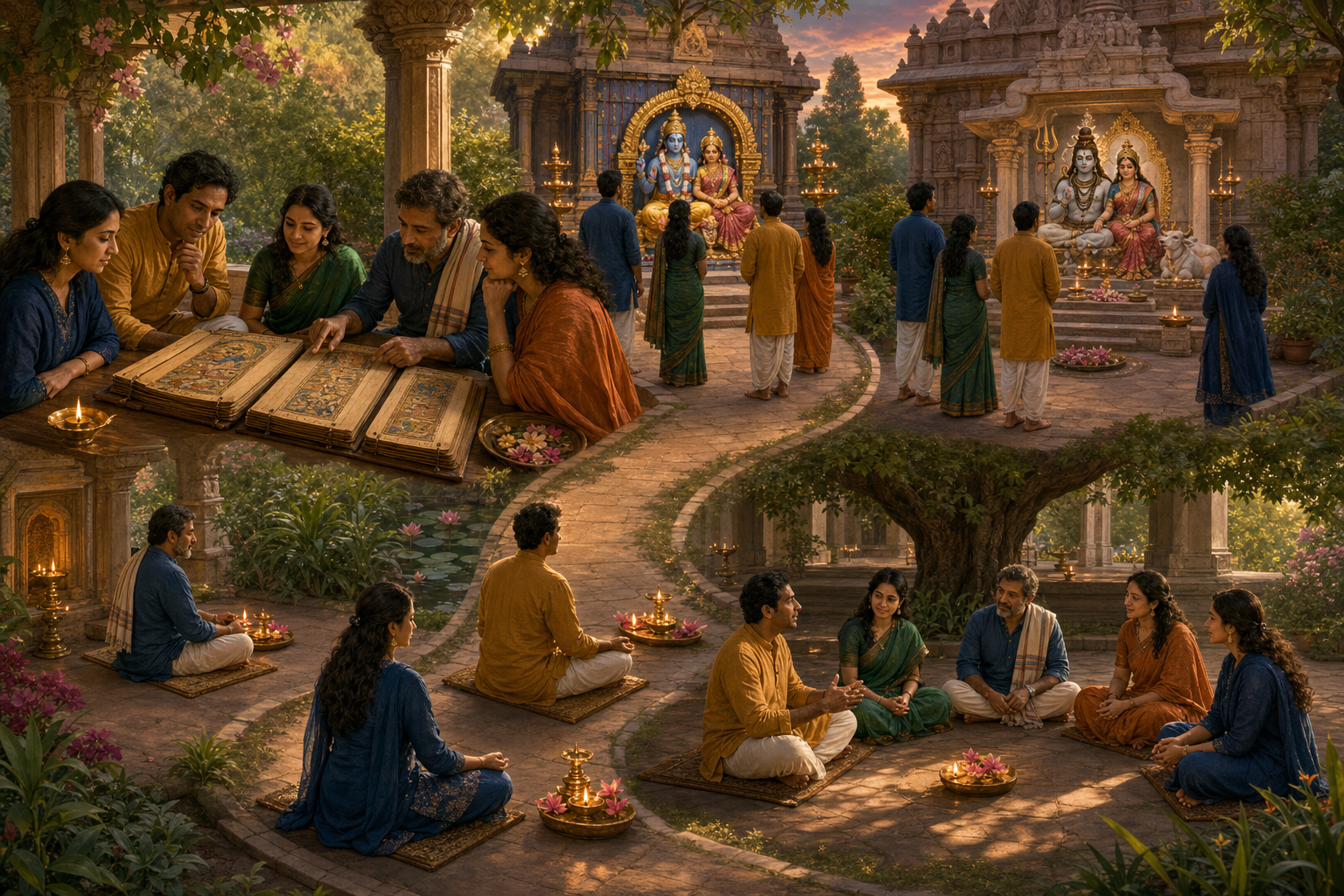
When you encounter a statement about Shakti, work through it in this order:
- Identify the referent. Is Shakti being discussed as universal power, a personal Goddess, or the potency of a named deity?
- Identify the relationship. Is the setting Vishnu-Lakshmi, Rama-Sita, Krishna-Radha, Shiva-Parvati, or another specific divine relation?
- Identify the level of the claim. Is the passage describing metaphysical identity, devotional companionship, divine function, iconography, or ritual practice?
- Identify the tradition. Before making a claim about rank or ultimate status, find out which sampradaya or theological standpoint governs the language.
You can then summarize the passage in one precise sentence: In this setting, Shakti is encountered as this divine form, in relation to this form of Bhagavan, with this theological or devotional emphasis. If you cannot fill in all three parts, you probably need more context before drawing a conclusion.
In worship, metaphysical unity is not a reason to improvise substitutions. A mantra, icon, or puja belongs to a particular liturgical setting. If your family, temple, or guru-parampara follows a specific form, respect that form’s names and procedures. Learning how another tradition approaches Shakti can deepen mutual understanding without requiring you to dissolve the practice you have received.
In conversation, begin with the relationship rather than a ranking. Say that Vaishnava practice encounters Shakti through her relation to Vishnu and his forms, while Maheswari practice encounters her through her relation to Shiva. Then ask how the particular school understands that relation. That question opens a real theological discussion; asking which energy is stronger usually closes it.
The next time you see Sita, Lakshmi, Radha, Parvati, Durga, or Kali placed under one sweeping label, pause and name the form, relationship, and context. Preserve those distinctions without imagining a divided divine power. That is the practical balance: recognize one Shakti, and meet each manifestation on the terms through which devotees actually know her.
References
