
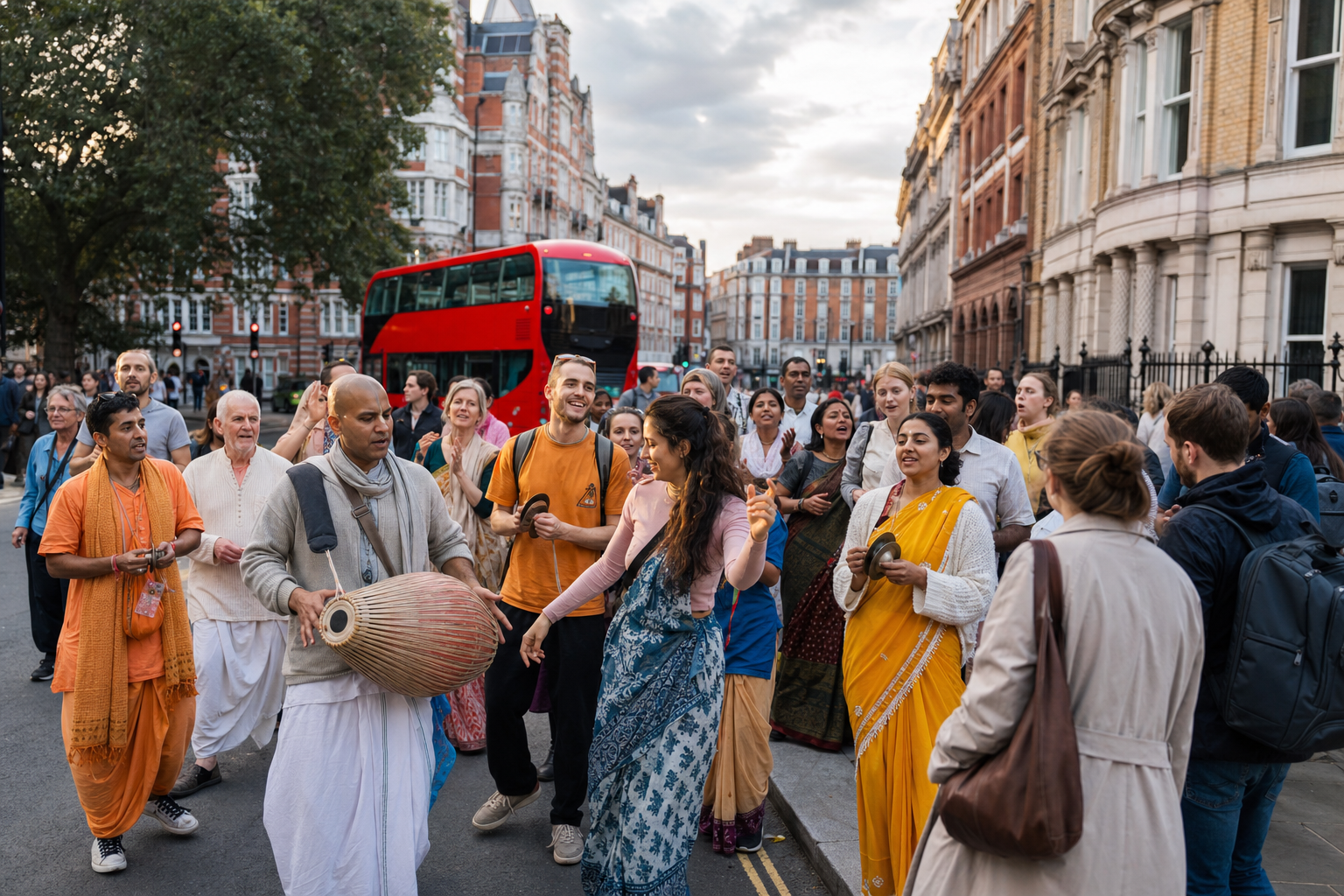
You hear the Hare Krishna mantra on a London street before you understand what is happening. People are chanting, dancing, watching, filming, or simply trying to pass. If you are unsure whether to join, observe, or give the gathering more space, begin with one distinction: you are encountering worship in public, not entertainment that happens to use sacred words.
A London celebration shared on 15 August 2026 shows how naturally Hare Krishna devotion can enter the rhythm of a global city. To respond well, you do not need specialist knowledge. You need to recognise what the chanting means, decide honestly how you want to participate, and treat the people involved as worshippers rather than street scenery.
Hear the devotion before judging the performance
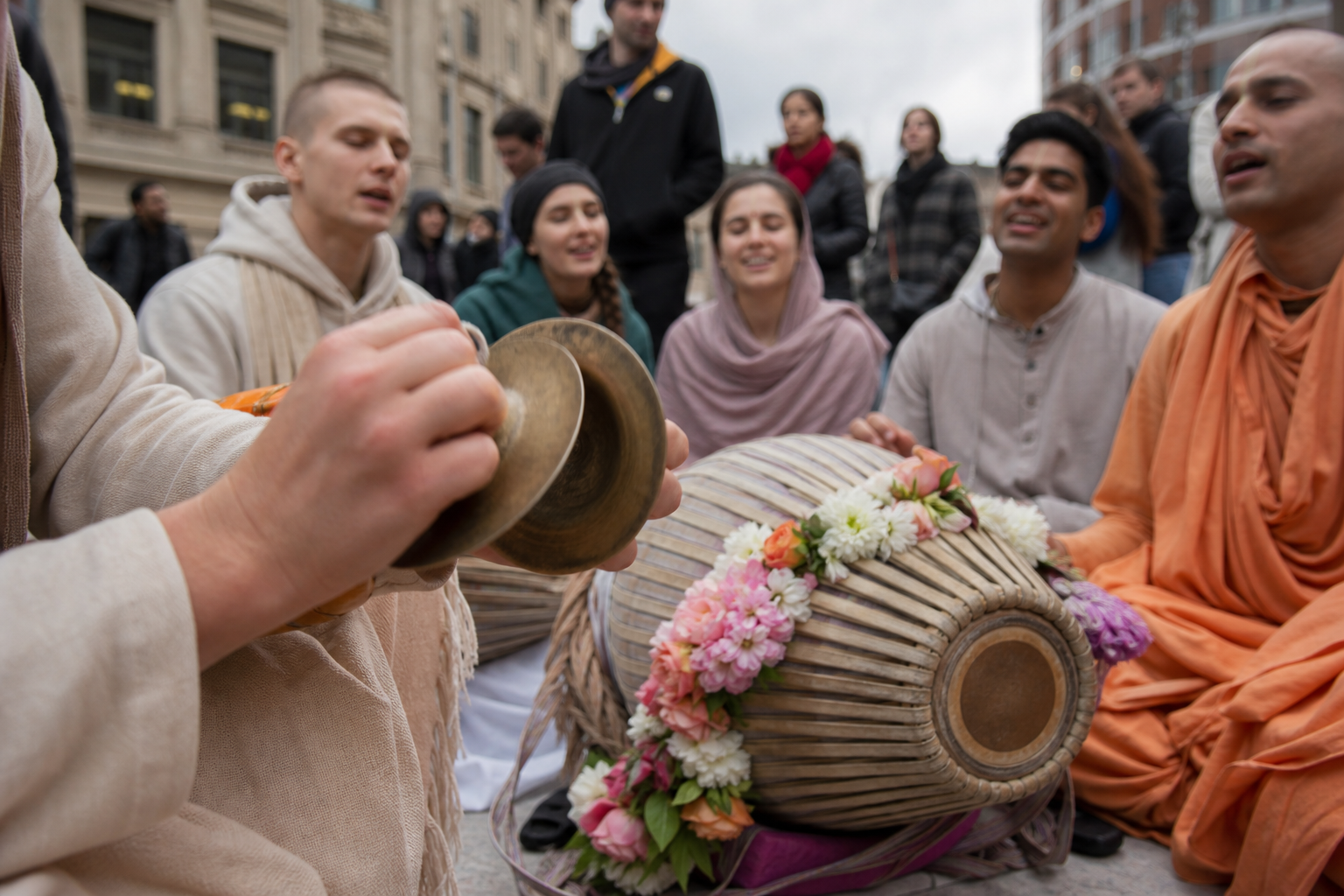
Public congregational chanting of divine names is commonly called sankirtana. Within Gaudiya Vaishnava bhakti, the sound of the name is central to the devotional act. Singing and dancing are not decorative additions placed around the worship. Voice, attention, rhythm, and bodily movement allow the whole person to participate.
The mantra you are likely to hear is: Hare Krishna, Hare Krishna, Krishna Krishna, Hare Hare; Hare Rama, Hare Rama, Rama Rama, Hare Hare. A leader may sing a phrase and the group may answer it. That repeating structure lets a passerby understand the pattern without receiving a formal lesson.
This matters because public celebration can be misread in two opposite ways. One observer sees singing and assumes that it is merely a performance. Another sees religious dress or sacred language and assumes that outsiders must keep away. Sankirtana crosses that divide: it remains a specific Vaishnava practice while making attentive participation possible for people who did not arrive as members of the community.
If you want to understand the gathering, do not judge its seriousness by volume, dancing, clothing, or the number of phones pointed at it. Listen for what remains at the centre. When the mantra directs the rhythm and the participants repeatedly return their attention to the chanting, the celebration is functioning as devotion rather than as a generic street show.
Join at the level you can honestly offer
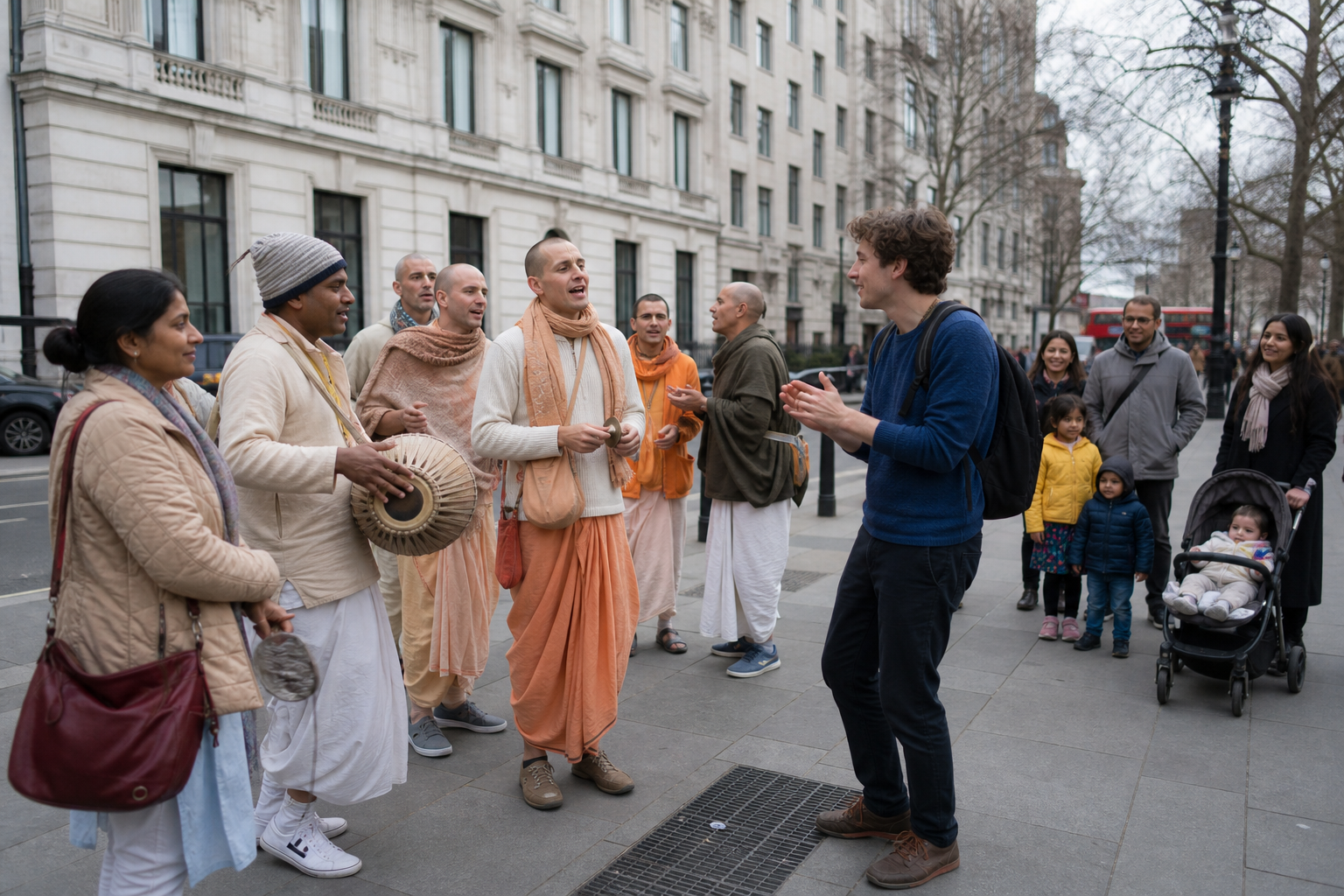
You do not have to choose between becoming fully involved and walking away. There are several respectful levels of participation. A devotee may chant with deliberate devotional intention. A curious passerby may repeat the response sincerely. Someone who does not wish to chant may listen without disrupting the gathering. Honesty is more respectful than performing religious enthusiasm for a photograph.
- Pause at the edge first. Spend a moment noticing the direction of movement, the space used by singers, and whether passersby are being guided around the gathering.
- Listen for the repeated response. You do not need to improvise. When the group answers the lead singer, repeat the same words in your ordinary voice.
- Let the rhythm teach you. If people are moving together and there is room, a simple step or gentle clap is enough. Do not imitate gestures dramatically or push into the centre to be seen.
- Ask when the invitation is unclear. A simple question about whether you may join is better than assuming that every part of the gathering is open to interruption.
- Leave without embarrassment when you need to. Chanting for a few minutes is not a declaration of membership. You may participate respectfully and then continue with your day.
Do not worry about producing a theatrical accent. Repeat the mantra plainly and listen closely enough to follow its sequence. Respectful attention matters more than polished pronunciation from someone encountering the chant for the first time.
If you are with a child, give a precise explanation: these are devotees chanting divine names as a form of bhakti. That sentence is more useful than calling the gathering an Indian dance, a parade, or a street party. It identifies both the action and its religious purpose without asking the child to adopt a belief.
Make room for worship on a shared street
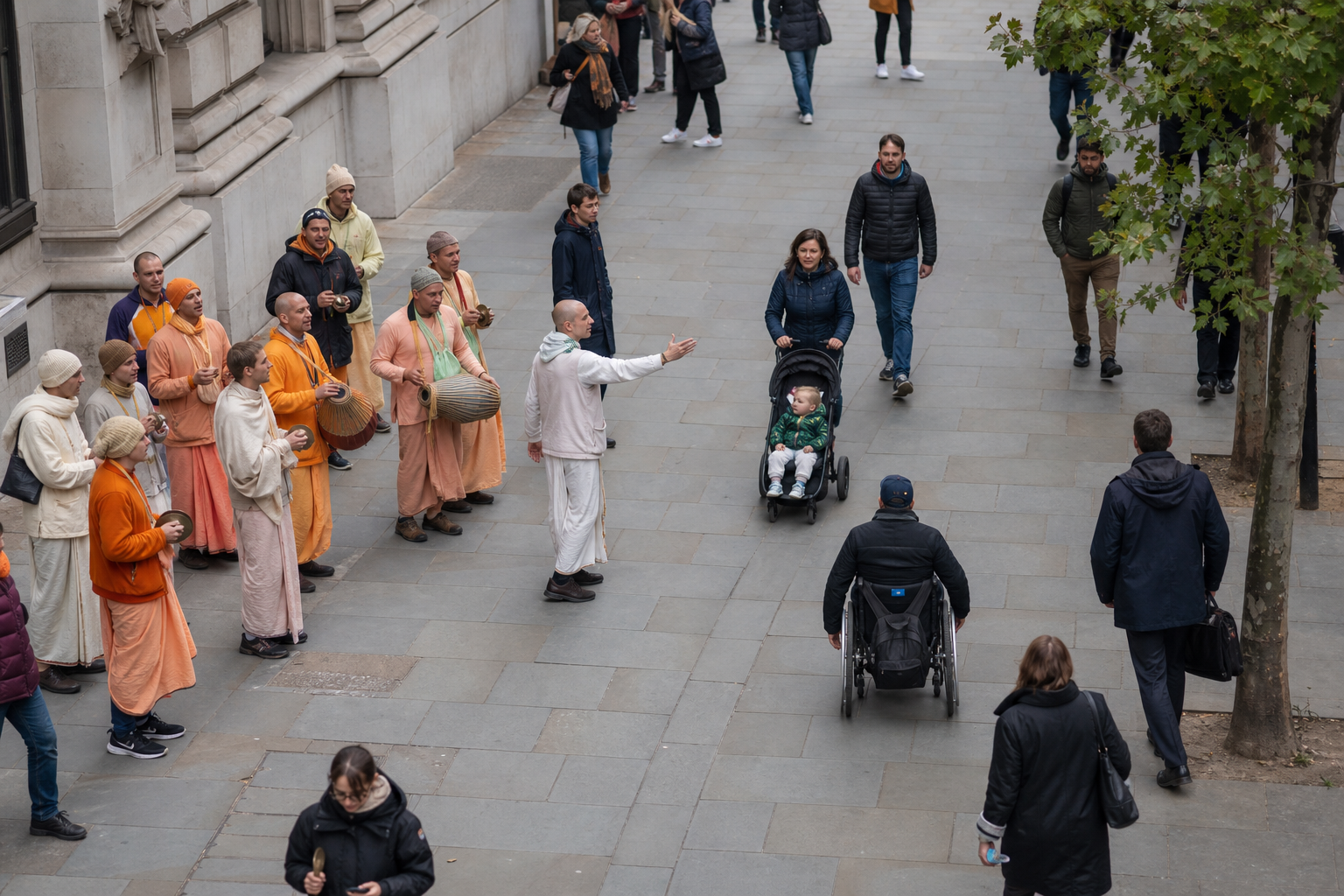
A public street is both an open civic space and, for the duration of the chanting, a place of devotional practice. Neither fact cancels the other. Worshippers should expect ordinary city movement around them, while observers should avoid treating public visibility as unlimited permission to intrude.
- Keep the route usable. Stand where pedestrians can pass, and follow any directions given by stewards or public officials.
- Ask before taking a close portrait. A wide image of a public gathering is different from putting a camera close to one person’s face. Be especially careful around children.
- Do not touch instruments or devotional objects. Their presence in the street does not make them public props.
- Save arguments for another moment. If you want to discuss theology, ask whether someone is available after the chanting instead of turning worship into an involuntary debate.
- Accept or decline invitations plainly. If someone offers conversation or printed material, you can respond courteously without pretending interest or reacting with suspicion.
The useful test is simple: would your action help a person practise, help you understand, or merely place you at the centre of someone else’s sacred moment? That question usually resolves uncertainty about filming, joining the dance, or approaching the chanters.
Describe London’s Hare Krishna presence accurately
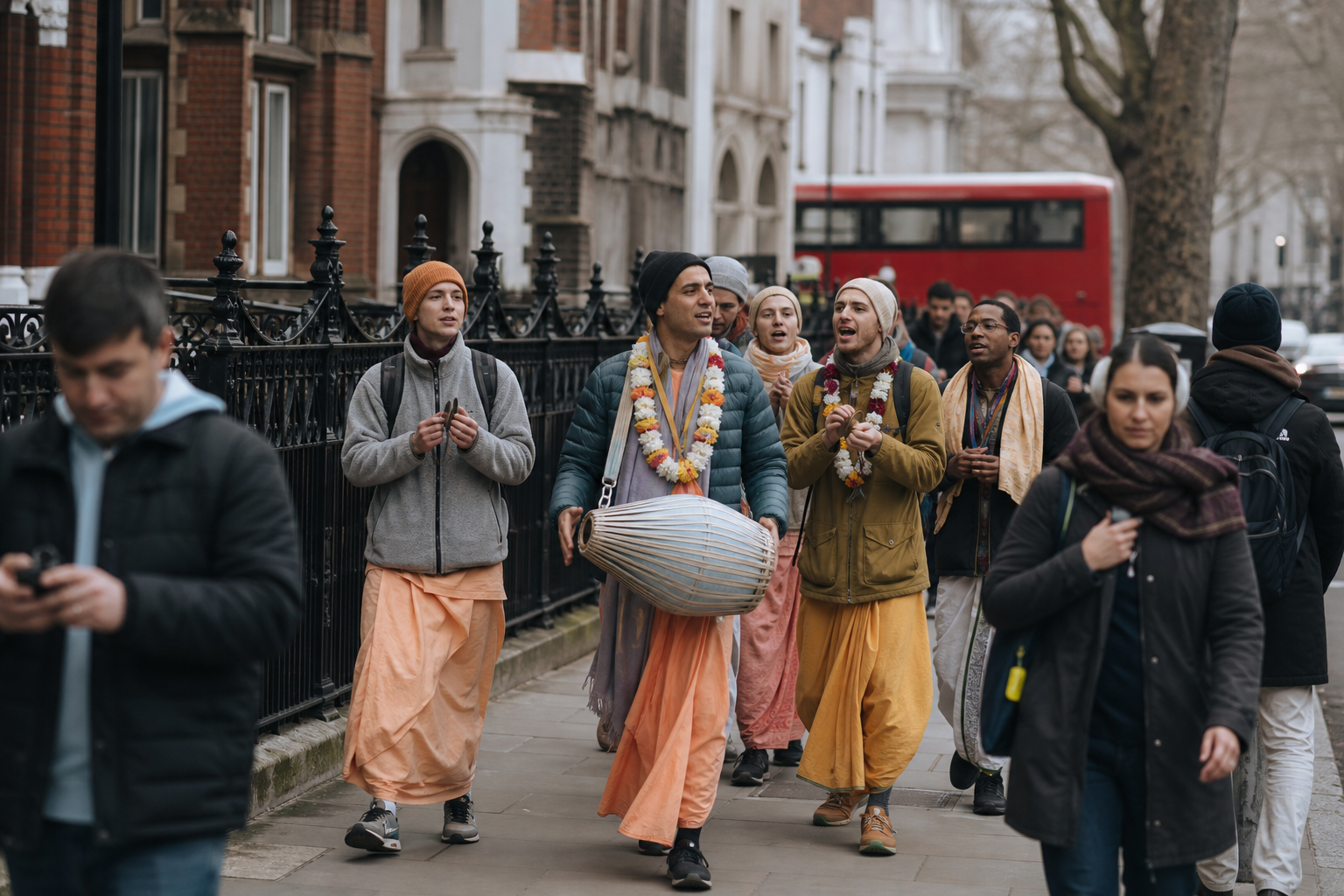
For a Dharmic reader, public visibility in London carries understandable significance. A bhakti practice rooted in Bharat is not confined to a private home, a temple interior, or an ethnic enclave. Sacred sound enters an ordinary urban setting and meets people who may have no prior knowledge of Krishna devotion.
That significance should not become exaggeration. One celebration establishes presence; it does not establish the size of a community, the opinion of London as a whole, or universal acceptance of the tradition. Crowd photographs and energetic dancing are poor substitutes for verified attendance figures or careful cultural analysis.
Precision also protects the tradition from being flattened into vague language about Eastern spirituality. Hare Krishna sankirtana is a Vaishnava form of congregational chanting. It is one expression within the large and internally diverse Hindu world, not a stand-in for every Hindu school, temple custom, or regional tradition.
If you share an image or describe the gathering to someone else, name it accurately. Calling it Hare Krishna sankirtana tells your audience more than labels such as colourful festival or Indian street dance. Add only the date, place, organiser, route, or attendance figure that you can actually verify. Cultural advocacy becomes more credible when enthusiasm is disciplined by accuracy.
Key takeaways
- Hare Krishna street chanting is public bhakti; singing and dancing belong to the devotional practice rather than merely accompanying it.
- You may listen, chant the repeated response, move with the group when space permits, or decline to participate without disrespect.
- Public visibility does not remove ordinary boundaries around close-up photography, personal space, instruments, or devotional objects.
- Describe the gathering as Hare Krishna sankirtana or Vaishnava congregational chanting, not as a generic Indian performance.
- Treat a documented celebration as evidence of a living presence, not as proof of unverified crowd size or wider public opinion.
The next time the mantra reaches you on a London street, stop long enough to hear how the response works. Join it once if the space and invitation are clear. If you prefer not to chant, offer the equally valuable courtesy of attentive observation and an unobstructed path. Public dharma remains intelligible when devotees bring sincerity and onlookers bring discernment.
References
