
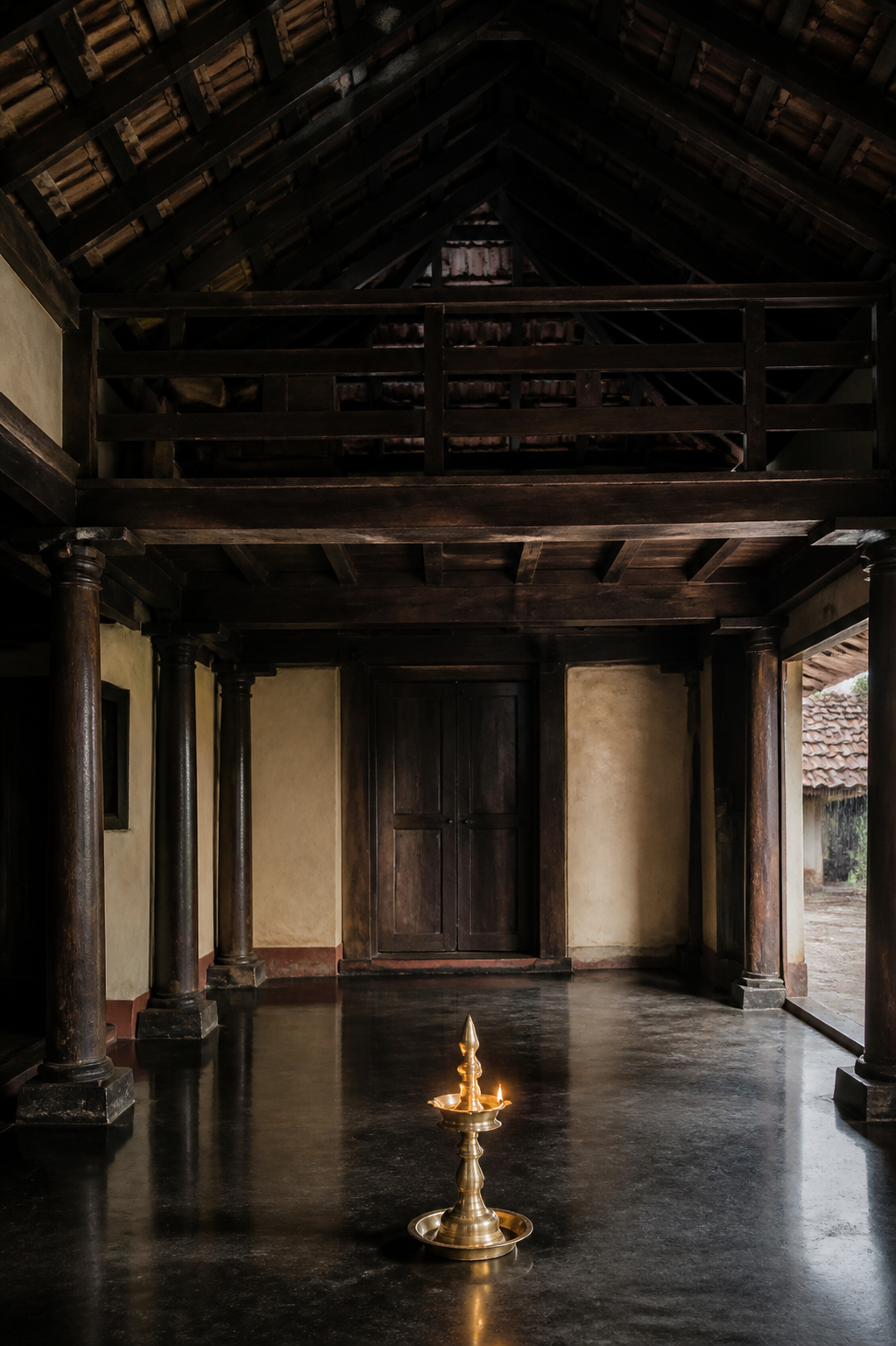
If your family speaks of Bhagavathy in the machil, you may be unsure how literally to take the words. Is the loft a shrine, a dwelling place, a family memory, or all three? The safest answer is not to force the tradition into a familiar temple model.
Machil Bhagavathy reveals a form of Kerala Shakta life in which the ancestral house itself carries sacred presence. Understanding it begins with the place, but preserving it requires something more practical: careful questions, respect for family-specific knowledge, and a refusal to invent missing rites.
The name begins with a place, not an image
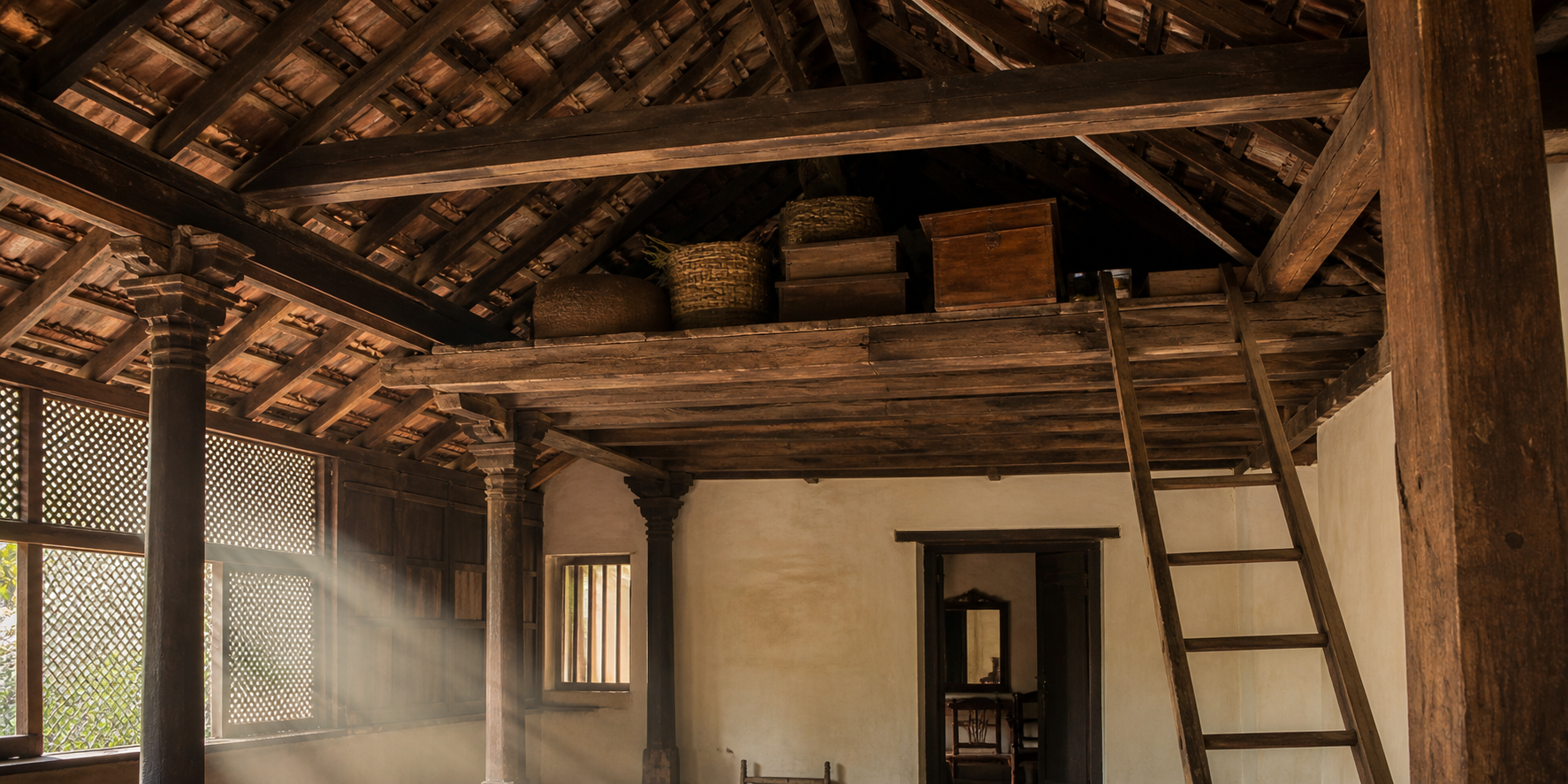
The machil is the attic or upper loft of the traditional Kerala house. In this household Shakta tradition, that highest part of the home is not treated as ordinary storage. It is held to be sacred and understood as the dwelling of Bhagavathy.
Bhagavathy is a name for the Goddess. Machil Bhagavathy can therefore be understood as the Goddess encountered through her particular place in the ancestral home. The spatial relationship matters. This is not simply a portable divine image that happens to have been put upstairs; the identity of the sacred presence is bound to the machil in the family’s religious memory.
That distinction protects you from three easy mistakes. The name does not establish that every Kerala attic is sacred. It does not make an ordinary pile of stored possessions divine. Nor does it prove that every family followed the same observances. It identifies a particular way in which a home could be inhabited and understood.
If you visit or inherit such a house, begin by noticing how relatives name the space. Do they say that Bhagavathy is in the machil, belongs to the machil, or is the Machil Bhagavathy? Those expressions may sound interchangeable, but they can preserve different understandings of presence, place and family obligation. Record the wording before translating it into a broader religious category.
Why the household setting changes how you understand Shakta worship
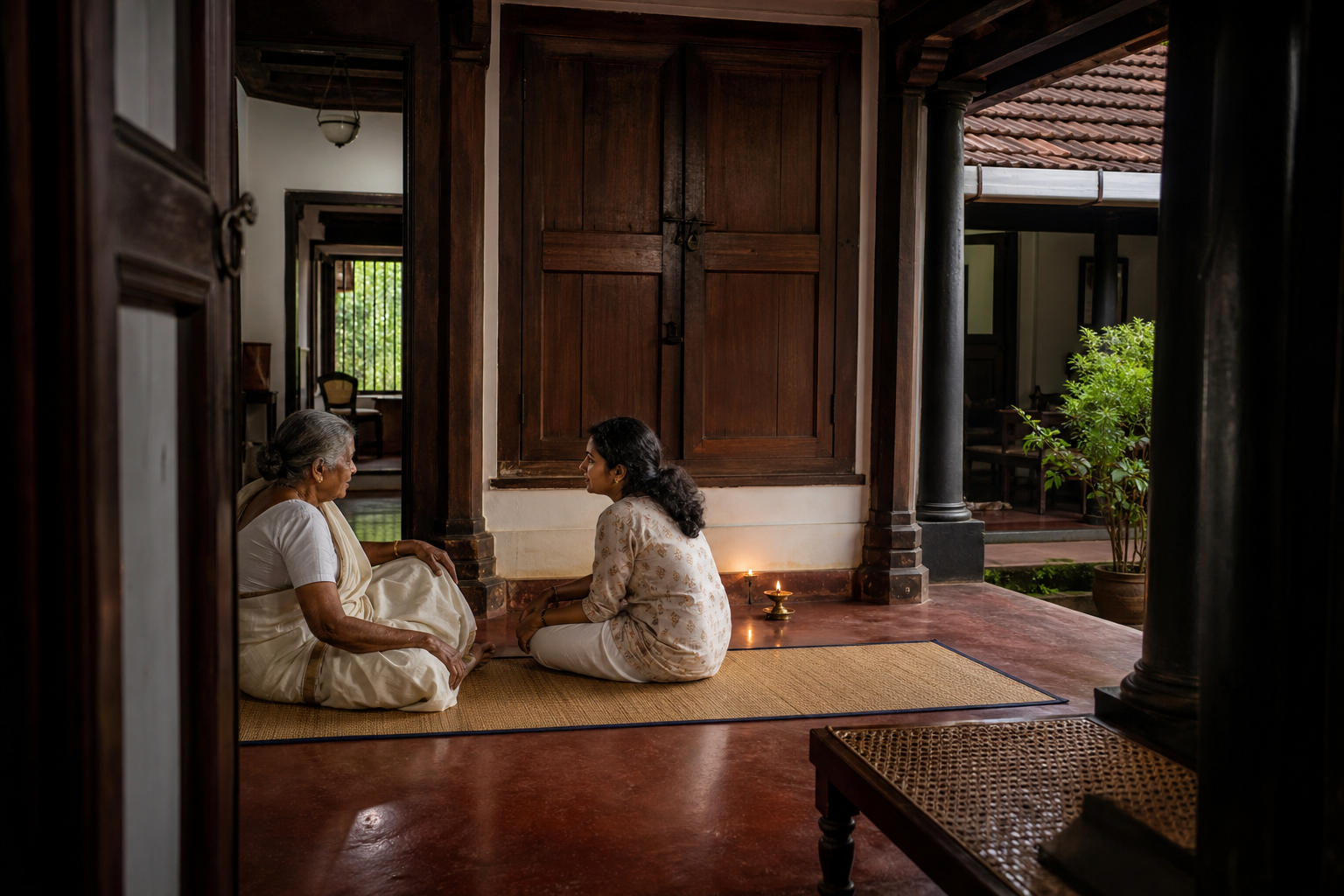
Shakta traditions approach ultimate reality through Shakti, the divine power worshipped as the Goddess. Machil Bhagavathy places that relationship inside the tharavadu, the ancestral joint-family home. The sacred centre is therefore not confined to a public temple or separated from domestic life.
This does not make the Goddess casual or merely private. It makes the house religiously legible. A structure used for sleeping, cooking, storing property and maintaining kinship can also contain a place that is not reducible to any of those functions. The home becomes part of the family’s sacred geography.
The position of the machil at the uppermost part of the house invites a vertical reading of that geography. Daily activity unfolds below, while the highest interior space is held apart for the Goddess. That is an interpretation of the arrangement, not a universal doctrine that should be imposed on every tharavadu. Its value is that it helps you notice how architecture can carry theology without needing a written philosophical statement.
You should also resist treating household worship as an incomplete copy of temple worship. A temple serves a wider body of devotees and follows its own inherited disciplines. A household tradition may instead be carried by kinship, remembered boundaries, the name of a room and practices known to particular members of the family. One form need not be measured by the outward scale of the other.
Ask these questions before repeating a family claim
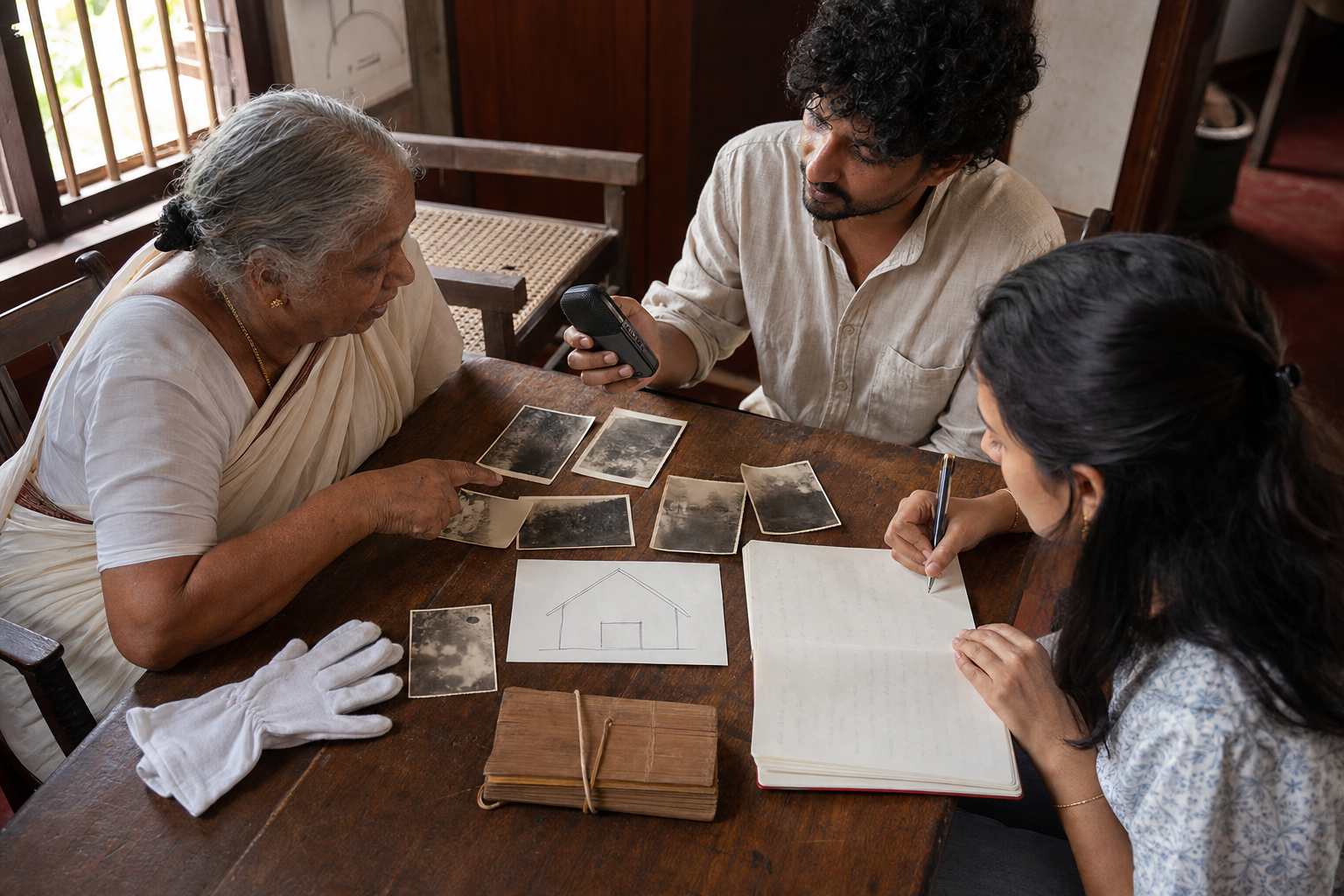
The phrase “Machil Bhagavathy” tells you where the sacred relationship is centred. It does not, by itself, tell you what your own family did there. If you are documenting a tharavadu tradition, ask precise questions while knowledgeable relatives can still answer them.
- What was the exact family name? Record the Malayalam expression, local pronunciation and any alternate name before settling on an English translation.
- What did “machil” mean in this house? Identify the actual room or loft rather than assuming that every upper space had the same status.
- How was Bhagavathy understood? Ask whether relatives speak of a divine presence, a designated sacred place, a material representation, or some combination. Do not supply the answer for them.
- Who held the knowledge? Note which family members remembered the place, cared for it or explained its significance. A confident memory should still be attributed to the person who gave it.
- What conduct was remembered? Ask separately about entry, cleaning, offerings, observances and occasions. A prohibition is not evidence of a ceremony, and a ceremony remembered by one branch may not have belonged to every branch.
- What survives? Distinguish the standing structure, material objects, photographs, documents and oral recollections. Each kind of evidence answers a different question.
Interview relatives separately at first. People often settle quickly on a shared version when speaking as a group, and uncertainty disappears from the retelling. Separate accounts let you preserve agreement as well as disagreement. Write “unknown” where knowledge has been lost; an honest gap is more useful than a polished invention.
Keep observation apart from interpretation. “The loft is above the central rooms” records a physical relationship. “It was placed there because height represents transcendence” offers an explanation that would need family testimony or another basis. Both statements may be worth preserving, but they should not be presented as the same kind of knowledge.
How to preserve the tradition without manufacturing a ritual
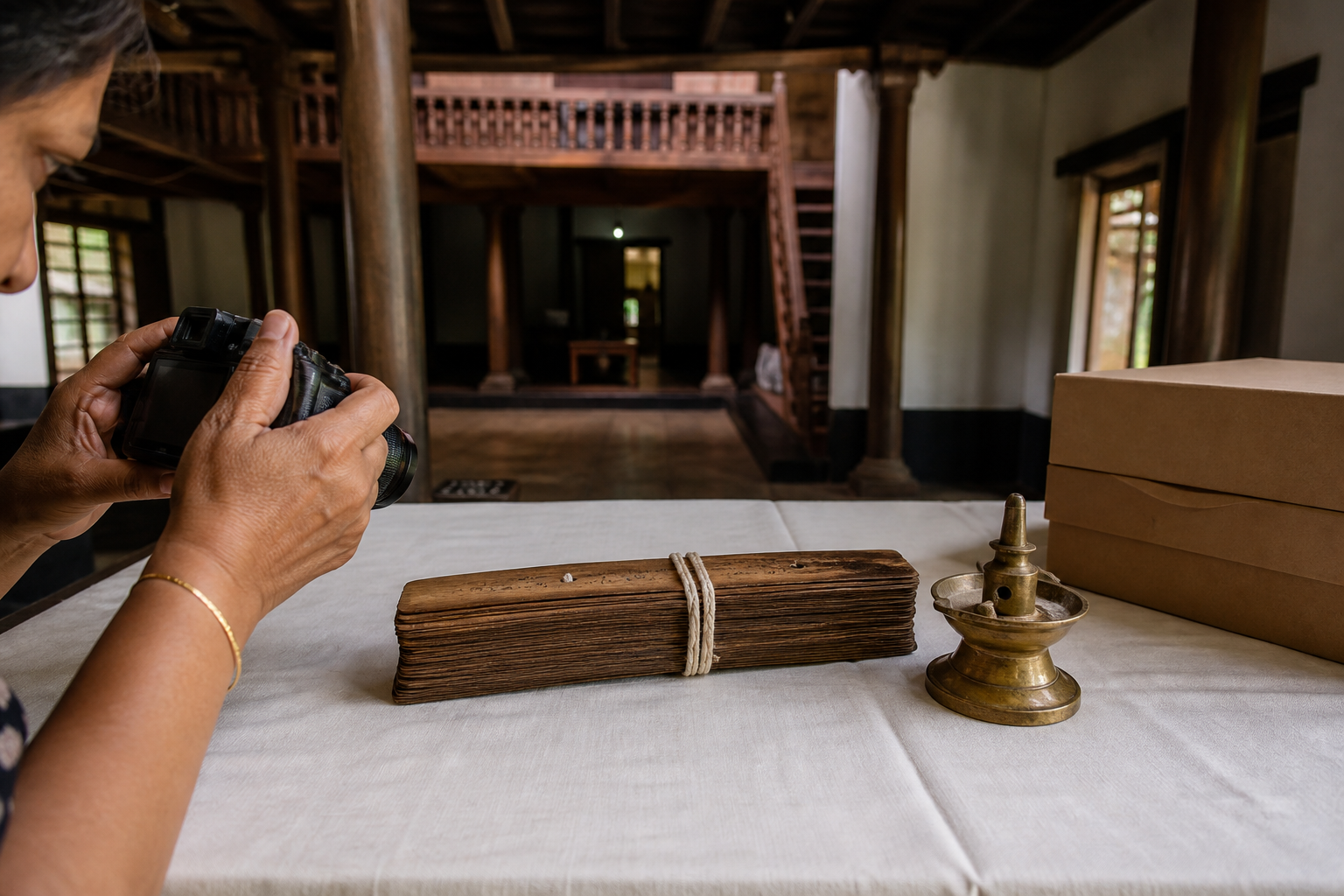
Loss of a house, migration and the passing of elders can break the chain by which household traditions are transmitted. The understandable impulse is to fill every gap immediately. That is precisely when a respectful reconstruction can turn into a newly invented practice presented as ancestral.
- Make an oral-history record. Save the speaker’s name, relationship to the tharavadu and exact words alongside the date of the conversation. Mark remembered facts, interpretations and uncertainty separately.
- Map the house. Draw the levels and rooms, then mark the location identified as the machil. If the building no longer exists, label the map as a reconstruction from memory rather than an architectural record.
- Build a family vocabulary. Preserve names for the Goddess, the sacred space, objects and actions in the language in which relatives used them. Translation can be added, but it should not erase the original terms.
- Confirm before altering anything. Renovation, relocation or disposal can destroy the physical context that made the tradition intelligible. Consult the family custodians and an appropriate practitioner familiar with the lineage before moving a sacred object or changing a space regarded as Bhagavathy’s place.
- Do not compose rites to make the record look complete. If the family remembers the sanctity of the machil but not a ritual procedure, preserve exactly that. Respectful restraint is better than presenting a modern improvisation as inherited custom.
If the old tharavadu has disappeared, documentation becomes even more important. Record where it stood, which branch of the family used it and how the machil was described. Do not claim that a new room automatically acquires the old space’s status. Whether a tradition can be transferred, restored or ritually re-established is a lineage-specific question, not something the name alone can answer.
The same care applies when sharing the tradition publicly. A family account can illuminate Kerala’s household Shaktism without being advertised as the practice of all Kerala Hindus. Say “in this tharavadu” or “in this family memory” when that is the actual scope of the evidence.
Key takeaways
- Machil Bhagavathy names a sacred relationship between the Goddess and the attic or upper loft of a Kerala ancestral home.
- The machil is not merely an incidental storage location in this tradition; it is understood as Bhagavathy’s dwelling place.
- The household setting shows that Shakta sacred life can be embedded in domestic architecture and kinship, not only in public temples.
- The name does not prove that all Kerala households followed one ritual system. Family-specific testimony matters.
- If details have been lost, document the surviving place-name and memories before attempting any revival.
- Preserve uncertainty openly, and seek lineage-appropriate guidance before altering a sacred space or introducing rites.
Your most useful next step is small: ask the oldest knowledgeable relative to identify the machil and explain, in their own words, why it mattered. Record the answer exactly. One careful conversation can preserve more of the tradition than an elaborate reconstruction built on assumptions.
References
