
If the phrase “Vedic Bharat” leaves you choosing between a return to old ritual and a modern political slogan, Sri Aurobindo offers a more demanding path. His vision asks whether Bharat can recover the spiritual intelligence of the Veda without turning the past into either a museum piece or a certificate of national greatness.
That question has practical consequences. It changes how you read a Vedic passage, how you assess claims about India’s civilizational continuity, and how you decide whether an educational or cultural project represents renewal rather than branding. The test is not how often someone says “Vedic.” It is whether a clear line can be drawn from text, through interpretation, to a disciplined change in life.
What Sri Aurobindo wanted Bharat to recover
Sri Aurobindo’s central move was to restore attention to the Veda’s spiritual significance. In this vision, the Veda is not one respected collection among many. It is understood as a foundation of Indian culture, civilization, literature, art, darshana, language and science.
“Foundation” needs careful handling. It does not mean that every later poem, philosophical doctrine or scientific finding appears fully formed in Vedic verses. A foundation sets orientations: the questions a civilization considers important, the relations it explores between human beings and the cosmos, and the kinds of knowledge it learns to value. Claims about a particular later development still require a demonstrable chain of continuity.
This distinction protects the Vedic vision from two equally weak readings. One dismisses the Veda because it does not look like a modern textbook. The other declares every modern achievement to have been secretly encoded in it. Neither approach takes the text or the history of interpretation seriously.
When you encounter a claim that something is Vedic, separate it into three levels:
- Textual claim: What word, image, teaching or passage in the Veda supports it?
- Continuity claim: Through which commentary, practice, school or later text did that idea travel?
- Present application: What are we being asked to believe or do now, and does that conclusion actually follow?
A claim may be valuable at the third level without being demonstrable at the first. In that case, call it a modern application inspired by the Veda. That is more honest, and ultimately more respectful, than manufacturing an ancient endorsement.
The shared date of 15 August gives this discussion symbolic force. On 15 August 2026, Sri Aurobindo’s 154th birth anniversary coincided with the 79th birthday of the modern Indian state. The coincidence can prompt a civilizational question, but it cannot answer one. A date does not prove destiny. The quality of Bharat’s institutions, education and conduct must do that work.
Read beyond ritual without belittling ritual
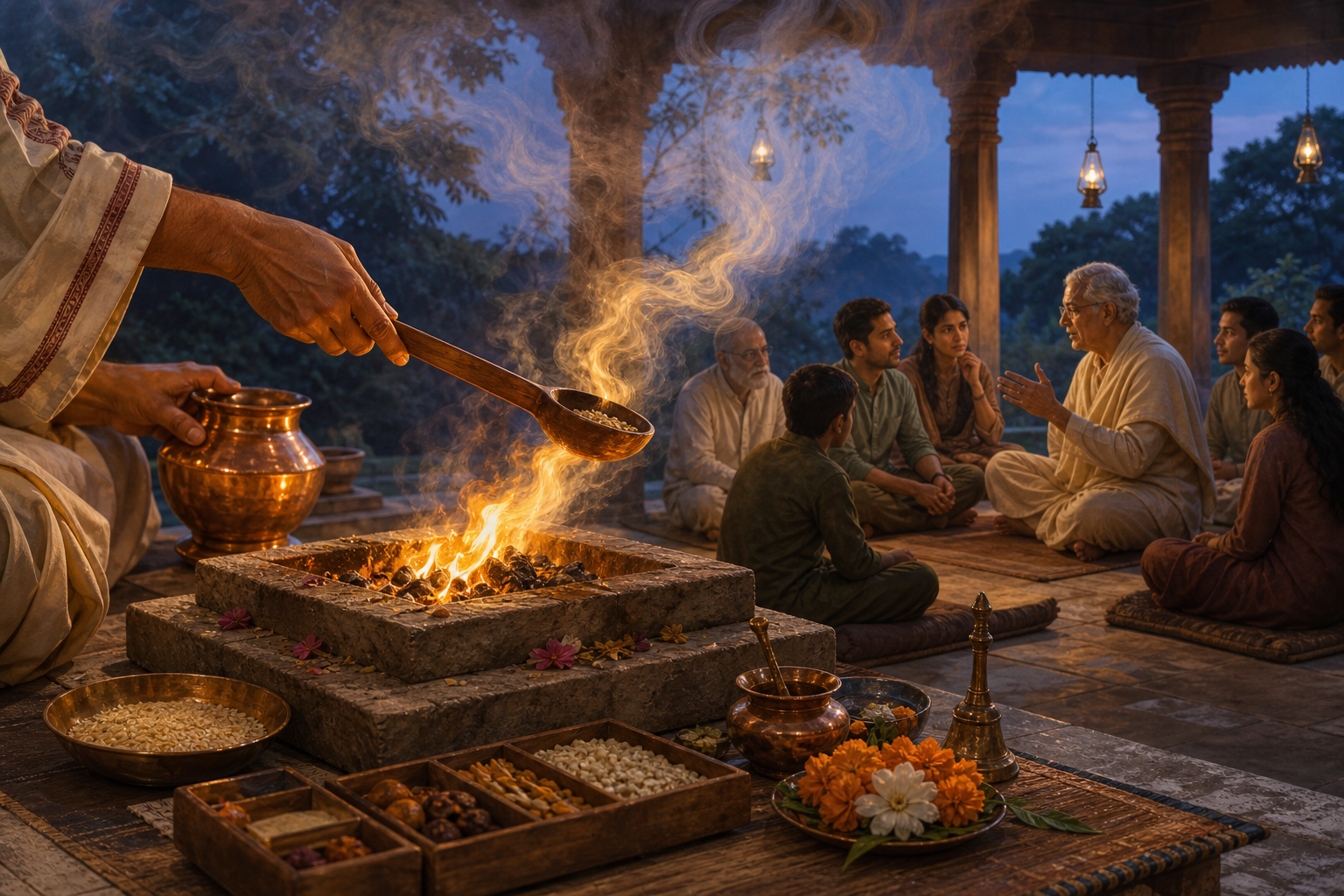
The interpretive problem begins with reduction. Over a long period, the Veda came to be treated chiefly as Karma Kanda, the domain of ritual action. Sri Aurobindo’s intervention was not simply to discard rites. It was to reject the idea that rites exhaust the Veda’s meaning.
That is an important distinction for a practising Hindu. Ritual can preserve memory, discipline attention and carry a tradition across generations. A ritual-only reading becomes limiting when the outer act is treated as the final horizon of the text, leaving no serious question about spiritual knowledge or transformation.
You can apply Sri Aurobindo’s challenge with a three-pass reading method:
- Read the visible layer. Record the act, deity, object, speaker and desired result that the passage actually presents. Do not rush past the words in search of a preferred symbolism.
- Ask the spiritual question. What understanding of the human being, consciousness, order or transformation might the passage invite? Mark this as interpretation unless the wording states it directly.
- Trace the later resonance. Look for a specific connection in an Upanishad, the Bhagavad Gita or a named commentary. Note both the continuity and whatever the later text changes.
The third pass matters because the spiritual understanding of the Veda did not appear from nowhere. The Veda contains reflection on its own spiritual message; the Upanishads drew substantially from that inheritance; and Sri Krishna brought its significance into the Bhagavad Gita. That Veda-Upanishad-Gita continuity is central to the vision being recovered.
Continuity is not identity. A shared term or image does not prove that texts composed in different settings are saying exactly the same thing. Your notes should therefore use three labels: “text says,” “interpreter argues” and “we can apply.” Those labels stop an attractive interpretation from quietly turning into a claimed translation.
A sound spiritual reading remains answerable to the language of the text. It can reveal more than the literal rite without treating the verse as an empty container into which any modern idea may be poured.
Place Aurobindo inside the history of Vedic recovery

Sri Aurobindo was not the first person in later Indian history to insist that the Veda deserved renewed attention. Understanding the sequence prevents his contribution from becoming a solitary-genius story.
The historical argument associated with this vision holds that the Veda’s deeper essence had faded from the Indian mind by the time of Adi Sankara. That is a strong interpretive judgment, not a reason to dismiss Adi Sankara or assume that every school and ritual lineage had retained nothing. “Forgotten” describes a perceived civilizational loss; it does not supply a complete survey of all communities and teachers.
Madhvacharya later attempted a recovery through a treatise on the first forty suktas of the Veda, although the wider classification of the Veda as principally ritual continued. In the 19th century, Swami Dayananda placed exclusive emphasis on the Veda and called Hindus back to what he regarded as its neglected treasures. Sri Aurobindo then made spiritual interpretation central to a modern account of Bharat’s civilizational identity.
These interventions should not be collapsed into a single doctrine. Madhvacharya’s commentary, Dayananda’s call to return and Aurobindo’s spiritual reading occupy different places in the recovery. Agreement that the Veda matters does not mean agreement about how every mantra should be understood.
When you study this history, make a simple lineage map. Give each thinker one row and record the problem he identified, the method he used and the result he sought. Leave a blank wherever you do not yet have textual evidence. The blank is more useful than an invented harmony.
Key takeaways for applying the vision
- The Veda may contain ritual without being reducible to a ritual manual.
- A spiritual interpretation must remain accountable to the words and structure of the text.
- Continuity through the Upanishads and Bhagavad Gita is something to trace precisely, not permission to flatten distinct texts into one voice.
- Calling the Veda a civilizational foundation does not mean that every later Indian achievement is literally described in it.
- A Vedic vision for Bharat becomes credible through education, practice and institutions, not through civilizational vocabulary alone.
In education, label each layer
A serious Vedic lesson should visibly distinguish four things: the Vedic passage, a traditional commentary, a modern interpretation and a contemporary application. Students can mark those categories in the margin. Assessment should reward their ability to explain the difference, not merely repeat the teacher’s preferred synthesis.
When a lesson connects a mantra with an Upanishadic passage or a teaching in the Gita, ask students to identify the shared term or problem. Then ask what changed. This teaches civilizational continuity as an argued relationship rather than a slogan of timeless sameness.
In religious life, seek meaning from within the form
You do not have to abandon a rite in order to inquire into its spiritual function. Before or after a practice, ask three questions: What is being done? What inner disposition is it meant to cultivate? Which part of that explanation comes from the tradition, and which part is your own reflection?
If you cannot yet support an inner meaning through the text, a teacher or a named commentary, state it modestly as personal reflection. This keeps inquiry open while protecting the rite from arbitrary reinterpretation.
In public debate, demand a complete chain of reasoning
Before accepting a proposal described as Vedic, ask four questions: What exactly makes it Vedic? What text or interpretive lineage supports that description? What present outcome is being proposed? What limit would prevent the claim from expanding to cover everything?
This test is especially important when people invoke Vedic science. A metaphor that resembles a modern concept is not, by itself, evidence of the corresponding discovery. Sri Aurobindo’s foundational claim can support a serious inquiry into the civilizational conditions that encouraged knowledge. It does not remove the need to demonstrate a particular scientific proposition through texts, methods and historical transmission.
The same discipline applies to arts, languages and darshanas. Instead of saying that all of them are Vedic and stopping there, identify the inherited question, category, symbol or practice. A concrete link strengthens the case for continuity. A vague claim only makes that case easier to dismiss.
Institutions can act on the vision without making inflated claims. A school can teach textual and interpretive layers separately. A reading group can compare one Vedic passage with one carefully chosen later passage. A cultural organization can fund translations, commentary study and teacher formation. In each case, the work deepens access to the inheritance instead of merely displaying it.
Test the vision through a four-session practice
You do not need to settle the whole history of Vedic interpretation before deciding whether this approach has value. Test it on one sukta through four focused sessions:
- Establish the textual ground. Read the sukta more than once. List its speakers, actions, images and explicit aims. Write down unfamiliar terms rather than guessing from context.
- Examine a spiritual interpretation. Record the interpreter’s main claim. Beside each part, mark whether it is directly stated, inferred from the passage or supplied by the wider philosophy of the interpreter.
- Check continuity. Compare one relevant Upanishadic or Gita passage when a commentary provides a defensible connection. Note the shared theme and the difference in expression. Do not force a connection merely to complete the exercise.
- Choose one present consequence. State one change the reading calls for in personal discipline, education or cultural work. Add one limit: what the passage does not authorize you to claim.
At the end, compress your work onto one page under five headings: text, interpretation, continuity, application and limit. If the only conclusion is that Bharat once possessed great wisdom, return to the passage. Admiration without discrimination has not yet produced understanding.
The next time you hear “Vedic Bharat,” ask to see the chain from mantra to meaning and from meaning to conduct. Where that chain holds, make one concrete change in how you learn, teach or serve. Where it does not, refuse the slogan without abandoning the search. That combination of reverence and intellectual discipline is the most useful way to begin.
References
