
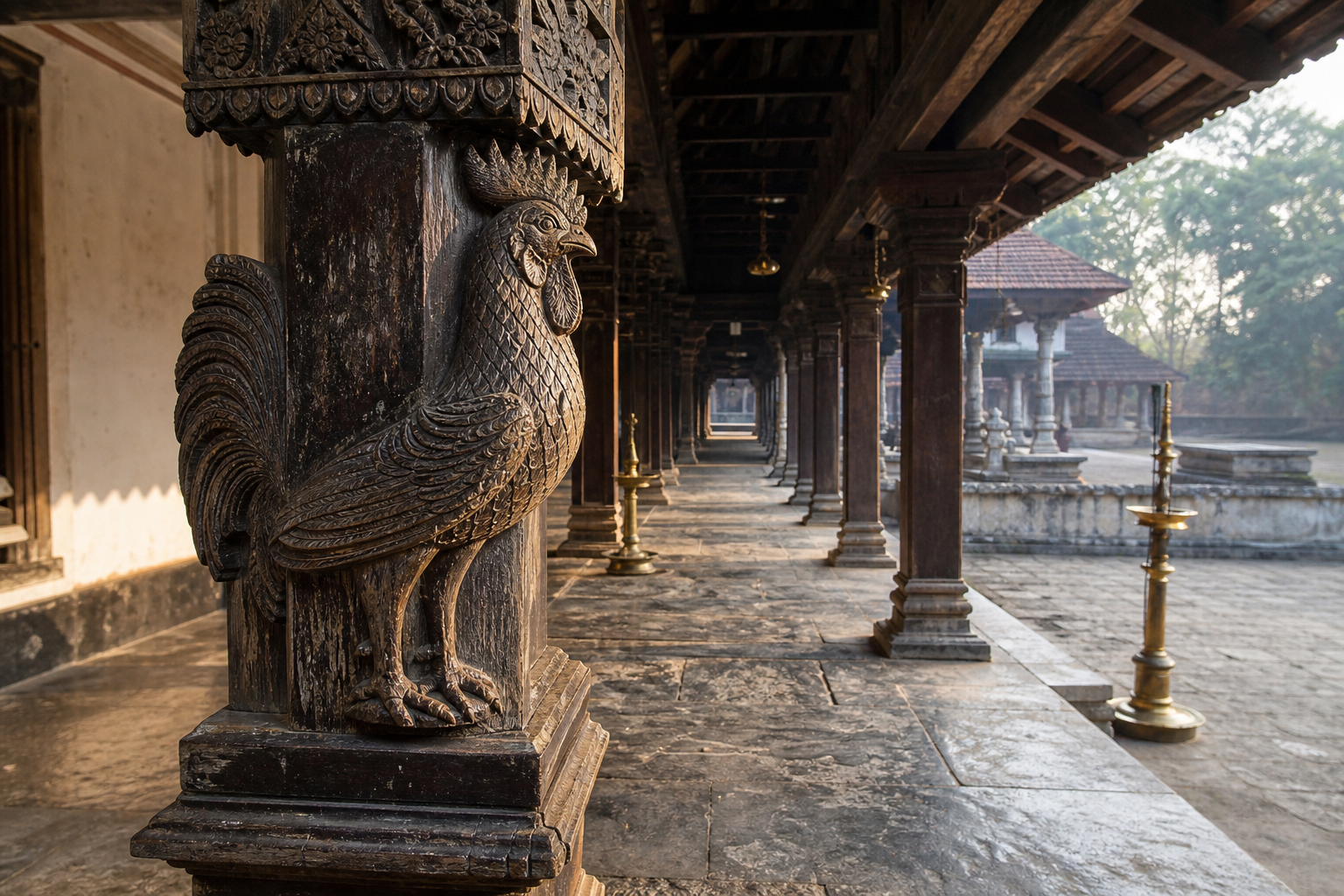
You have noticed a rooster carved into a South Indian temple and want to know what it means. The quickest answer – courage, dawn, vigilance, or a divine emblem – may sound satisfying, but it can also detach the bird from the temple that gives it meaning.
A better reading begins with what you can actually see. The sacred rooster known as Angavalan Poovan Kozhi appears in temple settings in Kerala and Tamil Nadu, including corridors, carved canopies, wooden pillars, and decorative friezes. Its position, posture, neighbouring figures, and repetition should guide your interpretation before any symbolic label does.
First identify the rooster as part of the temple
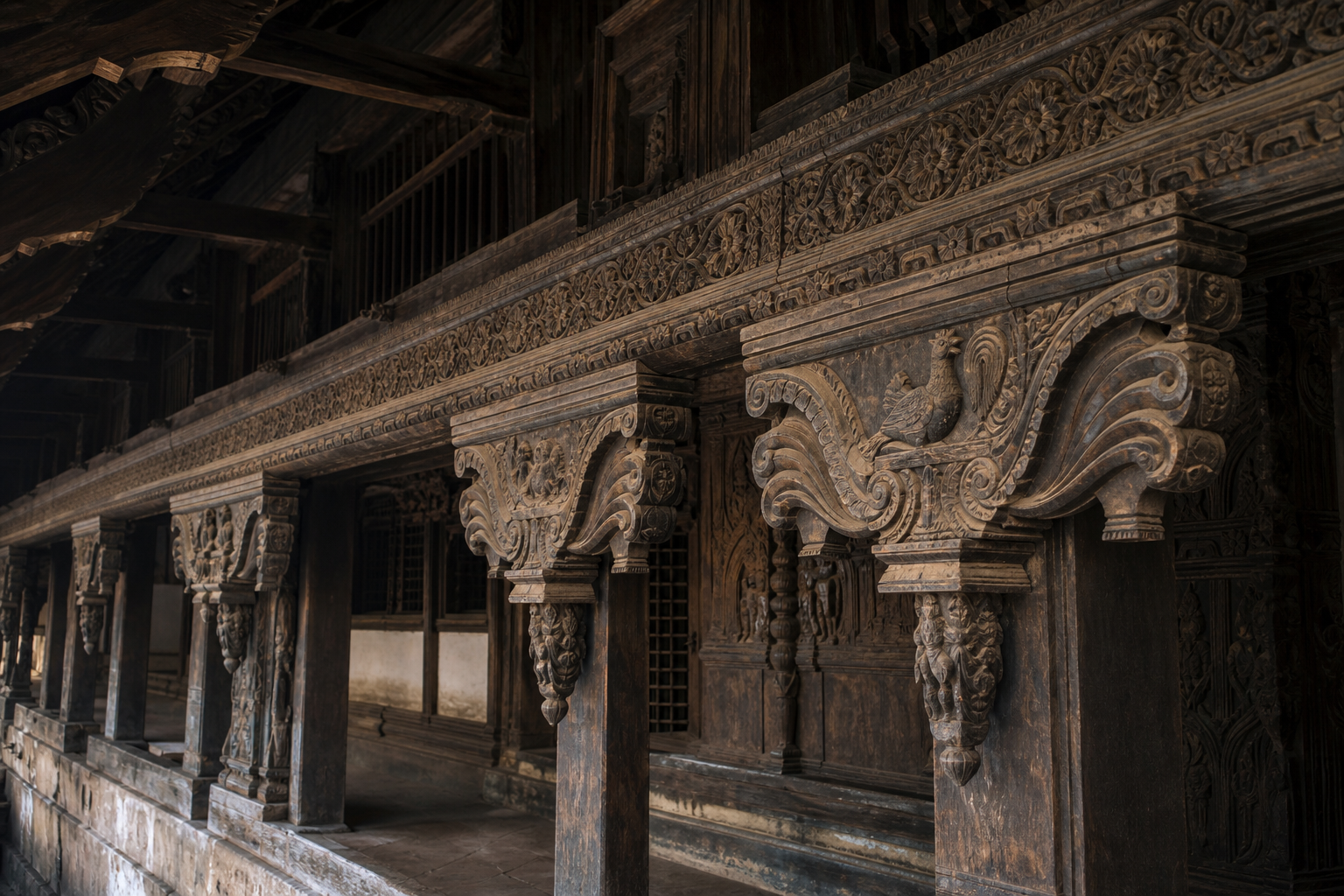
A temple animal is not merely an illustration of wildlife. Once a rooster is selected, carved, and placed within sacred architecture, it becomes part of the visual order through which the temple communicates. That does not necessarily make the bird an independently worshipped deity. It means its form has been admitted into a consecrated cultural setting where placement and relationship matter.
Start by confirming that you are looking at a rooster rather than a generic bird. Look for the combination of an upright stance, pronounced tail feathers, a visible comb, a forward head, and an alert bearing. Damage, repainting, shadow, and stylisation can obscure individual features, so use several traits together rather than relying on one.
Then record where it appears. Rooster figures have been observed among carved canopies, wooden pillars, decorative friezes, and temple corridors. These are not interchangeable locations. A figure on a structural pillar participates differently in the building than a small bird repeated as part of an ornamental band.
Before deciding what the carving means, note five things:
- Location: Is it near an entrance, along a passage, above a sacred space, or within a decorative sequence?
- Direction: Does it face inward, outward, toward another figure, or along the path of movement?
- Posture: Is it standing calmly, striding, calling, confronting, or turning its head?
- Company: What animals, human figures, vegetal forms, emblems, or architectural motifs surround it?
- Repetition: Is it a single focal image, one member of a pair, or part of a repeated pattern?
A photograph of the rooster alone may preserve its beauty but erase most of this evidence. Take one close image and at least one wider image showing the complete pillar, canopy, frieze, or corridor.
Dawn and wakefulness are the strongest natural clues
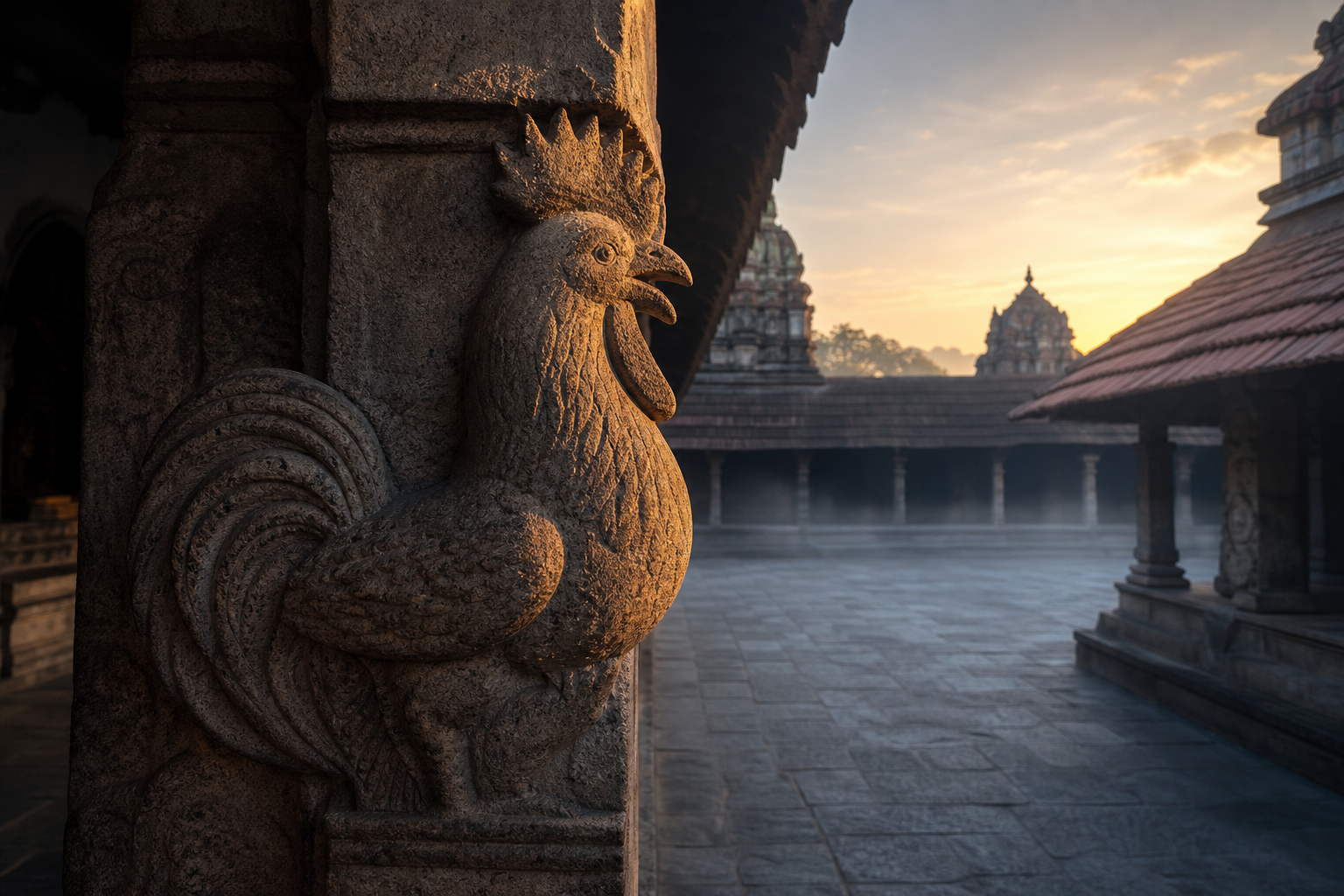
The rooster is closely associated with the transition from night to morning. Its call precedes full daylight, making it a natural image of awakening, announcement, and the defeat of sleep. In a spiritual reading, that behaviour can evoke the movement from heedlessness toward awareness.
This does not prove that every temple rooster means spiritual awakening. It gives you a disciplined starting point. Symbolism works most convincingly when the creature’s observed nature and its architectural setting reinforce each other.
If the rooster appears where worshippers pass from an outer area toward a more inward one, the dawn association may support a threshold reading: become attentive before proceeding. If it occupies an elevated canopy or a prominent pillar, its erect and watchful form may emphasise alertness. If it is simply one element in a long decorative band, the same meaning should be proposed more cautiously.
You can make this symbolism practical without pretending that the sculpture delivers a written command. When you encounter the bird, pause before moving on. Notice whether your body and mind have arrived together. In that modest sense, the rooster can do for a temple visitor what its call does at daybreak: interrupt unconscious continuation.
Its bearing also supports vigilance and moral courage
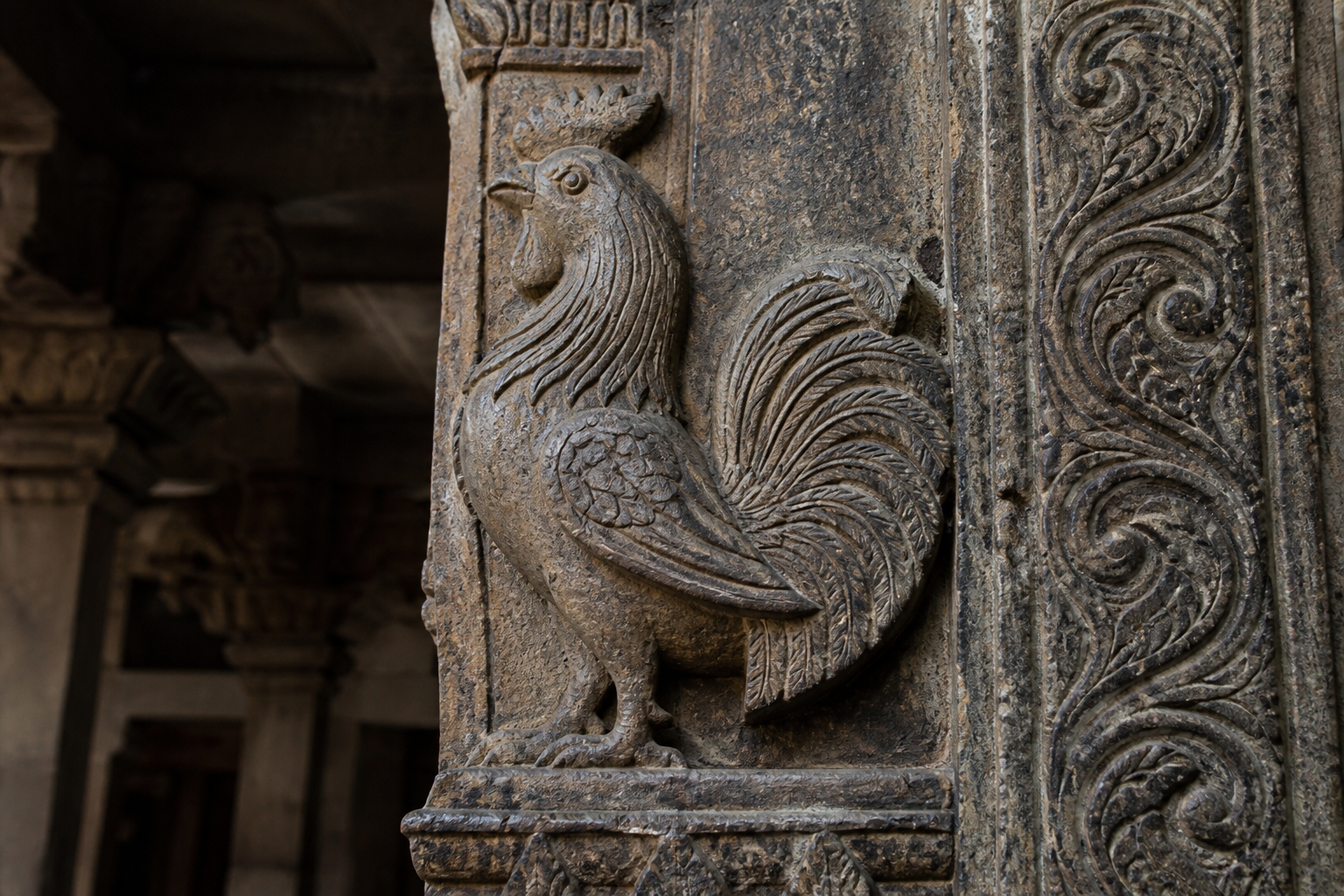
A rooster is not only a herald of morning. It is conspicuous, upright, territorial, and ready to respond. Those natural qualities make vigilance, confidence, and protective courage reasonable symbolic possibilities, especially when the sculptor has stressed a raised head, expanded chest, powerful legs, or dramatic tail.
The distinction between courage and aggression matters. Courage protects what is worthy without being ruled by fear. Aggression seeks conflict or domination. A sacred setting can redirect the rooster’s combative energy into a moral question: are you guarding dharma within yourself, or merely reacting from pride?
Posture helps you choose between those readings. An alert but composed rooster can suggest steadiness. A bird turned toward another figure may indicate a relationship or narrative. Two confronting birds may introduce rivalry, balance, or ornamental symmetry. Do not call every dynamic pose a battle; first check whether the surrounding design is symmetrical and decorative.
The same caution applies to colour. Paint may be old, restored, renewed, or unrelated to the original carving. Unless the temple preserves a clear local explanation, do not build an elaborate interpretation on pigment alone. Form, placement, and relationship are usually safer evidence.
Context prevents a symbol from becoming a slogan
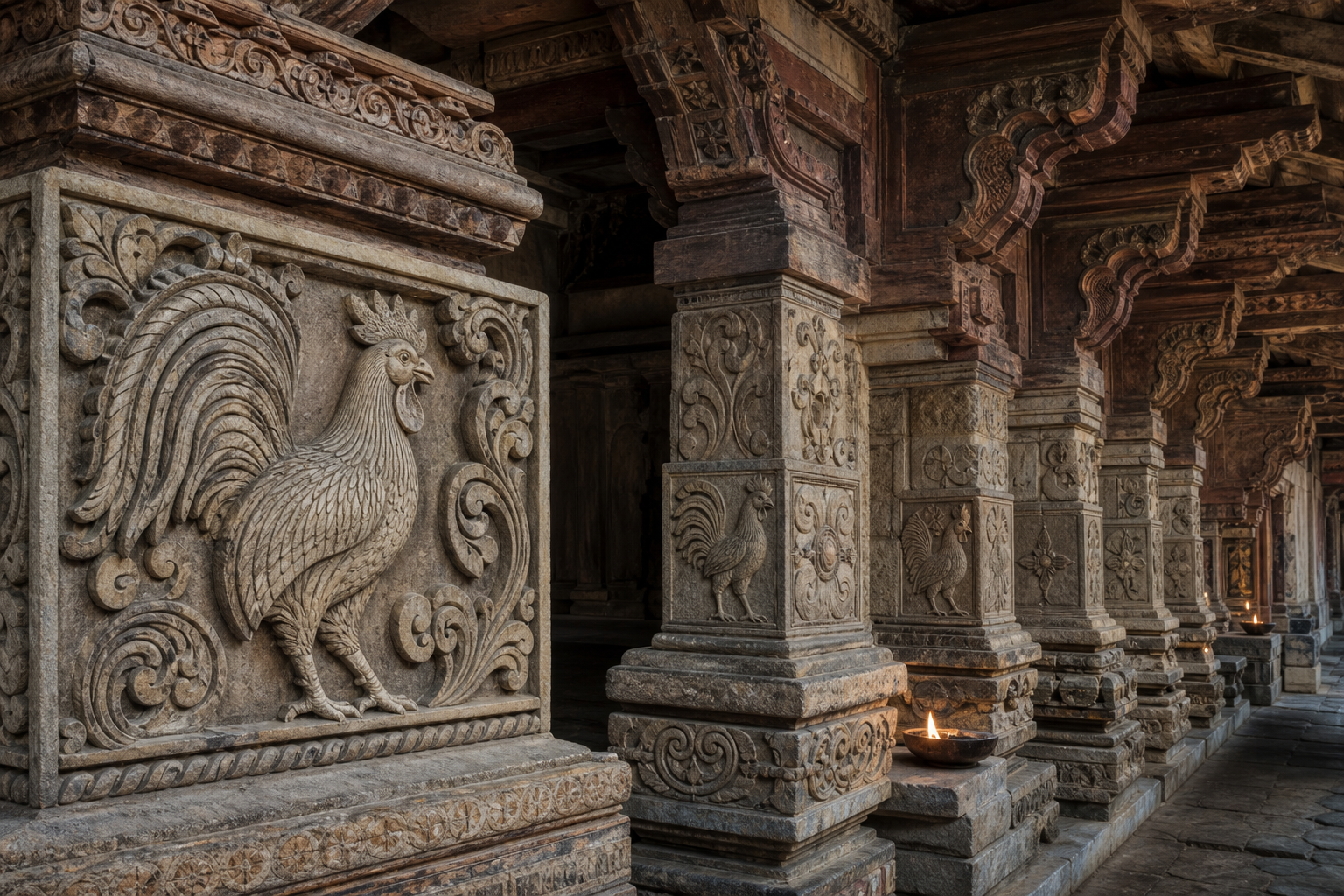
Temple symbolism is relational. The question is not simply, “What does a rooster mean?” Ask instead, “What is this rooster doing here?” That change in wording protects you from treating a living visual tradition like a dictionary in which every creature has one permanent definition.
Use an evidence ladder when you want to interpret a particular carving:
- Describe before interpreting. Write down the material, posture, direction, size, condition, and architectural location.
- Read the immediate group. Examine adjacent figures and motifs before searching for a broad symbolic meaning.
- Look for repetition. A repeated rooster may establish a visual rhythm or programme; an isolated one may carry greater emphasis.
- Compare within the same temple. Similar figures elsewhere in the complex are more relevant than a superficially similar image from a distant region.
- Ask for the local name. A priest, hereditary artisan, guide, or knowledgeable devotee may preserve terminology or ritual context that the carving alone cannot reveal.
- Separate certainty from possibility. Record what is visible as fact, local explanation as tradition, and your symbolic reading as interpretation.
The regional name Angavalan Poovan Kozhi is valuable because it reminds you that the figure belongs to a local vocabulary, not merely to the broad category “rooster.” Preserve the name when it is supplied locally. Do not replace it with an English label and assume nothing was lost.
You should also resist assigning a specific deity, legend, sect, or ritual function without supporting evidence beside the image or within the temple’s own tradition. A resemblance can prompt a question; it cannot settle an identification.
Key takeaways for your next temple visit
- The Angavalan Poovan Kozhi is a sacred rooster figure encountered in temple art in Kerala and Tamil Nadu.
- Dawn, awakening, vigilance, courage, and protective attention are plausible readings grounded in the rooster’s natural behaviour and bearing.
- No symbolic meaning should be assigned without checking the carving’s placement, posture, neighbouring figures, and repetition.
- A sacred animal image need not be an independently worshipped deity; it can participate in the temple’s larger architectural and philosophical language.
- Photograph the wider setting, preserve the local name, and distinguish visible evidence from interpretation.
The next time this rooster catches your eye, do not hurry to decode it. Stop where the sculptor placed it, look at what it faces, and notice the path you are taking through the temple. The most responsible interpretation will arise from that meeting of creature, carving, architecture, and attention.
References
