
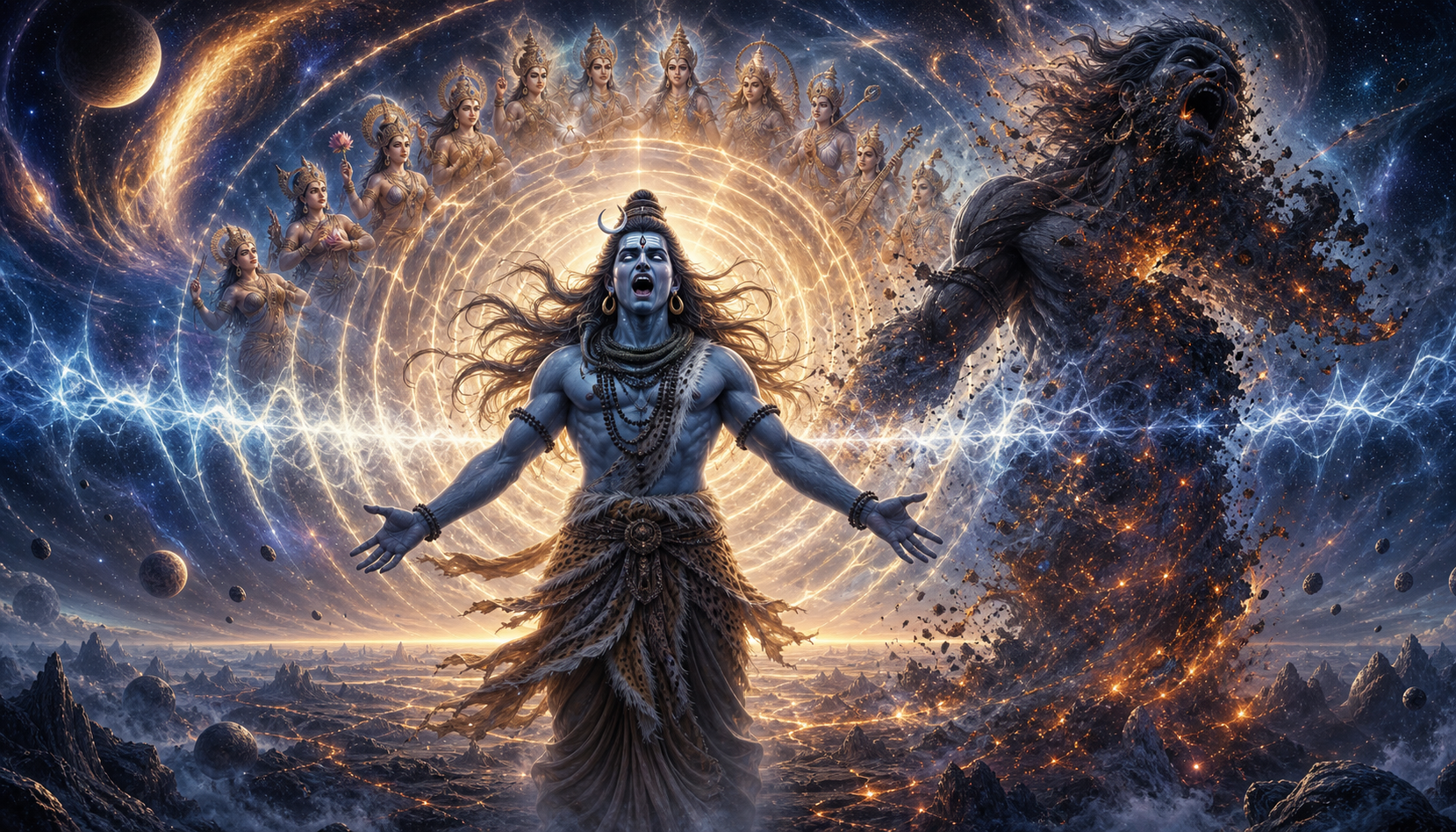
If you encountered the name Kalasha and wondered whether you were missing a major episode from Shiva’s better-known stories, the right response is not to fill the gaps with familiar Puranic details. This is a compact account with a distinctive theological movement: an apparently invincible demon arises during creation, Shiva destroys him with a roar, and that same sound brings forth the Mantra Devatas.
That sequence gives you the key to reading the episode. Kalasha’s defeat matters, but the story does not end with defeat. Shiva’s sound turns the termination of adharma into the manifestation of sacred powers. Destruction clears the obstruction; divine speech establishes what should follow.
The essential sequence of the Kalasha story

Within this telling, the scene is placed at the opening of cosmic existence. Brahma and Vishnu appear together at the centre of the cosmos. A single drop of sweat falls from Brahma’s body to the earth, and Kalasha emerges as an invincible demon.
The account then moves through four clear stages:
- Cosmic creation provides the setting.
- An unintended bodily residue from Brahma reaches the earth.
- Kalasha arises with a power that ordinary resistance cannot overcome.
- Shiva’s roar destroys Kalasha and becomes the occasion for the emergence of the Mantra Devatas.
Do not force additional details into those stages. The available account calls Kalasha invincible, but that does not require us to invent a boon, penance, weapon, genealogy, or condition of death. In sacred narrative, “invincible” commonly establishes that the problem has exceeded the ability of ordinary powers to solve it. Kalasha is invincible within that field of opposition, not an absolute beyond Shiva.
This distinction resolves an apparent contradiction. If an invincible being can be slain, the word was never meant to place him on the same metaphysical level as Mahadeva. It marks the extremity of the disorder. Kalasha has become unmanageable within creation; Shiva represents the power by which creation’s limits can be restored.
Why Shiva roars instead of reaching for a weapon
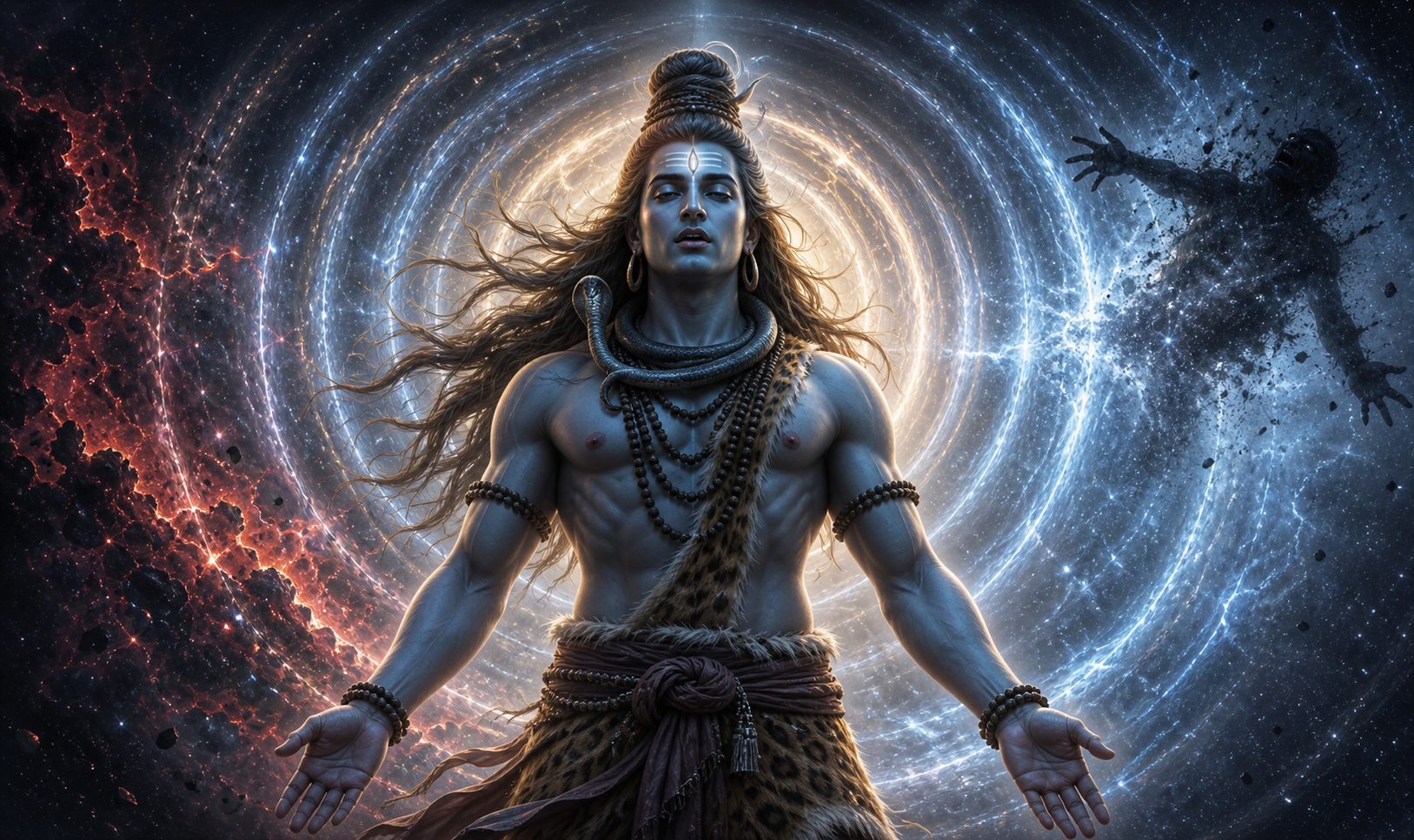
The means of Kalasha’s destruction is the episode’s most revealing feature. Shiva does not merely strike the demon. He roars. The action therefore places sound, presence, and divine authority at the centre of the confrontation.
A roar is not an argument offered to adharma. It is an unmistakable boundary. Kalasha’s power has reached the point at which accommodation is no longer the appropriate response. Shiva’s sound announces that the disorder will not be permitted to continue.
Yet the roar cannot be reduced to anger. Human rage often leaves confusion behind it. Shiva’s roar does the opposite: it ends a destructive force and gives rise to sacred order. Its fruit is not fear alone but the manifestation of the Mantra Devatas. The episode therefore distinguishes divine fierceness from uncontrolled temper by consequence. One scatters attention and damages what surrounds it; the other removes an obstruction and establishes a higher order.
This gives you a practical way to read other accounts of Shiva. Pay attention to three things: the form his intervention takes, the precise disorder it ends, and what appears after the intervention. Shiva’s fierce acts are easily misunderstood if you stop at the moment of destruction. Their meaning often becomes visible in the order made possible afterward.
What the Mantra Devatas add to the meaning
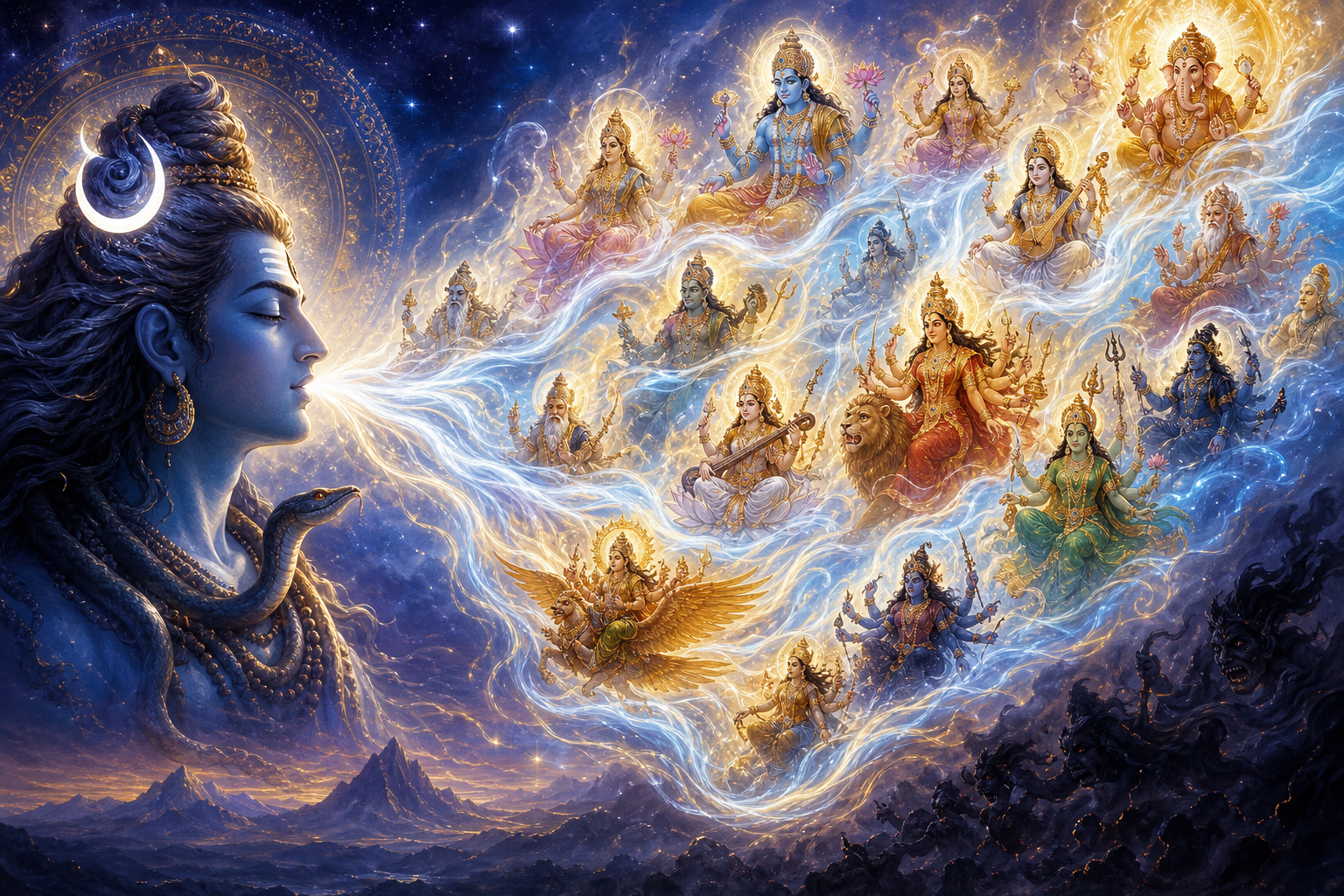
A mantra is not simply an inspirational phrase, and a Mantra Devata is not merely a poetic label for a sound. In Hindu practice, “devata” identifies the divine presence or presiding power approached through a mantra. Different sampradayas explain that relationship in their own theological language, but they agree that mantra cannot be reduced to ordinary speech.
The Kalasha episode makes that distinction vivid. The roar that destroys the demon also becomes generative. Sound aligned with Shiva does not merely describe reality; within the sacred action of the story, it participates in restoring reality. The transition from roar to Mantra Devatas directs your attention from noise to sacred articulation, from disruptive power to divine presence.
This does not mean that every loud utterance is holy, that anger grants spiritual authority, or that mantras are magical passwords. Those conclusions reverse the lesson. The roar is effective because it is Shiva’s expression, inseparable from divine consciousness and purpose. Volume is not the source of its sanctity.
If you bring this teaching into mantra practice, let it change your conduct in concrete ways:
- Receive a mantra through a trustworthy sampradaya or teacher when that tradition requires instruction or initiation.
- Learn its pronunciation and method rather than treating the syllables as interchangeable approximations.
- Give the practice undivided attention. Repetition performed mechanically while the mind pursues ten other things misses the discipline the story places on sacred sound.
- Do not separate mantra from dharmic conduct. Speech invoked as sacred should gradually make careless, dishonest, and needlessly harmful speech harder to tolerate in yourself.
- Never use Shiva’s roar to sanctify intimidation. A human outburst that humiliates others and leaves disorder behind does not resemble an act that removes adharma and manifests sacred order.
The useful test is fruit. After your practice, are attention and speech becoming steadier? Are you less governed by impulse? Are you more capable of drawing a firm boundary without becoming cruel? These questions keep the episode connected to sadhana rather than leaving it as supernatural spectacle.
How to retell the episode without inventing details
Little-known Hindu narratives are especially vulnerable to confident embellishment. A missing detail is noticed, a familiar motif is inserted, and the addition is repeated until it appears traditional. You can preserve the Kalasha account by being precise about what you know and transparent about interpretation.
- Keep the causal chain intact. Brahma’s sweat reaches the earth, Kalasha arises, Shiva’s roar destroys him, and the Mantra Devatas emerge in connection with that roar.
- Do not attach an unnamed scripture. Unless you have a text, recension, chapter, and verse in front of you, call this an account of Shiva and Kalasha. Do not assign it to a Purana simply because its style sounds Puranic.
- Do not manufacture a boon. “Invincible” does not by itself tell you who granted the power or under what conditions it could be overcome.
- Mark interpretation as interpretation. You may read Brahma’s sweat as unintended residue, Kalasha as power severed from dharma, and Shiva’s roar as the restoration of sacred order. Present those as readings of the sequence, not as missing lines from a scripture.
- Preserve the unusual detail. Replacing the roar with Shiva’s trishula would make the story more familiar but less accurate. The relationship between destructive sound and the Mantra Devatas is precisely what makes this episode distinctive.
There is also a linguistic trap worth avoiding. “Kalasha” in English transliteration can evoke the kalasha, the consecrated vessel used in Hindu ritual. A shared Roman spelling does not prove that the demon represents the ritual vessel or that the two have an intended symbolic relationship. Unless a Sanskrit form, etymology, or textual explanation establishes the connection, do not build a teaching on the resemblance alone.
A responsible two-sentence retelling would be enough for many settings: “At the beginning of creation, Kalasha arose from a drop of Brahma’s sweat and became an invincible demonic power. Shiva destroyed him with a roar, and from that divine sound came the Mantra Devatas.” You can then explain the theological meaning separately, so your listener always knows where narration ends and reflection begins.
Key takeaways
- Kalasha’s invincibility establishes the scale of the disorder; it does not make him metaphysically equal to Shiva.
- Shiva’s roar is central because the same divine sound both destroys adharma and gives rise to the Mantra Devatas.
- The episode presents sacred sound as ordered and generative, not as ordinary noise or uncontrolled anger.
- For mantra practice, the relevant response is disciplined attention, accurate learning, ethical speech, and respect for sampradaya.
- When retelling the account, retain its short sequence and resist adding an unnamed Purana, an invented boon, or a more familiar weapon.
The next time you hear this episode, listen for what follows the roar. Kalasha’s death is the turning point, not the final meaning. Let the account sharpen one practice now: remove one form of careless speech from your day, then give your chosen mantra the attention you usually give to distraction. That is a modest but faithful way to move from Shiva’s boundary against disorder toward the sacred order his sound reveals.
References
