
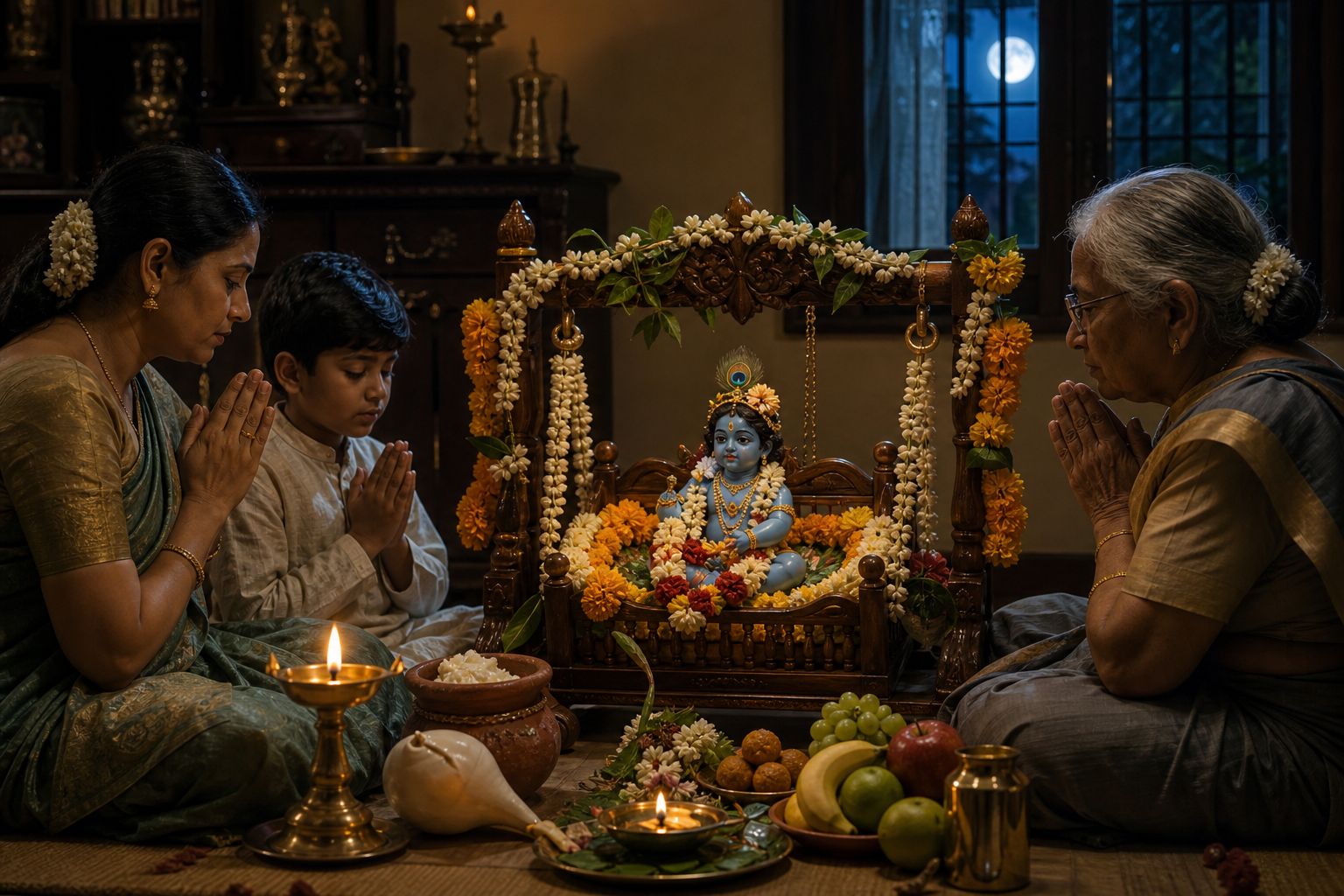
You want to honour Sri Krishna on Janmashtami, but the practical questions can crowd out the devotion. Which calendar should you follow? Is fasting compulsory? Must you stay awake until midnight? What should you do if your family’s custom differs from the local temple’s?
Janmashtami is an auspicious invitation to turn toward Sri Krishna, not an examination in ritual memory. Settle the calendar and fasting rules first, prepare a modest programme you can complete attentively, and let remembrance of Krishna govern the day.
First settle the calendar, tradition and vrata
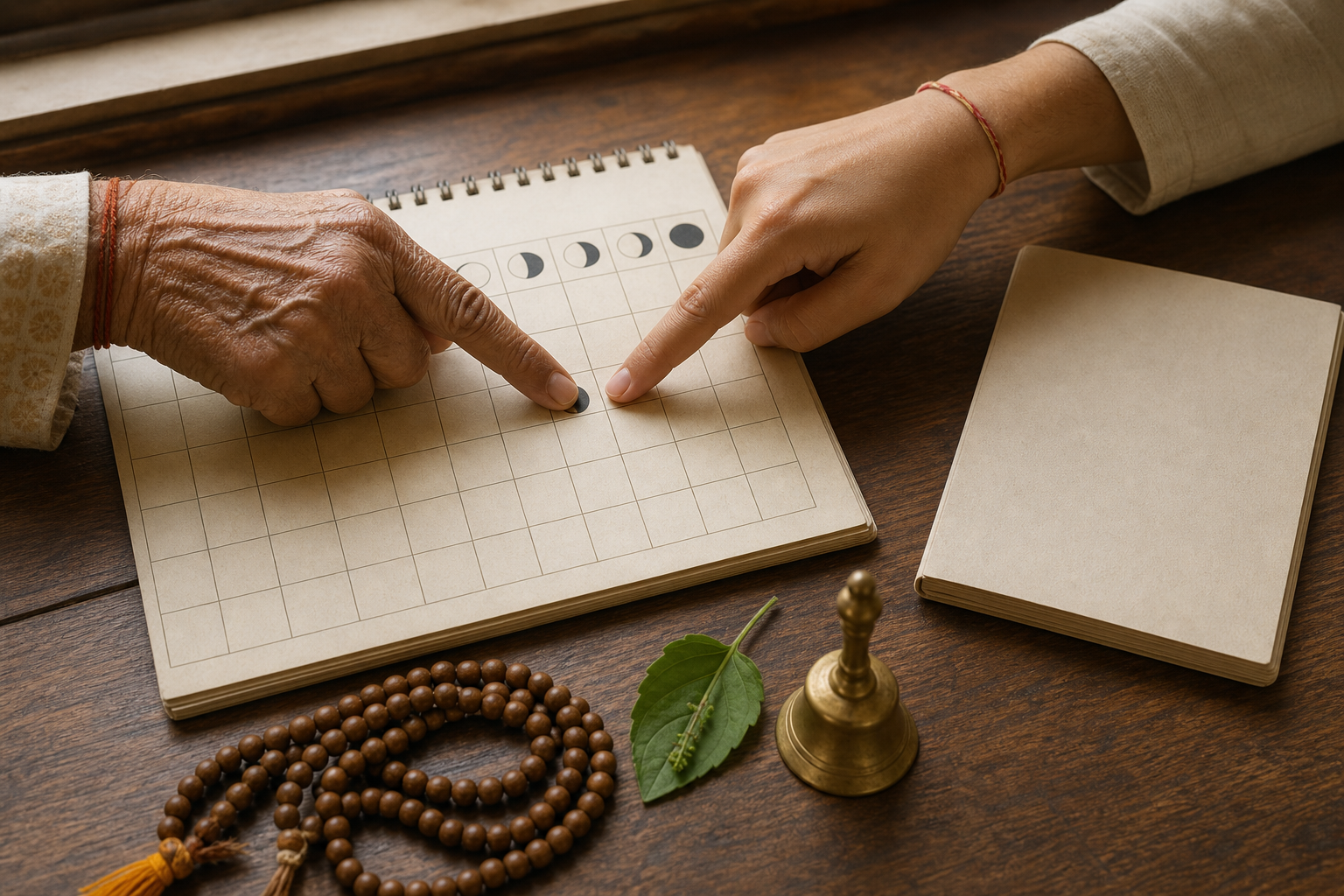
Do not choose your observance time from the first festival graphic that reaches your phone. Janmashtami is determined through a lunar calendar, and the applicable tithi boundaries depend on location. A schedule prepared for another city may therefore give you the wrong worship window.
Use one coherent authority. If you belong to a sampradaya or follow a guru, begin there. If you will celebrate at a temple, follow that temple’s published programme and ask which calendar it uses. If your household has an established parampara, speak with the family member who actually knows its practice rather than reconstructing it from several unrelated online posts.
Confirm these points before making plans:
- The locally applicable date and tithi.
- The time of the temple programme or principal household worship.
- The kind of vrata observed in that tradition, including whether food or water is restricted.
- When and how the vrata is concluded, sometimes called parana.
- Whether your temple accepts flowers, food, donations or volunteer help from visitors.
If two calendars disagree, do not create a stricter hybrid from both. Pick the rule set belonging to the tradition you are actually following. Ritual discipline becomes clearer when its calendar, worship and fast come from the same framework.
Then make a short sankalpa in language you understand. State what you intend to offer Sri Krishna through the day: attentive prayer, hearing about his appearance and lila, chanting his names, service to others, or restraint from a habit that usually scatters your attention. A clear intention prevents the festival from becoming a sequence of tasks performed on autopilot.
Build the day around remembrance, not decoration
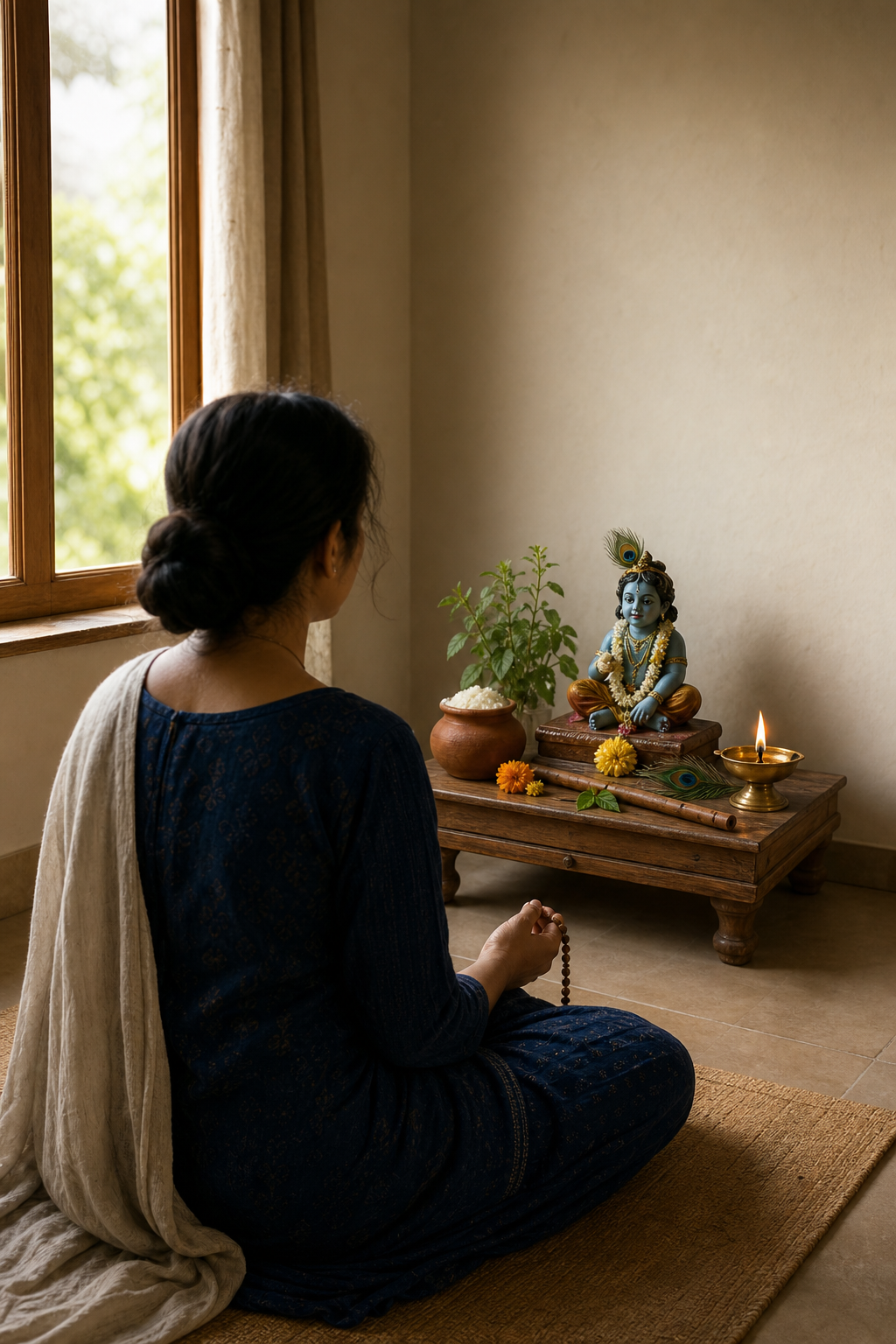
An elaborate altar can be beautiful, but it is not the organising principle of Janmashtami. Plan the day around acts that bring your attention back to Sri Krishna. Decorations, clothing and food preparation should support those acts rather than consume all the available time.
- Prepare before the festival. Clean the worship space, obtain permitted ingredients and flowers, select the scripture passage you will hear, and confirm transport if you are attending a temple. Doing this in advance protects the observance from last-minute shopping and hurried cooking.
- Begin the morning deliberately. Bathe according to your normal practice, wear clean clothes, tidy the altar and state your sankalpa. Silence unnecessary notifications so that the day does not immediately dissolve into ordinary distraction.
- Set aside time for hearing. Read or listen to the account of Krishna’s appearance and lila from a recognized edition used in your community, such as an accepted translation of the Bhagavata Purana. Read slowly enough to notice what the narrative asks you to remember, not merely how many pages you completed.
- Chant within your tradition. Use the mantra or nama practice given by your guru, family or sampradaya. If you normally chant japa, protect a quiet period for it. If your household gathers for bhajan or kirtan, choose familiar compositions so everyone can participate without turning the evening into a rehearsal.
- Offer practical seva. Help prepare the worship space, welcome a guest, assist an elderly relative, volunteer at the temple or complete an unglamorous household task without complaint. Seva keeps devotion from becoming private sentiment alone.
- Prepare the offering with care. Follow your tradition’s rules about ingredients and tasting. Keep the menu manageable. Several complicated dishes prepared in agitation are less helpful than a simple offering made cleanly and on time.
- Join the principal worship. This may include kirtan, reading, puja, aarti or worship around midnight, depending on the tradition. If your community observes Krishna’s appearance at midnight, arrange rest, transport and family responsibilities beforehand instead of relying on enthusiasm to carry everyone through the night.
- Conclude as instructed. Offer pranam and a final prayer, then distribute or receive prasada according to the local practice. Do not assume that midnight automatically marks the end of every fast; your temple or lineage may specify parana separately.
If you already serve a consecrated murti, continue the established standard of worship unless a qualified teacher has instructed you otherwise. Do not improvise an abhishekam with unsuitable substances or handling methods merely because you saw one performed elsewhere. You can participate through prayer, kirtan, flowers and service without attempting a ritual you have not been taught.
Treat fasting as a vrata, not a test of endurance
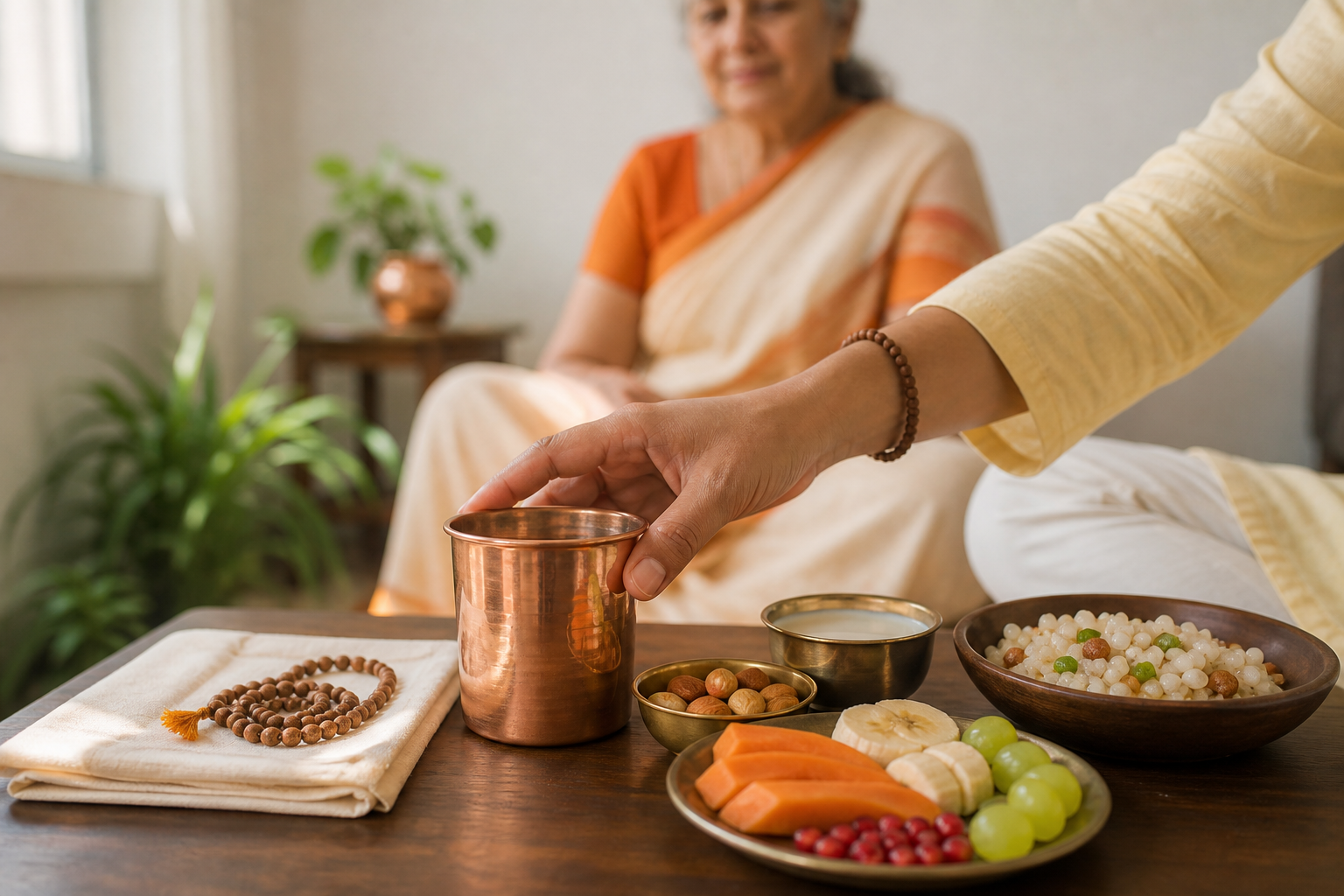
Janmashtami fasting practices vary. Some communities permit particular foods or water, while others follow a more restrictive discipline. That variation is a reason to ask what your tradition observes, not a reason to select the hardest version and call it more authentic.
A vrata is wider than an empty plate. Watch speech, anger, entertainment and compulsive phone use as carefully as food. A person who abstains from eating but spends the day quarrelling or scrolling has preserved the outer restriction while surrendering much of its purpose.
Food restriction also has real health consequences. If fasting could interact with pregnancy, nursing, diabetes, prescribed medication, a history of disordered eating, advanced age or another medical condition, do not guess. Follow the advice of a qualified clinician and ask your guru or priest for an appropriate form of observance. Do not stop medication to make a religious fast appear stricter.
Reduce strenuous activity if you are eating less than usual, and do not drive when weakness or poor concentration makes it unsafe. Fainting, confusion, chest pain or another acute symptom is not a spiritual achievement. End the fast as needed and seek medical help.
If you cannot undertake the customary food fast, resist two opposite mistakes. Do not treat yourself as excluded from Janmashtami, and do not privately declare an invented substitute equivalent to your lineage’s vrata. Ask for guidance, then place sincere attention on worship, hearing, nama, seva and disciplined conduct.
Make room for family, temple and continuing practice
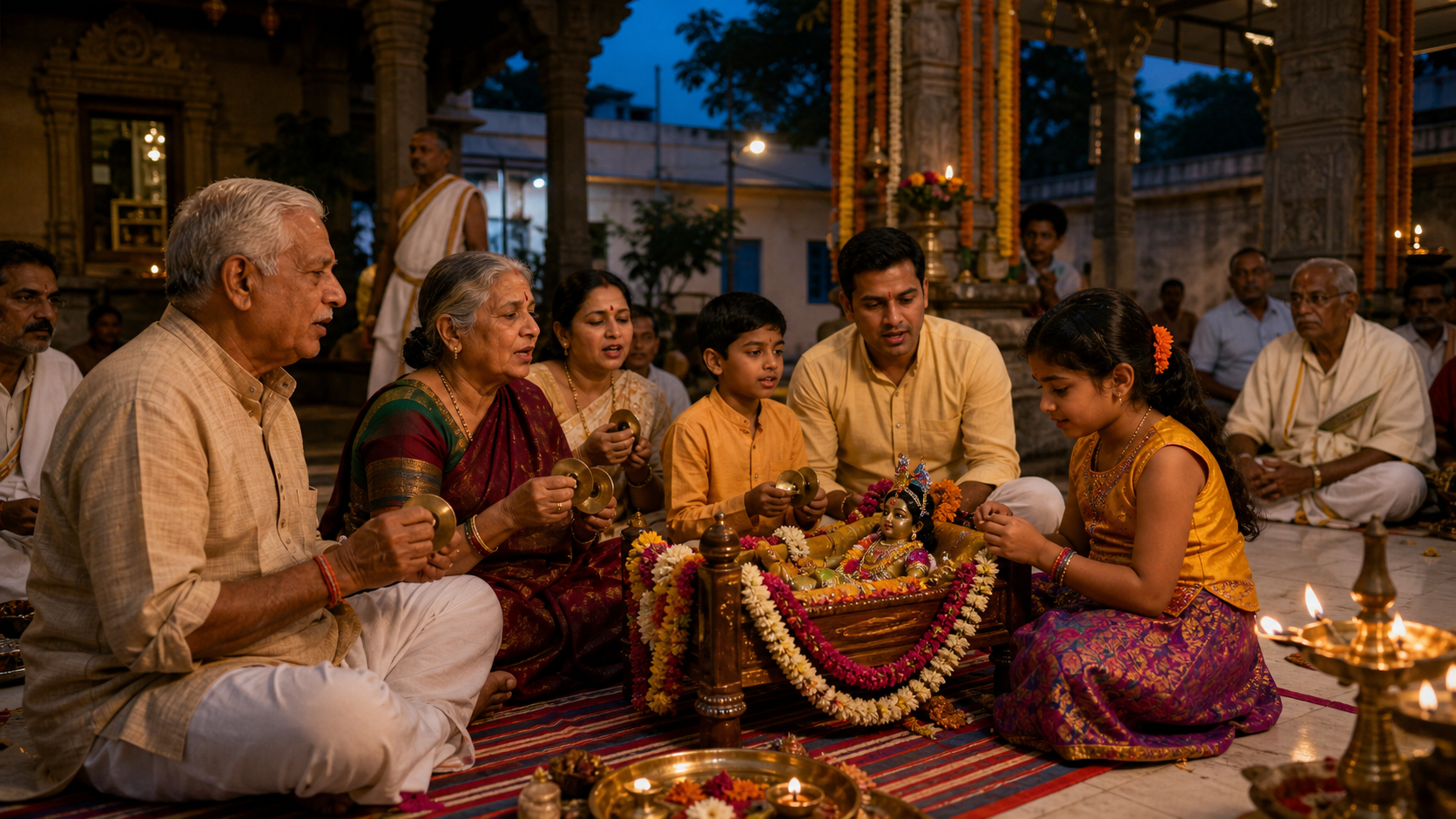
A temple celebration requires a little practical humility. Arrive early enough to understand the queue and programme. Bring only offerings the temple has said it can receive. Observe its rules for photography, footwear, prasada and access to the altar. During crowded darshan, take the time you need to offer pranam without blocking everyone behind you.
If you are bringing children, give each child a concrete role suited to their capacity: placing a flower, carrying an approved offering, singing a familiar response or helping distribute prasada. Explain the meaning before the programme becomes crowded and noisy. If staying until midnight would leave a child distressed or unwell, involve them fully earlier in the day rather than making exhaustion the measure of devotion.
Include relatives who cannot travel. A shared reading, a telephone call for chanting or a trusted temple broadcast can create participation without pretending that a screen replaces every form of physical community. When newcomers attend, tell them quietly what will happen next and what they should do with prasada or offerings. Hospitality is also seva.
Before the festival ends, choose a small practice to carry forward: a regular period of nama-japa, a passage of scripture to continue reading, a recurring act of temple service, or a more attentive food offering at home. Janmashtami has done more than decorate the calendar when it changes how you remember Sri Krishna on an ordinary day.
Key takeaways
- Confirm the local tithi, worship schedule, fasting rule and parana through one tradition you genuinely follow.
- Prepare the altar, reading, ingredients and transport in advance so logistics do not displace devotion.
- Build the observance around hearing, chanting, worship and seva; let decoration remain supportive.
- Do not use fasting to ignore medical needs, prescribed medication or signs that you are becoming unsafe.
- Give children, guests and less-mobile relatives practical ways to participate without coercion.
- Carry one manageable Krishna-centred practice into the days after the festival.
Your next step is simple: contact the temple or teacher you trust, confirm the local observance and vrata, and write down the few devotional acts you will protect. Once those decisions are made, the rest of the preparation can take its proper place around Sri Krishna rather than in front of him.
References
