
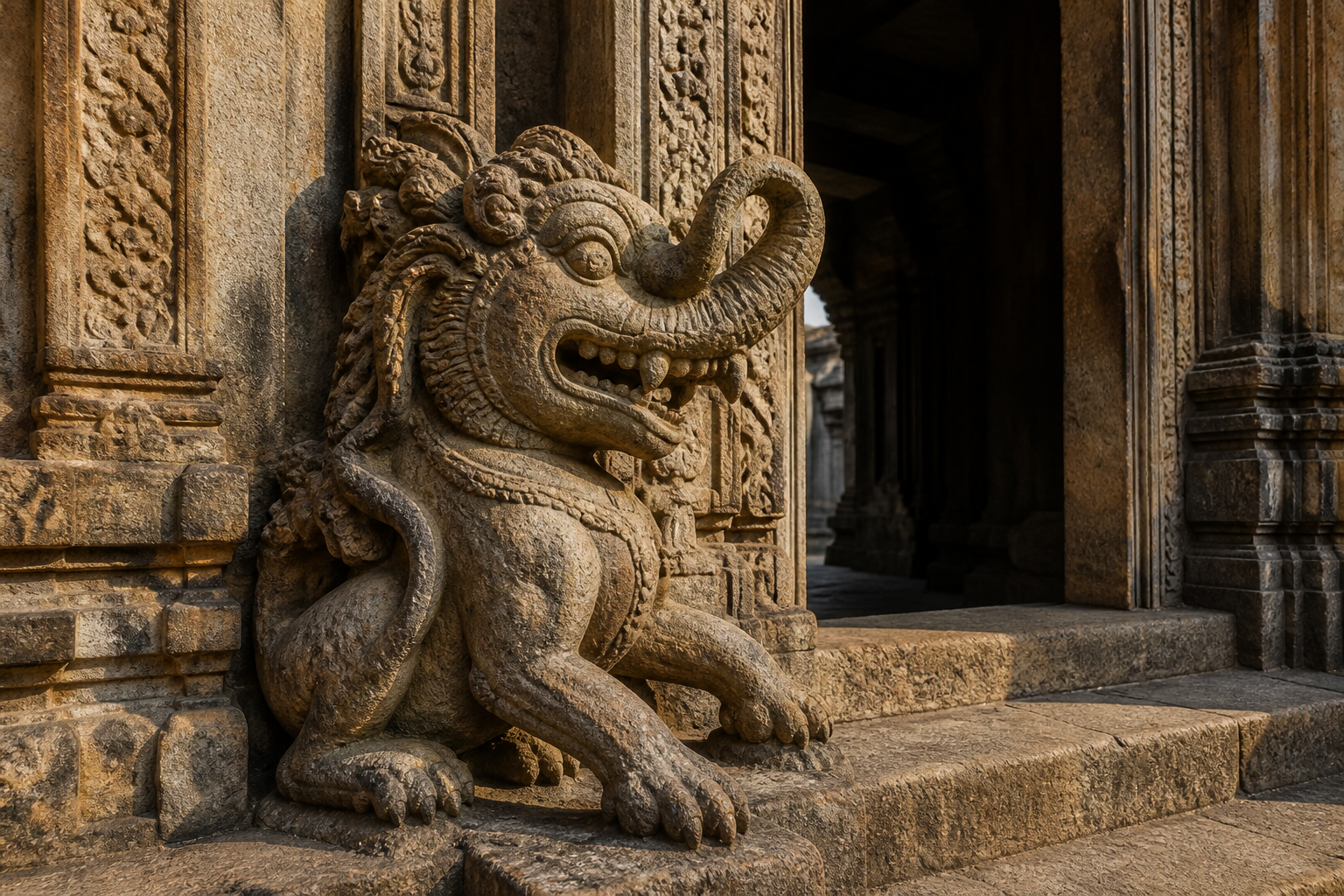
You notice it beside a temple doorway or on a pillar: an elephantine trunk, the force of a lion, and a body that refuses to belong to either animal alone. The immediate questions are practical. Is this a Gaja Vyali, what is it doing here, and how much meaning can you responsibly draw from it?
You can answer those questions without reducing the carving to either a decorative monster or a one-word symbol. Read it at three levels: its combined animal features, its architectural position, and the larger sacred transition that position marks.
Confirm the composite form before naming it
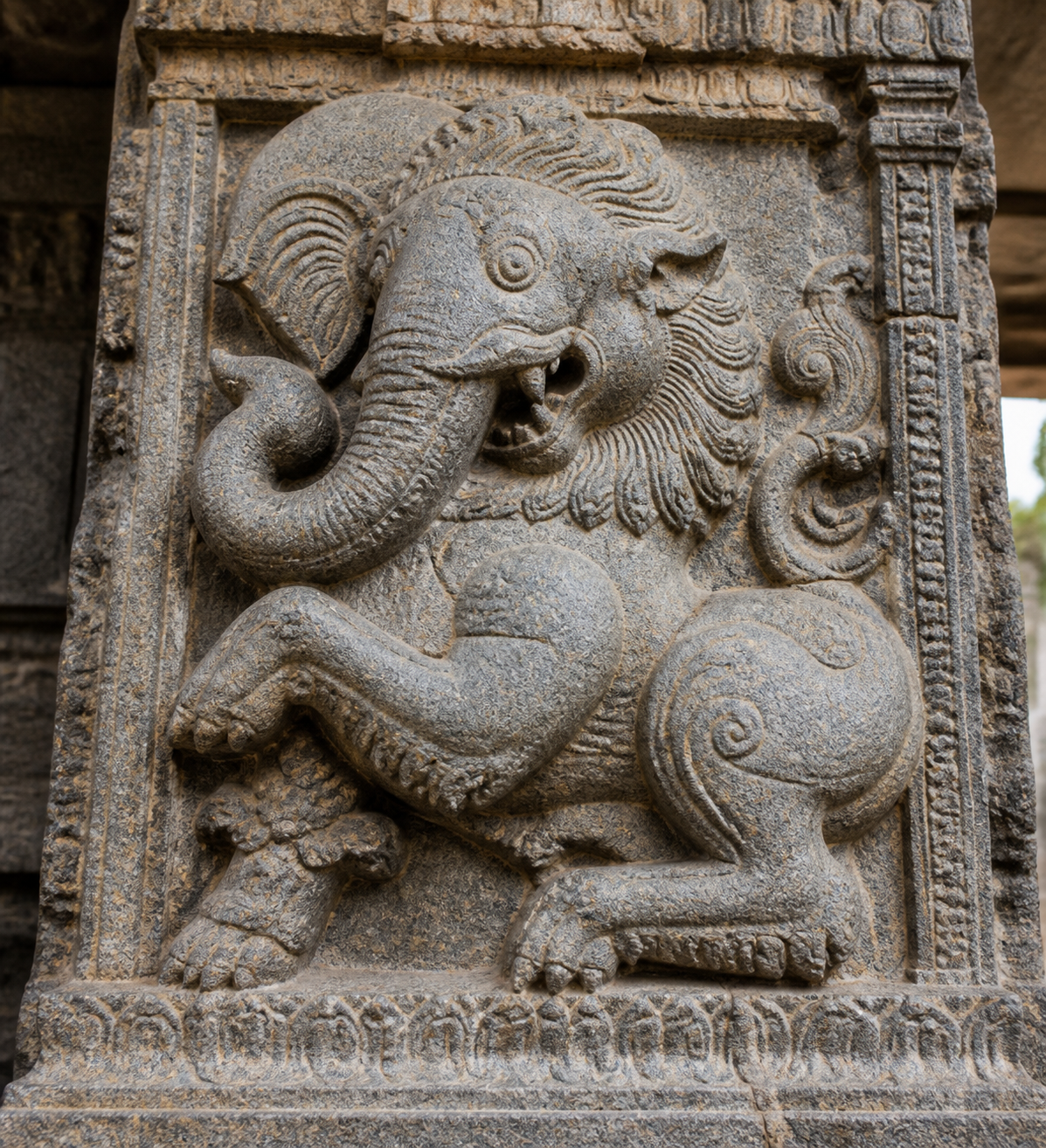
A Gaja Vyali, also written Gaja Yali, is a composite creature joining elephant and lion characteristics. The combination matters more than any isolated feature. You are looking for one deliberately hybrid being, not an elephant and lion carved beside each other.
Begin with what you can actually see:
- Look first for the clearest elephantine feature. A trunk is usually more decisive than a vague resemblance in the forehead or ears. Tusks may strengthen the identification, but damage can make them difficult to read.
- Then locate the leonine element. It may appear in the jaws, mane, paws, stance, or broader treatment of the body. Temple sculpture is stylised, so do not expect the anatomy of a naturalistic lion.
- Check whether the traits form a single body. Two neighbouring animals, an elephant under attack, or a lion standing above an elephant are different compositions.
- Compare repeated figures on the same doorway, pillar row, or ceiling. A better-preserved counterpart can clarify an eroded face or broken projection.
- Use a qualified identification when the stone or wood is badly worn. “Probable Gaja Vyali” is more accurate than forcing certainty from a fragment.
Do not identify a deity from one animal feature. An elephantine head does not by itself establish Ganesha, just as a leonine element does not by itself establish Narasimha. A deity is recognised through the complete set of attributes, posture, companions, and context. Gaja Vyali is first an architectural and iconographic motif.
Let the architecture tell you what the creature is doing
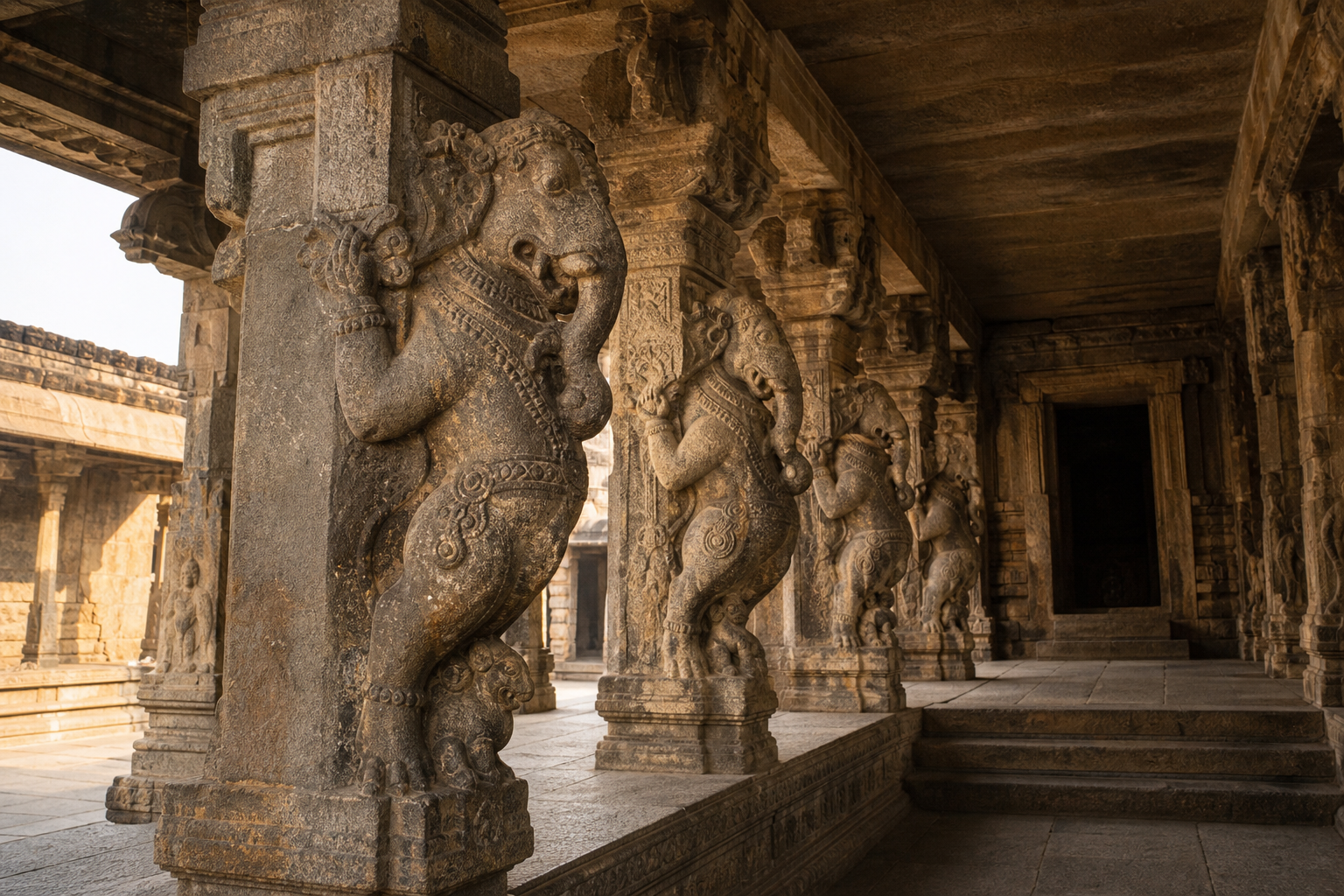
Location gives the creature a role. The same composite form can appear on pillars, doorways, and wooden ceilings, but those placements do not make identical statements. Before interpreting the animals, step back far enough to see the structure carrying them.
- At a doorway or along its approach, the guardian reading is strongest. The figure participates in a boundary between ordinary space and a more concentrated sacred environment.
- On a pillar, ask which direction the creature faces and whether it belongs to a pair or sequence. It may frame movement through the temple, mark an architectural division, or extend the protective character of an entrance into the hall.
- On a ceiling, look at the complete overhead arrangement. The Gaja Vyali may participate in a larger field of ordered sacred imagery rather than guarding a literal doorway.
- At a corner, bracket, or junction, notice how its body relates to the architecture. A creature that appears to emerge from, grip, or visually support a structural member is doing more than filling an empty surface.
A doorway is not merely a hole in a wall. In a temple, crossing it changes your orientation. Your pace, attention, bodily conduct, and relationship to the space are expected to change. A formidable composite placed there makes that transition visible before anyone explains it in words.
To test this reading, look from the position of an approaching visitor. Are the creatures paired across the entrance? Do they face outward, inward, or toward the path? Does the motif repeat as you move deeper into the building? These observations reveal more than a close photograph of the head alone.
Read the symbolism in layers, not as a fixed dictionary
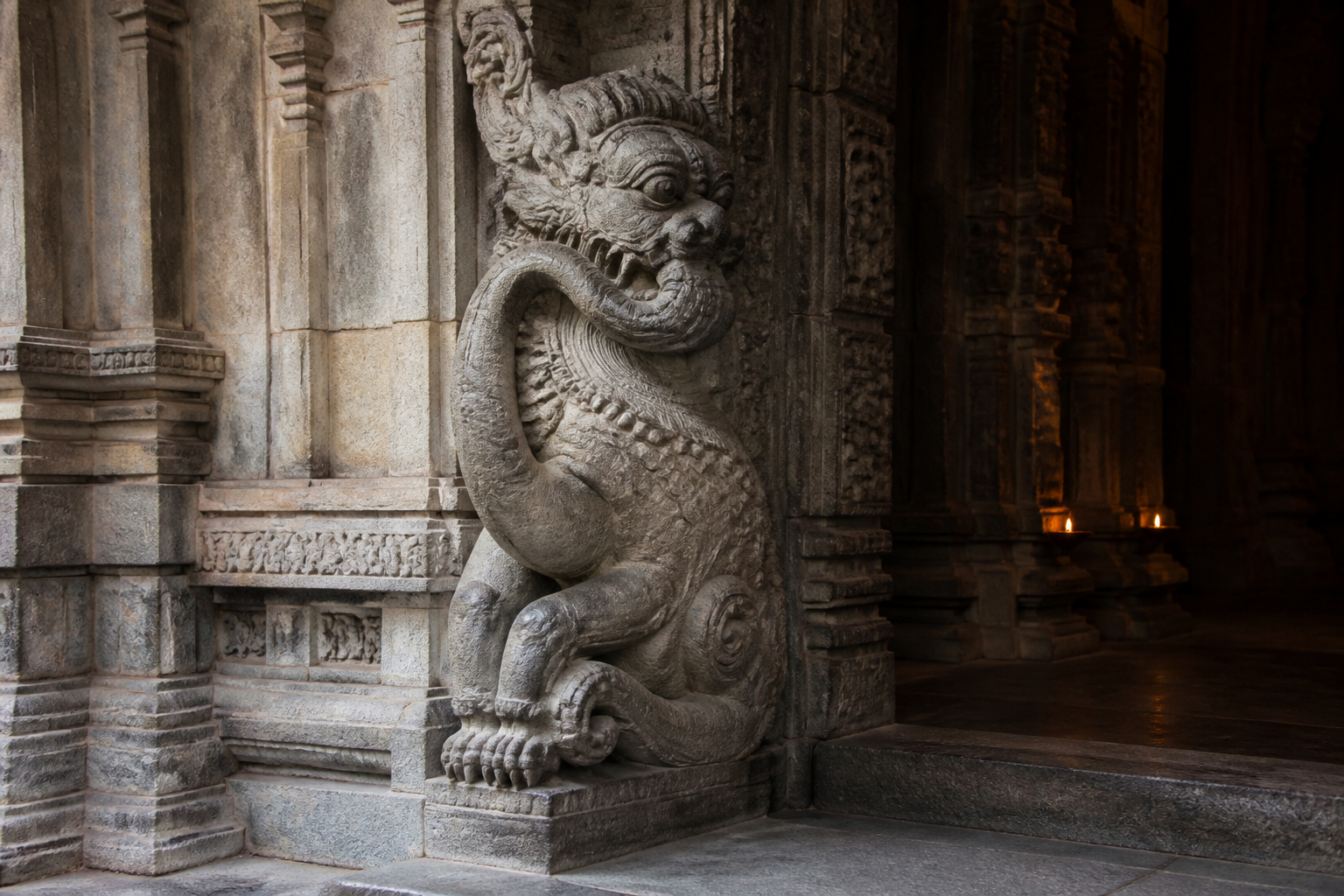
The elephant and lion both carry strong associations, but temple iconography is not a code in which every animal equals one abstract noun. The elephant can evoke immense, steady power; the lion can evoke fierce, alert power. Their fusion allows both capacities to inhabit one guardian form.
At a sacred threshold, that union can be read as integrated strength: weight without passivity, ferocity without disorder, and vigilance adequate to the space being guarded. This is a contextual interpretation, not a universal sentence that every Gaja Vyali must “mean.” The carving works through form, placement, repetition, and relationship with neighbouring images.
Keep three levels of confidence separate:
- Description: State the visible facts. “This is a composite elephant-lion figure” is an iconographic observation when both sets of traits are clear.
- Architectural function: Use placement as evidence. “Its paired position beside the doorway supports a guardian reading” is stronger than claiming guardianship from appearance alone.
- Theological interpretation: Treat a precise doctrinal claim as needing further support from the temple’s full visual programme, an inscription, a local tradition, or a knowledgeable explanation tied to that particular site.
This distinction protects the image from two opposite mistakes. One is to dismiss it as fantasy or ornament with no sacred work to do. The other is to invent an elaborate secret meaning that the visible evidence cannot sustain. The better reading respects both the deliberate symbolism and the limits of what one carving can prove.
Key takeaways: a five-question field key
- Is it one composite body? Confirm that elephant and lion traits are fused rather than merely adjacent.
- Which features support the identification? Name the trunk, tusks, mane, paws, jaws, or body treatment you can actually see.
- Where exactly is it placed? Record whether it belongs to a doorway, pillar, ceiling, bracket, corner, or another architectural element.
- How does it relate to other figures? Look for pairs, repeated examples, direction of gaze, and a sequence along the visitor’s route.
- What can you say with confidence? Separate visible form, likely architectural function, and broader theological interpretation.
If you can answer all five, you already have a defensible reading. If one answer is missing, preserve the uncertainty instead of filling it with a convenient story.
Document the Gaja Vyali without stripping away its context
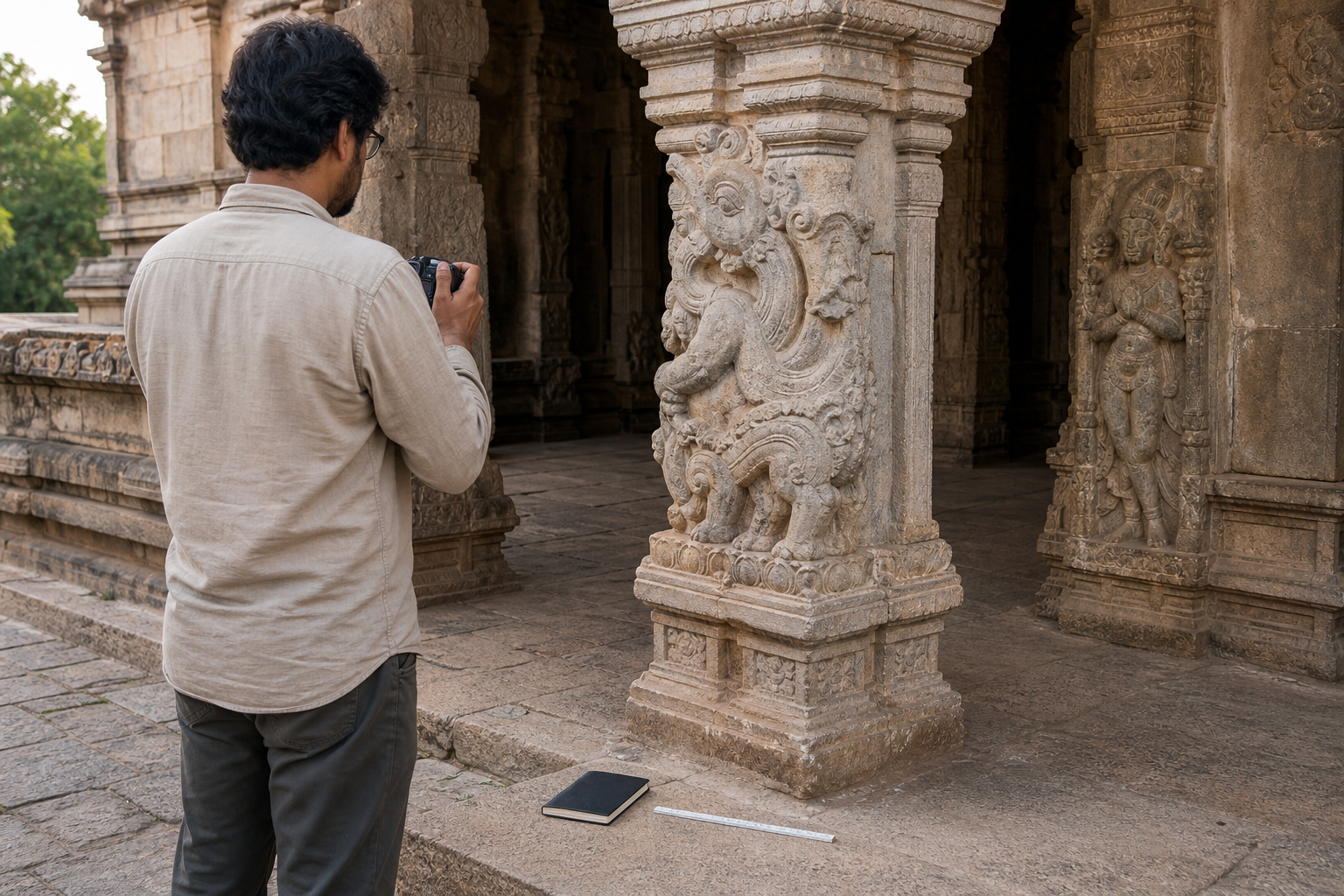
A useful temple record needs more than a close-up. Where photography is permitted, take one image showing the whole doorway, pillar, or ceiling arrangement before taking a detailed view. The contextual image preserves the evidence needed to interpret the creature’s role.
Keep your notes in separate layers:
- Observation: Describe the visible animal features and the condition of the carving.
- Position: Record the exact architectural element and the direction the creature faces.
- Pattern: Note whether it is paired or repeated and whether another example is better preserved.
- Local identification: Ask, “What is this figure called here, and what role is it understood to play?” An open question is less likely to force your own label onto a regional convention.
- Interpretation: Write down what the form and placement together allow you to infer, then mark any claim that still needs confirmation.
A responsible caption might read: “Gaja Vyali, or Gaja Yali, a composite elephant-lion figure placed beside the temple doorway. Its position supports an interpretation as a guardian of the sacred threshold.” If the identification is uncertain, add “probable.” If the figure is on a ceiling rather than an entrance, describe that location instead of automatically repeating the threshold interpretation.
Do not assign a date, dynasty, sectarian identity, or specific doctrine from the motif alone. Those conclusions require evidence beyond resemblance. Also respect the temple’s rules: when photography is restricted, written notes or a simple sketch preserve context without turning observation into intrusion.
On your next temple visit, pause before crossing the entrance. Find the composite body, trace its relationship to the architecture, and notice how it changes your awareness of the boundary. The Gaja Vyali becomes legible when you read the whole threshold, not just the beast.
References
