

If your mandir or community is considering Gaṅgā Ārati beside the Thames, or beside any river outside Bharat, you may hear a blunt objection: Gaṅgā belongs in India, so her ārati must remain there too. You do not have to choose between honouring Gaṅgā’s unique place in Bharat and practising Sanātana Dharma where you now live.
The sound answer depends on one precise distinction. The river before you does not geographically become Gaṅgā. Yet Hindus may invoke Gaṅgā Mātā, offer light and approach local waters with a Dharmic consciousness of sacredness. Preserve that distinction and the rite becomes intelligible; abandon it and both supporters and critics can end up arguing against claims Hindu practice does not require.
Keep geographical identity and ritual presence distinct

Begin with the physical fact. Gaṅgā is Gaṅgā, with her own sacred geography, tīrthas, traditions and material course in Bharat. The Thames is the Thames. Performing Gaṅgā Ārati beside the Thames does not move Gaṅgā’s channel, reproduce Varanasi or confer a new geographical name on Britain’s river.
Ritual presence answers a different question: whom are worshippers invoking, and through which sacred understanding are they approaching the water? Hindu worship regularly makes a sacred presence ritually available without claiming that every physical distinction has disappeared. That is why invoking Gaṅgā beside another river need not amount to identifying that river as Gaṅgā.
This gives you a reliable test. If an event claims that the local river has literally become Gaṅgā, the language is misleading. If it invokes Gaṅgā Mātā while naming and respecting the local river, there is no necessary contradiction. Sacred participation is not geographical replacement.
Do not defend the ceremony by saying that every river is simply the same river. That defence gives away too much. Hindu thought can affirm two truths at once: many waters are worthy of reverence, and Gaṅgā possesses a distinctive sacred identity. Difference does not prevent devotion; devotion does not require erasing difference.
The scriptural grammar is sacred plurality, not sameness

Ṛg Veda 7.49.2 invokes celestial waters, flowing waters, waters reached by digging and waters that arise naturally. It addresses them as āpo devīḥ, divine waters. The verse does not restrict sacred regard to one watercourse or one mode by which water appears.
The Nadī Sūkta of Ṛg Veda 10.75.5 places Gaṅgā within a collective invocation of rivers, including Yamunā, Sarasvatī, Śutudrī and Paruṣṇī. Vedic sacred geography is therefore plural. Reverence for several rivers does not reduce them to interchangeable names.
Gaṅgā’s special standing remains explicit. In Bhagavad Gītā 10.31, Śrī Kṛṣṇa declares, “Among rivers, I am Jāhnavī”. Jāhnavī is Gaṅgā. This is precisely why a good explanation should not claim that Gaṅgā is merely a generic symbol for water. Her particular identity matters.
Traditional pūjā supplies the practical bridge between those two principles. Worshippers invoke Gaṅgā, Yamunā, Godāvarī, Sarasvatī, Narmadā, Sindhu and Kāverī into water used in worship. The practice makes sacred geography ritually present without pretending that the vessel, well or local waterway has physically become all seven rivers.
These passages do not provide a modern event plan for the Thames. They establish the theological premises you need: water may be approached as sacred in more than one place; several rivers may be revered together; Gaṅgā still retains her exceptional identity; and invocation does not depend on geographical confusion. When someone questions the ceremony, make that four-part case instead of relying on the vague slogan that divinity is everywhere.
Honour the river before you instead of treating it as a blank stage
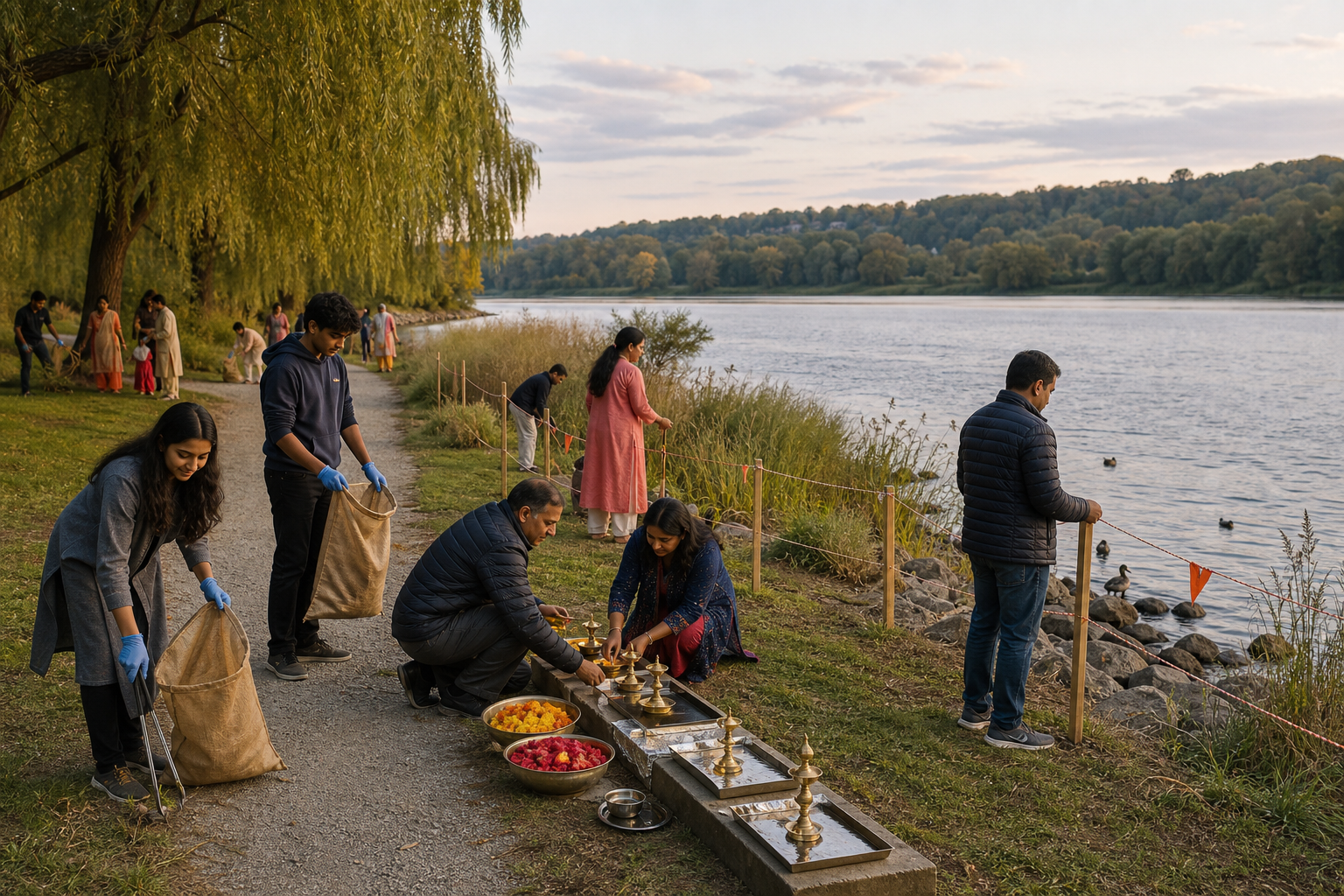
A Dharmic ceremony abroad should recognise where it is taking place. The Thames has its own name, landscape and inherited meanings, including sacred significance in Britain’s pre-Christian past. That history need not be erased, appropriated or recast as hidden evidence of Hindu ownership. It can simply be respected.
The river’s name offers an instructive example of how to speak carefully. A cautious etymological account traces “Thames” through ancient Brittonic Tamesa or Tamesis, probably associated with “dark.” Sanskrit tamas, darkness, is a cognate within the wider Indo-European language family. This linguistic kinship is striking, but it does not prove that Indians named the Thames. Related words can preserve deep linguistic ancestry without establishing direct naming, migration or religious ownership.
If you mention that connection in an event programme, label it as a possible Indo-European cognate rather than a settled story about Sanskrit speakers naming Britain. If you mention older British reverence for the Thames, present it as Britain’s inheritance rather than evidence that the river was secretly Gaṅgā. A modest claim is not a weaker claim; it is one that remains standing after scrutiny.
- Say “Gaṅgā Ārati beside the Thames,” because that wording identifies both the invoked sacred presence and the physical location.
- Say that Hindus are honouring water through Sanātana Dharma, not that they are replacing the river’s local identity.
- Describe ancient linguistic or religious parallels as connections worth contemplating, not as proof of possession.
This posture also clarifies what ārati contributes. Its central movement is an offering of light, gratitude and reverence. It does not need a territorial claim. The local river is not being annexed into a Hindu map; worshippers are meeting it through a Hindu act of offering.
A five-part test for organisers and attendees
Before publishing an announcement, run its title, description and spoken introduction through this test. The same questions can help you decide whether an event is practising rooted Hinduism or using careless civilisational language.
- Name the physical river accurately. A visitor should immediately know whether the ceremony is beside the Thames, the Seine, the Hudson or another waterway.
- Name the sacred presence being invoked. Explain that the rite invokes Gaṅgā Mātā; do not reduce the event to a generic festival of lamps if it is specifically Gaṅgā Ārati.
- State the distinction plainly. One sentence should say that invocation does not rename the local river or make it geographically identical to Gaṅgā.
- Acknowledge the host landscape. Use the river’s own name and avoid language implying that it had no meaning until Hindus arrived.
- Frame the act as an offering. Gratitude, light and reverence communicate the rite’s purpose more accurately than claims about ownership, conquest or cultural replacement.
A concise event description could read: This Gaṅgā Ārati beside the Thames invokes Gaṅgā Mātā through a Hindu offering of light and gratitude. It honours the Thames in its own name and place; it does not rename or claim the river.
That wording does useful work. A Hindu reader can see that Gaṅgā has not been made generic. A local visitor can see that the Thames has not been overwritten. A critic must then address the actual practice of ritual invocation rather than an imagined attempt to turn Britain into Bharat.
You can apply the same test when attending rather than organising. Listen for whether the local river is named respectfully, whether Gaṅgā’s unique status is retained and whether the ceremony is presented as devotion rather than possession. If those elements are present, location outside India by itself is not a sufficient theological objection. If they are absent, ask for clearer language instead of dismissing the entire possibility of Hindu river worship abroad.
This matters for diaspora life. If sacred practice is treated as authentic only when it occurs thousands of miles away, Hinduism abroad can be reduced to recollection and occasional cultural display. Rooted practice offers another path: remain loyal to Bharat’s sacred geography while learning to live dharmically in the landscape where your community actually wakes, works, raises children and worships.
Key takeaways
- A Gaṅgā Ārati abroad is coherent when it invokes Gaṅgā Mātā without claiming that the local river has geographically become Gaṅgā.
- Ṛg Vedic reverence for diverse waters and multiple named rivers supports sacred plurality; Bhagavad Gītā 10.31 preserves Gaṅgā’s distinctive status.
- Traditional invocation of seven sacred rivers into pūjā water shows how sacred geography can become ritually present without physical identities being collapsed.
- Respectful public language names the local river, acknowledges its own inheritance and presents ārati as an offering rather than a claim.
- The Thames–tamas connection should be described as cautious Indo-European linguistic kinship, never as proof that Indians named the Thames.
Before the next ceremony is announced, read its title and first paragraph as a newcomer would. If you can tell which river is physically present, whom the worshippers are invoking and what they are offering, the essential distinction is clear. Then approach the water without apology or exaggeration: rooted in Gaṅgā, truthful about place and grateful for the river before you.
References
