

If you arrived asking whether Maharaja Nandakumar was murdered through a court, the honest answer is more useful than a simple yes or no. The known sequence makes suspicion unavoidable, but chronology alone cannot prove a conspiracy. You have to examine how the charge, the court, the imported law and the political context worked together.
On 5 August 1775, Nandakumar was hanged in Calcutta at nearly seventy years of age. His formal offence was forgery. Only months earlier, however, he had accused Warren Hastings, the most powerful British official in Bengal, of accepting bribes and abusing public office. That proximity is why his execution cannot be understood as an ordinary criminal case detached from politics.
The chronology that makes the case impossible to dismiss
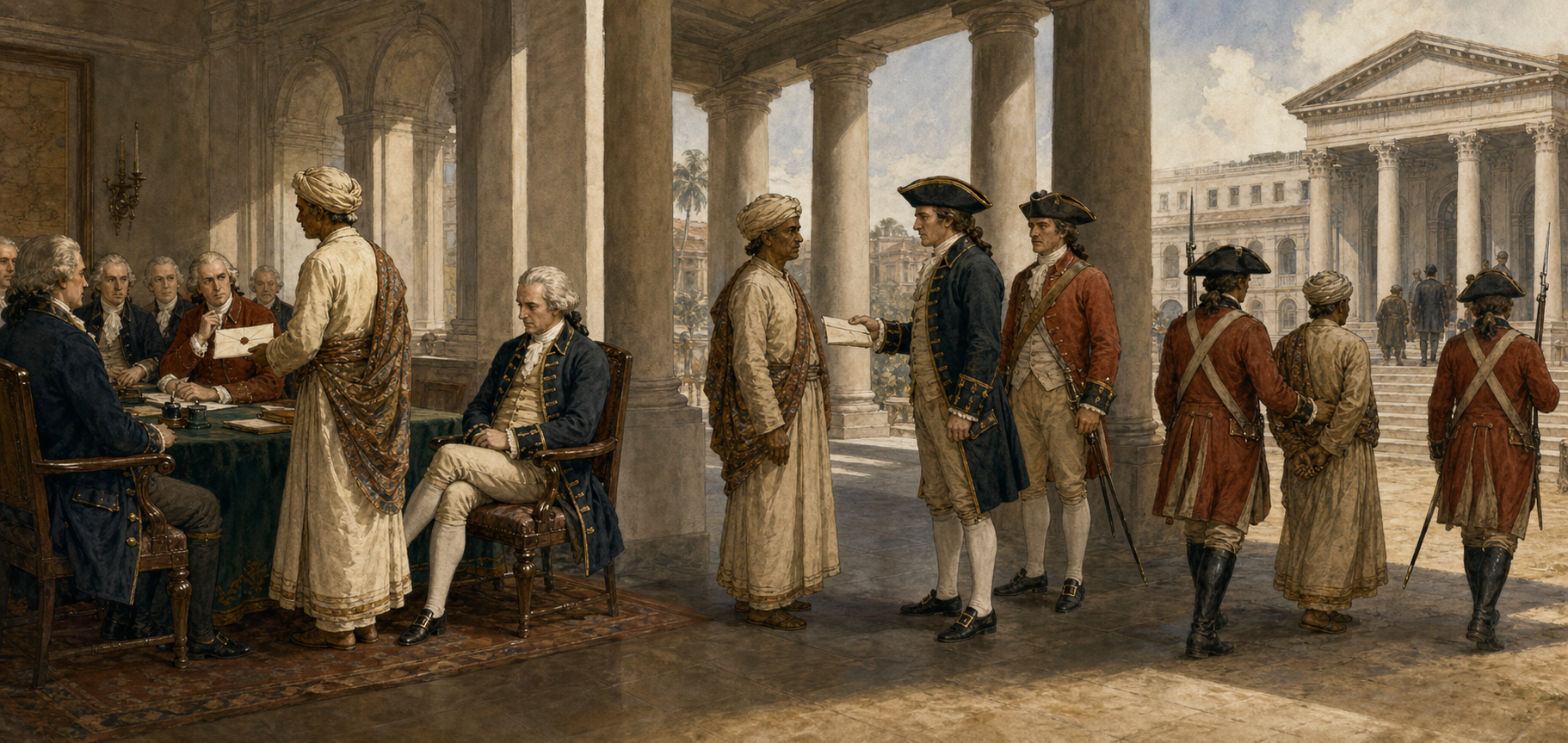
Begin with the timeline, not with a label such as martyr, criminal or victim of judicial murder. The sequence is the strongest part of the case against treating the execution as routine:
- Nandakumar accused Warren Hastings of bribery and abuse of public office.
- Soon afterwards, Nandakumar was arrested and tried before the newly established Supreme Court at Calcutta.
- He was convicted under an English statute, sentenced to death and hanged on 5 August 1775.
This order creates a serious appearance of retaliation. It does not, by itself, establish that Hastings directed the prosecution, that the forgery charge was invented or that every participant in the trial acted from a political motive. Sequence is evidence that demands investigation; it is not a substitute for evidence about coordination, jurisdiction and procedure.
Four questions are often collapsed into one. They must be kept separate: Was Nandakumar’s accusation against Hastings true? Was the forgery allegation true? Was the court entitled to try and condemn him under the law it used? Was the prosecution pursued or punished so severely because he had challenged Hastings? One answer does not automatically decide the others.
That distinction matters because political prosecution does not always require a fabricated charge. Power can operate through selective urgency, unequal scrutiny, a convenient forum or an exceptionally severe punishment. Conversely, suspicious timing cannot establish innocence. When you encounter a confident retelling of this case, sort its claims into three columns: established event, reasonable inference and unresolved question. If an interpretation quietly moves material from the third column into the first, it is overstating what can be known.
Recovering Nanda Kumar Ray from the name Nuncomar

Nandakumar was not an anonymous subject suddenly caught in an unfamiliar political struggle. Born around 1705 at Bhadrapur in present-day Birbhum, Nanda Kumar Ray came from a Bengali Brahmin family connected with revenue administration. His father, Padmanabha Ray, worked in that administrative world, and Nanda Kumar followed the same path.
That background does not prove his allegations against Hastings. It does tell you that he was an experienced participant in Bengal’s governing order rather than merely an outside agitator. He understood revenue administration and public office from within. His confrontation with colonial authority therefore belongs to the history of one governing system displacing, absorbing and judging people formed by another.
British records commonly rendered him as Nuncomar, while his personal name was Nanda Kumar Ray and history remembers him as Maharaja Nandakumar. If you investigate the case further, search all three forms. A catalogue or index built around colonial spelling can otherwise make parts of the same life look like separate subjects.
The personal name of his mother has not been securely preserved in the surviving historical record, even though his final days received unusually close attention. Notice the imbalance. Administrative archives often preserve offices, accusations, judgments and punishments more readily than the family worlds surrounding the people they govern.
That silence should produce discipline, not invention. Mark the name as unknown rather than filling the gap with an unsupported claim. This is a useful rule for reading colonial history generally: an archive can be detailed without being complete, and its omissions do not explain themselves.
Five tests for judging colonial justice

The use of an English statute in Bengal does not, by itself, prove that the proceeding was unjust. Nor does a conviction prove that colonial power had become impartial merely because it acted through a court. Apply five concrete tests before accepting either conclusion.
- Jurisdiction and applicability: What authority allowed the Supreme Court at Calcutta to try this defendant for this alleged conduct under this English statute? Ask whether the rule applied to the person, place and time involved. The name of a statute is not an answer to the jurisdictional question.
- Notice and a meaningful defence: Could the accused reasonably know the rule under which he was being judged, understand the charge and challenge the evidence? A responsible assessment needs the trial procedure, not merely the eventual verdict.
- Institutional independence: Was the new court sufficiently insulated from the colonial executive and from the political interests surrounding Hastings? Newness does not prove dependence, but it increases the need to examine appointments, relationships and incentives rather than assuming independence from the existence of a courtroom.
- Equal scrutiny: Were allegations against a powerful British officeholder examined with the same seriousness applied to the accusation against his Indian challenger? Equality before law is tested most clearly when power itself becomes the accused.
- Proportionality: Even if forgery could be proved and the court possessed jurisdiction, why did the offence result in death? Legality and proportionality are separate questions. An irreversible punishment demands especially strong confidence in the law, forum and procedure.
The known facts make all five tests relevant. Nandakumar challenged the leading British official in Bengal, was soon prosecuted before a newly established British court, was convicted under an English law and received a death sentence. None of those features alone settles the case. Their convergence is what makes an uncritical appeal to formal legality inadequate.
A retelling that stops at the word convicted leaves out the institutional question. A retelling that jumps from suspicious timing to a proven conspiracy leaves out the evidentiary question. Good history has to hold both demands at once.
How far the evidence supports the charge of judicial murder

Judicial murder is a grave description. It means that legal forms were used to produce a killing serving political power rather than justice. In Nandakumar’s case, the phrase identifies the central suspicion, but it should be the conclusion of an argument rather than its starting assumption.
Several points can be stated confidently. Nandakumar accused Hastings of corruption. His own arrest and prosecution followed. A new colonial court tried him under an English statute for forgery. It imposed death, and he was hanged. These are not peripheral details; together they explain why the case has remained controversial.
A narrower inference is also justified: the political context prevents us from treating the proceeding as self-validating. When an accuser of the colony’s most powerful official is rapidly transformed into a condemned defendant, the burden falls on the institutions involved to demonstrate independence, lawful authority, even-handedness and procedural fairness.
What cannot be established from chronology alone is direct orchestration. A conclusive claim would require closer evidence about the alleged forgery, the court’s authority, the conduct of the trial, communications among the relevant officials and the treatment of Nandakumar’s allegations against Hastings. Suspicion is warranted; certainty has to be earned.
The most defensible verdict is therefore calibrated but not evasive: Nandakumar’s execution was a gravely suspect exercise of colonial justice, inseparable from the challenge he had made to Warren Hastings. Political retaliation is a serious interpretation of the sequence. Calling orchestration proved, however, requires evidence beyond the sequence itself.
A dharmic reading sharpens the moral question. Rajadharma binds political authority to duty and justice; authority does not become righteous merely because it can issue an official sentence. The forgery allegation still has to be examined on its merits, but the ruler and the institutions serving power must also be judged. Formal procedure answers what the state commanded. It does not, without further inquiry, answer whether the state upheld dharma.
Two shortcuts should therefore be rejected. The first says that British courts brought law, so their judgments represent justice. The second says that a colonial court condemned an Indian, so the underlying criminal allegation must have been false. Both replace investigation with allegiance. You can recognise the possibility of guilt while still asking whether the prosecution was selective, the forum legitimate and the punishment proportionate.
Key takeaways
- Maharaja Nandakumar was hanged for forgery in Calcutta on 5 August 1775, only months after accusing Warren Hastings of bribery and abuse of office.
- The sequence creates a serious appearance of political retaliation, but timing alone does not prove that the charge or verdict was orchestrated.
- Judge the proceeding through five tests: jurisdiction, meaningful defence, institutional independence, equal scrutiny and proportionality.
- Keep factual guilt separate from political selectivity. A charge can contain evidence and still be used selectively against an inconvenient accuser.
- When researching further, search Nanda Kumar Ray, Maharaja Nandakumar and Nuncomar, and label archival gaps honestly instead of filling them with conjecture.
The next time someone invokes Nandakumar either to celebrate imperial rule of law or to declare a fully proven conspiracy, ask for the timeline, the legal basis, the trial procedure and the treatment of his accusation against Hastings. That method preserves more than one man’s memory. It denies power the privilege of defining justice merely because it controlled the court.
References
