
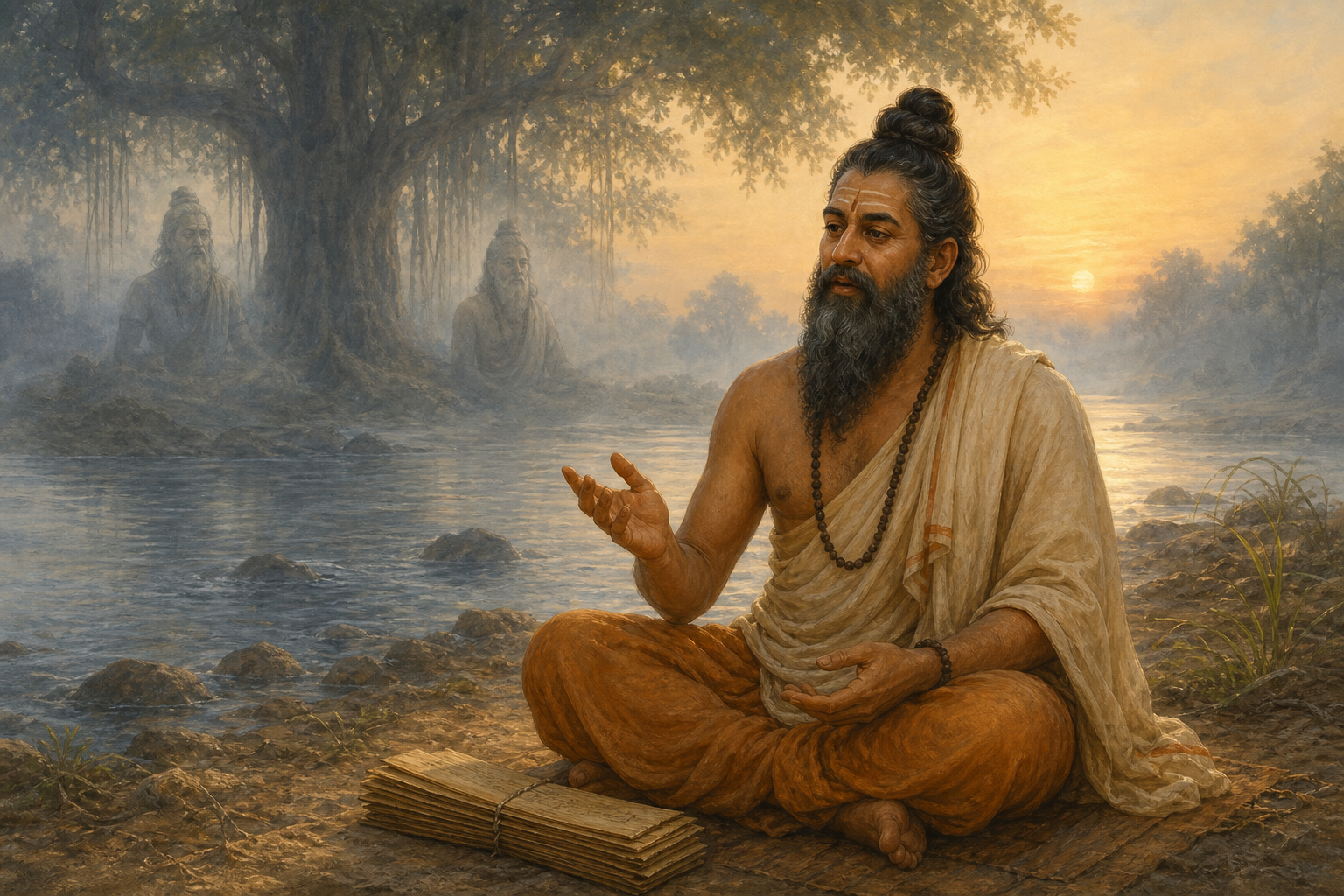
You may have encountered Sage Parashara’s name in a family discussion, a discourse, or a passage about the rishis and wondered what you should actually remember. The difficulty is not recognizing that he was revered. It is keeping three different questions clear: who he was, where he stood in the lineage, and what his name came to represent.
The dependable starting point is concise: Parashara was the son of Shakti and Adrishyanti, the grandson of Vasishtha through Shakti, and a sage remembered for wisdom, compassion, and divine knowledge. That small set of facts gives you a sound framework without forcing uncertain details into the account.
Begin with the family relationships
Parashara belongs to a sacred rishi lineage. His immediate family relationships can be stated in three lines:
- Vasishtha was his grandfather.
- Shakti, the son of Vasishtha, was his father.
- Adrishyanti was his mother.
The resulting paternal sequence is Vasishtha, then Shakti, then Parashara. The fuller statement is that Parashara was born to Shakti and Adrishyanti and was the grandson of Vasishtha.
This distinction matters whenever you make a family tree, teach the account to a child, or introduce the sage in writing. If you draw the relationships, place Vasishtha above Shakti, place Shakti and Adrishyanti together as Parashara’s parents, and place Parashara below them. Do not accidentally make Adrishyanti a member of the vertical father-to-son sequence, but do not omit her either.
A useful one-sentence introduction is: “Sage Parashara was the son of Shakti and Adrishyanti and the grandson of the great rishi Vasishtha.” It answers the genealogical question directly. Dates, locations, additional relatives, and elaborate biographical episodes are separate claims; add them only when you have a reliable basis for each one.
Read the name as remembrance, not a loose translation
People often ask what a sacred name “means” when they are really asking several different things. They may want a literal derivation, the identity of its bearer, or the qualities associated with that person. Those are not interchangeable answers.
In Hindu remembrance, Parashara’s name is associated with wisdom, compassion, and divine knowledge. That is a statement about the name’s religious and cultural symbolism. It should not automatically be turned into the stronger claim that every one of those qualities is a literal dictionary translation of the name.
When you explain the name, use this three-part test:
- Identity: Are you identifying the sage called Parashara?
- Lineage: Are you explaining his relationship to Shakti, Adrishyanti, and Vasishtha?
- Symbolism: Are you describing the virtues that Hindu tradition remembers through his name?
If your claim falls into the third category, say that the name “evokes,” “represents,” or “is associated with” those virtues. Do not quietly replace symbolic meaning with linguistic certainty. That one wording choice makes your explanation both more accurate and more respectful.
Why the Vasishtha lineage is more than a family tree
A rishi’s lineage is not decorative information attached to an otherwise isolated personality. It locates the sage within a continuity of sacred learning and memory. Naming Vasishtha, Shakti, and Parashara in the right order shows that Parashara is remembered as part of an inherited tradition rather than as a figure appearing without context.
You should nevertheless keep genealogy and spiritual stature distinct. The genealogy tells you whose son and grandson Parashara was. His reputation as a divine scholar tells you how Hindu tradition regarded him. His remembered virtues tell you what his name came to signify. One statement should not be used as a substitute for the others.
This distinction helps when you meet an embellished retelling. First confirm the relationship being claimed. Then ask whether the statement concerns family descent, religious esteem, or symbolic interpretation. A claim can sound devotional and still require precise wording. Reverence does not become weaker when it is disciplined by clarity.
Adrishyanti’s presence is also worth preserving. A shortened genealogy may focus only on the sequence from Vasishtha to Shakti to Parashara, but that does not make the mother irrelevant. When space permits, give both parents before naming the grandfather. You retain the useful vertical lineage while presenting Parashara’s birth relationship completely.
Preserve Parashara’s legacy without inflating it
Parashara’s enduring legacy can be understood at three levels. He is remembered as a particular sage, as a descendant in the Vasishtha line, and as a figure whose name carries an ethical and spiritual ideal. Keeping all three levels together produces a fuller portrait than either a bare genealogy or a string of honorifics.
- Preserve the person by naming Parashara as a revered sage and divine scholar in Hindu tradition.
- Preserve the lineage by identifying Shakti and Adrishyanti as his parents and Vasishtha as his grandfather through Shakti.
- Preserve the ideal by connecting his remembrance with wisdom, compassion, and divine knowledge.
This gives you a practical standard for evaluating introductions, captions, lessons, and devotional material. A useful account should let the reader identify Parashara, place him correctly, and understand why his name continues to command respect. It does not need unsupported dates, invented quotations, or an indiscriminate catalogue of achievements to sound substantial.
If you are teaching younger readers, ask them two different questions: “Who were Parashara’s parents and grandfather?” and “Which virtues does his name represent?” The first tests genealogy; the second tests spiritual understanding. Separating the questions prevents children from memorizing names without grasping their significance.
If you are writing for a general audience, begin with the relationships and then explain the symbolism. If you are writing devotionally, you can reverse the emphasis, but keep the relationships exact. In either setting, the aim is the same: transmit inherited memory without confusing devotion, genealogy, and etymology.
Key takeaways
- Parashara was born to Shakti and Adrishyanti.
- Shakti was the son of Vasishtha, making Vasishtha Parashara’s grandfather.
- The paternal sequence is Vasishtha, Shakti, and Parashara.
- Parashara is remembered as a divine scholar whose name represents wisdom, compassion, and divine knowledge.
- Symbolic associations should not be presented automatically as a literal translation of the name.
- A careful account separates genealogy, religious esteem, and spiritual symbolism.
The next time you encounter Parashara’s name, pause long enough to identify which layer is being discussed. Place him accurately in the lineage, retain Adrishyanti in the family account, and carry forward the virtues attached to his remembrance. That is a small but meaningful act of Dharmic continuity.


References
