
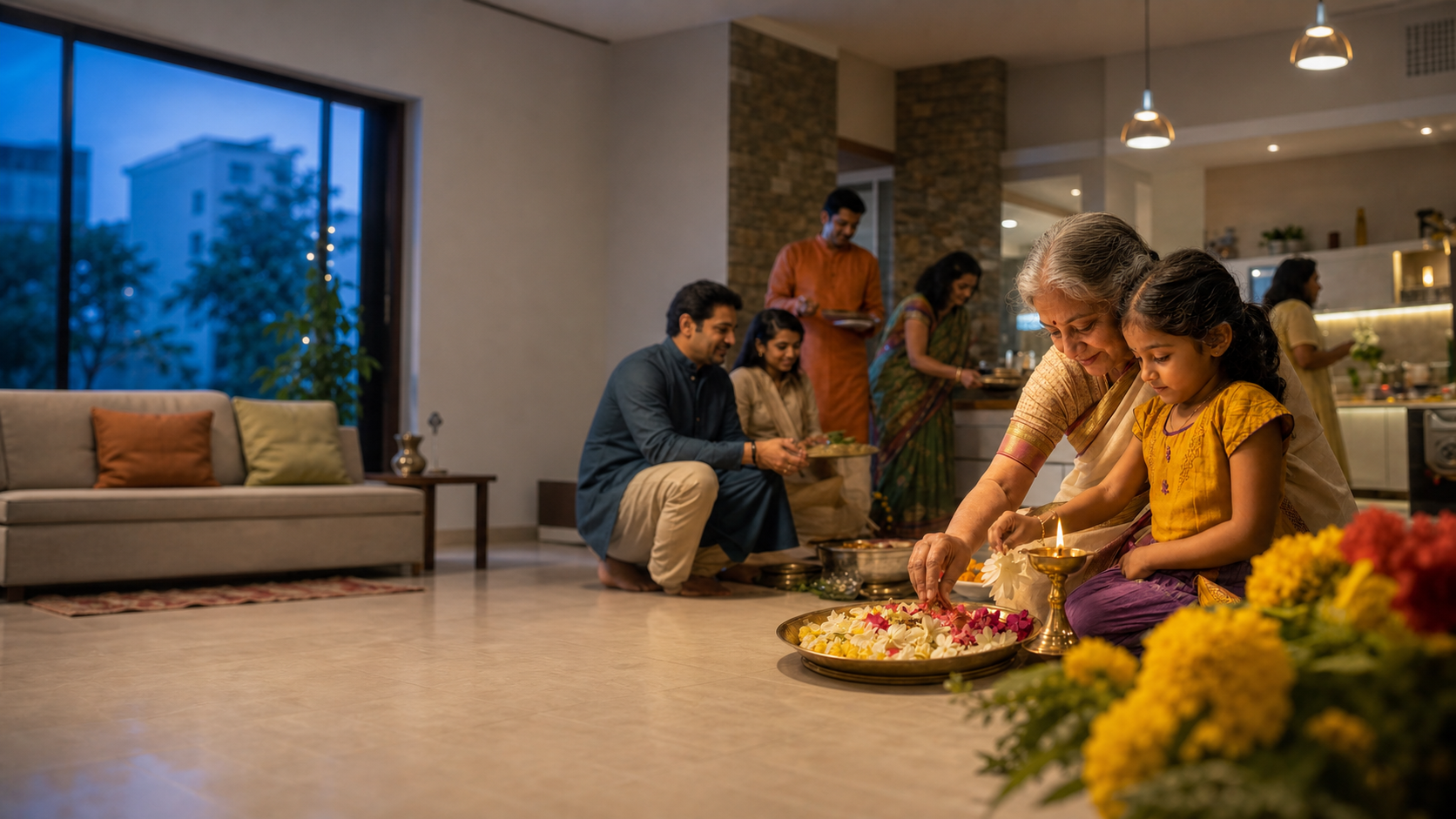
If you are trying to keep a Hindu festival meaningful for children, relatives, or friends outside its ancestral setting, the hardest part is not choosing the food or decorations. It is deciding what must survive when time, language, and location change.
You do not need to reproduce every inherited detail to preserve a festival faithfully. You do need to protect its memory-bearing core: whom it remembers, which truth or virtue it rehearses, what act gives that memory a physical form, and how other people are brought into the observance. Mahalaya and Onam show how this can hold a community together without demanding cultural sameness.
A festival is a calendar of relationships and obligations
A Hindu festival does more than commemorate something that happened long ago. Its return on the calendar places you inside a relationship again: with ancestors, a deity, an ethical exemplar, a sacred story, a region, or a community. Memory becomes active because the festival asks something of the people who remember.
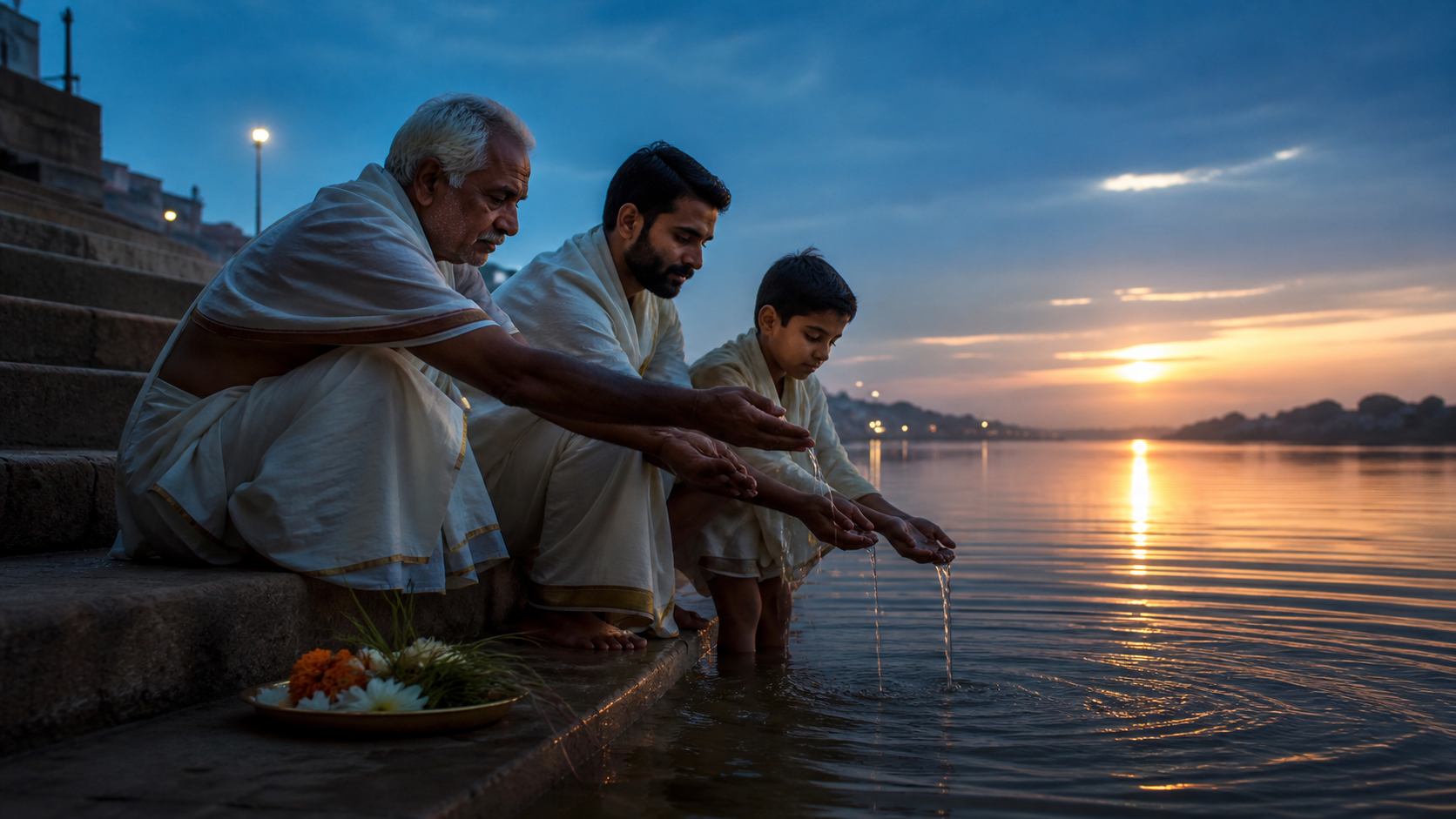
Mahalaya makes this structure especially clear. It comes at the end of the 15-day lunar period of Pitru Paksha, when families who follow the observance honor their forebears through shraddha and rites such as pind daan and tarpan. Rice balls may be offered in pind daan, while tarpan includes an offering of water mixed with sesame seeds. The period culminates on Sarvapitri Amavasya, also known as Mahalaya Amavasya.
The meaning lies not only in the individual rites but also in their position within a sequence. Pitru Paksha turns attention toward those from whom life and inheritance were received. Devi Paksha then begins, shifting the emotional register from solemn remembrance to the anticipated arrival of Maa Durga. Gratitude to the departed and welcome to the Divine Mother are not competing concerns. The calendar places them beside each other and teaches a movement from inheritance to renewal.
Onam carries memory through a different relationship. In a widely told Onam narrative, Mahabali is remembered as a generous ruler associated with just governance. Bhagwan Vishnu appears as Vamana and tests the king’s humility and integrity. Mahabali gives up his possessions and finally offers his own head for Vamana’s last step. His surrender brings a divine blessing and the promise of an annual return. Communities may emphasize parts of this narrative differently, but the homecoming remains central to the festival’s emotional and ethical life.
Welcoming Mahabali is therefore more than recalling a king. It asks the household to make generosity, reciprocity, humility, and good hospitality visible. The remembered ruler returns, and the people preparing for his return must decide what kind of social order their own conduct creates.
Before planning your next celebration, answer four questions. If your family cannot answer them, that is the first gap to repair:
- Who or what are we being asked to remember?
- What relationship does that memory renew?
- What virtue or obligation should become visible in our conduct?
- Which ritual, story, sound, food, or act allows everyone present to carry the memory forward?
These questions prevent a festival from being reduced to themed entertainment. They also help you distinguish an adaptation from a loss. The scale, language, venue, and menu may change. If the remembered relationship and its obligation remain intelligible, continuity is still possible.
Ritual gives memory a body, a sound, and a time
People rarely preserve a tradition by memorizing an explanation once. They preserve it by doing something recognizable at a recurring time. The body rises, listens, cooks, offers, arranges, serves, sings, or gathers with others. These repeated actions become handles by which memory can be retrieved.
For many Bengali households, Mahalaya begins before ordinary daily life has started. At 4:00 in the morning, families listen to Mahisasura Mardini, whose combination of Sanskrit chants from the Devi Mahatmya, Bengali devotional music, and narration evokes Maa Durga’s victory over Mahishasura. First broadcast in 1931, it remains closely associated with the voice of Birendra Krishna Bhadra. Radio gave way to television and online streaming, but the shared act of waking and listening endured.
This shared timing matters. A family in Kolkata, San Francisco, or Toronto may use a different device and inhabit a different social environment, yet the pre-dawn observance places each household inside the same remembered rhythm. Technology changes the route by which the sound arrives; it does not have to change what the listening means.
Mahalaya also includes Chokku Daan, when the eyes of Maa Durga’s murti are painted. The act makes the transition toward Devi Paksha visible. The murti is not merely another object added to a decorated space. The painting of the eyes marks an invitation to divine presence and directs attention toward the one being welcomed.
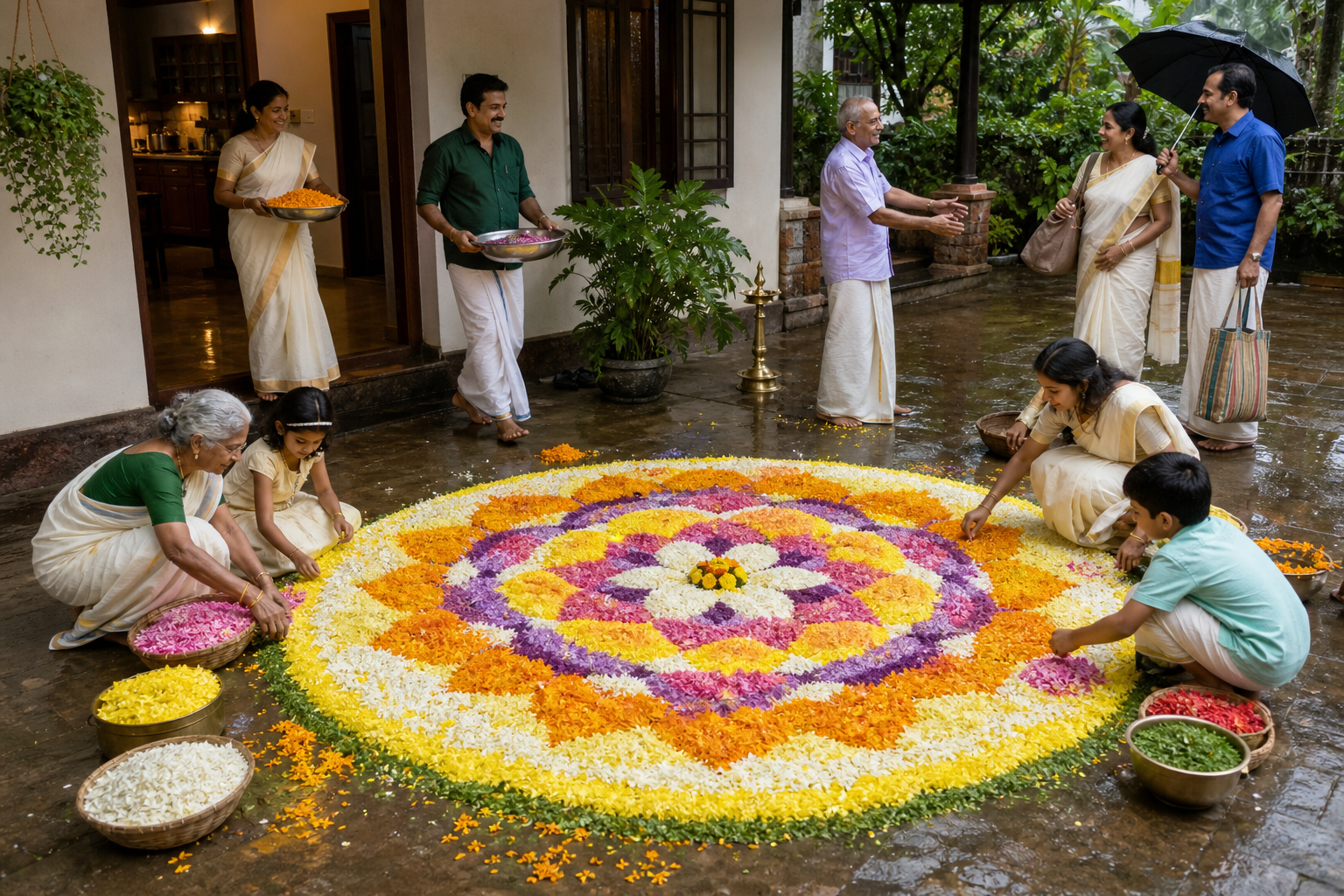
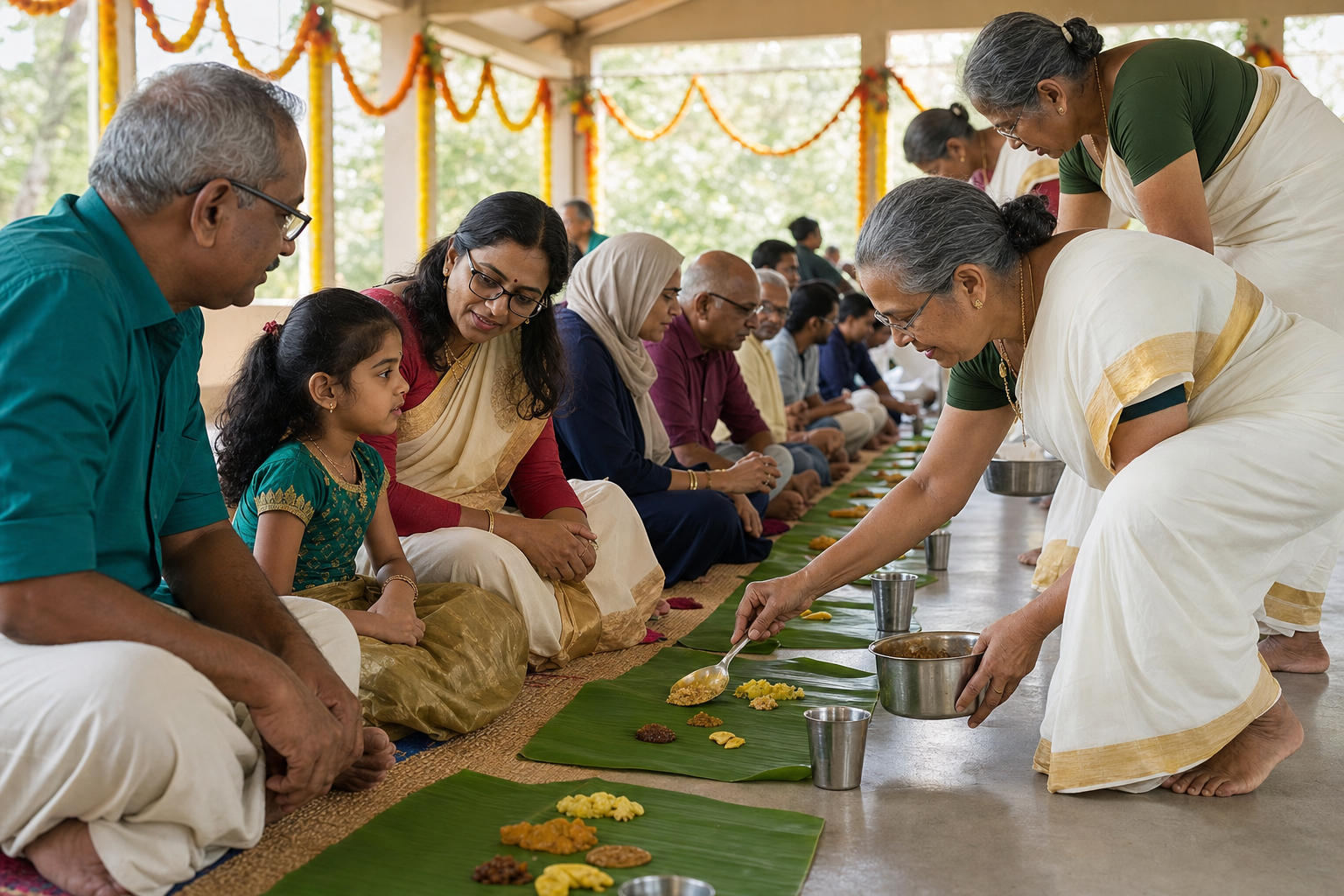
Onam uses a different sensory vocabulary. A pookkalam takes shape through flowers arranged together. A sadhya gathers people around a shared meal. Payasam, coconut, cumin, banana chips, jaggery sweets, Malayalam conversation, and thiruvathira rhythms can become carriers of belonging. No single smell, dish, or movement contains the whole festival. Together, however, they make the homecoming memorable enough to be recognized and repeated.
When you need to simplify a celebration, do not choose elements only by visual appeal. Choose at least one carrier from each of these functions:
- A time anchor: a recurring moment that interrupts ordinary routine, such as Mahalaya’s pre-dawn listening.
- A spoken memory: the story, name, chant, or explanation that tells people why they have gathered.
- An embodied act: offering, arranging flowers, preparing food, listening together, or serving another person.
- A sensory anchor: a sound, fragrance, taste, or image that participants can recognize when the festival returns.
- A shared responsibility: a task that turns younger relatives and guests from spectators into contributors.
This is also a useful test for inherited customs. If a visible symbol remains but no one can explain whom it welcomes or what it remembers, restore the explanation before adding more decoration. If you are unfamiliar with a lineage-specific rite, learn from the family or community member who carries that practice rather than presenting an improvisation as inherited tradition.
Unity grows from rooted participation, not cultural sameness
There are two easy ways to weaken unity around a festival. One is to flatten the observance into generic culture until its Hindu names, narratives, and sacred relationships disappear. The other is to treat ancestry or language fluency as the price of admission, leaving willing participants with no honorable way to join.
Onam demonstrates a better approach. Participation can begin through Malayali friends, an invitation to a sadhya, flowers placed in a pookkalam, or help offered in the kitchen. A guest does not need Kerala ancestry or fluent Malayalam to serve food, arrange flowers, listen to the story of Mahabali, or receive hospitality with respect. Yet openness does not require the host to obscure the festival’s roots.
The practical distinction is between access and authority. A newcomer can be given meaningful access to the celebration. People who inherit or deeply know the tradition should still explain its names, sequence, sacred frame, and any boundaries surrounding particular rites. That balance allows a community to expand without pretending that every participant has the same knowledge or role.
Shared Dharmic values offer another bridge. Dana, generosity; karuna, compassion; ahimsa, non-harm; and seva, service, appear across Hindu, Buddhist, Jain, and Sikh moral vocabularies. Onam’s communal hospitality can be placed in conversation with anna-dana and Sikh langar because each makes feeding and service socially meaningful. A pookkalam can also resonate visually with contemplative, mandala-like forms found elsewhere in Dharmic life.
Resonance is not identity. Traditions do not need to have identical histories or theology in order to recognize a shared ethical concern. Naming both the connection and the distinction produces stronger unity than claiming that every practice is fundamentally the same.
Use these rules when welcoming people into a festival:
- Name the festival and its rooted story clearly. Do not replace them with a vague label such as seasonal celebration.
- Give a newcomer one sentence of context before asking for participation.
- Offer a real task: arrange flowers, prepare a dish, set places, serve guests, help an elder, or manage the shared listening.
- Explain unfamiliar words without discarding them. Say tarpan, pookkalam, sadhya, and seva, then explain what each means in that setting.
- State any ritual boundaries calmly. Hospitality does not require every person to perform every act.
- Let the festival’s virtue govern the gathering. A celebration of generosity that burdens one exhausted host has missed its own lesson.
A practical plan for carrying a festival forward
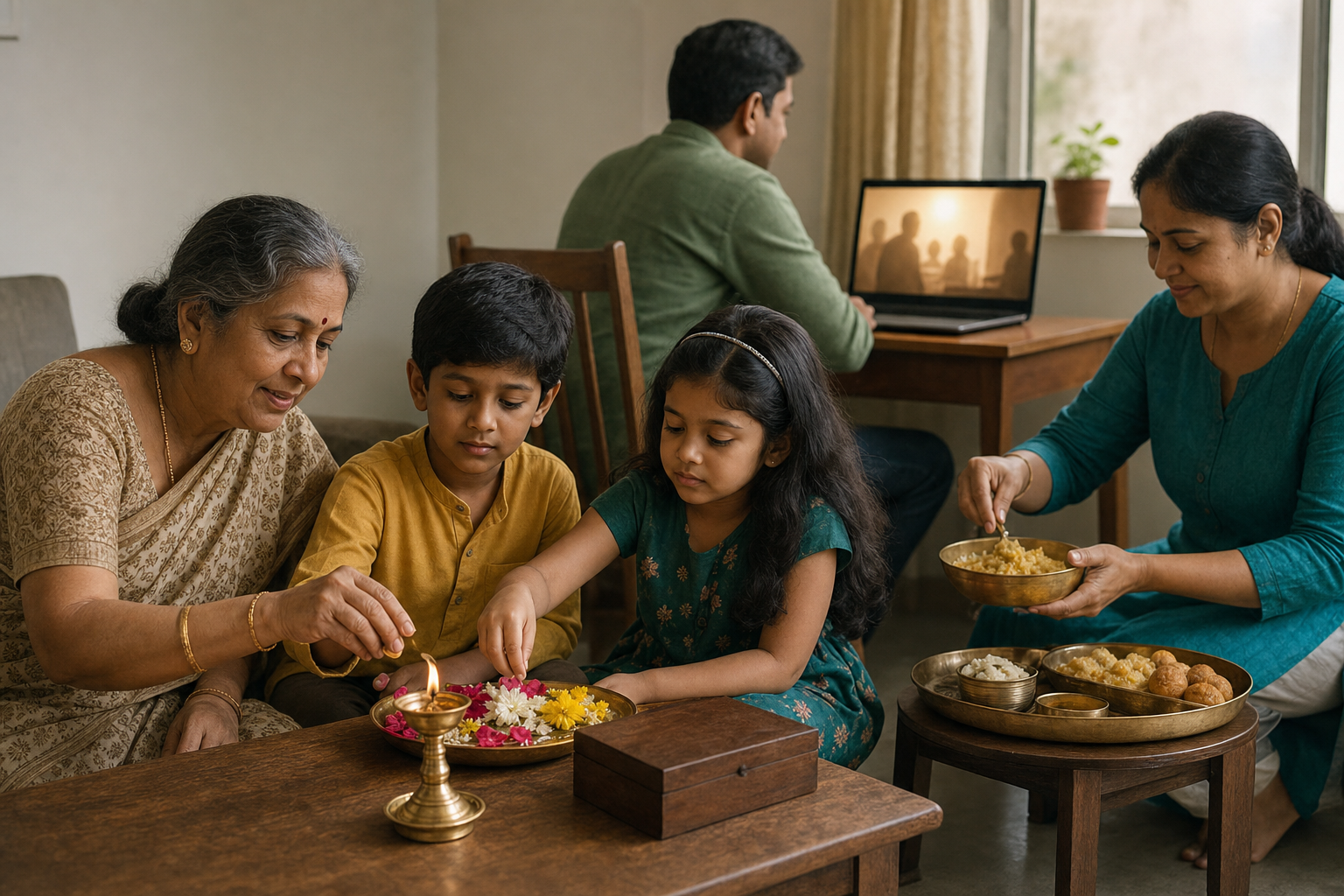
If your family celebration has become rushed, fragmented, or mostly decorative, rebuild it in this order. Start with meaning and assign logistics afterward.
- Write the central memory in one sentence. For Mahalaya: we honor our ancestors before turning to the arrival of Maa Durga. For Onam: we welcome Mahabali home and make generosity, humility, and just conduct present among us.
- Protect the sequence. Mahalaya’s movement from Pitru Paksha to Devi Paksha carries meaning that a disconnected Durga image cannot convey. Onam’s meal becomes more intelligible when participants first know whose return is being welcomed.
- Choose one household anchor that you can repeat. It might be the Mahalaya broadcast, a family-appropriate act of ancestor remembrance, making the pookkalam together, or gathering for the sadhya. Treat it as your continuity point, not as a universal rule for every family.
- Give each generation a role. An elder can tell the story or clarify a family custom. An adult can coordinate food and ritual materials. A young person can prepare the audio or invite relatives. A child can place flowers, help serve, or learn the name of the person or deity being honored.
- Translate the function without erasing the original vocabulary. Explain that Pitru Paksha is a period of honoring ancestors, that Devi Paksha turns toward Maa Durga, and that a pookkalam helps prepare a beautiful welcome for Mahabali. Familiarity begins when a word and an action are learned together.
- Build hospitality into the plan. Tell guests what is being celebrated, give them a task they can perform respectfully, and make room for questions without turning the gathering into a test of knowledge.
- Connect the remembered virtue to a visible act. If generosity is central, share food or choose an appropriate act of dana. If seva is central, distribute the work and serve others attentively. If gratitude to ancestors is central, preserve their names, stories, teachings, or family practices alongside the formal observance.
- Leave a usable record for the next celebration. Note the ritual order your family followed, who carried each responsibility, which words needed explanation, and what should not be forgotten next year. A short household record is more useful than an unlabelled folder of photographs.
When the household is short on time
A compact Mahalaya observance can retain the movement from ancestors to Maa Durga: name that sequence, follow the form of remembrance appropriate to your family, and listen together to a meaningful part of Mahisasura Mardini with enough explanation for younger participants to understand why it matters.
A compact Onam gathering can begin with Mahabali’s homecoming, include a modest pookkalam made together, and culminate in a shared meal in which guests help prepare or serve. The meal need not become a display of abundance to express hospitality.
In both cases, simplify scale before you simplify meaning. A small gathering can transmit a tradition faithfully when its story, sequence, and obligation remain clear. An elaborate event can fail to do so when participants encounter only a stage, a menu, and a photo opportunity.
Key takeaways
- A festival carries memory when a recurring date is joined to a named relationship, a story, and a repeated act.
- Mahalaya moves from honoring ancestors during Pitru Paksha toward welcoming Maa Durga in Devi Paksha.
- Onam welcomes Mahabali’s annual return and makes humility, generosity, reciprocity, and good governance matters of present conduct.
- Sound, food, flowers, offerings, shared timing, and assigned roles help the body carry what an explanation alone cannot preserve.
- Unity does not require cultural sameness. Invite participation while naming the festival’s Hindu roots and respecting ritual boundaries.
- When adapting a celebration, reduce its scale if necessary, but protect its story, sequence, vocabulary, and ethical obligation.
Before the next festival on your calendar, write four lines: whom you remember, which story must be told, what everyone will do together, and how a guest can join. Share those lines with the family before assigning the menu or decorations. That small change turns event planning into cultural transmission.
References
- DharmaRenaissance Blog – Discover the Sacred Dawn of Mahalaya: A Personal Journey
- DharmaRenaissance Blog – The Ultimate Onam Guide: Discover Mahabali’s Homecoming and a Proven Dharmic Unity Path
