

You encounter a confident claim about Indian history: one side calls it suppressed truth, while another dismisses it as communal mythology. Both demand that you choose a camp before you have seen the evidence. How do you decide what deserves belief?
Begin with a harder discipline: make every interpretation answer to the surviving record, including interpretations that affirm your own civilisational sympathies. This does not require false neutrality about Bharat or Dharma. It requires a standard strong enough to distinguish a historical correction from a preferred story.
Turn a sweeping narrative into a claim you can test

Ideological disputes usually arrive as bundles. “Marxists erased Indian history,” “nationalists invented a golden age,” and “religion explains the conflict” may each contain several claims about people, events, motives, institutions and consequences. You cannot test the bundle until you unpack it.
Write the disputed proposition as one sentence. Name the actor, action, place, period and degree of certainty. “A historian denied the destruction of Nalanda” is testable only after you identify the historian’s exact words, edition and page. “Ancient Indians ate beef” remains underspecified until you ask where, when, in which community, under what circumstances, and whether the evidence records occurrence, permission, prescription or approval.
Then separate three layers that are commonly collapsed:
| Layer | Question | Uttaramerur example |
|---|---|---|
| Record | What survives, and from when and where? | A 10th-century inscription preserves information about local self-governance at Uttaramerur. |
| Inference | What does that record reasonably support? | Formal local arrangements existed there and were important enough to place in an enduring public record. |
| Generalisation | How far may the conclusion travel? | Claims about every village, dynasty or century require comparable evidence from other places and periods. |
The first layer may be directly observable. The second requires reasoning. The third requires additional evidence. Much ideological history begins with a secure first layer and quietly leaps to an enormous third one.
Use the narrowest conclusion that fully fits the evidence. This is not timidity. A precise local conclusion is stronger than a civilisational slogan that its own evidence cannot carry. Once comparable records accumulate across regions and periods, you can widen the conclusion openly rather than smuggling scale into it.
Read an inscription through its makers, genre and purpose
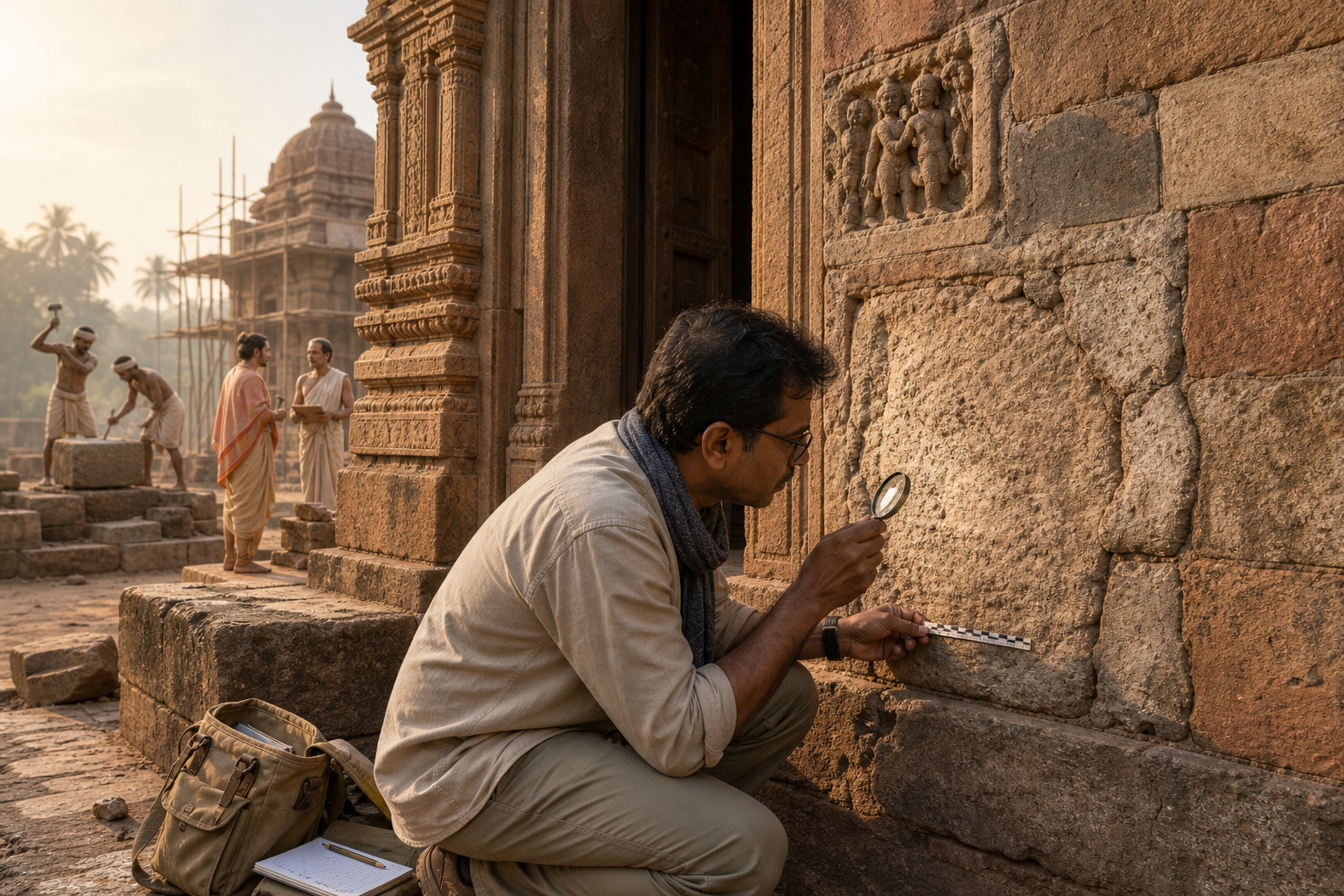
Stone and copper feel authoritative because they are physical, datable and difficult to alter after engraving. Yet durability is not neutrality. A Śāsana was produced by people for a purpose: a ruler or official commissioned it, a learned composer shaped its language, a writer prepared the text, and a Shilpi transferred it to the chosen material.
A temple-renovation record from Haruvanahalli, associated with the reign of the Hoysala monarch Vira Narasimha II, makes that chain unusually visible. Somanatha Pandita dictated the composition, the ambidextrous writer Srikarananda Vishwanatha wrote it down, and the Rāya sūtradhāri Suroja arranged its engraving. Such credits tell you that “authorship” may describe a production system rather than one individual.
That production chain clarifies provenance; it does not automatically verify every assertion. The patron may shape what deserves commemoration. The poet may magnify royal virtue. The administrative writer may preserve exact names, places or obligations. The engraver may introduce copying errors. Ask which participant was positioned to know each detail and which participant had an incentive to frame it favourably.
Genre matters just as much. The Arthaśāstra’s concern with clarity, exactitude, etiquette, eloquence and handwriting shows that official composition was treated as a disciplined craft. Later Śāsanas could combine prose and poetry. Literary elegance therefore does not make a record useless, but neither should ornate praise be read like a revenue register. A eulogy can be excellent evidence for political ideals and royal self-presentation even when its superlatives cannot be taken literally.
Chola records show why you should preserve these distinctions. Administrative procedures under Vira Rajendra I moved land-related information through revenue registers before engraving it on copper plates and stone. An extensive land survey under Kulothunga Chola I in 1086 was followed by a remission of customs duties, and the ruler became associated with the praise-name Sunkadavirta Chola. The survey and remission are administrative claims. The title reveals public or political memory. The further conclusion that the ruler embodied the Praja-Vatsala ideal is an interpretation that must be presented as such.
For any inscription, record five things in your notes: physical location, approximate date, commissioning authority, named makers and declared purpose. Then mark each sentence you extract as administrative information, genealogy, donation, praise, religious affirmation or literary convention. This prevents a fact that is strong in one category from being made to prove something in another.
Finally, account for survival bias. What rulers, temples and officials chose to engrave had a better chance of reaching us than ordinary speech, informal practice or perishable records. Silence in the epigraphic archive may limit your conclusion, but silence alone does not establish that a practice, community or institution did not exist.
Make every ideology obey the same burden of proof
No historian approaches the past without questions. A Marxist may look first for class, labour and material relations. A civilisational historian may foreground sacred continuity, institutions and cultural memory. Either starting point can uncover neglected evidence. Distortion begins when the framework decides the answer in advance, excludes contrary evidence or applies a harsher standard to rival interpretations than to its own.
Watch for four warning signs. The conclusion remains unchanged no matter what evidence appears. Moral labels replace a description of what happened. A local instance becomes a civilisation-wide rule. Or the historian treats absence as decisive only when it helps the preferred thesis.
The controversy around D.N. Jha is a useful stress test because critics accuse him of imposing Marxist categories on Gupta history, treating Hindu traditions with derision, and denying Bakhtiyar Khalji’s destruction of Nalanda. These are serious allegations, but their seriousness does not settle their accuracy. Each requires its own textual and evidentiary audit.
For Nalanda, locate Jha’s exact statement before repeating the accusation. Determine whether he disputes the event, the responsible actor, the scale of destruction, the burning, the chronology or a later embellishment. Those are different propositions. Compare the evidence relevant to the proposition he actually made. Refuting one narrow point does not automatically vindicate or invalidate his entire historical method.
For claims about beef or liquor in ancient India, build a chronology rather than collecting provocative quotations. A passage can establish that an idea or act was known to its author. It cannot by itself establish frequency, geographical spread, social acceptance or uninterrupted continuity. Distinguish descriptive accounts from ritual prescriptions, prohibitions, polemics and literary imagery. A rule may reveal an ideal precisely because actual behaviour differed from it.
For claims about “Brahmanical intolerance,” identify the event and participants before accepting the civilisational label. Evidence for a conflict involving particular Brahmins does not automatically describe every Brahmin, institution or century. The reverse error is equally serious: reverence for a tradition cannot erase a documented abuse committed by people acting within it. Scope must come from the evidence, not from the moral identity of the group under discussion.
For an interpretation of the Gupta period, require the proposed economic or political mechanism to be stated clearly. What evidence would support it? What finding would weaken it? If no imaginable evidence could change the conclusion, you are dealing with a closed ideology rather than a historical explanation.
Offensiveness is not an evidentiary category. A vulgar or derisive portrayal of Hindu deities may display poor judgment and deep disrespect, but you still need to demonstrate the mistranslation, missing context, chronological error or unsupported inference. The same rule applies in the other direction: love for Dharma can motivate preservation and recover neglected voices, but love alone cannot authenticate a date or prove an event.
Academic rank, institutional dominance and textbook adoption affect how widely an interpretation circulates; they do not make it true. Nor does exclusion from an institution make a contrary interpretation true. Authority can tell you which claim deserves examination. Only method and evidence can tell you what confidence it deserves.
Use this six-question audit before accepting a historical claim

Key takeaways
- What exactly is being claimed? Rewrite it with an actor, action, place, period and degree of certainty. Do not investigate a slogan.
- What is the strongest surviving evidence? Record its date, location, material form, language, provenance and present condition as far as they are known.
- Who produced it, for whom and why? Separate the patron, composer, scribe, engraver, intended audience and later interpreter whenever the evidence permits.
- What can the genre establish? Treat a tax record, royal eulogy, ritual prescription, polemic and literary image as different kinds of testimony.
- What rival explanation fits the same facts? Try to state the strongest alternative without caricature, then identify evidence that would distinguish between the two readings.
- How wide may the conclusion travel? Label it established, probable, plausible or unsupported, and confine it to the communities, regions and periods actually represented.
Apply the audit to a familiar example. “The Uttaramerur inscription proves that medieval Bharat was democratic” reaches too far. The record strongly supports a structured form of local self-governance at a particular place in the 10th century. It does not, without further evidence, establish modern democracy, identical institutions across Bharat or continuity through every later period. The corrected conclusion is narrower, but it is also much harder to dismiss.
Use calibrated language when the record is incomplete. “Establishes” should be reserved for a conclusion directly supported by strong evidence. “Supports” allows a reasoned inference. “Is consistent with” means the evidence fits but does not distinguish that explanation from rivals. “Does not establish” is often more accurate than “disproves.” These verbal distinctions keep uncertainty visible instead of letting rhetoric conceal it.
If you care about correcting anti-Hindu distortion, this discipline is an ally. It prevents a valid correction from being weakened by exaggeration, and it makes selective burdens of proof easy to expose. It also honours the inscription-makers themselves: not by turning their work into ammunition, but by reading it with enough care to recover who made it, what it was meant to do and what it can still tell us.
The next time a historical claim provokes an immediate reaction, put three lines on a page before sharing it: the exact claim, the strongest evidence, and the narrowest conclusion that follows. The distance between the second and third lines is where interpretation belongs. If the conclusion outruns that distance, ideology has taken control.
References
- DharmaRenaissance Blog — Discover the Secret Legacy of India’s Inscription Masters: A Complete Guide to Śāsanas.
- DharmaRenaissance Blog — The Complete Exposé: Discover How D.N. Jha’s Narratives Distort Indian History and Faith.
