
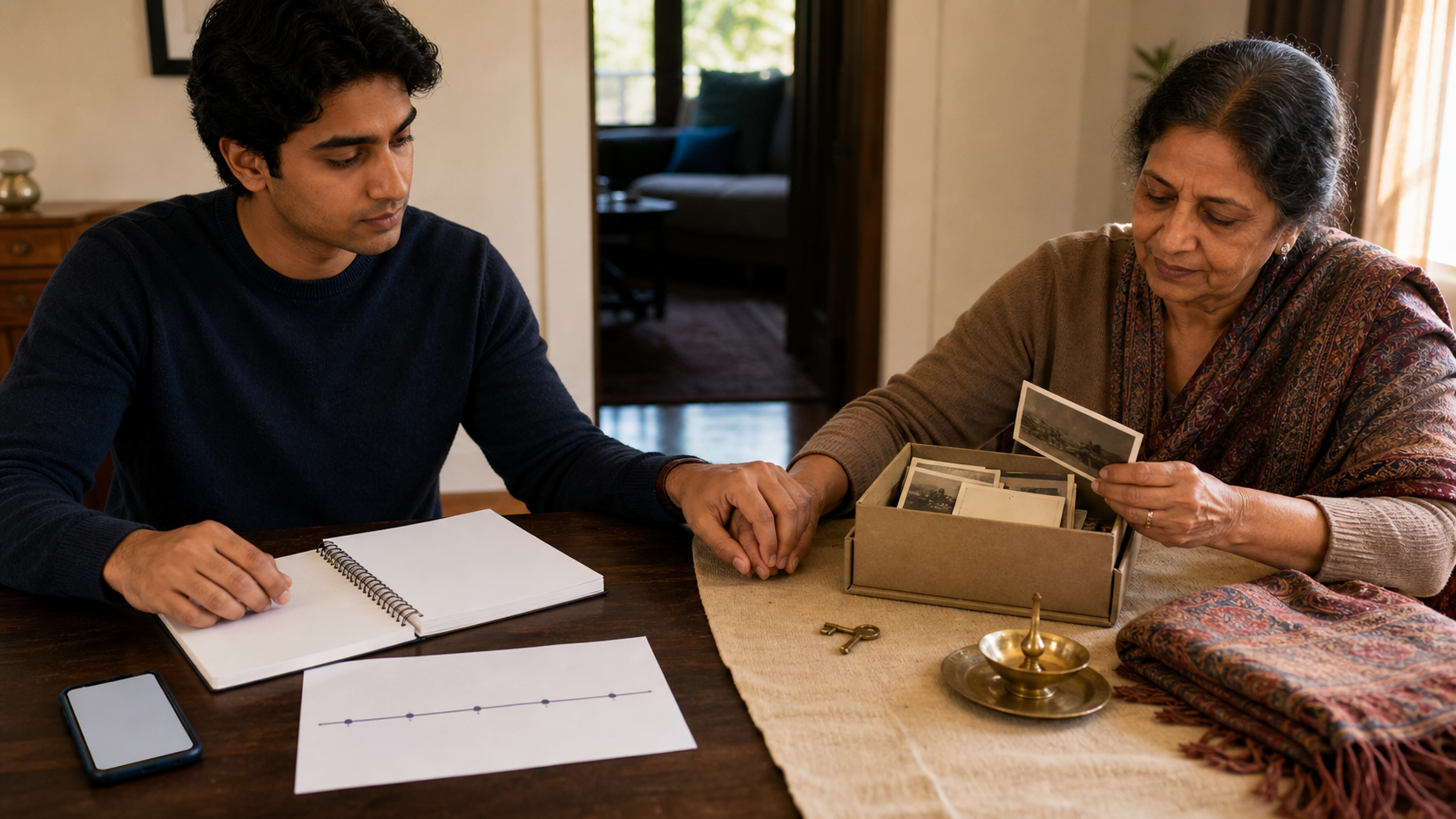
If you are deciding whether a remark was anti-Hindu, anti-Indian, racial, religious, caste-based, or simply careless, you do not need one label to carry every burden. And if your family also carries the memory of displacement from Kashmir, that inherited loss does not have to become a present-day grievance before it deserves protection.
The useful response is to build two records: one for discrimination happening now and another for Hindu memory carried across generations. You can connect them when the evidence supports that connection, but keeping them distinct will make both more credible, more durable, and easier to act on.
Do not make one label carry three different harms
A biased incident, an institutional pattern, and a community’s displaced memory can affect the same person. They still require different kinds of proof and different remedies.
- A present incident has a setting, an actor, identifiable conduct, and an immediate effect. A slur at work, religious stereotyping in class, or unequal treatment by a campus organization belongs in an incident record.
- An institutional pattern appears when similar conduct recurs, complaints receive inconsistent treatment, or rules are applied differently. A pattern requires a chronology and comparable examples, not merely a stronger adjective.
- Displaced memory preserves what happened to a family or community before you were in a position to document it yourself. It rests on testimony, objects, places, practices, language, and carefully marked historical claims.
This separation matters because each record answers a different question. The incident record asks, What happened here? The pattern record asks, How did the institution behave across cases? The memory record asks, What must not disappear when witnesses, homes, and languages are lost?
Displaced memory can explain why a present dismissal feels especially consequential, but it does not by itself prove that discrimination occurred. The reverse is also true: the absence of a current actionable incident does not erase a community’s history. You protect accuracy by refusing to use either claim as a substitute for the other.
Let the discrimination numbers set priorities, not limits
In 2025, 49% of Indian Americans reported discrimination during the previous year. Skin color was the most frequently reported basis at 31%, followed by country of origin at 20%, religion at 19%, gender at 15%, and caste at 7%. These categories should not be added together as though they represent separate groups; a person’s experience can involve more than one perceived basis.
The broad level had barely moved from 2021, when 50% reported some form of social discrimination. Skin color then stood at 30%, religion and gender at 18% each, country of origin at 16%, and caste at 5%. The persistence is more important than a one- or two-point fluctuation: roughly half of the community continued to report some form of discrimination.
That distribution should change how you listen. If every Indian American complaint is routed immediately into a caste framework, the more frequently reported problems of color, origin, and religion can disappear from view. If caste is dismissed because its reported prevalence is lower, a real complaint can disappear for the opposite reason. Seven percent is neither the master explanation for Indian American life nor permission to ignore a person describing specific conduct.
There is also a classification problem. In 2021, roughly one-third of respondents reporting caste discrimination attributed it to people of non-Indian origin. Because caste usually is not visually identifiable, an intake process should ask what made caste relevant: Was it disclosed, assumed, referenced through a slur, tied to an association, or inferred afterward? Asking that question does not deny the harm. It prevents a category from being assigned more confidently than the facts allow.
Population percentages cannot decide whether an individual complaint is true. They can tell an institution what it has been undercounting, where its forms need better options, and why a single ideological explanation is inadequate. Use the numbers to improve the questions, not to prejudge the person answering them.
Document the conduct before debating its label
When something happens at work, on campus, or online, begin with observable conduct. Labels are interpretations; your contemporaneous record is the material another person can assess.
- Fix the time and place. Record the date, approximate time, location or platform, and the event or meeting in which it occurred.
- Preserve the words accurately. Use quotation marks only when you are confident of the wording. Mark everything else as a paraphrase.
- Name the participants and witnesses. Distinguish people who heard or saw the conduct from people you told afterward.
- Keep original material. Preserve the original email, message, recording, screenshot, assignment, or event notice. Do not crop away context in the master copy.
- Describe the response. Record what you said or did, whom you notified, and how the recipient answered. Silence, correction, escalation, and retaliation are different events.
- Separate evidence from interpretation. Write the conduct first, then explain why you understood it as relating to Hindu identity, Indian origin, skin color, gender, caste, or another basis.
- State the remedy you want. Ask for a preserved record, correction, policy review, investigation, protection from retaliation, or written response. A complaint without an identifiable request is easier to acknowledge without resolving.
If an incident may involve several forms of bias, you do not have to choose one forever. Identify the basis most directly supported by the conduct, then note plausible additional bases. For example, hostility toward an Indian accent is not automatically evidence of anti-Hindu bias, while mockery of Hindu worship should not be reduced to generic national-origin friction. Precision makes the overlap visible without pretending the categories are interchangeable.
California’s SB 403 did not become law after Governor Gavin Newsom concluded that caste-related incidents could be handled through existing protected categories. That policy judgment does not determine whether any particular workplace or campus claim will succeed, and it does not eliminate procedural deadlines. If employment, education, housing, immigration status, or possible retaliation is at stake, preserve the evidence and obtain advice from a qualified civil-rights or employment lawyer in the relevant jurisdiction rather than relying on a general account of the legislation.
Support for addressing caste discrimination also does not settle the design of a stand-alone law. Before taking a position, ask three concrete questions:
- Which documented conduct is not already reachable through religion, ancestry, ethnicity, national origin, race, or another existing category?
- What definition would cover an actual gap without presuming that every person of Indian origin holds or can be assigned a caste identity?
- Would the proposed rule recognize discrimination flowing in more than one direction, including hostility toward Brahmins or another named community?
Those questions are not a reason for inaction. They are how concern becomes a rule that can be applied consistently.
Build a Hindu memory archive that can survive distance
For Kashmiri Hindus displaced in 1990, the loss was not limited to movement from one address to another. It involved homeland, neighborhood, language, worship, property, and the ordinary continuity through which a child learns who the family is. A descendant born in the United States may struggle with the ancestral language or never see Kashmir while still inheriting a real relationship to it.
The details tell you what a serious archive must hold. Memories shared at a UC Berkeley forum included the rise of militancy before the exodus, neighborhoods becoming unsafe, a 250-year-old family home that was later looted and burned, and the difficulty of preserving identity in diaspora. The cultural record reached beyond the rupture to Sharada Peeth, Kashmiri Shaivism, the dejhor worn by married Kashmiri Hindu women, and the punn legend of a golden thread restored after it was broken.
Do not archive only the moment of departure. If trauma is the entire record, descendants inherit an account of what was done to the community but little knowledge of the world the community created. Preserve the ordinary life before displacement as carefully as the violence that ended it.
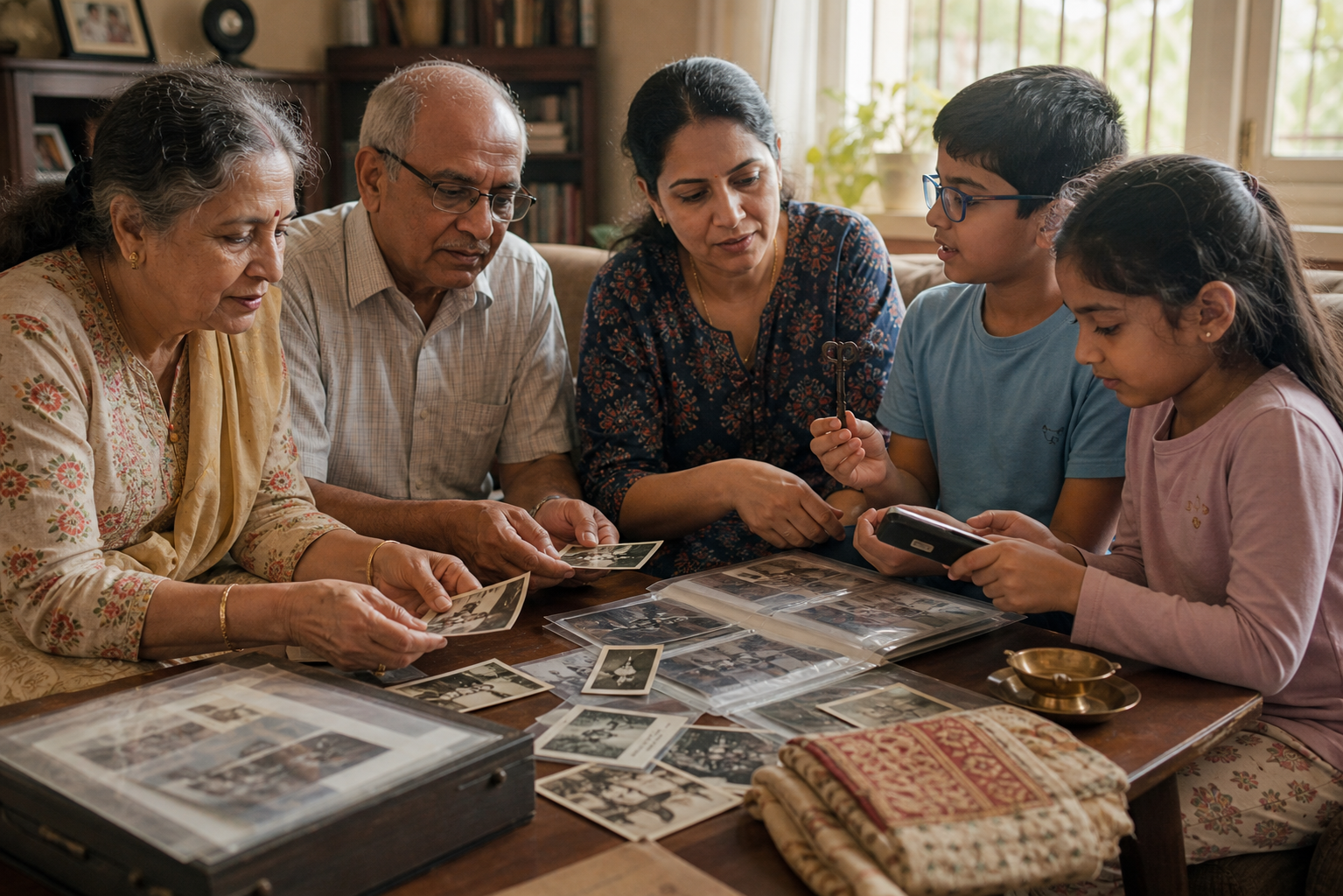
- Obtain consent before recording. Agree on whether the conversation is private, family-only, available to researchers, or suitable for public release. Record that permission with the interview.
- Attach provenance. Include the narrator’s name, relationship to the family, interview date, language, location, and the name of the person making the recording.
- Separate kinds of knowledge. Mark what the narrator witnessed, what another person told them, what the family later learned, and what remains uncertain. Do not smooth these layers into one voice.
- Ask about place before politics. Record the neighborhood, home, school, temple, route, seasonal practice, household vocabulary, and relationships that made the place recognizable. If an address or date is uncertain, preserve the uncertainty.
- Preserve cultural grammar. Ask what terms such as Sharada Peeth, Kashmiri Shaivism, dejhor, or punn meant inside family life. A dictionary definition cannot replace remembered use.
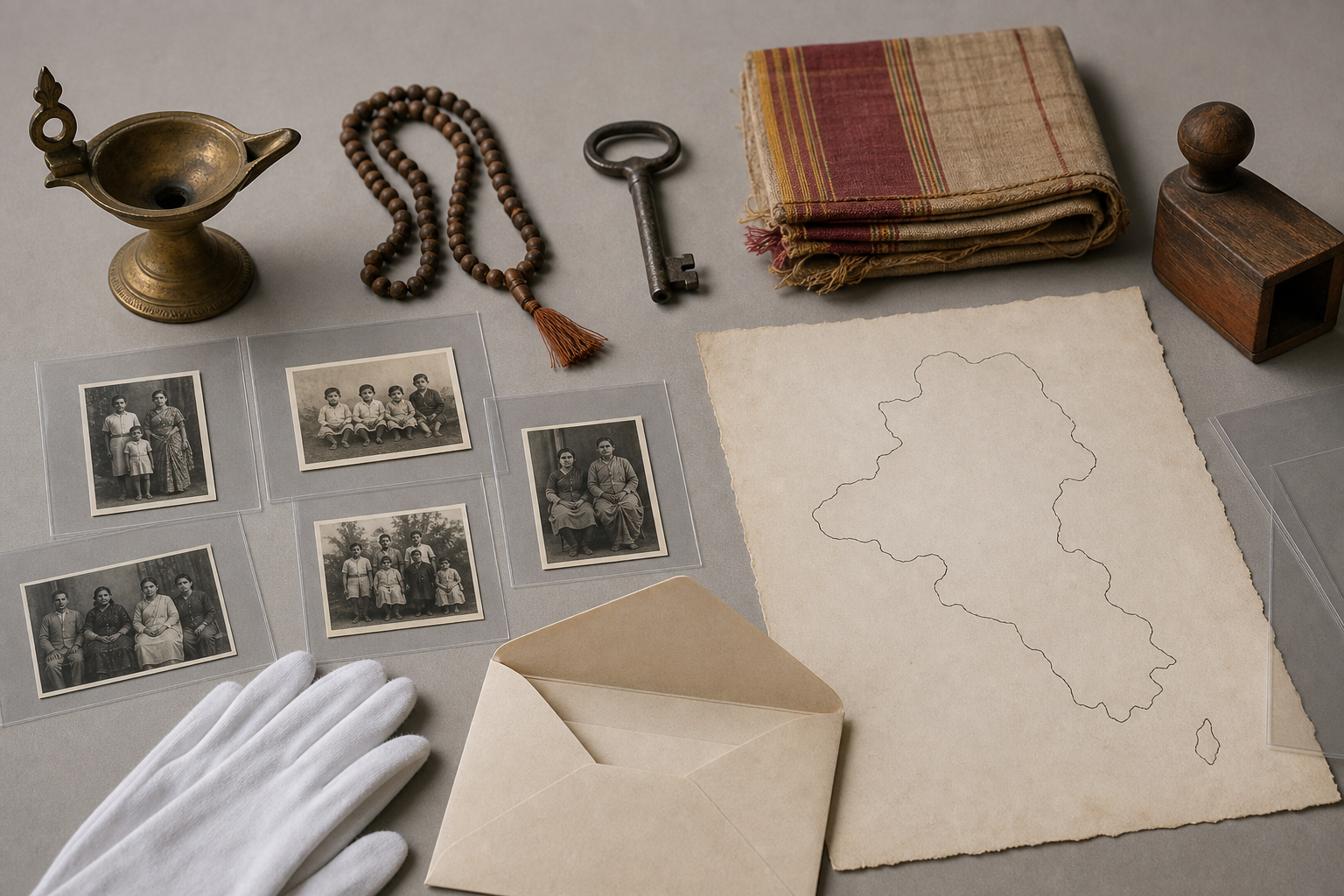
- Describe objects on both sides. Photograph what survived and document what was abandoned, destroyed, looted, or could not be recovered. Record who identified each object and why it mattered.
- Keep an unedited master. Save the original audio, image, or scan separately from cleaned copies and excerpts. Use consistent filenames, retain transcripts, and keep backups in more than one secure location.
- Protect living people. Before public release, review addresses, property information, family disputes, and names that could expose someone to harassment or unwanted legal attention.
Contested historical terms need the same care. If a narrator describes the exodus as genocide or ethnic cleansing, preserve that language as their stated understanding. Do not silently turn an attributed description into a universally accepted classification, and do not delete it merely because others contest it. Accurate attribution lets the testimony remain intact while keeping the archive intellectually honest.
If you are Hindu but not Kashmiri, your role is stewardship without appropriation. Invite Kashmiri Hindu testimony, retain the speaker’s name and context, support preservation work, and resist replacing first-person memory with a generic statement made on the community’s behalf. Kashmir’s Hindu heritage can matter to the wider Hindu world while Kashmiri voices remain primary in telling what happened to their families.
Ask each institution for one answerable remedy
A workplace, university, community organization, and family archive do not have the same authority. Your request becomes harder to evade when it matches what the recipient can actually do.
| Situation | Record to present | Answerable request |
|---|---|---|
| Present bias incident | Dated conduct, exact or clearly paraphrased words, witnesses, original files, and reported effect | Preserve evidence, apply the stated policy, protect against retaliation, and provide a written outcome |
| Repeated institutional pattern | Chronology, comparable cases, prior reports, responses, and differences in treatment | Review the pattern, identify an accountable decision-maker, and explain corrective action |
| Exclusion of Kashmiri Hindu displacement | Program or curriculum scope, the omitted perspective, and suitable first-person testimony | Add a speaker, testimony, archive, reading, or recorded session and disclose the inclusion criteria |
| Family memory preservation | Consented testimony, provenance, artifact descriptions, access limits, and unresolved questions | Accept the material under clear privacy, ownership, correction, and future-access rules |
For a current incident, a concise opening can be: On [date], during [setting], [person] said or did [conduct]. I understood this as relating to [basis] because [specific connection]. The following people witnessed it, and I have preserved [material]. I am requesting [remedy]. Use only facts you can stand behind, and distinguish exact wording from paraphrase.
For historical exclusion, try: Your program addresses Kashmir but does not include Kashmiri Hindu displacement or first-person Kashmiri Hindu testimony. Will you add that perspective and explain the criteria used to select speakers and materials? This gives the institution a defined omission and a practical correction. It is stronger than demanding agreement with every political conclusion.
Do not ask a human-resources office to adjudicate the whole history of Kashmir. Do not ask a family archive to prove a workplace claim. Do not ask one survey category to explain every Indian American experience. Give each record the job it can actually perform.
Key takeaways
- Keep a current discrimination record separate from a displaced-memory archive, even when the two affect the same person.
- In 2025, skin color, country of origin, and religion were reported more frequently than caste among Indian Americans; that ordering should broaden institutional attention without dismissing specific caste complaints.
- Document conduct before assigning a category. Preserve exact words, context, witnesses, original files, your interpretation, and the remedy requested.
- Archive the life that existed before displacement, not only the rupture. Place, language, ritual, objects, and family relationships are part of the evidence.
- Mark the difference between witnessed events, inherited accounts, later findings, and contested interpretations.
- Match the request to the institution: an investigation for an incident, a pattern review for repeated treatment, inclusion for historical omission, and clear access rules for an archive.
This week, create two folders. Put a blank incident-record template in one. In the other, place a consent note, one recorded family memory, and the description of one place, practice, or object tied to the family’s Hindu life. You are not manufacturing a grievance by preparing the first or turning memory into a museum piece by beginning the second. You are making sure that a claim can survive scrutiny and that a displaced inheritance can survive distance.

References
- DharmaRenaissance Blog – Discover the Essential Questions Carnegie Missed on Caste Bias and Proven Ways Forward
- DharmaRenaissance Blog – Discover Resilience: UC Berkeley’s Breakthrough Forum on Kashmiri Hindus’ Displacement
