

If you came here wondering whether Bhakti Madhava Puri Maharaja’s scientific credentials make bhakti scientifically proven, the honest answer is no. A doctorate cannot certify a theology. His life offers a more durable lesson: disciplined reason and disciplined devotion need not be enemies.
What should you take from his legacy? Respect evidence without pretending that all truth is laboratory data. Accept spiritual discipline without using faith as a shield against difficult questions. That standard is more demanding, and more useful, than turning a scientist-saint into an apologetic slogan.
His chronology matters more than a dramatic conversion story

The biographical core is short and precise. Known as Michael Marchetti, he earned a PhD in Theoretical Chemistry from Georgetown University in Washington, DC, in 1970. Two years later, he received harinama diksa from Srila A. C. Bhaktivedanta Swami Prabhupada, who gave him the devotional name Madhava dasa.
The order matters. His formal entrance into the Gaudiya Vaishnava lineage followed advanced scientific training. Bhakti was not a refuge from never having encountered rigorous thought. At the same time, his degree should not be used as borrowed authority for every religious proposition someone wishes to defend.
Three points can be carried forward with confidence:
- Scientific training preceded his harinama diksa; reason and devotion therefore belonged to one biographical path rather than two imaginary, mutually exclusive lives.
- His spiritual commitment was received within a living relationship of guru, disciple, mantra and discipline. It was not merely a private interest in religious ideas.
- The name Madhava dasa marked an orientation toward service. The transition concerned how knowledge and life were directed, not simply which opinions he held.
Notice what these facts do not establish. They do not disclose every motive behind his initiation, document a sudden rejection of science or identify a scientific discovery that proves Gaudiya Vaishnava theology. Unless further primary material is available, do not embellish his inner life, technical work or reasons for particular decisions. Honest reverence stops where the evidence stops.
The real bridge is disciplined inquiry, not borrowed proof

Science and bhakti impose different forms of accountability. Scientific work asks whether an explanation fits observable evidence, survives criticism and performs better than alternatives within its field. Bhakti asks whether the practitioner can order knowledge, desire and action toward Bhagavan through teaching, mantra, remembrance and service. Those forms of accountability can shape the same person, but they are not interchangeable tests.
The meaningful bridge is discipline. Scientific inquiry requires attention, patience, intellectual honesty and a willingness to correct a preferred explanation. Serious bhakti also requires sustained attention, humility before instruction, self-correction and constancy in practice. One discipline need not pretend to be the other before they can share those virtues.
Keep these distinctions in view when discussing Bhakti Madhava Puri Maharaja:
- Expertise is not universal authority. A doctorate demonstrates advanced training in a defined field. It does not automatically make every philosophical or theological statement a scientific conclusion.
- Compatibility is not experimental proof. His life shows that scientific formation and committed bhakti can coexist. A biography, however admirable, is not a laboratory result.
- Surrender is not credulity. Receiving diksa means accepting guidance and discipline. It does not require careless reasoning or the repetition of claims that cannot be supported.
- Questioning is not hostility. Asking what a claim means, which kind of evidence bears on it and where its limits lie can protect both scientific integrity and spiritual seriousness.
These distinctions protect his memory from opposite distortions. One distortion rejects devotion because scientific methods alone cannot adjudicate every metaphysical question. The other uses a scientist’s credential as a substitute for philosophical argument, scriptural reasoning or spiritual practice. Neither does justice to the man being remembered.
A responsible formulation is simpler: Bhakti Madhava Puri Maharaja was scientifically trained and spiritually committed. His biography challenges the assumption that rigorous education automatically excludes devotion. It does not end every dispute between natural science and metaphysics, and it should not be made to carry that burden.
Turn admiration into a disciplined way of learning
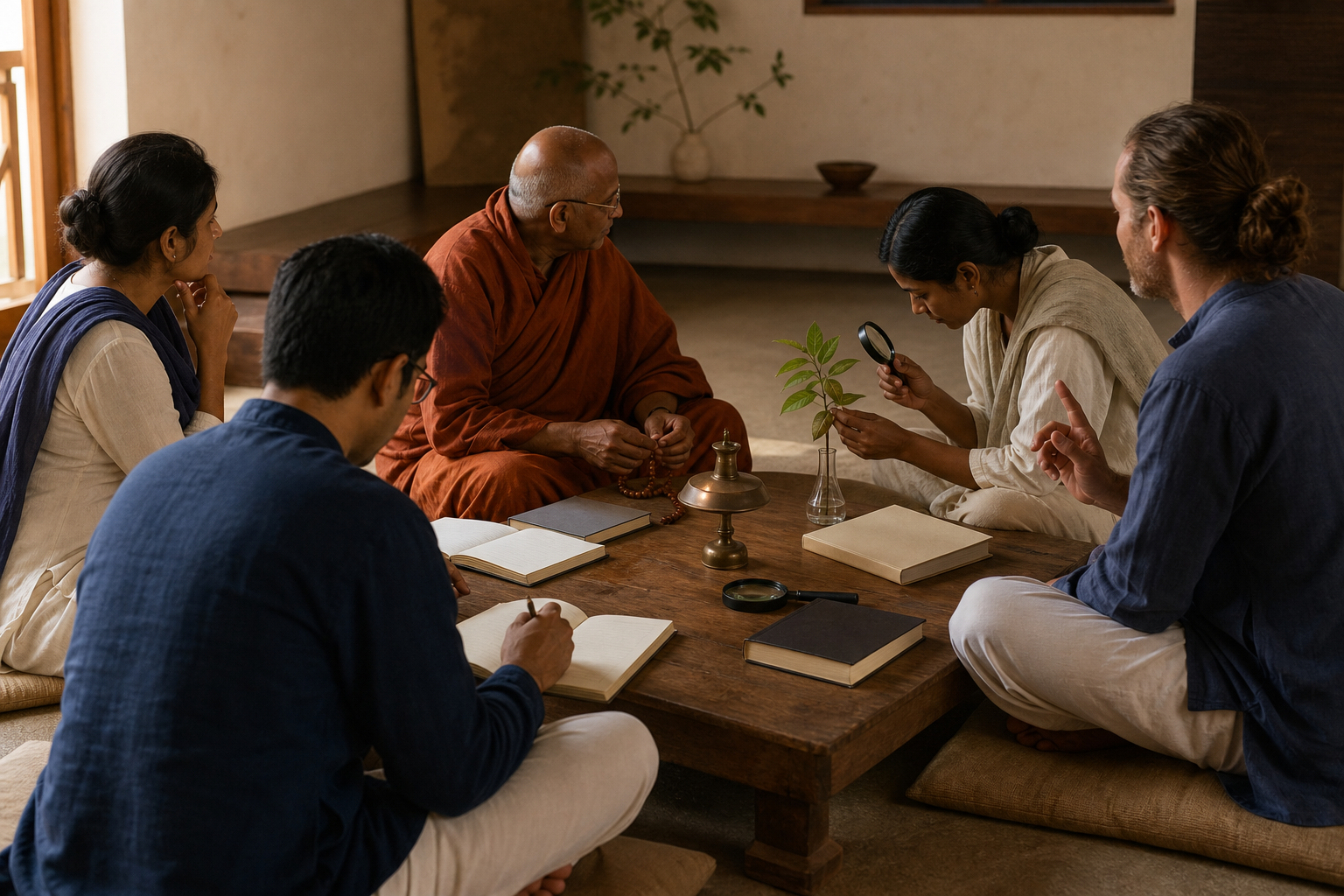
If you are working through science-and-spirituality questions
Do not begin by asking which side wins. Begin by identifying the claim in front of you. For each claim, write down:
- the exact proposition being asserted, without devotional or scientific decoration;
- whether it is empirical, historical, philosophical, theological or experiential;
- which kind of evidence could properly support or challenge it;
- what remains an inference, a commitment or an unresolved question.
This simple separation prevents common category errors. A statement about chemical behavior calls for scientific evidence. A statement about when someone received diksa calls for historical evidence. A claim about the nature of ultimate reality requires philosophical and theological reasoning. A testimony about devotional transformation may be meaningful evidence about a person’s experience without becoming a universal laboratory demonstration.
Apply the same rigor inwardly. Ask whether your study is making you more honest about uncertainty, more receptive to correction and steadier in service. Intellectual sophistication can become another form of ahankara when it is used to dominate a discussion. Devotional vocabulary can do the same when it is used to avoid scrutiny. Bhakti Madhava Puri Maharaja’s path is valuable precisely because it calls both habits into question.
If you are teaching or commemorating his life
You can preserve the legacy without inflating it. Use a clear standard:
- State the verified chronology: Michael Marchetti, PhD in Theoretical Chemistry from Georgetown University in 1970, followed two years later by harinama diksa from Srila Prabhupada and the name Madhava dasa.
- Explain what diksa means in context. It places the disciple within a relationship of instruction, practice and service; it is more substantial than general admiration for Indian spirituality.
- Label interpretation as interpretation. Say that his life illustrates the compatibility of disciplined inquiry and devotion, not that his degree scientifically proves bhakti.
- Do not attribute unspecified discoveries, experiments, publications or theories to him. A tribute becomes less trustworthy, not more impressive, when missing details are filled with assumptions.
- Invite the audience to ask what intellectual honesty and spiritual humility would require in its own life. That question carries his example beyond biography.
Readers from Hindu, Buddhist, Jain and Sikh backgrounds can recognize a wider Dharmic vocabulary here: inquiry, self-discipline, compassion and service. Shared virtues make serious dialogue possible, but they do not make every tradition doctrinally identical. Bhakti Madhava Puri Maharaja should remain situated specifically within Gaudiya Vaishnava bhakti and the disciplic relationship he accepted from Srila Prabhupada.
Key takeaways
- Bhakti Madhava Puri Maharaja, known as Michael Marchetti, completed a PhD in Theoretical Chemistry at Georgetown University in 1970.
- Two years later, Srila A. C. Bhaktivedanta Swami Prabhupada gave him harinama diksa and the devotional name Madhava dasa.
- His life demonstrates that advanced scientific formation and serious bhakti can inhabit the same person; it does not turn theology into an experimental result.
- The strongest way to honor him is to preserve exact facts, distinguish evidence from inference and refuse to use credentials as a substitute for argument.
- You can apply his example by asking precise questions, accepting correction and directing knowledge toward disciplined practice and service.
The next time you speak or write about Bhakti Madhava Puri Maharaja, begin with the verified chronology and identify clearly where interpretation begins. Then bring that same honesty into your own practice: ask difficult questions, accept the discipline appropriate to the question and let knowledge issue in service. That is how a legacy becomes a living standard rather than a slogan.
References
