
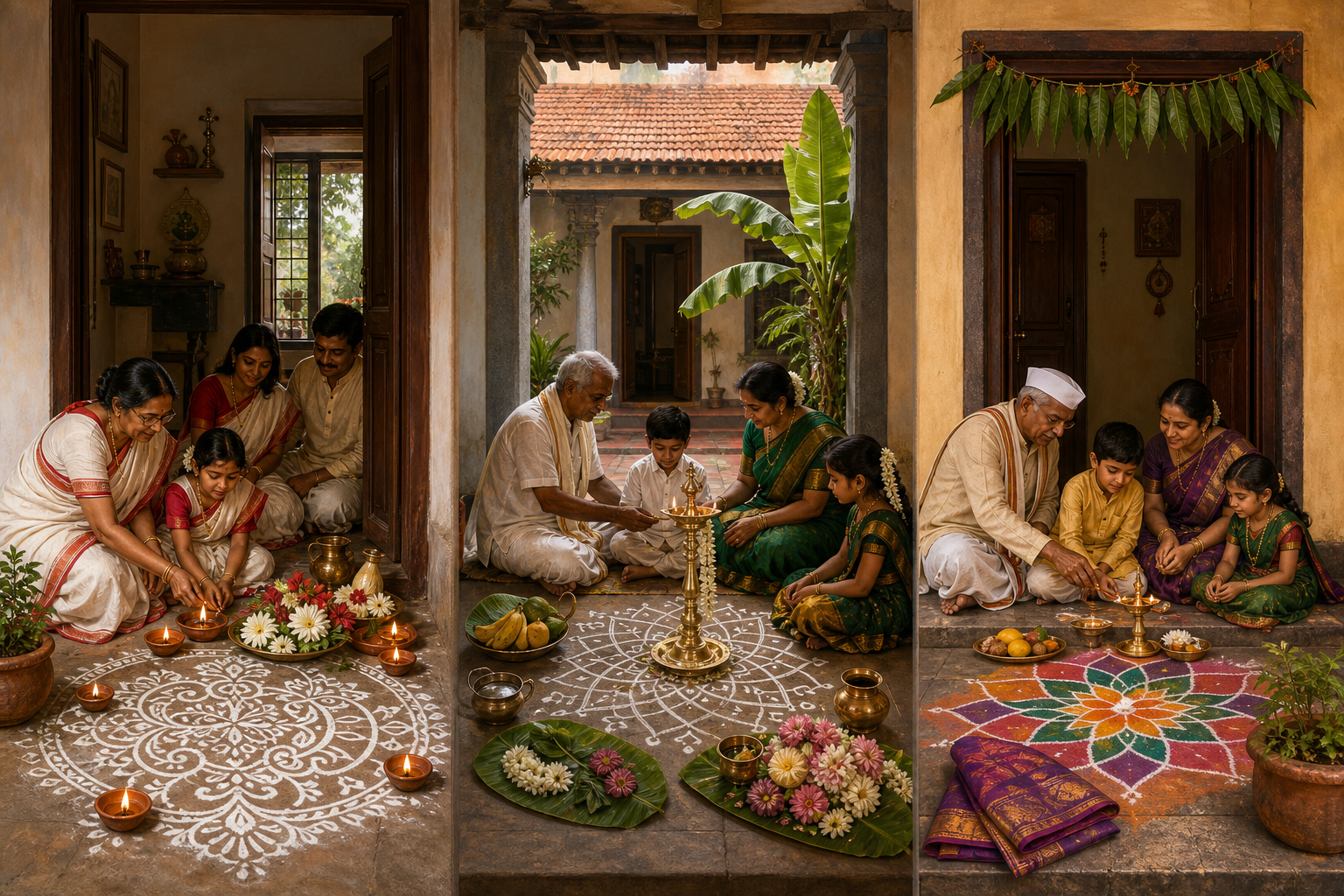
You want to observe a Hindu festival properly, but your family elder, community temple, and phone calendar give you different instructions. The disagreement may concern the date, the closing time of a vrat, the order of the puja, or even which story and public celebration belong at the centre.
You do not need to manufacture one supposedly pan-Indian version. You need to identify the festival’s dharmic centre, preserve the tradition that actually formed your family or community, and calculate time for the place where you are standing. That distinction lets you adapt without quietly replacing an inherited observance.
Separate the dharmic centre from the regional form
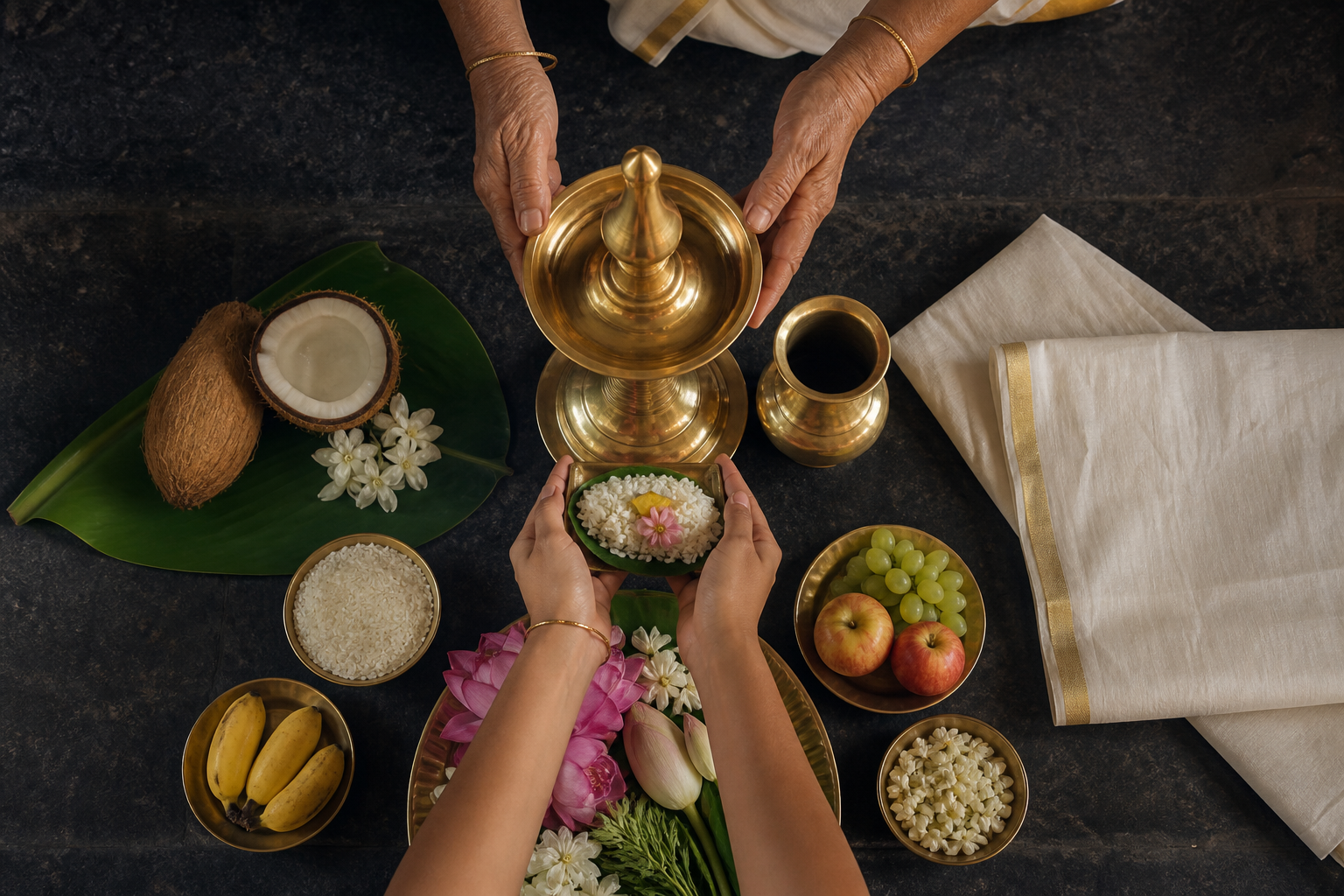
Regional difference is not evidence that one community has misunderstood the festival. Hindu traditions often carry a common principle through different narratives, arts, foods, vows, and public rites.
Vijaya Dashami offers a clear example. Its shared centre is the victory of dharma over adharma at the culmination of Navaratri. North Indian communities may embody that teaching through Ramlila and the burning of Ravana effigies. In Bengal, Durga Puja reaches its culmination through Vijaya Dashami and visarjan. Mysuru marks Dasara with processions and public illuminations; Tamil households arrange Golu displays; Kerala gives special prominence to Vidyarambham; Gujarat gathers for Garba and Dandiya; and Kullu convenes deities from its surrounding valleys. These are not interchangeable decorations around a single standardized ceremony. Each is a tradition-bearing way of teaching, remembering, and participating.
When you plan an observance, write down three separate things:
- The dharmic centre: the virtue, deity, vow, or sacred event being honoured.
- The inherited form: the regional, family, temple, or sampradaya practice through which you received it.
- The local determination: the calendar, tithi, moonrise, venue, and conditions that apply where you will perform it.
This prevents a timing question from turning into a theological dispute. It also prevents a visually prominent custom from another region from displacing the quieter practice your own household is responsible for carrying forward.
Karva Chauth makes the distinction especially practical. Its familiar observance includes sargi before dawn, a day-long vrat, preparation of the puja thali, the evening katha, Chandra Darshan, and arghya to the Moon. The devotional sequence can remain recognizable across continents, while the moment of Chandra Darshan must be determined locally.
When calendars disagree, choose one authority for one observance
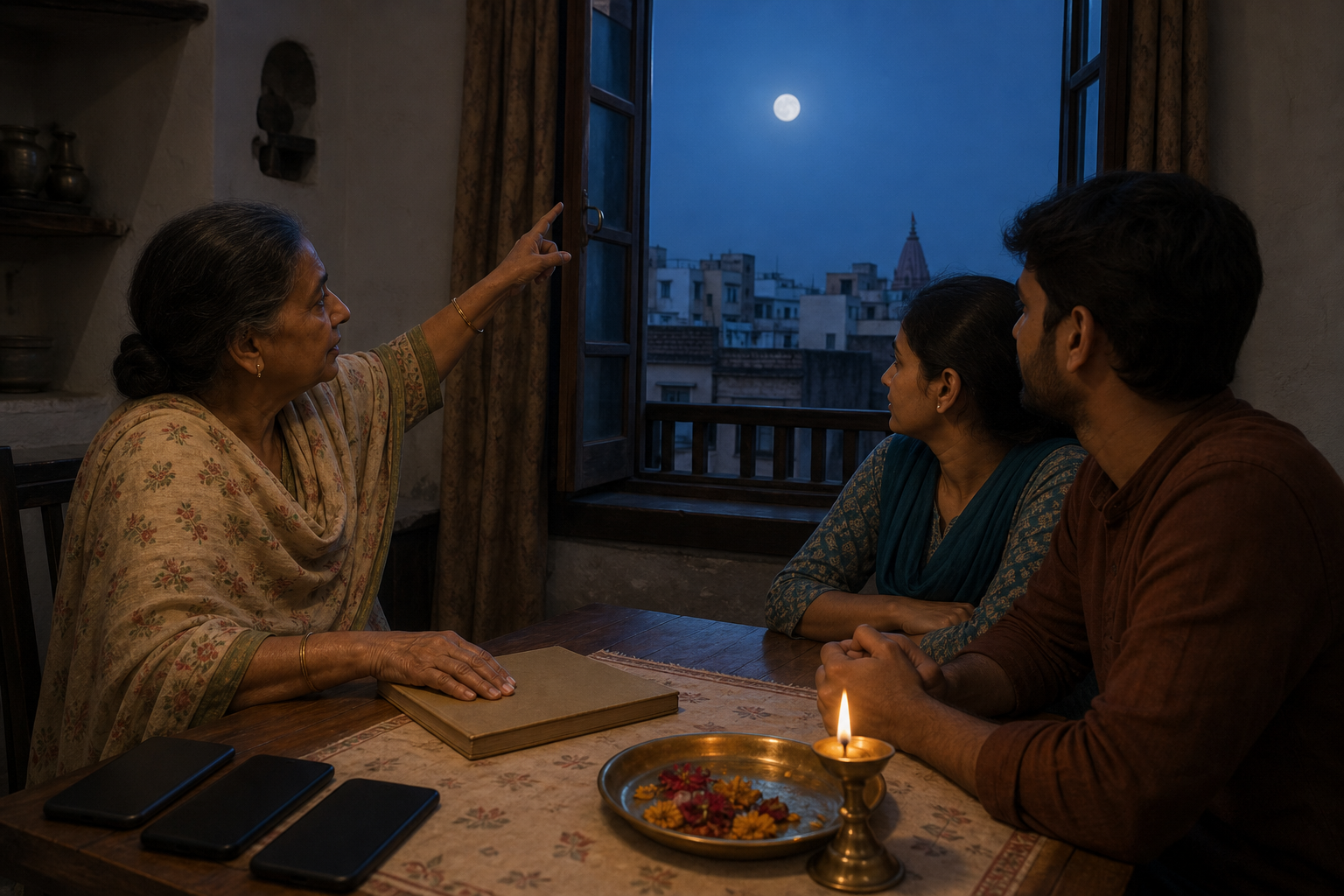
Do not average two conflicting times, splice together unrelated ritual sequences, or keep changing calendars until you find the answer you prefer. A coherent decision made before the observance is more useful than a last-minute attempt to satisfy every notification.
The following is a practical conflict-resolution order, not a universal ruling for every lineage. If your sampradaya, guru, or temple has a defined method, that method takes precedence within its own practice.
- Name the observance precisely. Do not treat Navaratri, Durga Puja, Dussehra, and Vijaya Dashami as though every household uses the names for an identical sequence.
- Decide where the ritual authority sits. For a temple programme, use the temple’s schedule and method. For an inherited home vrata, begin with the household tradition and the elder or priest who actually knows it.
- Use a panchang calculated for your location. A national or India-based calendar may help you identify the festival, but it cannot supply a reliable local moonrise for a family living abroad.
- Keep timing and ritual method distinct. A local panchang can settle a local astronomical time without rewriting your family’s katha, offerings, language, or order of worship.
- Record the decision. Note the panchang or temple used, the location, the key time, and the sequence followed. Next year, the family will have a precedent instead of reopening the entire dispute.
The location rule matters even when relatives are observing on the same civil date. On Friday, 10 October 2025, for example, Karva Chauth moonrise across Indian cities was expected within a broad 7:41 p.m. to 8:27 p.m. window. Observers in Canada, the United States, the United Kingdom, and Europe needed their own local moonrise because time zone and latitude change the relevant moment. If you live in Toronto, London, or New York, a Delhi moonrise should not end your local Chandra Darshan observance.
Cloud cover creates a different problem: the calculated time arrives, but the Moon cannot be seen. Many households handle this by following the local almanac’s scheduled moonrise when the sky is overcast. Establish your household’s contingency with a trusted temple, priest, or elder before the evening. Do not wait until everyone is tired and hungry to debate it.
Ritual discipline should not become medical bravado. If fasting may be unsafe for you because of a health condition, pregnancy, or a medication schedule, ask a qualified clinician about the medical risk before undertaking it. Then ask a trusted religious elder how your tradition accommodates a modified observance, prayer, or seva. Medical safety and spiritual sincerity are not questions that an undifferentiated online timetable can settle for you.
Build the day around transitions, not a loose checklist
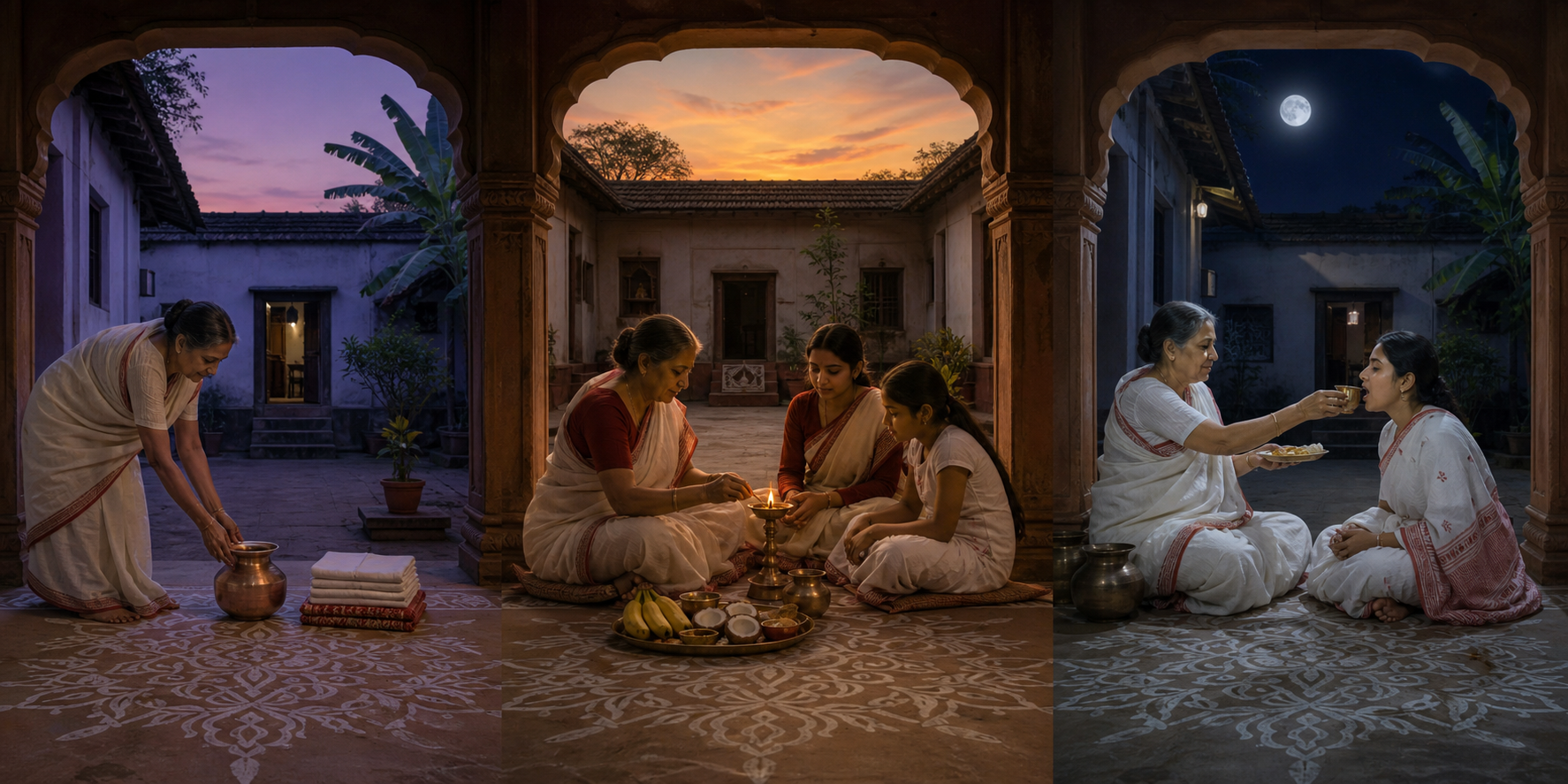
A festival plan works when everyone knows what changes from one stage of the day to the next. A shopping list alone will not tell a child why the family has gathered, tell a spouse when a fast concludes, or tell a volunteer which act must happen before a procession begins.
Prepare a one-page observance sheet with six lines:
- Place: the city and the home, temple, hall, or public ground where the observance will occur.
- Authority: the family elder, temple, priest, sampradaya calendar, or local panchang whose method you are following.
- Anchor: the tithi, dawn, moonrise, temple schedule, or other transition that governs the rite.
- Sequence: the acts that must occur, in their proper order.
- Roles: who prepares, recites, teaches, offers, hosts, accompanies children, and handles cleanup.
- Contingency: what you will do if the Moon is obscured, the venue changes, or a public programme runs late.
For Karva Chauth, the sequence is concrete: sargi belongs before dawn; the vrat occupies the day; the puja thali and katha belong to the evening; Chandra Darshan and arghya precede the formal conclusion; and water and the first morsel of food are traditionally received from a spouse or elder. Writing those transitions down prevents the most common practical confusion: treating the published moonrise as though it were the entire puja rather than the anchor for its concluding acts.
For Dussehra, begin by selecting the regional focal practice you are actually keeping:
- If your tradition centres on Ramlila, plan around the performance, its ethical teaching, and the concluding symbolism associated with Ravana.
- If your community keeps Durga Puja, protect the movement from pandal worship toward Vijaya Dashami and responsible visarjan.
- If your Tamil household arranges Golu, decide who will explain the mythic and social tableaux to younger visitors rather than treating the display as seasonal decor.
- If your Kerala tradition gives prominence to Vidyarambham, organize the child’s ceremonial beginning of learning as the central act, not as a brief photo opportunity.
- If Garba or Dandiya is your community’s Navaratri expression, make the gathering hospitable and disciplined while retaining its devotional centre.
- If you join a practice from another region, participate respectfully and learn its meaning. You do not have to claim it as your ancestral household rite in order to honour it.
This approach leaves room for cultural exchange without producing a festival assembled from whichever customs look most impressive on a screen.
Transmit the reason, the role, and the regional name
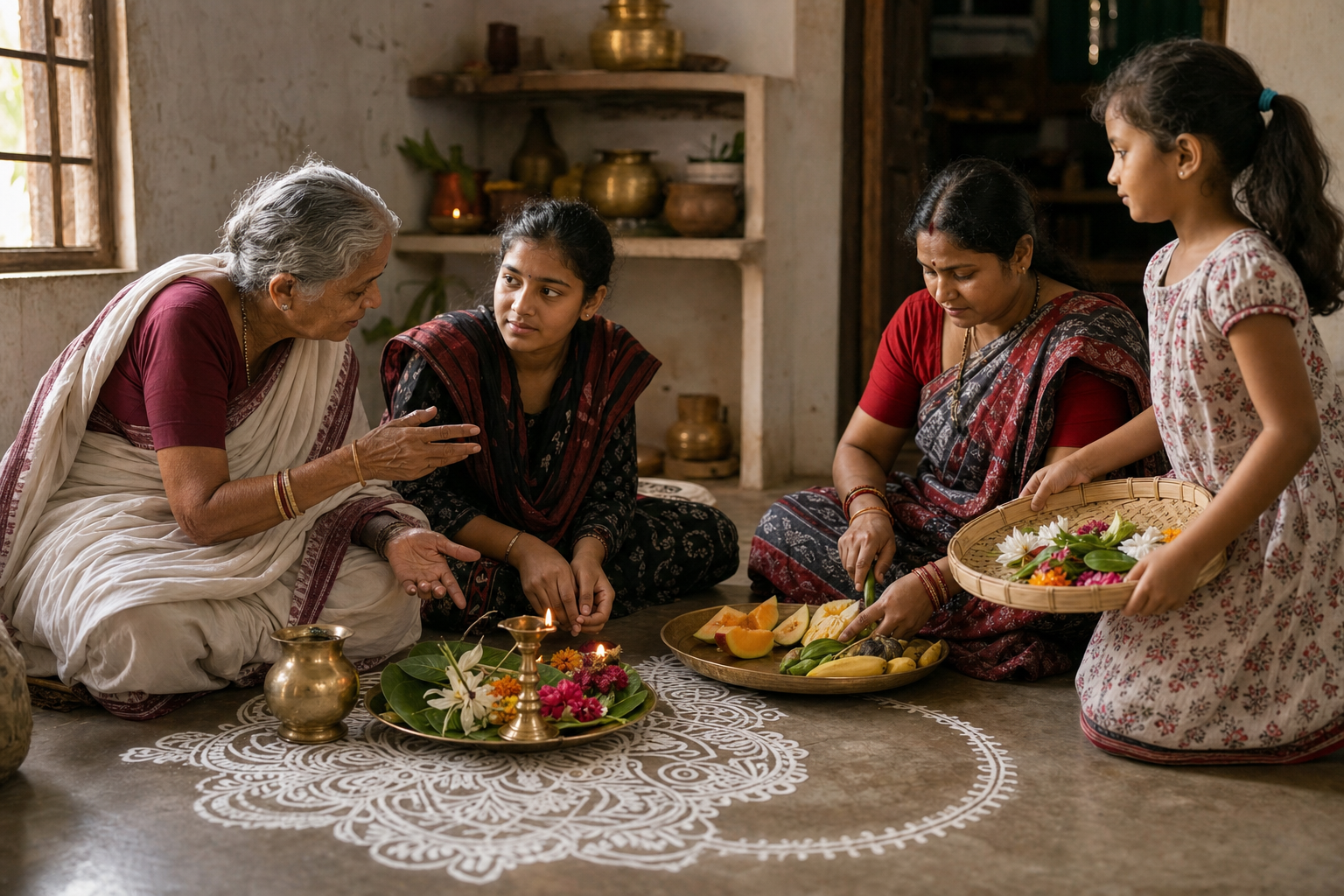
A tradition weakens when one generation performs every act while the next generation merely watches. Give each younger participant three things: a reason for the observance, a real role in it, and the correct name for the regional practice.
Explain the moral centre before explaining the costume or menu. In Dussehra, the central question is not simply who defeats whom; it is how dharma is upheld against adharma through courage, restraint, knowledge, and collective responsibility. Ramlila turns that lesson into public drama. Durga Puja expresses it through Devi as shakti and moral force. Vidyarambham directs it toward the renewal of learning. The forms differ because they teach through different social and devotional languages.
Then assign a role with a visible consequence. A child can introduce one Golu tableau. A teenager can learn the sequence and prepare a legible family timetable. An adult who is new to the tradition can contact the local temple and verify the panchang. Another family member can coordinate transport, welcome elders, or manage post-event cleanup. Participation becomes memory when somebody is trusted with part of the observance.
Retain regional vocabulary even when you explain it in English. Say Golu, Vidyarambham, Ramlila, visarjan, Garba, sargi, arghya, and Chandra Darshan, then explain the term. Translation should open the door; it need not erase the name through which the practice has travelled.
Stewardship also extends beyond the puja room. Dussehra and Durga Puja support artisans, sculptors, costume makers, musicians, and performers who carry living cultural knowledge. When you control a festival budget, direct a meaningful part of it toward those tradition-bearers rather than spending everything on disposable spectacle.
Public devotion carries obligations to shared space. Natural dyes, biodegradable materials, and responsible immersion allow celebration to remain aligned with care for sacred ecologies and public places. Put cleanup, material choice, crowd care, and local rules into the plan from the beginning. They are part of responsible observance, not administrative chores to remember after the sacred acts are over.
Cooperation with Buddhist, Jain, and Sikh neighbours can likewise take the form of seva, education, and community programmes without pretending that every Dharmic path has identical theology or ritual. Shared ethical work is strongest when difference is acknowledged rather than blurred.
Key takeaways
- Do not search for one standardized pan-Indian script when your question is really about family, temple, regional, or sampradaya practice.
- Separate the festival’s dharmic centre, inherited form, and local timing before resolving a disagreement.
- For a location-dependent rite such as Chandra Darshan, use a reliable panchang or temple timetable calculated for the place where you are observing.
- Choose one coherent authority for one observance; do not average conflicting times or casually splice ritual sequences.
- Pass on more than visible celebration: teach the reason, preserve the regional name, and give the next generation a consequential role.
- Treat artisanship, environmental care, cleanup, and seva as parts of cultural stewardship.
Before your next festival, create a family note headed Tradition, Place, Authority, Anchor, Sequence, Roles, and Contingency. Fill it in with an elder, your temple, and a local panchang. That single act will resolve most practical confusion while leaving the living regional character of the observance intact.
References
- DharmaRenaissance Blog — Karva Chauth 2025 Guide: Complete Vrat Significance, Moonrise Window & Fasting Puja End Time
- Hindu Existence — Complete Guide to Dussehra in India: Discover Vibrant Traditions That Unite Dharmic Cultures
