

If you are a Rutgers student, parent, alumnus, or community organizer troubled by the campus controversy over Hinduphobia, the most useful question is not how loudly you can object. It is how you can turn a contested event into an accurate record, a defensible institutional request, and a safer campus for Hindu students.
That requires restraint, but not passivity. You can defend Hindu dignity, support open inquiry, and insist on accountability at the same time. The discipline with which you respond will determine whether the university has to address your concern or can dismiss it as another political quarrel.
Decide exactly what you are challenging

The immediate controversy concerned an October 27 event titled “Hindutva in America: A Threat to the Universe”. Many Hindu Americans regarded that framing as provocative. A provocative title, however, is not by itself proof of discrimination or a campus-policy violation. Your case becomes stronger when you identify the exact words, conduct, or institutional decision that caused the problem.
Criticism of Hindutva, Indian government policy, a Hindu organization, a historical claim, or any political movement is not automatically Hinduphobia. Academic freedom must protect rigorous criticism, including criticism that Hindu students dislike. Hinduphobia becomes the relevant concern when political disagreement slides into stereotypes, prejudice, or hostility toward Hindu beliefs, symbols, and people, or when students face intimidation and unequal treatment because they are Hindu.
Do not allow Hinduism, Hindus, Hindutva, the Indian state, and every form of Hindu political activity to be treated as interchangeable. If an organizer says the subject is Hindutva, ask for the definition being used and examine the claims attached to it. If a speaker generalizes from a political organization to Hindu students, scriptures, temples, practices, or symbols, preserve the exact language and explain the generalization. Precision prevents legitimate criticism from becoming a shield for collective stigma.
- Was the disputed statement a claim about an ideology, or did it assign a threatening character to Hindu people as a group?
- Were conclusions supported with identifiable evidence, or built from insinuation and association?
- Did the event permit disagreement, questions, and competing evidence, or were Hindu viewpoints treated as inherently illegitimate?
- Did the concern arise from promotional language, a speaker’s words, audience conduct, an administrative decision, or harassment after the event? These are different problems and require different remedies.
- Can you reproduce the full context accurately, including any clarification or response that complicates your interpretation?
Key takeaways
- Defend academic freedom while opposing identity-based stereotyping. You do not have to sacrifice either principle.
- Name the exact expression or conduct at issue. Broad accusations are easy to reject; verifiable claims require an answer.
- Separate criticism of political ideas from hostility toward Hindu identity, practice, or belonging.
- Ask for a concrete remedy instead of demanding that Rutgers simply agree with your interpretation.
- Keep personal attacks, speculation, and partisan score-settling out of the response.
Build a record the university can act on

A message saying that an event felt hateful communicates distress, but it gives an administrator little to investigate. An evidence packet turns the concern into a reviewable matter. Prepare it before seeking meetings, media attention, or legal escalation.
- Identify the event. Record its exact title, date, organizer, listed sponsors, venue, promotional description, and public registration or announcement links.
- Preserve the disputed material. Save the full page, image, video segment, or transcript surrounding the words at issue. A clipped sentence without context can weaken an otherwise legitimate complaint.
- Separate the incidents. List event promotion, statements made during the program, audience behavior, online harassment, threats, and administrative actions as distinct entries.
- Describe the impact without exaggeration. Include first-person student accounts only with consent. State what the person saw, heard, or experienced. Do not convert an assumption about motive into a fact.
- Match the concern to a rule. Quote the applicable Rutgers event, student-conduct, nondiscrimination, safety, or complaint policy. If you cannot identify a relevant provision, ask the university which standard governs the conduct.
- Request a remedy. Ask for a policy review, written clarification, facilitated dialogue, educational program, reporting pathway, safety measure, or another action Rutgers can actually provide.
Preserve original files and public links. Do not publish private addresses, telephone numbers, student schedules, immigration information, or other personal data. Do not secretly record private conversations without first checking the applicable law and university rules. If you receive a specific threat or believe anyone is in immediate danger, treat that as a safety matter and contact the appropriate campus or local emergency authority rather than debating it online.
Legal vocabulary should also be used carefully. Offensive speech, a policy violation, unlawful discrimination, and a credible threat are not synonyms. If you are considering a formal civil-rights or legal complaint, have a qualified civil-rights lawyer assess the facts and the relevant state or federal framework. Public advocacy cannot substitute for legal advice about an individual’s case.
A concise request you can adapt
Subject: Request for review of conduct connected with the October 27 event. I am requesting a review of [specific material or conduct] connected with [event and organizer]. My concern is [precise distinction between protected criticism and identity-based stereotyping, harassment, or unequal treatment], supported by [attached evidence]. I ask Rutgers to [specific remedy] while preserving academic freedom and viewpoint diversity. Please identify the responsible office, the policy governing the review, and the next step in writing.
This format does not prejudge the outcome. It makes the university answer a defined question. Send the evidence as an organized attachment, retain the original submission, and keep all replies in the same record.
Organize a visible response without surrendering discipline
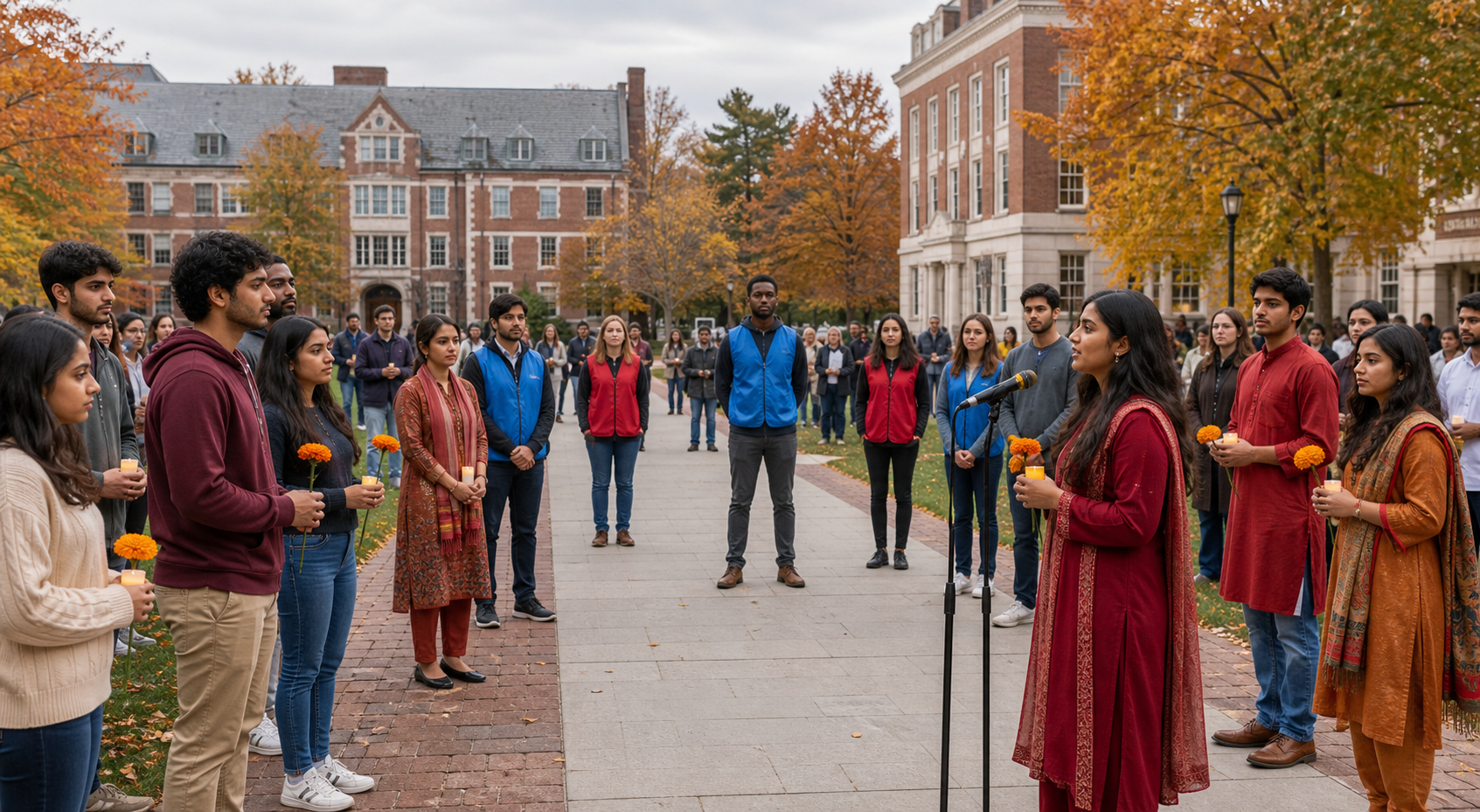
A peaceful public gathering can make concern visible while demonstrating the civic standards being requested from the university. The gathering should have a defined purpose: explain the objection, affirm the rights of Hindu students, invite evidence-based debate, and present specific institutional requests. A protest organized mainly to answer provocation with provocation will obscure all four.
Build the response around dharmic values that a wider public can recognize in conduct. Hindu, Buddhist, Jain, and Sikh participants need not erase their theological differences to stand together around nonviolence, mutual respect, and pluralism. Interfaith partners, civil-rights advocates, scholars, alumni, and student leaders can join on the same basis. The coalition should defend a consistent rule against prejudice, not demand political agreement about Bharat or Hindutva.
- Name one event coordinator. Campus officials, participants, journalists, and safety personnel should know who can make an operational decision.
- Select prepared spokespersons. Include students and representatives who can speak about Hindu experience, dharmic traditions, academic freedom, and the requested remedies without improvising accusations.
- Adopt a written code of conduct. Prohibit threats, personal abuse, property damage, doxxing, and interference with people entering or leaving a lawful event.
- Assign de-escalation and safety roles. Establish a liaison with campus safety and, where appropriate, local law enforcement. Plan how participants will arrive, leave, report a threat, and obtain help.
- Prepare for distress. Students directly affected by harassment may need access to campus well-being or mental-health resources. Do not pressure them to become public witnesses.
- Make participation accessible. Provide a clear meeting point, program, contact method, and expectations so that families, elders, students, and allies know what they are joining.
Nonviolence is not merely a slogan for the placard. It is a practical constraint on tone, logistics, and response. A participant who is baited into an ugly confrontation can become the entire public story. Organizers should therefore decide beforehand who speaks, who engages counter-protesters, and who documents misconduct. Most participants should do none of those jobs; they should follow the program.
Give media and allies a clean explanation
A journalist or unfamiliar student may have only a few moments to understand the dispute. If your explanation begins with a long account of geopolitics or factional history, the central civil-rights point will disappear. Begin with a consistent standard, identify the evidence, and end with the remedy.
- Principle: We support rigorous criticism, academic freedom, and the right to question political and religious ideas.
- Concern: Our objection is to [exact words or conduct], because it moves from criticism of an idea to [the precise stereotype, hostility, harassment, or unequal treatment].
- Request: We are asking Rutgers to [specific review, clarification, dialogue, safety measure, reporting process, or educational response].
Keep a short fact sheet containing the event details, the disputed language in context, the policy question, contact information, and the requested action. Add brief explanations of Hindu symbols or concepts only when they are directly relevant. A personal account from a student can humanize the issue, but it must be voluntary, accurate, and protected from unnecessary exposure.
Do not let the controversy be reduced to a left-versus-right performance. Hindus with different political views can oppose identity-based hostility while disagreeing sharply about India, American politics, or Hindutva. Say so. A nonpartisan standard against prejudice is more credible than a message that excuses hostility from friends and condemns it only in opponents.
If discussion turns to Audrey Truschke or another controversial scholar, address the work that is actually relevant: textual interpretation, methodology, evidence, public claims, and the effects of those claims on how Hindu communities are perceived. Do not speculate about a scholar’s ancestry, private beliefs, hidden motives, or personal life. Personal vilification abandons the academic standard you are asking Rutgers to uphold.
Correct mistakes openly. If a name, quotation, sponsorship claim, or sequence of events proves inaccurate, update the fact sheet and notify anyone who received the earlier version. Accuracy is not a concession to the other side. It is the foundation of your credibility.
Turn one event into durable campus change

The public event will pass quickly. Institutional change depends on what you do after attention moves elsewhere. Publish a factual account, request a meeting with a written agenda, and maintain a visible list of commitments and responses. Track documents and decisions, not applause, social-media impressions, or the size of a temporary audience.
- Ask Rutgers to explain how students report religion- or ethnicity-related bias, who reviews reports, and how complainants are informed about the process.
- Request educational programming that distinguishes Hindu traditions, Hindu communities, Indian politics, and competing uses of the term Hindutva.
- Invite scholars with different interpretations to a moderated forum governed by evidence, equal questioning, and viewpoint diversity.
- Develop teach-ins on Hindu, Buddhist, Jain, and Sikh traditions with participants qualified to represent their own communities.
- Seek training for staff and student leaders on anti-Hindu stereotypes, while keeping that training open to scrutiny and correction.
- Ask for restorative dialogue when affected students want it and when it can occur without coercing them to defend their identity.
- Keep a named community contact responsible for following up until Rutgers gives a written answer or clearly closes the matter.
Rutgers also has a broader vocabulary for confronting difficult history. Henry Rutgers owned enslaved people in the late eighteenth and early nineteenth centuries, while the land-grant system created under the Morrill Act of 1862 benefited universities through lands taken from Native nations, including lands connected with the Lenni Lenape. These facts should not be used to assign inherited guilt to present-day students or to evade the immediate controversy.
Use that history as a standard of institutional seriousness. A university capable of examining slavery and Indigenous dispossession should also be capable of examining how its teaching, events, and public language affect Hindu and other dharmic communities. Historical transparency, curricula on dharmic traditions, and responsible partnerships with Indigenous communities and descendants of enslaved people can belong to the same commitment to inclusive education. None cancels the others.
Success does not require Rutgers to endorse your theology, politics, or reading of Hindutva. It requires a fair process, accurate distinctions, protection from harassment, room for Hindu students to answer contested claims, and visible follow-through. Begin with the evidence packet. Send the precise request. Then organize a response whose conduct already models the pluralism you are asking the university to protect.
References
