
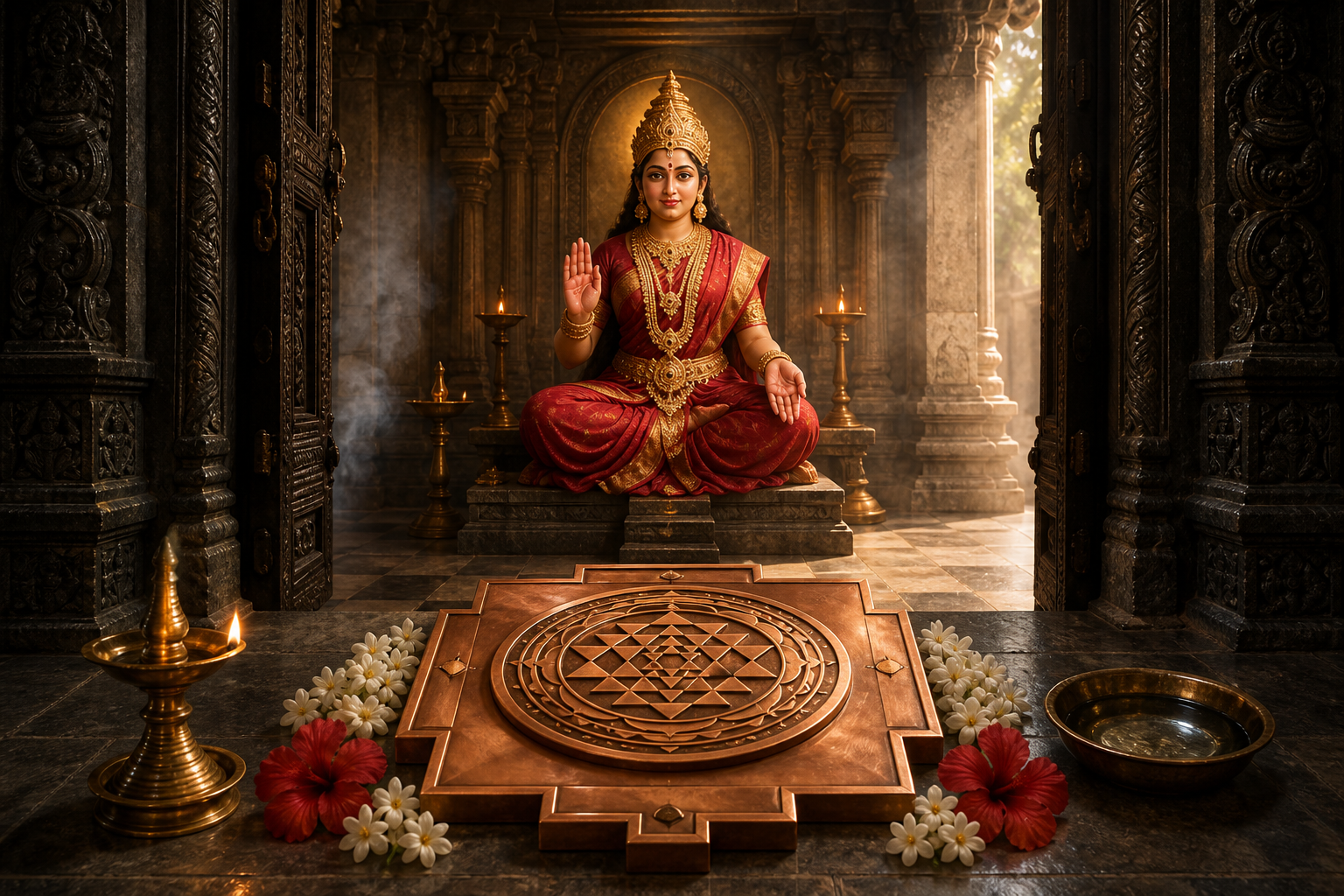
If you have turned to Sri Nimishamba because a decision, conflict, or inner knot feels urgent, the promise associated with her name can be both consoling and confusing. Does help within a nimisha mean the outer problem must disappear in a minute? Or might the first answer be the clarity and courage to meet it differently?
A sound approach holds urgency and discipline together. You can pray without hesitation, but you should not reduce the Devi to an emergency service or the Sri Chakra to a device for obtaining results. Their deeper invitation is to move from agitation to attention, from scattered desire to a dharmic course of action.
Ask without delay, but do not put grace on a deadline
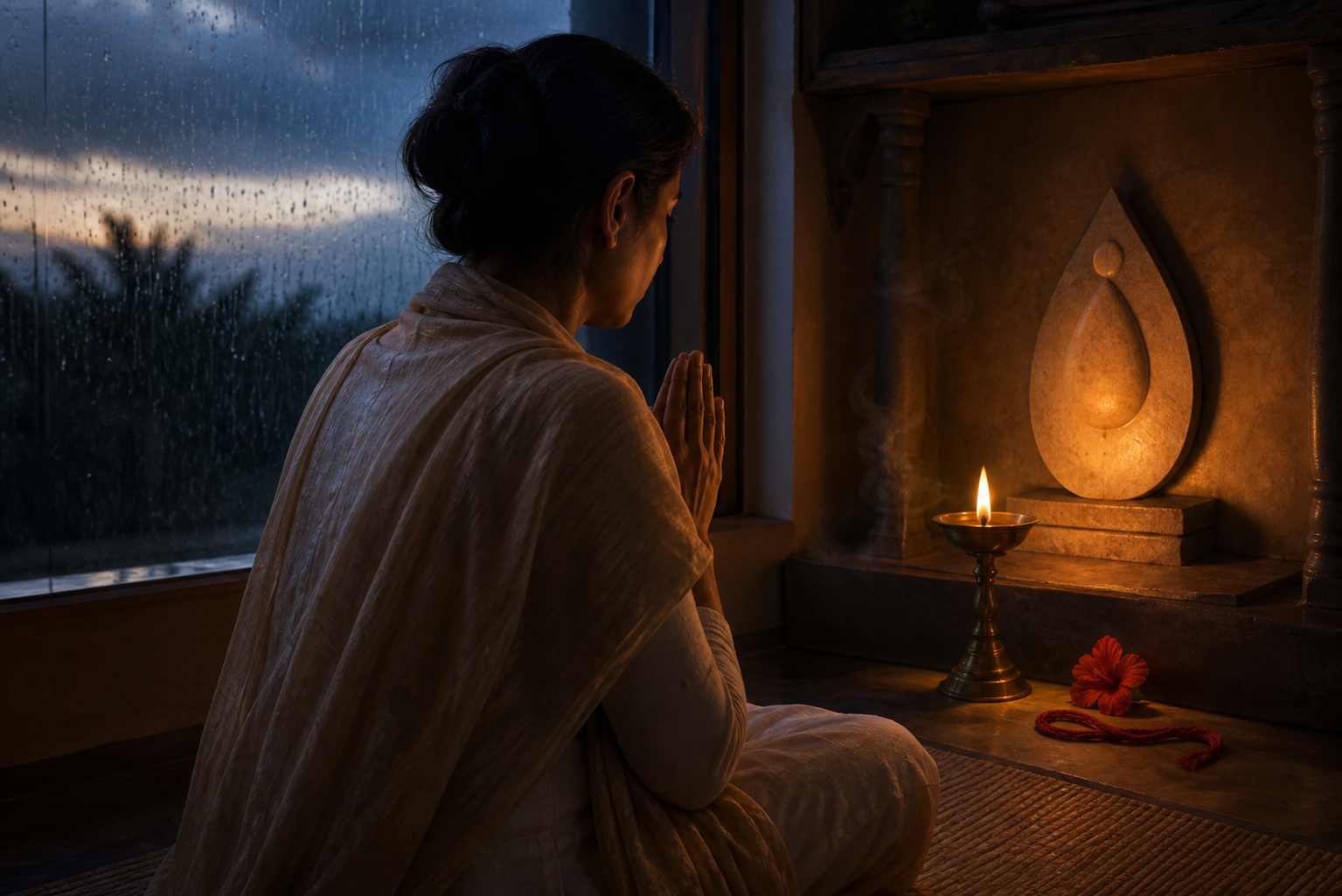
Local tradition holds that Sri Nimishamba responds to sincere prayer within a nimisha, understood here as a minute. The teaching conveys the Mother’s nearness and readiness to receive you. It is not a contractual promise that every external circumstance will change before a clock completes its turn.
That distinction matters when you are anxious. If you make a demand, start a timer, and then interpret an unchanged situation as divine rejection, the expectation itself becomes another source of distress. Pray immediately, but let the response take more than one possible form: a changed circumstance, a clearer perception, restraint where you were about to act rashly, or courage to do what you already know is right.
You do not need an elaborate formula to place an urgent matter before the Devi. A plain-language prayer can contain these elements:
- Name the situation without exaggerating it or hiding your own part in it.
- Ask for the obstacle to be removed in a way consistent with dharma, rather than demanding harm or humiliation for another person.
- Ask to see the next truthful action that belongs to you.
- Offer your willingness to take that action once it becomes clear.
After praying, resist the urge to treat every coincidence as a command. A sound response should survive basic dharmic scrutiny: it should not require deception, cruelty, vanity, or the abandonment of an evident duty. Divine immediacy does not remove discernment; it makes honest discernment more urgent.
Key takeaways
- The nimisha tradition expresses the Devi’s accessibility, not a guaranteed timetable for the outcome you prefer.
- The Sri Chakra leads attention from the outer boundary toward the bindu, turning scattered awareness toward unity.
- Sri Nimishamba’s severity and compassion must be read together: destructive impulses are not made sacred merely by calling them protection.
- Simple prayer and contemplation are appropriate starting points; formal Navavarana puja is a more layered discipline.
- Close worship by choosing one dharmic action. Otherwise even sincere devotion can remain an escape from responsibility.
Read the Sri Chakra from the boundary to the bindu

The Sri Chakra is not a random arrangement of attractive lines. Its interlocking triangles, concentric enclosures, lotus petals, outer earth-square and central bindu form a coherent map. The movement can be read in two directions: outward, as the unfolding of cosmic multiplicity, and inward, as the return of divided attention to the still center of consciousness.
When you contemplate the yantra, follow that inward logic instead of staring vaguely at the whole design:
- Begin with the bhupura, the outer earth-square with four gateways. Treat it as a threshold. Notice the concerns, roles and sensory distractions you are carrying, but do not fight them.
- Move through the concentric enclosures and lotus petals. Let each successive layer gather attention that was dispersed among many competing wants.
- Attend to the interlocking triangles. They signify the dynamic union of Shiva and Shakti, not two hostile powers struggling for control. Creation, awareness and sacred power belong within one reality.
- Rest your gaze at the bindu. Do not strain for a vision or unusual sensation. The point is a cue for collectedness, simplicity and unity.
- Close your eyes briefly and retain the sense of a center. When thought scatters again, return without annoyance.
This is contemplation, not a substitute for formal ritual. Its practical value is easy to test: after looking inward, are you less fragmented and better able to identify the duty in front of you? If the practice only multiplies fantasies about hidden power, return to the basic movement from boundary to center.
Use a correctly formed Sri Chakra rather than casually drawing approximate triangles and assuming the result is equivalent. Precision is part of the yantra’s contemplative discipline. If you do not have a reliable form, it is better to pray before an image of the Devi or through her name than to treat sacred geometry as decoration.
The outer-to-inner movement also offers a point of conversation across dharmic traditions. A Buddhist may recognize a resonance with mandala contemplation; a Jain may appreciate disciplined inwardness joined to ethical refinement; a Sikh may recognize the gathering of attention associated with remembrance of Naam. These are resonances, not claims that the traditions or their practices are interchangeable. Attention, compassion and truth-seeking provide common ground, while the Sri Chakra remains a distinctly Shakta sacred form with its own theological setting.
Let the Devi’s fierce and compassionate aspects correct each other
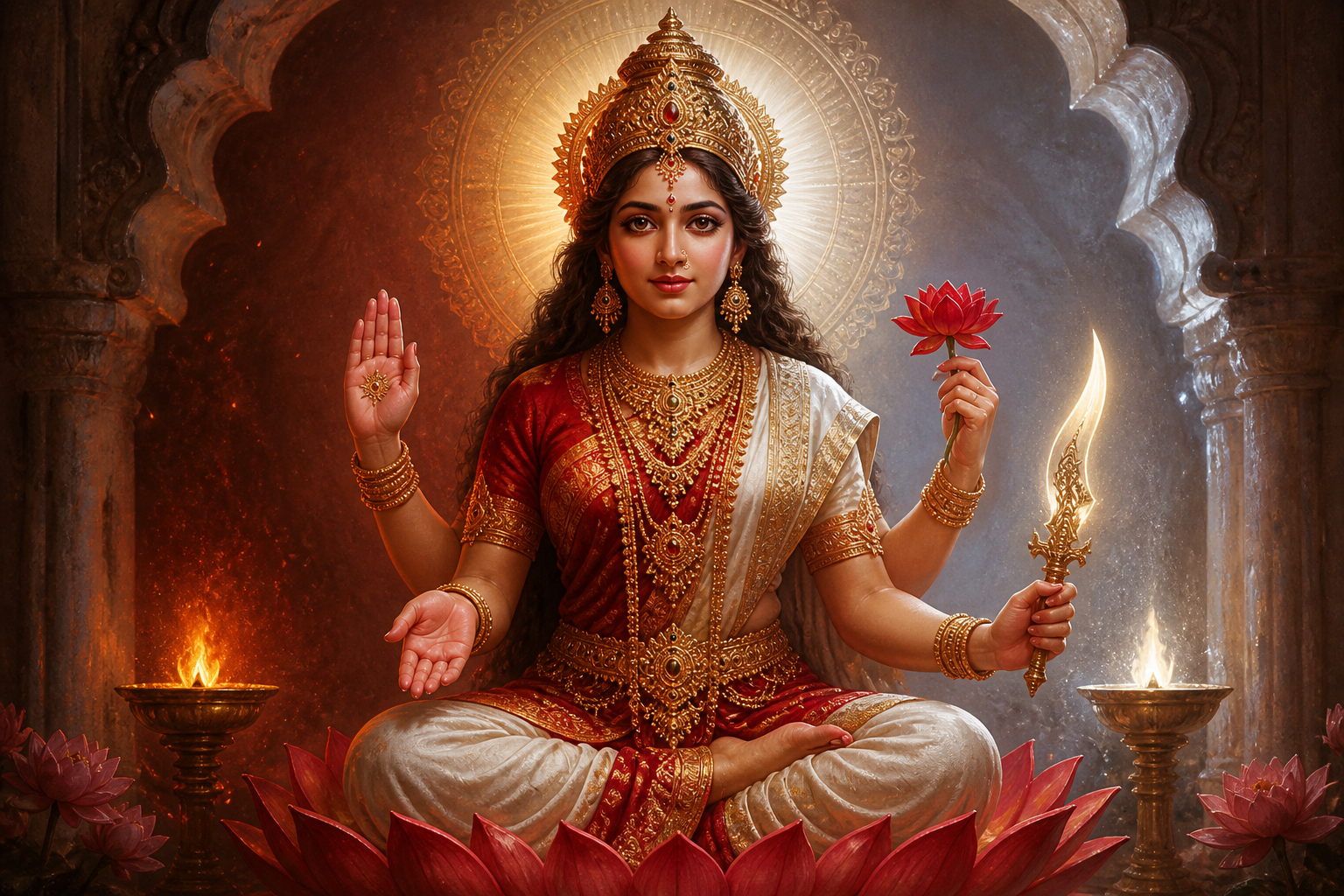
Sri Nimishamba is approached as both a force that removes obstruction and a Mother who grants refuge. These are not separate personalities. Her fierce aspect prevents compassion from becoming helpless indulgence; her benevolent aspect prevents power from becoming rage, domination or revenge.
This balance gives you a practical test for prayer. When asking for protection or the removal of negativity, examine what you are actually seeking:
- Are you asking for safety, or for the satisfaction of seeing someone punished?
- Is the obstacle entirely outside you, or are fear, pride, avoidance or attachment helping to sustain it?
- Would the outcome you desire allow you to fulfil dharma more faithfully, or merely make your preferences easier to satisfy?
- What must be cut away, and what vulnerable responsibility must still be protected?
The Devi’s assuring and blessing gestures make the same point visually: power need not terrify the person who seeks refuge sincerely. At the same time, refuge does not mean permanent passivity. If the insight received in worship asks you to apologize, set a boundary, complete neglected work, or refuse an adharmic demand, maternal grace may appear as the strength to do precisely that.
This keeps Sri Nimishamba worship from slipping into magical blame. You do not have to deny a real external wrong, but you should not use devotion to avoid examining your contribution to a recurring problem. Ask the Devi to remove the obstacle, then stop feeding it through the habit she has helped you recognize.
Choose the right level of worship for where you are
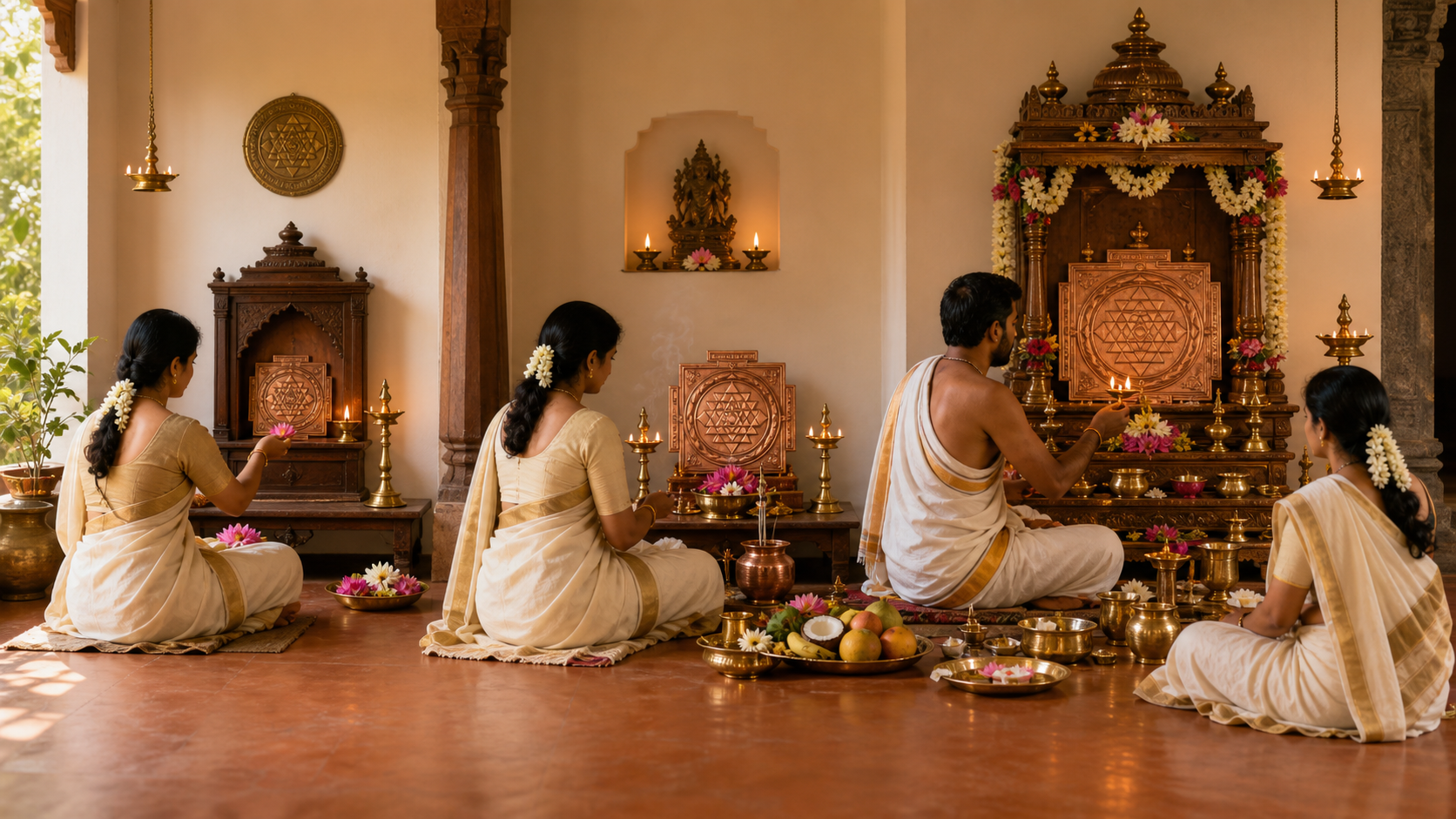
Devotees sometimes collapse darshan, simple household worship, Sri Chakra contemplation and formal Navavarana puja into one undifferentiated activity. They are related, but they are not identical. Choosing a modest practice you can sustain is more honest than imitating a complex rite whose sequence and meaning you have not learned.
A simple practice at home
Worship associated with the shrine brings mantra, Lalita Sahasranama recitation, naivedya, deepa and sacred sound into a unified practice. At home, use the elements that genuinely belong to your household tradition rather than assembling them as spiritual accessories.
- Prepare a clean, stable place for the Devi’s image or a correctly formed Sri Chakra. Handle the sacred form deliberately rather than leaving it among ordinary clutter.
- State your intention in plain words. Keep it narrow enough to be honest: one concern, one request for clarity and one willingness to act.
- If lighting a deepa belongs to your practice, place it safely and keep it attended. If an open flame is not safe in your setting, omit it; reverence does not require preventable risk.
- Recite Lalita Sahasranama if it is already part of your practice, or use a familiar prayer to the Devi. Do not invent claims of ritual authority around words you do not understand.
- If you make naivedya, offer it with attention rather than measuring devotion by expense or display.
- Move your gaze from the outer boundary of the Sri Chakra toward the bindu. At the center, let recitation give way to quiet attention.
- Close by naming the next dharmic act you will undertake. Keep it concrete enough that you can recognize whether you did it.
The final step prevents a common split between puja and life. If you prayed for harmony, the next act may be to speak without contempt. If you prayed for clarity, it may be to collect the missing facts before deciding. If you prayed for courage, it may be to stop postponing a duty. The offering continues through conduct.
When Navavarana puja is the right next step
Navavarana puja honours the enclosures of the Sri Chakra in a layered progression toward the bindu. It is therefore more than looking at the yantra while repeating a general prayer. Mantra, offering, sacred form and the order of the enclosures work together.
If you have not been taught that sequence, do not assume that a diagram and a list of names reproduce the full discipline. Attend the puja where it is properly performed, observe with humility, and seek qualified guidance within a living tradition if you want to undertake it formally. This restraint does not make your present devotion inferior. It keeps a precise practice from being reduced to improvisation.
Approaching the temple near Ganjam
The Sri Nimishamba Temple stands on the banks of the Cauvery near Ganjam in Karnataka’s Mandya region. Confirm current timings and worship arrangements locally before travelling, since those practical details can change.
Once there, let the visit have an inward sequence as clear as the Sri Chakra itself:
- Arrive with one principal prayer rather than a hurried catalogue of demands.
- Follow the temple’s local order and the instructions given by those responsible for the shrine.
- Receive darshan before trying to interpret what it means. Do not demand immediate access, touch or photography where permission has not been given.
- After darshan, remain quiet long enough to notice whether urgency has softened into a clearer question.
- Before leaving, name the responsibility you will carry back into ordinary life.
- Treat the Cauvery-side setting as sacred space. Do not leave packaging, ritual remnants or other waste behind.
Do not grade the pilgrimage solely by whether the desired event happens at once. A visit can bear fruit as steadiness, moral clarity or the resolve to take the next necessary step. The tradition of the nimisha asks you to trust that the Mother is near; the Sri Chakra teaches you how to become inwardly present enough to receive that nearness.
If you begin today, begin simply. Place the concern before Sri Nimishamba, let your attention travel from the boundary to the bindu, and then do the next truthful thing that has become clear. Return to the practice when you need recollection, not only when you want rescue.
References
