

If a clip from Cuttack or a voice note from Bhubaneswar lands on your phone, your first decision is not which community to blame. It is whether your next action will protect people and preserve evidence or enlarge an angry crowd. You can defend Hindu religious practice, insist that cattle-protection laws be enforced, and reject vigilantism at the same time. Those positions belong together.
On October 6, 2025, two reported episodes showed how quickly a legitimate grievance can become a communal emergency. In Bhubaneswar, self-identified activists reportedly dismantled a makeshift butcher facility and a nearby meat shop, alleging illegal cow slaughter and removing cattle. In Cuttack, stone-pelting allegedly disrupted a Durga Puja immersion procession. Because the publicly available details were still preliminary, responsible action required verification, separate investigations, and protection against retaliation.
Begin by separating four different questions
Communal escalation begins when one accusation is allowed to answer every question. A claim about illegal slaughter does not establish who committed it. Anger over that claim does not authorize damage to property. An attack on a procession does not make an entire locality or religious community responsible. A retaliatory act does not become lawful merely because an earlier wrong was serious.
Before you speak publicly, organize a response, or forward a message, separate these questions:
- What is alleged? State the specific act: suspected illegal slaughter, animal cruelty, property damage, unauthorized removal of cattle, stone-pelting, intimidation, or another identifiable offence. Do not replace the act with a communal label.
- What is directly known? Distinguish what a witness personally saw from what someone inferred, heard from another person, or read in a caption.
- What evidence exists? Preserve original video, CCTV, photographs, eyewitness details, official records, and the exact location. An edited clip or a forwarded screenshot may omit the context investigators need.
- Which authority must act? Police investigate offences and maintain public order. Veterinary officers and authorized shelters have defined roles where animals are involved. Courts determine legal responsibility.
This separation is not moral evasiveness. It is how you prevent a genuine complaint from being weakened by exaggeration or an unlawful counter-action. Equal enforcement does not mean pretending every alleged act is identical. It means investigating each act on its own evidence and holding the people responsible for it accountable, irrespective of identity.
De-escalation also does not mean silence. It means moving the dispute from the street to a documented process in which facts can be tested and punishment cannot be dictated by a crowd. A firm demand for lawful action is more durable than a burst of collective anger.
Report suspected cattle violations without compromising the case
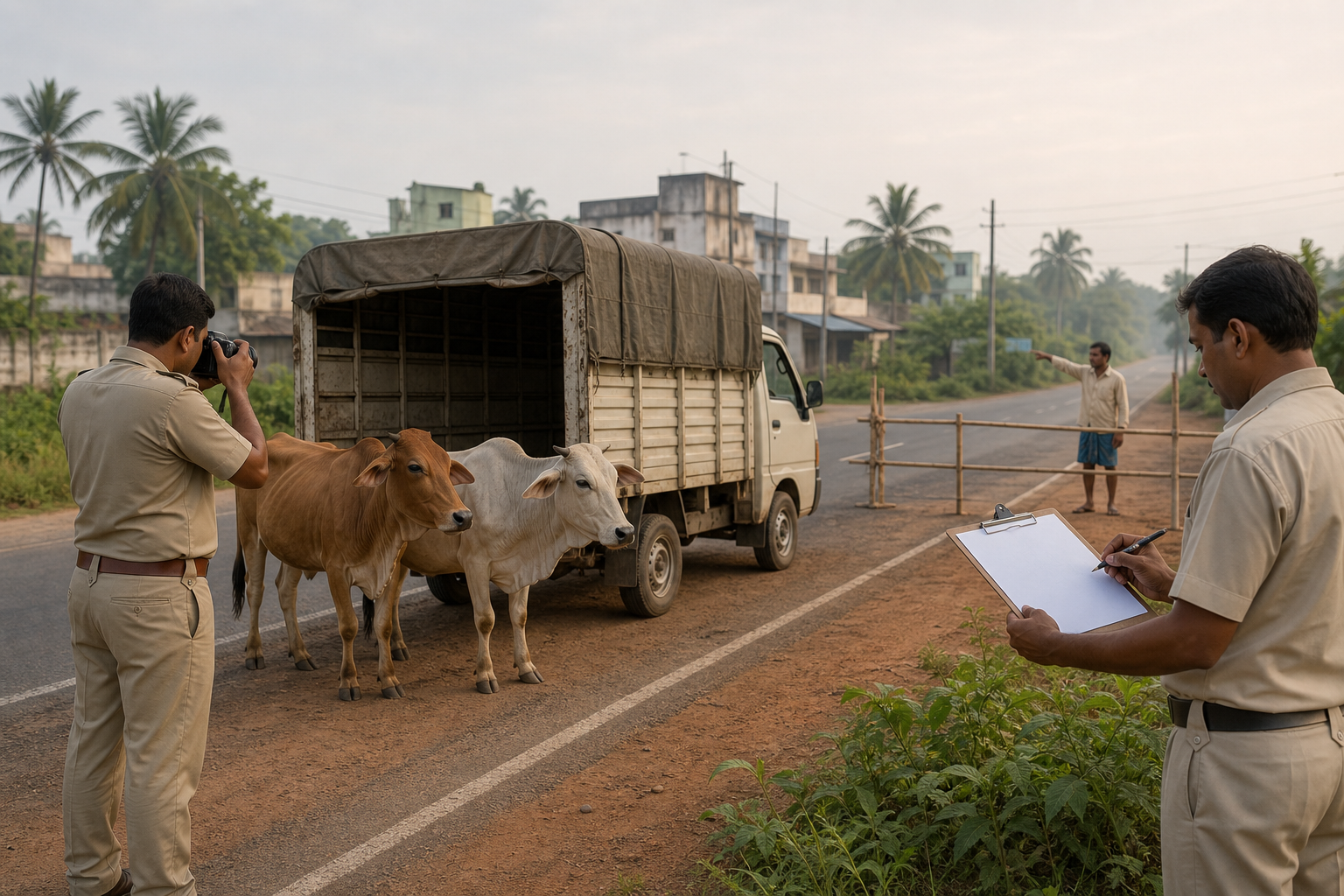
For many Hindus, the protection of cattle is a matter of profound religious and moral concern. That concern deserves serious enforcement, not a chaotic scene that destroys evidence, endangers animals, damages unrelated property, or creates a second set of allegations against the complainants.
If you encounter suspected illegal slaughter or cruelty, use a sequence that officials can verify:
- Keep yourself and other residents out of immediate danger. Do not enter private or restricted premises, force open a structure, threaten anyone, or summon a crowd. If violence appears possible, move to a safe place and contact police.
- Record only what you can lawfully observe. Note the location, the time of observation, what you personally saw, and what remains an allegation. Keep the original photographs or video. Do not crop the material, add accusatory captions, or circulate identities before verification.
- Use a verified official reporting channel. Give police a precise description rather than a communal conclusion. Ask that the allegation be inspected and documented. Where animal condition or identification matters, request coordination with the appropriate veterinary officer.
- Leave seizure and removal to authorized personnel. If cattle must be transferred, the location of origin, the official taking custody, the condition of the animals, and the receiving shelter should be documented. Retain any complaint acknowledgement or reference information you receive.
- Keep witnesses and evidence distinct. Each witness should describe personal observations rather than repeating a jointly composed story. Supply original files privately to investigators instead of relying on social-media circulation.
- Follow the complaint through lawful channels. Seek an update from the authority that received it. A community representative, peace committee, or lawyer can help press for a timely response without turning the matter into a confrontation.
The chain of custody matters because it connects an animal or object to the place where it was found and records who handled it afterward. Coordination among police, veterinary personnel, and authorized shelters makes the process more transparent. Removing cattle without authorization or dismantling a suspected facility can cloud that record and shift attention from the original allegation to the conduct of the crowd.
If an animal appears to be in urgent distress, say so explicitly when reporting the matter and request immediate official attendance. Urgency justifies a faster lawful response; it does not automatically authorize trespass, destruction, threats, or an improvised seizure.
If you are a complainant, property owner, organizer, accused person, or witness asked to sign a statement, obtain case-specific advice from a qualified lawyer. A viral explanation of Odisha law is not a substitute for legal advice, especially when injury, arrest, property damage, or prosecution may follow.
Protect a religious procession without feeding retaliation

A Durga Puja immersion is an act of devotion conducted in shared civic space. Protecting it requires more than a general appeal for peace. Organizers and police need a route, a time window, sound conditions, named contacts, and a pre-agreed response if an object is thrown or the procession is obstructed.
Before the procession, organizers should complete a practical route audit with police and community representatives. The final plan should identify the approved route, agreed timings, applicable sound conditions, liaison contacts, and who has authority to pause, resume, or redirect the procession. Any changes should be communicated to marshals and participants before movement begins, not improvised after tension develops.
- Nominate recognizable marshals. Their role is to keep the procession together, convey police instructions, assist elders and families, and stop participants from breaking away to confront someone.
- Establish a direct liaison chain. Organizers, police, and nearby community representatives should know whom to call without broadcasting unverified claims to a large group.
- Agree on a stop-and-report procedure. Participants should know that an alleged attacker is not to be chased into a lane, building, or neighborhood.
- Protect the devotional purpose. Route discipline and sound compliance deny provocateurs an easy way to turn an avoidable dispute into a communal confrontation.
- Prepare one public statement in advance. It should affirm the right to worship, reject obstruction and violence, ask participants to follow police directions, and reserve conclusions about responsibility until evidence is checked.
If stone-pelting or another attack occurs, the immediate objective is to prevent one offender’s conduct from drawing the entire procession into pursuit. Warn participants, contact the police liaison, move vulnerable people away from danger, and obtain medical assistance for anyone injured. Note the precise place from which the object appeared to come, but do not enter that area to search for a suspect.
Give investigators original recordings and direct witness accounts. Do not publish a face, name, address, or community identity merely because it appears in a forwarded message. In the Cuttack matter, CCTV footage, social-media material, and eyewitness accounts were reportedly being examined. That evidence-based process should identify individual responsibility and establish causation.
After an attack, restraint must be matched by visible enforcement. Organizers are entitled to ask what protective arrangements will change, whether evidence has been secured, and how the remaining religious events will be safeguarded. Police should provide verified updates without compromising the investigation. Asking worshippers not to retaliate while leaving them uninformed creates a vacuum that rumor will fill.
Treat every viral claim as an evidence problem

A dramatic clip can move through Odisha faster than officials can inspect the scene. The danger is not only that a clip may be false. It may show a real event while carrying a false location, an invented motive, an unverified identity, or a caption that turns the conduct of particular people into an accusation against a whole community.
Use four labels in internal messages and public statements: directly observed, officially confirmed, alleged but unverified, and opinion. Do not silently promote a claim from one category to another. A witness can confirm what was seen, not necessarily the motive. A police acknowledgement can confirm that a complaint exists, not that every allegation in it has been proved.
Before forwarding inflammatory material, ask:
- Can you identify the original recording or uploader rather than only the latest forward?
- Does the material itself establish the date and Odisha location being claimed?
- Is it the complete recording, or does it begin after the confrontation started?
- Was the alleged offender identified by an investigating authority, a direct witness, or merely a caption?
- Would sending the material to police preserve evidence more effectively than broadcasting it to people who may gather at the site?
If those questions cannot be answered, do not add certainty with your own wording. Send potentially relevant material privately to the appropriate authority and describe it as unverified. If you already shared a false or misleading claim, correct it in the same group where it appeared. Name the specific error, provide the verified position if one exists, and ask the group administrator to display the correction prominently.
Community leaders can reduce speculation with short holding statements. Useful wording includes:
- An incident has been reported at [location]. Verification is under way. Do not travel to the scene, confront anyone, or circulate unconfirmed identities.
- The procession is [paused or continuing] under police direction. Participants should remain on the agreed route and follow marshal instructions.
- We condemn the specific alleged act and support prompt legal action against those responsible. No community should be blamed for conduct that has not been individually established.
Authorities can strengthen those messages through regular briefings, a verified helpline, and multilingual advisories. A useful briefing distinguishes confirmed facts, unresolved allegations, public-safety instructions, and the time or condition for the next update. It should not declare that everything is normal when restrictions, risks, or unanswered questions remain.
Key takeaways for residents, organizers, and officials
- Defend religious freedom and cattle protection by strengthening evidence, inspection, and prosecution, not by creating a crowd-led substitute for them.
- For a suspected slaughter or cruelty violation, report the exact observation and seek police, veterinary, and authorized-shelter coordination with a documented chain of custody.
- During an attack on a procession, protect people, prevent pursuit, contact the police liaison, and preserve original recordings and witness accounts.
- Investigate the suspected original offence and any later property damage, assault, obstruction, or retaliation separately. One does not excuse another.
- Attribute responsibility to individuals on evidence. A neighborhood, religion, or community identity is not proof of culpability.
- Use peace committees, route audits, verified official updates, and prompt corrections to close the space in which rumors mobilize crowds.
A dharmic response joins ahimsa with justice. Ahimsa is not passivity in the face of cruelty, obstruction, or violence. It disciplines the means used to oppose them. Justice without self-control can become revenge; self-control without a demand for justice can become abandonment. The lawful path refuses both failures.
Sarva-dharma-samabhava does not require you to erase religious differences or treat every claim as equally credible. It asks for equal civic dignity while evidence determines accountability. Hindu-Muslim relations become safer when people know that worshippers will be protected, allegations will be investigated, offenders will not be shielded, and innocent neighbors will not be treated as substitutes for suspects.
At peaceful Durga Puja immersions, neighbors have helped by offering water, clearing routes, and assisting elders. Those ordinary acts are not sentimental extras. They make a public procession safer and give residents a stake in its orderly completion.
Before the next sensitive event, save the verified district contact channels, nominate a liaison, confirm the route and stop procedure, and prepare a factual holding statement. When the next inflammatory clip arrives, preserve the original, mark what remains unverified, and send evidence to the people authorized to act. That is how you defend dharma without surrendering the rule of law that makes lasting justice possible.
References
