
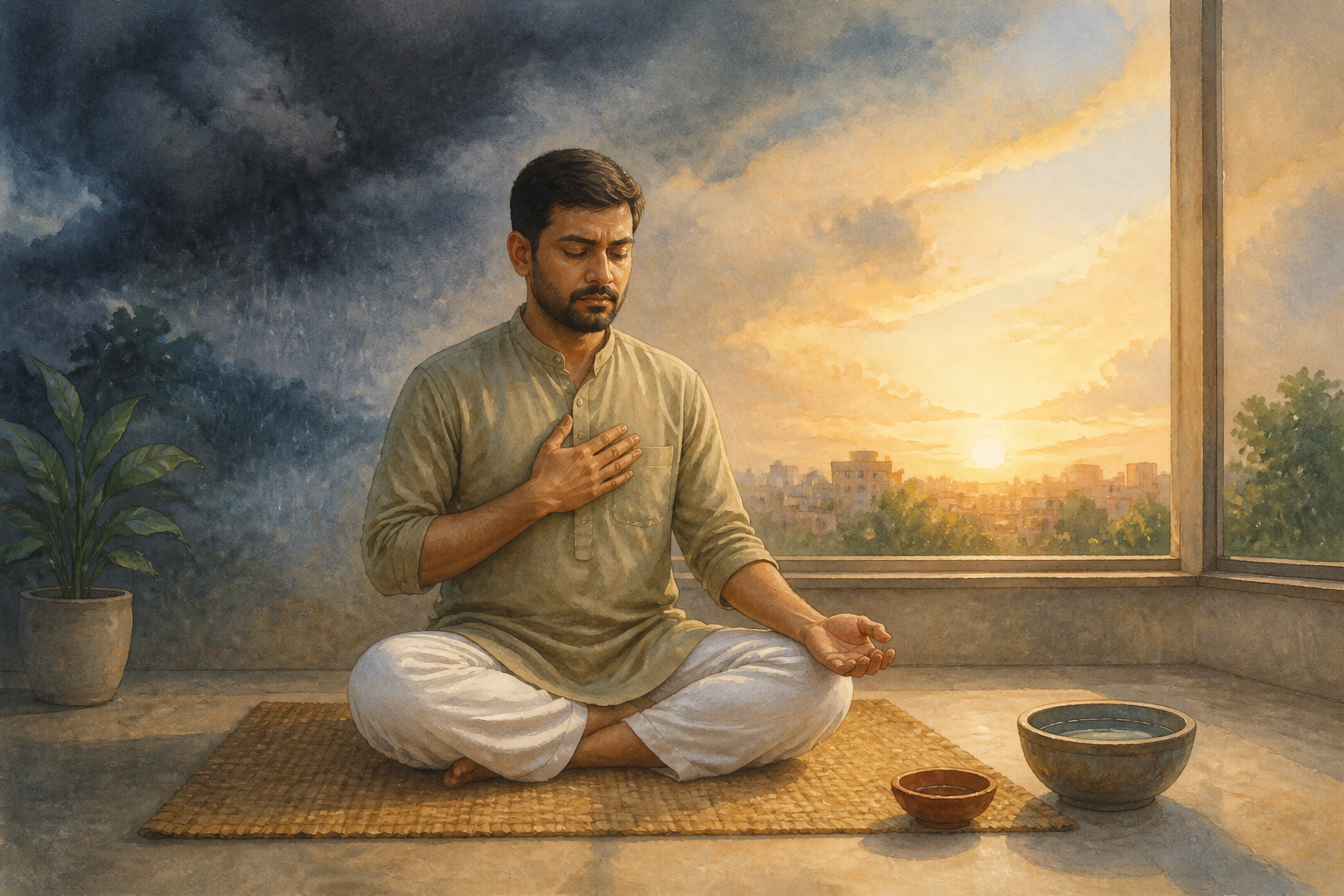
You may already understand that attachment magnifies suffering, yet lose access to that understanding when grief, conflict, humiliation or uncertainty is active. In that moment, philosophy can feel distant and the mind can treat its first reaction as the whole truth.
Your task is not to force yourself into serenity. It is to stop pain from automatically deciding what you believe, say and do next. Dharmic practice gives you a way to make that space, then fill it with clear attention, ethical action, devotion and service.
Separate what happened from what the mind added

Begin by dividing the experience into two layers: the event itself and the mind’s response to it. This does not mean that distress is imaginary. Contact with changing conditions, relationships and responsibilities is genuinely painful, while perception and response shape what happens inside that pain.
When you are upset, write or say four plain lines:
- The event: Describe only what a camera or careful witness could confirm.
- The direct experience: Name the bodily sensation or emotion present now, without explaining it.
- The interpretation: State what your mind says the event means about you, another person or the future.
- The impulse: Notice what you want to do immediately, such as attack, withdraw, cling, distract yourself or give up.
Suppose a colleague criticises your work. The event might be: A colleague identified a problem in what I submitted. The interpretation might be: Everyone now sees me as incompetent. The impulse might be to send a defensive reply. The event requires evaluation; the interpretation is still a claim; the impulse is not yet a command.
This is where samskaras and vasanas become practical rather than abstract ideas. Learned patterns and habitual tendencies can turn an experience into attraction, aversion, fear or resistance. You do not dissolve those patterns by condemning yourself for having them. You weaken their authority by seeing them before acting through them.
Do not use this distinction to minimise bereavement, betrayal, illness or injustice. Raw pain deserves acknowledgment. The useful question is narrower: What part of this situation must be felt or addressed, and what part is being repeatedly manufactured by prediction, resistance or wounded identity?
Dharmic traditions do not give one identical metaphysical answer. Atman, emptiness, pure awareness and Divine presence are not interchangeable doctrines. Moksha, nirvana, kevala-jnana and Sachkhand should not be flattened into a single concept. The shared practical move is more modest: do not let a transient experience eclipse the deeper truth recognised within your own lineage.
Use a dharmic pause while suffering is active

A pause is useful only if it changes the next action. When a wave of distress arrives, move through this sequence:
- Prevent the next avoidable wound. Unless immediate safety or duty requires action, do not send the message, make the accusation or take the irreversible step while the first surge is directing you.
- Return attention to an anchor. Feel the contact of your feet with the ground or your body with the chair. Follow the natural breath without forcing it. If devotion is your path, repeat the Divine Name you have received or trust.
- Name the movement of the mind. Ask whether you are grasping for an outcome, pushing an experience away, defending an identity or fearing a future that has not happened.
- Widen the frame. Instead of saying I am ruined or I am anger, recognise that grief, anger or fear is present in awareness. A feeling can be fully real without becoming your complete identity.
- Choose the next dharmic act. Ask what now serves truth, non-harm, responsibility and compassion. The answer may be an apology, a boundary, a factual correction, protection from danger, a report of injustice, practical care or silence until your speech can be clean.
For a Krishna bhakta, the anchor may be Hare Krishna, Hare Krishna, Krishna Krishna, Hare Hare / Hare Rama, Hare Rama, Rama Rama, Hare Hare. It can be voiced gently, spoken softly or repeated silently as japa. If another sacred form belongs to your lineage, invoke the Divine Name taught there. The point is faithful remembrance, not borrowing religious vocabulary merely because it sounds calming.
Chanting is not a spell for removing an unwanted fact. It redirects attention from compulsive rehearsal toward devotion. Judge the pause by what follows: Are you more capable of hearing the truth, restraining harmful speech and doing what the situation requires? The disappearance of every uncomfortable feeling is not the test.
Build the practice before the next difficult moment

A mind trained only during crisis will usually return to its strongest habit. Abhyasa means returning to practice. The return matters more than constructing an impressive routine that ordinary household life cannot sustain.
Attach your practice to transitions that already occur:
- Upon waking: Before entering the day’s stream of tasks, offer a few attentive repetitions of a mantra or Divine Name, or sit with the breath and establish an intention for your conduct.
- Before a meal: Pause, recollect gratitude and practise a short round of japa or silent remembrance.
- While moving between tasks: Chant softly or silently during a walk, cooking or a routine commute. Never let the practice compete with the attention required for safety.
- Before sleep: Review one reaction from the day. Identify the event, the interpretation and the impulse. Decide whether truth, apology, restraint or repair is needed, then close with remembrance.
Home bhakti needs no specialised equipment and can be woven into waking, meals, walking and rest. This makes it especially useful when an elaborate ritual would be difficult to maintain. Simplicity is not spiritual inferiority; it removes the excuse that practice can begin only when life becomes quieter.
Keep the routine narrow enough to repeat. Choose one element from each of these three areas:
- An attention anchor: breath awareness, meditation, mantra, japa or another discipline given by your tradition.
- An ethical restraint: truthful speech, sense regulation, non-harm or a commitment not to act from the first angry impulse.
- An outward expression: seva, practical care, patient listening or work that relieves another being’s burden.
The three parts correct one another. Attention without ethics can become self-absorption. Ethics without inner steadiness can become brittle moralism. Inner practice without seva can turn suffering into a private project centred entirely on the self.
You do not need to practise every method at once. Bhakti, self-inquiry, mindfulness, disciplined action and seva can support one another, but indiscriminate mixing can leave you with many techniques and no depth. Let your own tradition provide the language and ultimate orientation. Use the wider Dharmic family to deepen respect, not to erase meaningful differences.
Keep karma, acceptance and action in the right order

When you consider your own suffering, karma can restore agency: present intention and action matter, even when you cannot change what has already occurred. When another person is suffering, karma must never become an accusation about what that person supposedly deserved. Responsibility for present choices belongs beside compassion and recognition of real injustice.
Put care before metaphysical explanation. If someone is grieving, unsafe or oppressed, help with the burden in front of them. Speculation about unseen causes neither proves anything nor fulfils seva. A Dharmic understanding of causation should make you more responsible, not less humane.
Watch for four common misuses:
- Karma as blame: treating another person’s hardship as evidence of moral guilt.
- Acceptance as surrender: remaining in preventable harm because resistance has been mistaken for attachment.
- Calm as the sole measure: assuming that grief, anger or fear proves the practice has failed, even when those emotions are proportionate to the event.
- Spiritual identity as avoidance: declaring yourself detached, empty or surrendered while refusing a necessary conversation, boundary, repair or act of protection.
Acceptance means seeing what is present without falsifying it. It does not mean approving cruelty, abandoning justice or leaving preventable harm untouched. Suffering can become a teacher, but that does not make every painful condition necessary or worthy of preservation.
Test your practice by its fruit. Does it make you clearer about facts? Less governed by compulsive attraction and aversion? More truthful and non-harming in speech? More available for duty, repair and seva? If it consistently produces passivity, superiority or indifference to another person’s pain, something in its application needs correction.
Spiritual practice is not a substitute for medical or psychological care. If you may harm yourself or cannot keep yourself safe, seek urgent local emergency or crisis support. If distress is seriously disrupting basic functioning, consult a qualified mental-health professional. Meditation, prayer, chanting and community support can accompany appropriate care; they should not be used to postpone it.
Key takeaways
- Distinguish the event, the direct feeling, the interpretation and the impulse before you act.
- Use breath, mindful awareness or the Divine Name to create a pause, then end that pause with a dharmic decision.
- Measure practice by clearer conduct and greater compassion, not by the immediate disappearance of pain.
- Build remembrance into ordinary transitions so the habit exists before crisis arrives.
- Let karma increase responsibility for your choices; never use it to blame another person for suffering.
- Join inner discipline to truthful action, ahimsa and seva, while seeking professional help when the situation requires it.
Choose one transition that will occur in your day, such as waking, eating, walking or preparing for sleep. Pair it with one trusted anchor and one ethical intention. At the next difficult moment, do not demand instant peace from yourself. Notice the pattern, return to the anchor and make the next action Dharmic.
That is the beginning of transformation: pain may still be present, but it no longer has unquestioned authority over your attention, speech and conduct.
References
- DharmaRenaissance Blog – Complete Dharmic Guide to Suffering: Discover Proven Ways to Transform Pain into Inner Peace
- DharmaRenaissance Blog – Essential Home Bhakti: Discover a Proven, Anywhere-Anytime Krishna Consciousness Chant
