
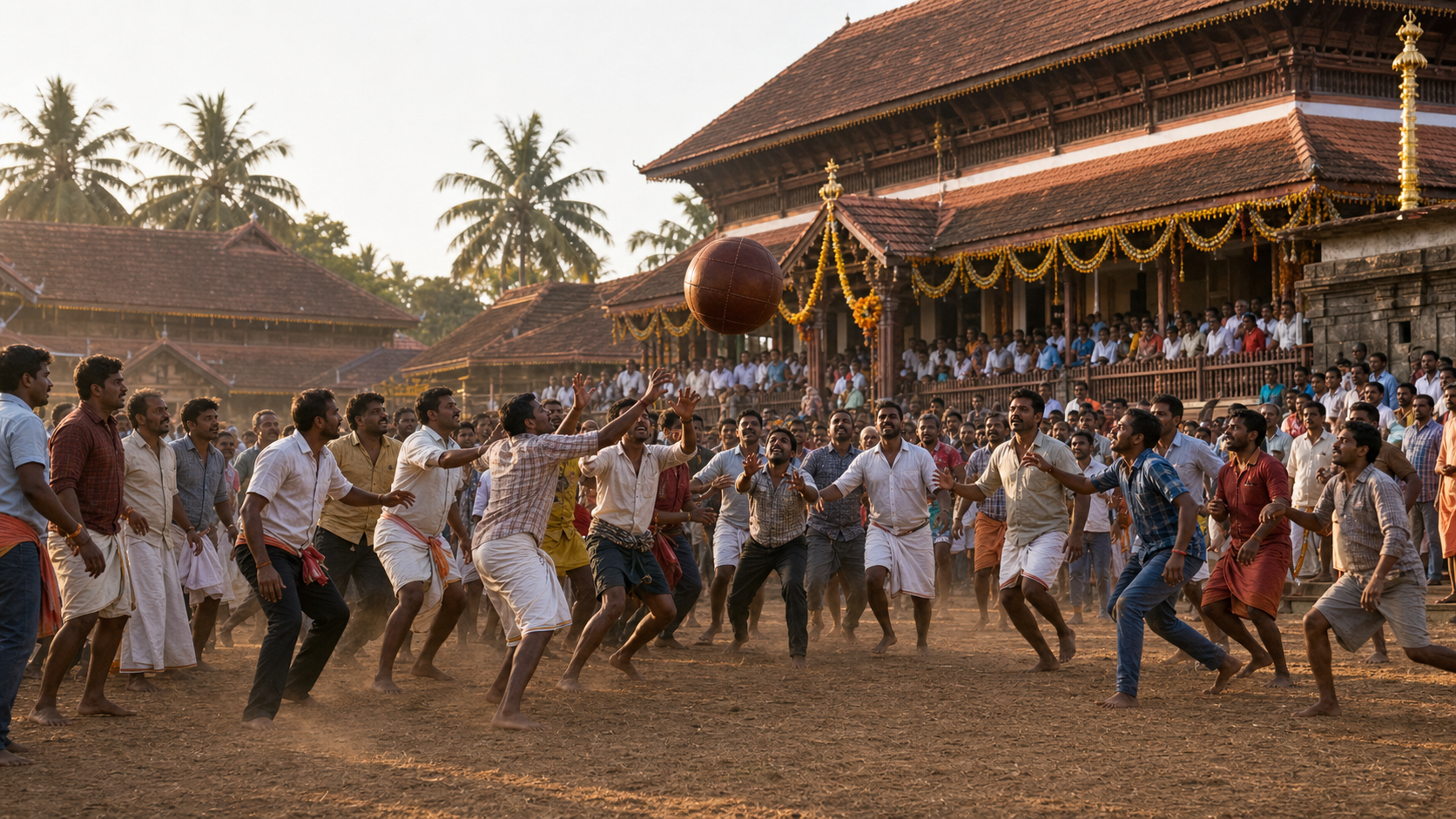
If you are thinking of visiting Polali Chendu, the first question is not whether you enjoy football. It is whether you are prepared to watch physical play as part of worship. Arrive expecting a conventional match and you may miss the event’s meaning; arrive as a pilgrim or respectful observer and the entire sequence becomes legible.
Polali Chendu belongs to the annual jatra of the Polali Rajarajeshwari Temple in Dakshina Kannada, Karnataka. The Kannada word chendu means ball, but here the ball is consecrated before it enters the field. That one fact changes how you should watch, behave, and plan your visit.
Do not read the field as an ordinary football pitch
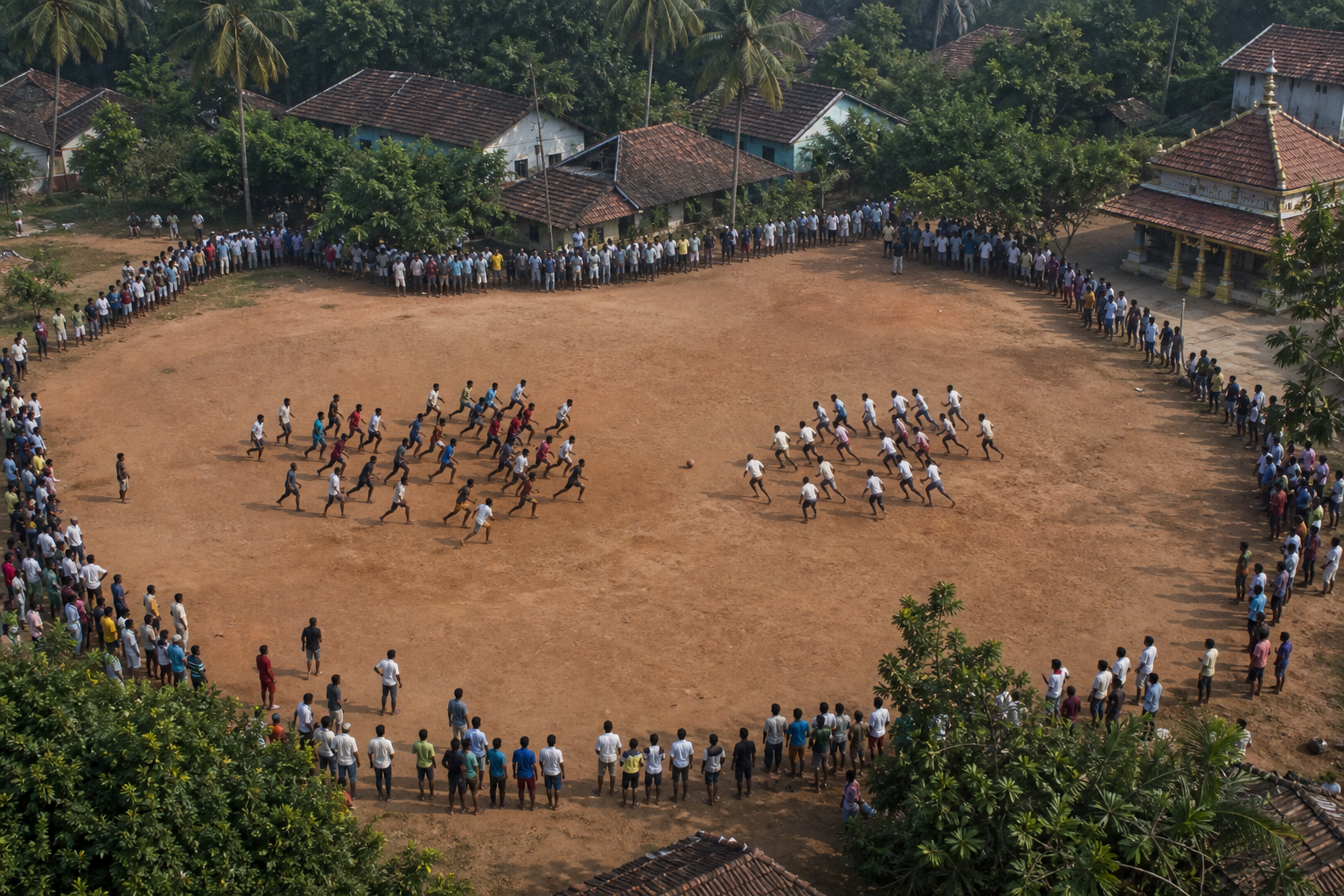
Calling Polali Chendu a form of temple football helps a newcomer picture coordinated movement, passing, boundaries, and a shared objective. The comparison stops being useful when it makes victory over an opponent the main story. The ritual’s governing values are cooperation, restraint, discipline, and reverence toward Rajarajeshwari.
That distinction gives you a practical way to follow the action. Do not spend the event searching for a familiar score, star player, or defeated side. Watch how the consecrated ball draws many bodies into coordinated movement, how participants contain their strength, and how temple stewards preserve order around the play. The central achievement is not domination. It is the directing of collective energy toward the Devi.
The ball’s symbolism also becomes clearer from this angle. Its roundness can be understood as completeness and ordered wholeness. Consecration takes an everyday object into a sacred setting, showing how ordinary action can be offered rather than abandoned. The field then resembles the arena of human conduct: energy is necessary, but energy acquires value when dharma directs it.
You do not have to insist that every participant explains the symbolism in identical words. Let the ritual itself teach the simpler lesson. Strength is present, joy is present, and vigorous movement is present, but none is permitted to displace sacred purpose.
Follow the ritual sequence, not only the moving ball
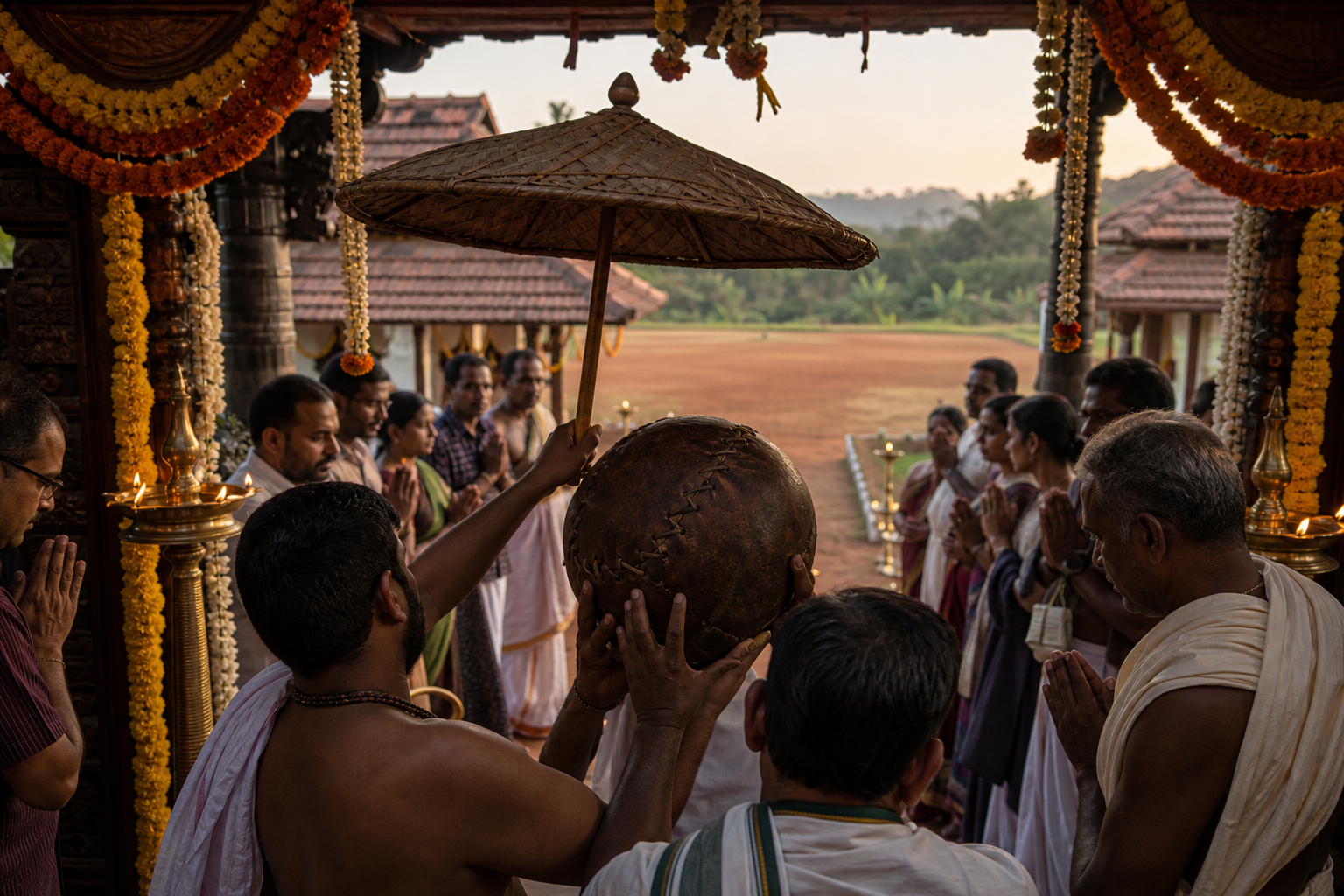
The most important moments begin before anything resembling a game. If you arrive only after the play is underway, you may see an unusual spectacle while missing the act that makes it sacred. Plan to be present before the opening movement and follow this sequence:
- Puja establishes the devotional setting. The chendu is not introduced as ordinary sporting equipment. Its consecration places the coming activity within temple worship.
- The transition to the temple grounds connects worship and play. The movement from puja into the playing space is part of the ritual, not dead time between separate events.
- Drums and conches gather attention. Listen for the change in the soundscape and notice how many individual conversations become one shared focus.
- The first flight of the ball is a collective devotional moment. Treat it as the opening of an offering, not a competitive kickoff.
- Coordinated play unfolds under sacred discipline. Watch the relationship between vigor and restraint rather than trying to force the action into standard football rules.
This sequence also tells you where to place your attention. During the puja, do not obstruct the ritual in pursuit of a close photograph. During the procession, leave its route open. When the ball first rises, watch the congregation as well as the players. The synchronized attention of families, elders, youth, musicians, and temple functionaries is part of what Polali Chendu creates.
If you have only limited time, prioritize the consecration, transition, and opening flight. Those moments explain why the activity belongs inside the temple’s annual jatra rather than on an ordinary sports calendar.
Attend as a pilgrim: etiquette protects both sanctity and safety
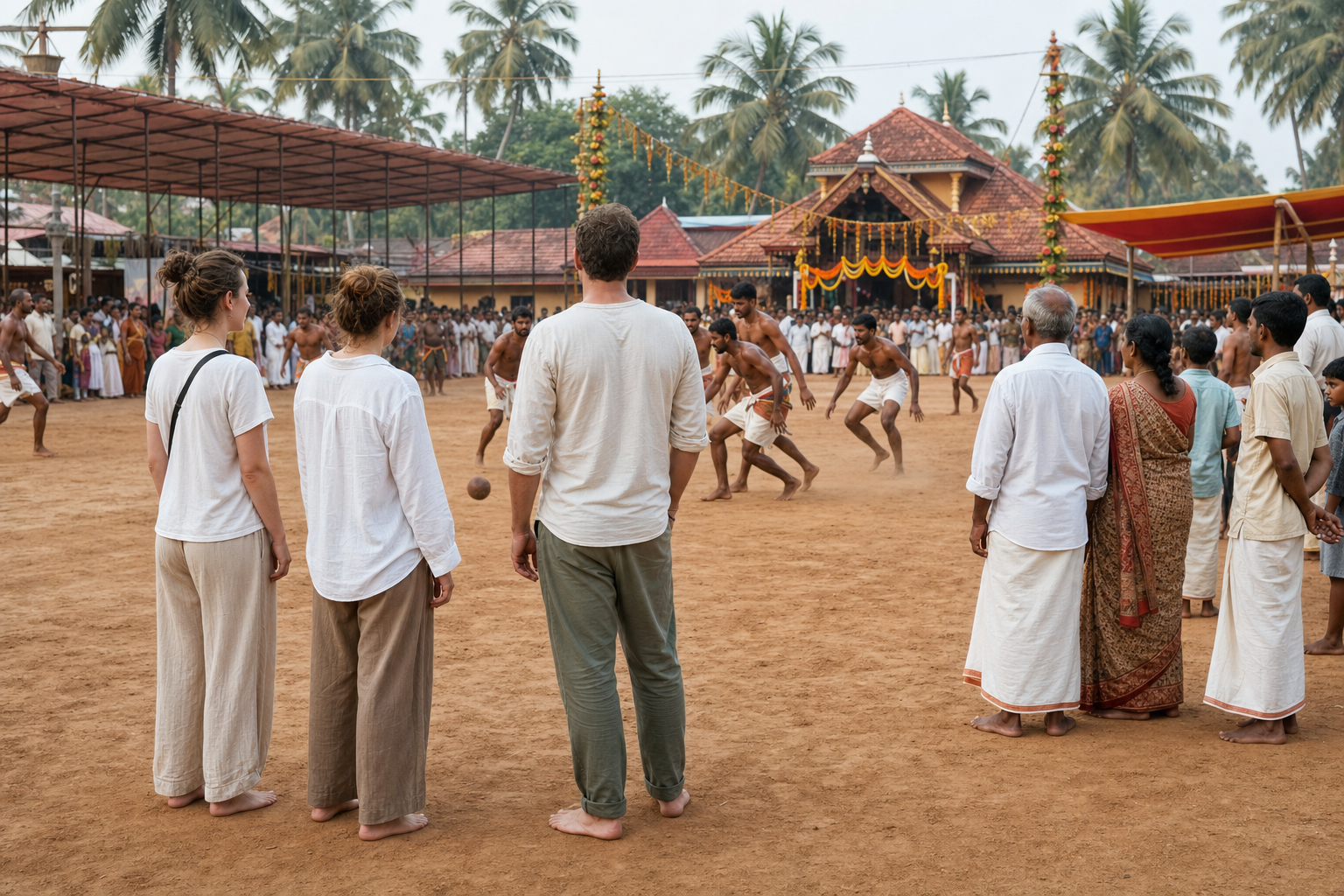
Polali Chendu is visually striking, but being able to see it does not make every viewpoint, photograph, or movement appropriate. The temple’s instructions take precedence over a visitor’s preferred angle. A simple rule works throughout the day: observe first, then act only when the expected conduct is clear.
- Wear modest, temple-appropriate clothing. You are entering a place of worship before you are entering a festival crowd.
- Follow priests and temple stewards promptly. They determine where visitors may stand, how the ritual space is protected, and when movement must stop.
- Ask before photographing. Do not assume that a large public gathering makes every ritual moment available for recording. Put the device away immediately if photography is restricted.
- Keep processional and playing spaces clear. Stepping forward for a better view can obstruct ritual movement and place you in the path of vigorous play.
- Do not touch the chendu unless explicitly invited. Consecration gives the ball a ritual status that an outsider should not treat casually.
- Keep children close and give elders room. If the crowd compresses or stewards redirect people, step back rather than resisting the flow.
- Do not join merely because the activity looks familiar. Participation is governed by local custom and temple authority, not by a spectator’s enthusiasm.
These courtesies are not decorative additions to the experience. Restraint is one of the values embodied by the ritual itself. Your conduct should display the same relationship between enthusiasm and discipline that you came to witness on the field.
The gathering is centered unmistakably on Hindu worship of the Devi, yet its community character can also accommodate respectful well-wishers from Jain, Buddhist, Sikh, and other backgrounds. If that describes you, there is no need to imitate participation you do not understand. Honor the temple’s ritual grammar, make space for devotees, and let attentive presence be enough.
Plan around a living jatra, not a fixed tourist timetable
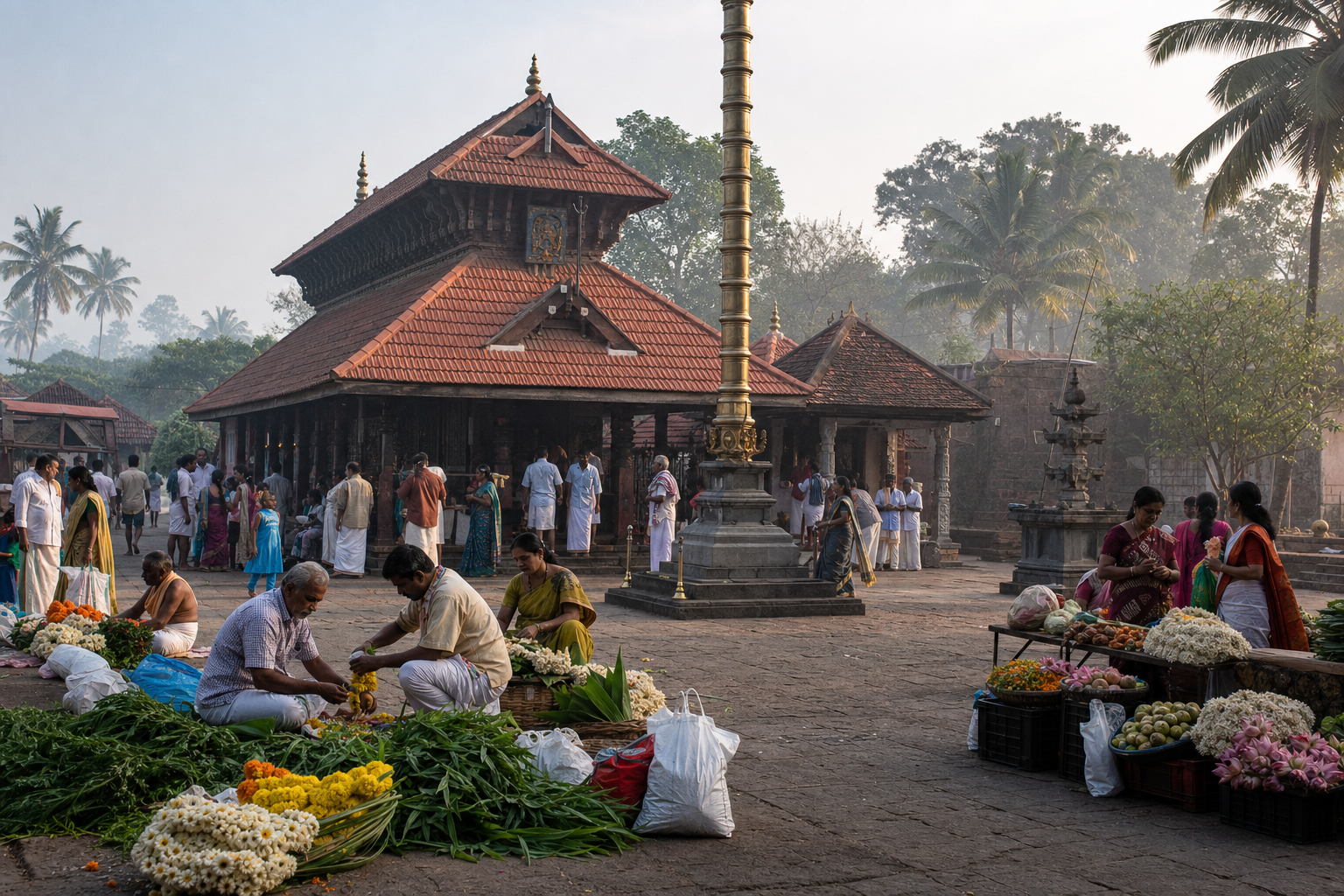
The annual jatra generally falls in the late-winter-to-spring period, but that is a planning window, not an exact appointment. Do not book a journey solely by copying a previous year’s date. Confirm the current year’s festival day and the timing of the chendu ritual through a reliable local or temple-connected channel before committing to transport.
Polali lies in the Bantwal region and can be approached through Mangaluru’s transport hubs. That makes Mangaluru the sensible place from which to organize the onward leg, but you should leave time for local travel, festival traffic, and crowd-control directions. A tightly scheduled arrival risks placing you at the temple after the consecration and opening flight have already occurred.
- Confirm the exact festival date for the year you intend to travel. A seasonal estimate is not enough for booking a single-day visit.
- Ask specifically about Polali Chendu’s ritual time. The wider jatra may contain several activities, so knowing the jatra dates alone may not identify the moment you want to witness.
- Aim to arrive before the puja. The consecration supplies the context that distinguishes sacred play from an athletic exhibition.
- Allow margin in the onward journey from Mangaluru. Do not make a narrow connection the condition for seeing the opening ritual.
- Check the day’s wider cultural program separately. Local performance traditions such as Yakshagana may accompany the celebration, but they should not be assumed without a current program.
- Carry a simple plan rather than a production agenda. Temple-ready clothing, minimal belongings, and readiness to follow local directions will serve you better than a rigid list of photographs to obtain.
Festival timing and access belong to the community that sustains the jatra. Treat confirmation as part of pilgrimage preparation, not as an inconvenience. A living tradition may require you to adapt your itinerary to the ritual rather than expecting the ritual to fit your itinerary.
Key takeaways for a respectful first visit
- Polali Chendu uses the recognizable form of a ball game, but its purpose is devotional rather than opponent-centered.
- The puja and consecration are essential. Arriving only for the field action removes the context that gives the event its meaning.
- Watch for disciplined cooperation, the direction of collective energy, and the congregation’s shared attention rather than a conventional score.
- Modest dress, permission-conscious photography, clear processional routes, and obedience to temple stewards are basic requirements.
- The jatra generally occurs from late winter into spring, but you should confirm the exact date and chendu timing for your chosen year.
- Mangaluru provides a practical transport gateway to Polali in the Bantwal region; leave enough margin to arrive before the opening ritual.
Before you set out, verify the current day and ritual time. Once at Polali, arrive early enough to let the puja frame everything that follows, and allow local stewards to determine where you stand and what you record. You will then encounter Polali Chendu on its own terms: as communal strength made disciplined, joyful, and sacred.
References
