

If you know Bhakti Madhava Puri Maharaja only as a devotional teacher or only as a scientifically trained thinker, you miss the most useful part of his legacy. He showed how a seeker can protect spiritual conviction without becoming intellectually careless, and pursue difficult questions without allowing inquiry to become spiritually barren.
That example matters whenever you face a confident claim about life, consciousness, or the relationship between science and spirituality. His life offers a practical standard: determine what kind of claim is being made, ask what supports it, and make sure the discussion produces humility, disciplined sadhana, and service rather than prestige or argument.
His legacy is a method, not a science-and-faith slogan
Known earlier as Madhava Das, Bhakti Madhava Puri Maharaja brought together the Bhakti Tradition, serious scholarship, and service to Hindu Dharma. The important word is “together.” He did not merely place religious language beside scientific language. He treated devotion and inquiry as disciplines that could correct different human weaknesses.
Reasoning can expose a vague definition, an unsupported conclusion, or an answer designed to protect itself from every objection. Bhakti can expose a different set of failures: pride in one’s intelligence, the desire to defeat rather than understand, and knowledge that never changes conduct. If you preserve only the intellectual side, the work can become sterile. If you preserve only devotional certainty, difficult questions can be dismissed before they are understood.
This distinction is especially important when discussing the “Life Comes From Life” theme. His work within the Bhaktivedanta Institute supported symposia and initiatives that invited scholars to examine life, consciousness, and meaning. An invitation to examine a foundational question is not permission to announce that every scientific dispute has already been settled. A strong Dharmic argument does not need borrowed certainty.
Before you repeat a science-and-spirituality claim, classify it. Is it an empirical observation about what can be detected or tested? Is it a philosophical inference about what those observations mean? Or is it a theological conviction grounded in guru, shastra, and tradition? These forms of knowledge can inform one another, but they are not interchangeable. Labeling the claim prevents you from presenting a metaphysical conclusion as laboratory data or reducing a spiritual teaching to a material measurement.
Guru-shishya learning makes knowledge answerable to character
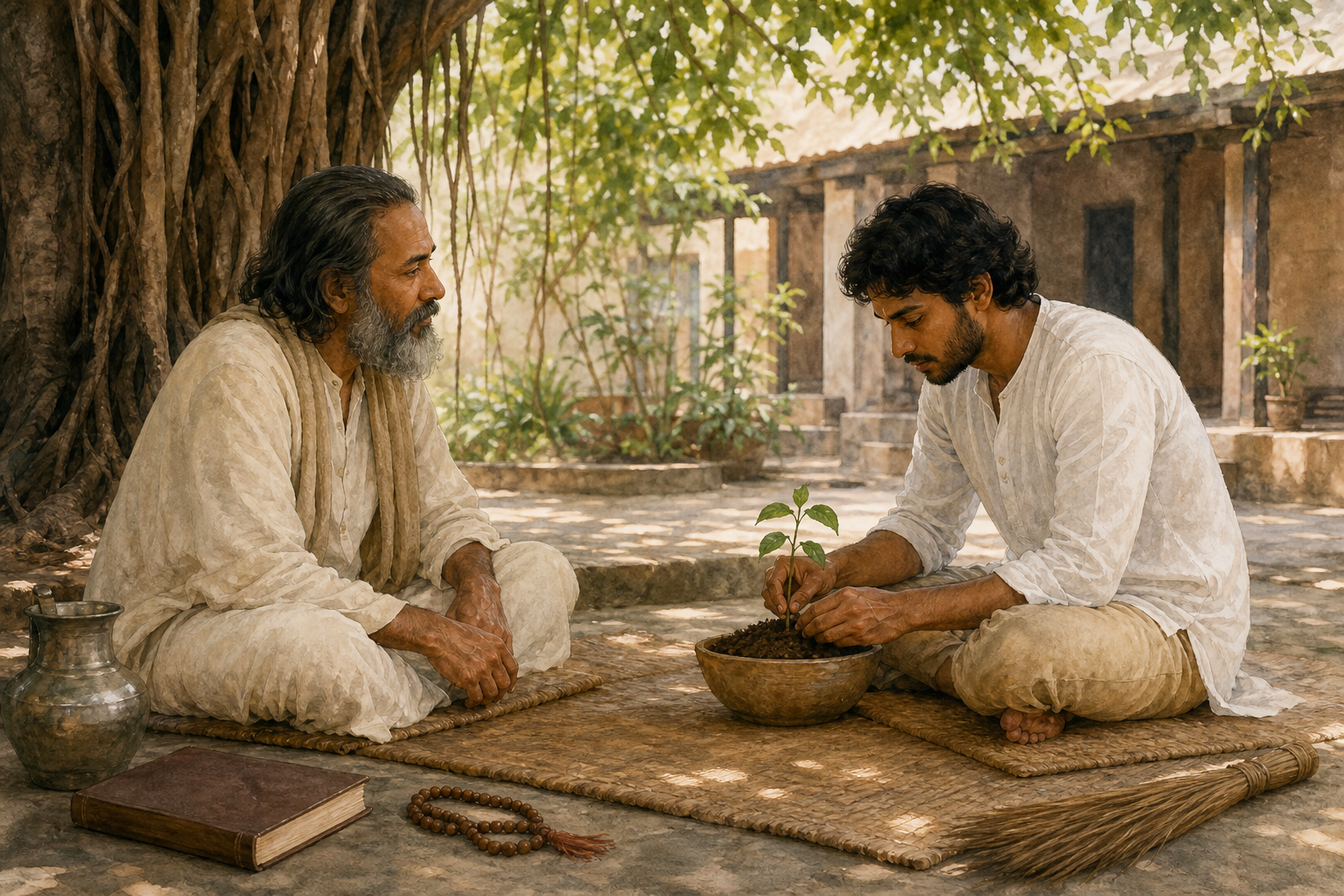
The remembered image of Puri Maharaja walking with Srila Prabhupada reveals something a list of credentials cannot. The Guru-Shishya Tradition transmits knowledge through attention, proximity, humility, disciplined practice, and service. Its purpose is not merely to place information in the student’s mind. It forms the person who will use that information.
Proximity to a guru does not make reasoning unnecessary. It changes the moral conditions under which reasoning happens. A disciple learns to ask not only, “Can I defend this position?” but also, “What is my motive, what have I understood, and how should this knowledge change the way I live?” That is why guru-shishya learning remains relevant even when a question involves modern scientific terminology.
You can apply this principle without imitating the outer form of another person’s life. Keep paired notes during serious study: record the concept you are trying to understand, then record the change in practice or conduct that should follow from it. If you cannot explain the concept clearly, return to study. If the conviction makes you contemptuous, return to sadhana. If the knowledge never becomes service, ask whether it has actually been assimilated.
This also gives you a better way to assess spiritual teachers and institutions. Do not look only at how confidently they answer complex questions. Notice whether their teaching trains students to define terms, admit limits, hear objections fairly, maintain devotional discipline, and serve without demanding recognition. Intellectual clarity and character formation should reinforce one another.
Scientific dialogue requires precision before persuasion

Puri Maharaja’s conversations with Nobel laureate George Wald, sometimes alongside HH Bhaktisvarupa Damodara Swami, joined scientific and philosophical inquiry in a spirit of mutual respect. Their importance does not lie in using a famous scientist’s presence as a ceremonial endorsement of every devotional conclusion. The more durable lesson is how to keep a fundamental disagreement open to disciplined examination.
Begin such a conversation by defining its central terms. “Life,” “consciousness,” “matter,” “mind,” and “cause” often carry several meanings. Two people can appear to disagree about reality while using the same word for different things. Ask what is directly observed, what is inferred from the observation, and what remains an open question. Then state what kind of evidence could weaken your preferred explanation. A claim that permits no conceivable correction is not functioning as an empirical claim.
Precision also protects science from scientism. Empirical science ordinarily seeks testable explanations for observable phenomena. That working method does not, by itself, prove the philosophical proposition that only material reality exists. In the other direction, a gap in current scientific explanation does not automatically prove whichever theological answer someone prefers. The honest response to an unresolved problem is to call it unresolved and continue the inquiry.
When you teach or discuss this subject, grade the strength of your language. Call well-supported observations established within their proper scope. Call reasoned but unsettled interpretations plausible or contested. Call unanswered questions open. This vocabulary may sound less dramatic than declaring victory for one side, but it gives Dharmic thought greater credibility because your conclusion never outruns your case.
Respect, in this setting, is not polite vagueness. It means being able to describe another person’s position in words that person would recognize, answering the strongest version of the objection, and refusing to turn a scientific title or spiritual status into a substitute for reasoning. Puri Maharaja’s model asks you to listen patiently, explain carefully, and remain firm without becoming dismissive.
Dharmic unity should preserve real differences

His inclusive outlook identified ahimsa, satya, karuna, and seva as shared ground for engagement among Hindu, Buddhist, Jain, and Sikh traditions. These values make genuine cooperation possible, but common ethical ground should not be mistaken for identical doctrine. Unity becomes fragile when it depends on pretending that distinct traditions use the same concepts, accept the same authorities, or describe liberation in the same way.
A better Dharmic conversation begins with a shared value and then permits each tradition to explain how it understands and disciplines that value. Take ahimsa, for example: participants can examine its foundation, its daily practice, and the difficult situations in which its application requires judgment. The goal is neither to erase differences nor to convert the gathering into competitive apologetics. It is to make each participant more truthful, compassionate, and responsible.
If you organize a study circle, campus discussion, or community event, connect dialogue with a specific act of seva. Conversation then has an ethical destination. Participants do not have to settle every philosophical disagreement before serving a real need together. This is unity in spiritual diversity as a practice rather than a slogan.
This approach also guards against a common weakness in inter-tradition work: reducing Dharma to a collection of agreeable moral sentiments. Shared virtues are an entry point, not the entire inheritance. Let each tradition speak in its own vocabulary, acknowledge disagreements without hostility, and show how disciplined practice forms character. Honest difference is more respectful than a superficial sameness.
Key takeaways for carrying his legacy forward
- Treat bhakti and reasoning as mutually corrective disciplines: reasoning tests the clarity of a claim, while bhakti tests the motive and character of the person making it.
- Separate empirical observation, philosophical inference, and theological conviction before presenting an argument about life or consciousness.
- Use language proportionate to the evidence. Do not turn an open scientific question into proof of a preferred conclusion.
- Measure guru-shishya learning by what it produces in attention, humility, sadhana, conduct, and seva, not only by how much information a student can repeat.
- Build Dharmic cooperation around ahimsa, satya, karuna, and seva while allowing Hindu, Buddhist, Jain, and Sikh traditions to retain their genuine distinctions.
- Judge a legacy project by whether it produces clearer inquiry, steadier devotion, and useful service rather than publicity or borrowed prestige.
The next time you prepare a class, essay, or discussion about consciousness, mark each major claim as an observation, an inference, or a spiritual conviction. Check whether its wording exceeds its support. Then name the practice or service that should follow from it. That small discipline is a more faithful tribute to Bhakti Madhava Puri Maharaja than praise alone.
References
