
You may have seen Shivaji’s treasure invoked in two unsatisfying ways: as proof of fabulous personal wealth or as a catalogue meant simply to inspire awe. Neither reading tells you what you most need to know. The useful question is what the inventory reveals about the way sovereignty was organized, transferred, and judged.
Read that way, the objects become more than relics. They show you the material architecture of Swarajya: stored value, military capacity, ceremonial authority, ritual continuity, and the clerical discipline needed to hand a kingdom from one ruler to the next.
The first treasure was an accountable transfer
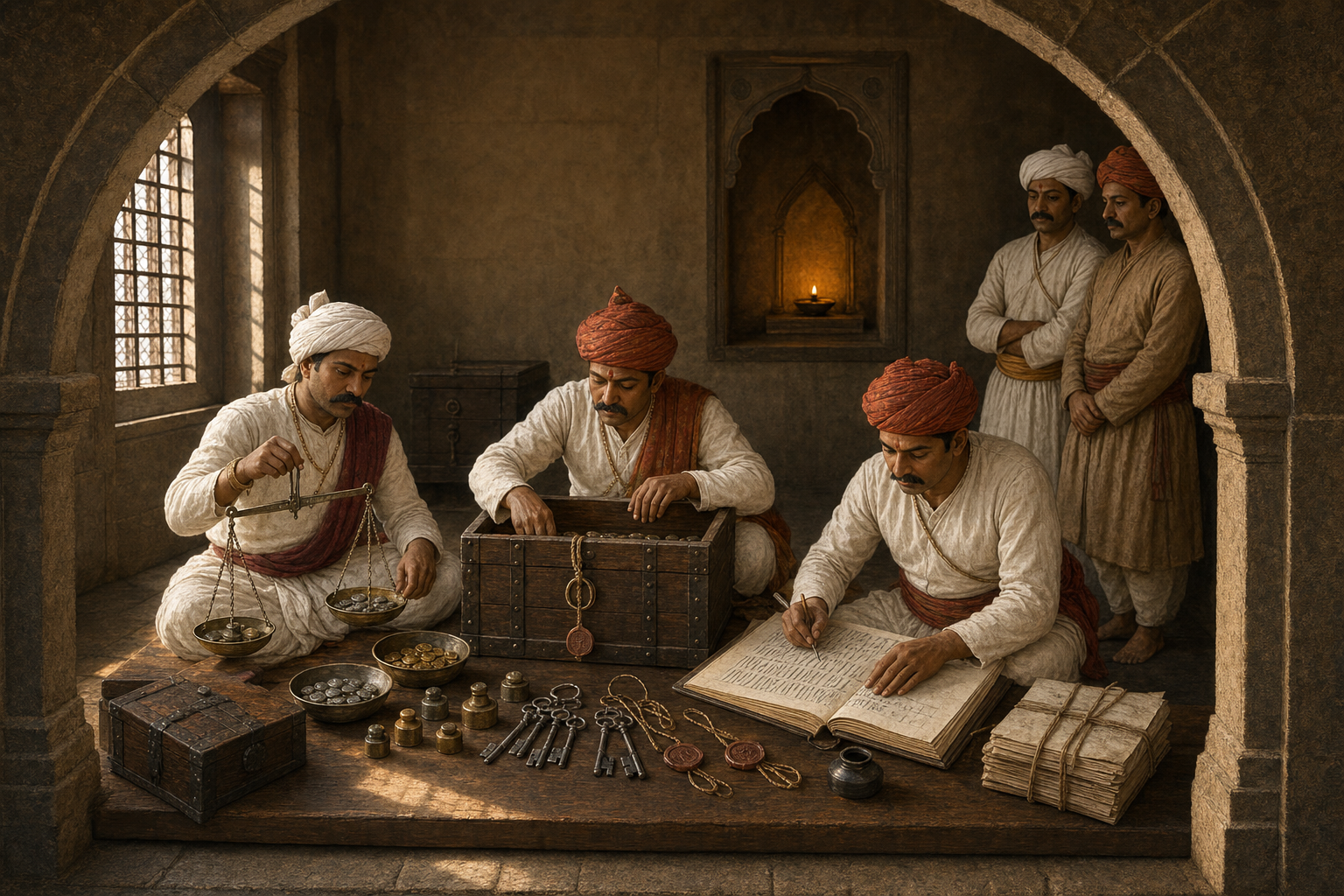
Shivaji died in 1680 at the age of fifty, six years after his coronation in 1674. A reign that short could easily have left its material affairs tangled in personal authority, household memory, and competing claims. Instead, Sambhaji ordered a meticulous enumeration of his father’s possessions, mobilized the clerical establishment, and personally supervised the work.
That sequence matters more than any dazzling entry in the inventory. Death is the moment when a court’s apparent order is tested. Assets can disappear, officials can conceal information, and royal property can become indistinguishable from family possession. Enumeration converts memory and access into a record that a successor can inspect.
This should not be mislabeled as a modern public audit. We do not have enough here to claim modern standards of disclosure, accounting, or legal separation between the sovereign and the state. What we do have is evidence of an administrative habit: valuable property was sufficiently classified and controlled to be counted during a dangerous transition.
When you evaluate a claim about Shivaji’s governance, look for three markers before you look at the size of the treasure:
- A defined trigger: the ruler’s death initiated an inventory rather than an informal division of possessions.
- A responsible authority: Sambhaji did not leave the task as an anonymous clerical exercise; he supervised it.
- Administrative machinery: trained clerks could identify, classify, and record a wide range of holdings.
A wealthy court can exist without administrative depth. A court capable of accounting for its wealth during succession points to something sturdier: procedures that did not depend entirely on the founder’s physical presence. If a retelling dwells on splendour but cannot explain the process of custody and transfer, it is describing royal display rather than statecraft.
Five material classes reveal five dimensions of rule

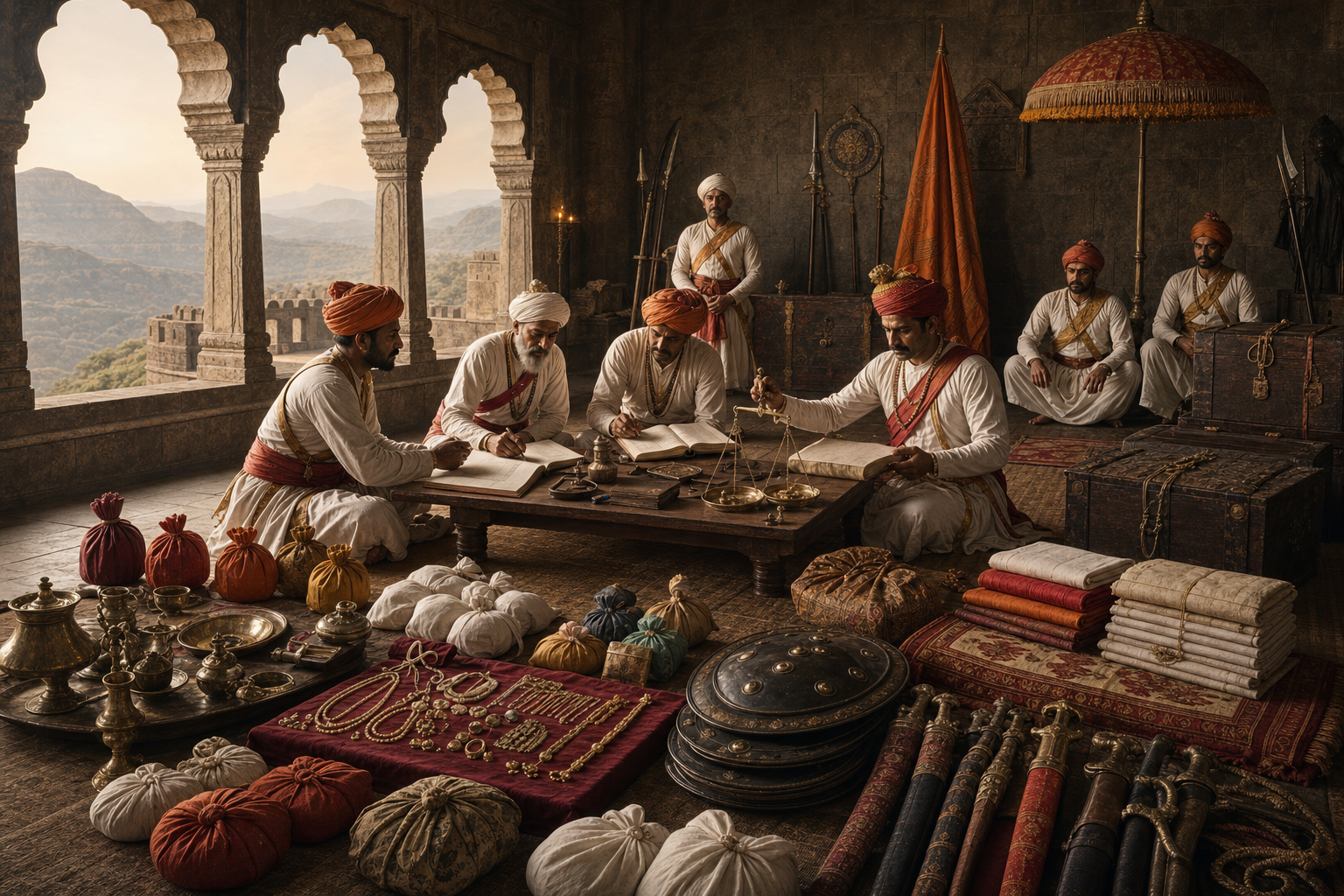
The surviving enumeration ranged across precious metals and jewels, regalia and textiles, arms and armour, ritual and courtly objects, and administrative records. Do not flatten these categories into a single cash total. Each belongs to a different part of sovereign life and must be interpreted differently.
| Material class | What it helps you notice | What it does not prove by itself |
|---|---|---|
| Precious metals and jewels | The storage and accounting of concentrated value | That every item was the ruler’s freely spendable personal fortune |
| Royal regalia and textiles | The organized ceremonial life through which rank and sovereignty became visible | That every costly object was acquired for private luxury |
| Arms and armour | The material capacity associated with protection, command, and Kshatra | The condition, battlefield use, or effectiveness of every recorded item |
| Ritual and courtly objects | The integration of worship, sacred legitimacy, and royal ceremony | That ceremonial presence alone made every decision Dharmic |
| Revenue and household records | The clerical order needed to track different domains of royal administration | A complete reconstruction of all revenue, expenditure, and legal ownership |
The breadth is the important fact. Bullion alone would tell you that wealth had been accumulated. The combination of value, weapons, regalia, ritual equipment, textiles, and records points instead to an operating establishment. The inventory gives you a cross-section of what a seventeenth-century Hindu court needed to preserve value, exercise force, enact authority, maintain sacred observance, and continue its daily administration.
This distinction also protects you from anachronism. A royal treasury was not a modern finance ministry, and a palace inventory was not a present-day corporate balance sheet. Categories that we now separate as personal, dynastic, ceremonial, military, religious, and governmental could meet within the sovereign establishment. The list establishes custody and material breadth; it does not automatically settle every question of ownership.
So if someone presents one large number as “Shivaji’s net worth,” ask what has been added together. A jewel used as regalia, a weapon held for defence, a ritual vessel, and a quantity of metal are not economically interchangeable merely because all can receive a price. Combining them without explaining their functions produces a dramatic figure, not a careful historical valuation.
Dharma supplied the purpose; administration supplied the discipline
For a Dharmic reader, the relevant test of a sovereign is not monastic poverty. It is whether Artha and Kshatra remain ordered toward duty. Wealth gives a ruler options. Arms give him coercive power. Regalia gives him visible authority. None of these is self-justifying. Their moral value depends on the ends they serve and the restraints placed upon their use.
The remembered pattern of Shivaji’s daily discipline begins with reverence toward Ramdas Swami and Jijabai. That detail should not be reduced to a decorative scene of personal piety. It presents an ideal relationship between inward discipline and outward command: the king acknowledges formative authorities before exercising his own.
Jijabai’s importance sharpens this point. She formed in Shivaji an understanding of courage governed by Dharma, not courage released from restraint. Kshatra, in this frame, is not aggression for its own sake. It is the readiness to protect a people and their sacred order. The inventory shows the instruments available to a sovereign; the Dharmic standard asks what those instruments were for.
You can apply four tests whenever royal wealth is presented as evidence of Dharmic kingship:
- Purpose: Did material capacity support protection, administration, continuity, and sacred life, or is possession itself being treated as the achievement?
- Restraint: Was power understood as an obligation governed by Dharma, rather than a licence supplied by victory?
- Accountability: Could assets be identified, counted, and placed under responsible custody?
- Continuity: Did institutions and habits survive when the ruler who created them was no longer present?
The inventory speaks strongly to the third test and gives meaningful evidence for the fourth. It also reveals the breadth of material capacity relevant to the first. It cannot, on its own, prove that every acquisition, policy, or act met the second. Respect for Shivaji does not require us to ask an inventory to establish more than an inventory can establish.
Jadunath Sarkar’s sharper historical judgment placed Shivaji’s greatest inheritance not in territory or treasure, but in the example, system, habits, and spirit transmitted to the Maratha people. This is the decisive measure of stewardship. A hoard can be captured. A founder’s charisma dies with him. Administrative habits, trained people, political confidence, and a shared conception of duty can continue to act.
The Maratha polity outlived Shivaji and developed into a force extending far beyond Maharashtra. That does not mean every successor reproduced his standard or that every later decision can be credited to him. It means the institutional inheritance survived its founder. In practical terms, this is more consequential than a treasure total: the stored objects supported a kingdom, while the cultivated habits enabled a people to keep building one.
How to check a modern claim about Shivaji’s treasure
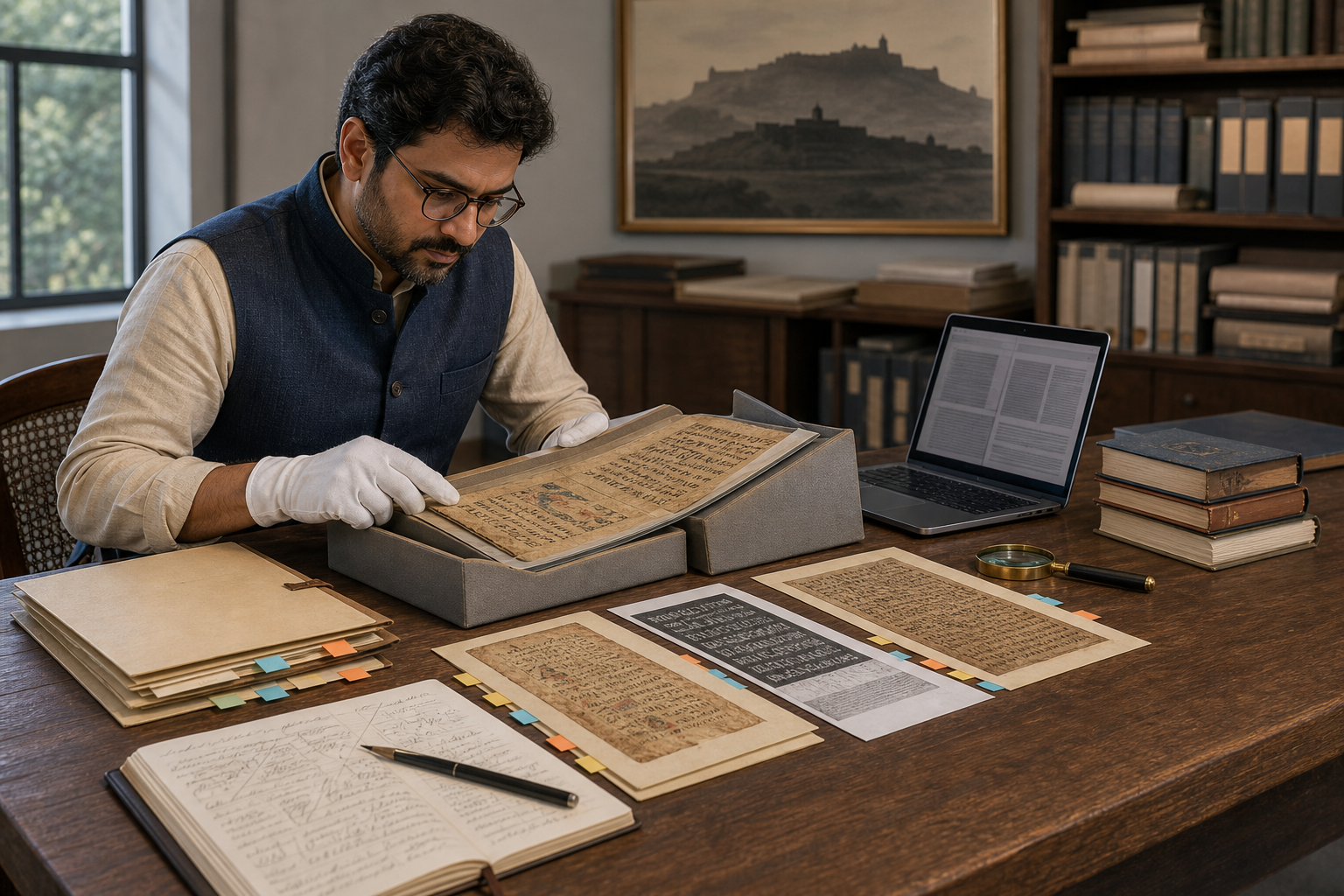
We know the holdings through two courtly records. One line of transmission comes through Krishnaji Anant Sabhasad’s Shri-Shiva-Prabhuce-Charitra, commonly called the Sabhasad Bakhar and generally dated to 1694 or 1697. Another comes through the Shri Shiva Chhatrapatichi 91 Kalmi Bakhar, associated with the courtier Dattaji Triambak and also known as the Dattaji-Malkare Bakhar. The especially detailed enumeration occupies leaves 42-44 of the latter.
That chain of transmission is valuable, but it also tells you how to be careful. Courtly origin warrants attention to genre and purpose. Administrative detail can coexist with commemoration and political meaning. The correct response is neither automatic disbelief nor credulous repetition. It is to preserve the distinction between what was enumerated, how an editor renders it, and what a modern commentator calculates from it.
The original enumeration uses period weights and measures, while modern editions and discussions commonly add contemporary equivalents. Before accepting a converted quantity or a viral rupee figure, check five things:
- Identification: Does the claim name the chronicle and edition from which the entry comes?
- Original unit: Does it preserve the historical measure rather than supplying only a modern number?
- Conversion rule: Does it explain how that period measure was converted into a contemporary unit?
- Valuation date: If a monetary total is offered, does it name the commodity price and date used?
- Asset logic: Does it distinguish metal value from ceremonial, military, artistic, historical, and institutional value?
Converting a historical weight into grams is one operation. Assigning a present-day monetary value is another. Declaring the result to be personal net worth is a third, and it requires an ownership theory that the conversion itself cannot supply. When these steps are collapsed into one headline number, the appearance of precision conceals several unproved assumptions.
The defensible conclusion is narrower and more useful: Shivaji’s royal establishment possessed a broad and systematically enumerated material base. The surviving record offers unusual access to courtly, military, ritual, and administrative life. It does not, without further work on editions, units, prices, and ownership categories, yield one unquestionable modern fortune.
Use the same discipline with a museum label, a speech, or a forwarded message. Save the citation rather than the screenshot. Preserve the original unit beside its conversion. Keep an object in its historical category instead of turning everything into bullion. If the claim survives those checks, it can teach you something about the royal establishment. If it does not, do not repeat the number merely because it flatters your view of Shivaji.
Key takeaways
- Shivaji’s inventory matters first as evidence of succession discipline: Sambhaji ordered and supervised a systematic enumeration after the king’s death.
- The holdings belonged to several functional classes. Precious metal, regalia, weapons, ritual objects, textiles, and administrative records should not be reduced to one undifferentiated cash total.
- Dharmic stewardship does not treat wealth or force as ends in themselves. It judges whether material power remains ordered toward duty, protection, restraint, and continuity.
- An inventory can establish custody and breadth without proving modern legal ownership, lifetime fiscal policy, or a precise present-day net worth.
- Shivaji’s most durable legacy was the institutional and moral capacity that survived him, not the collection of objects that could be counted after his death.
The next time Shivaji’s treasure appears in a speech, exhibition, or forwarded message, do not begin with its price. Ask what was counted, who counted it, what function each class served, how the units were converted, and what survived the king. That sequence will lead you past spectacle and into the real architecture of Swarajya.
References
